
The Murthal paratha-dhaba owner and the PCB consent trap
Balwan's dhaba occupied a plot of roughly three hundred square metres on the Murthal stretch of National Highway 44, about thirty-five kilometres north of Delhi, where the highway widens and trucks begin their climb toward the Haryana plains. The building was a low-slung structure with a corrugated tin roof, a front room with plastic chairs and low tables, and a kitchen area that opened directly onto the road so that customers could watch the parathas being made. Four clay tandoors lined the kitchen, heated each morning at five o'clock and kept burning until ten at night. The parathas came out every forty-five seconds: aloo, pyaaz, mooli, puri, methi. Butter pooled on each one.
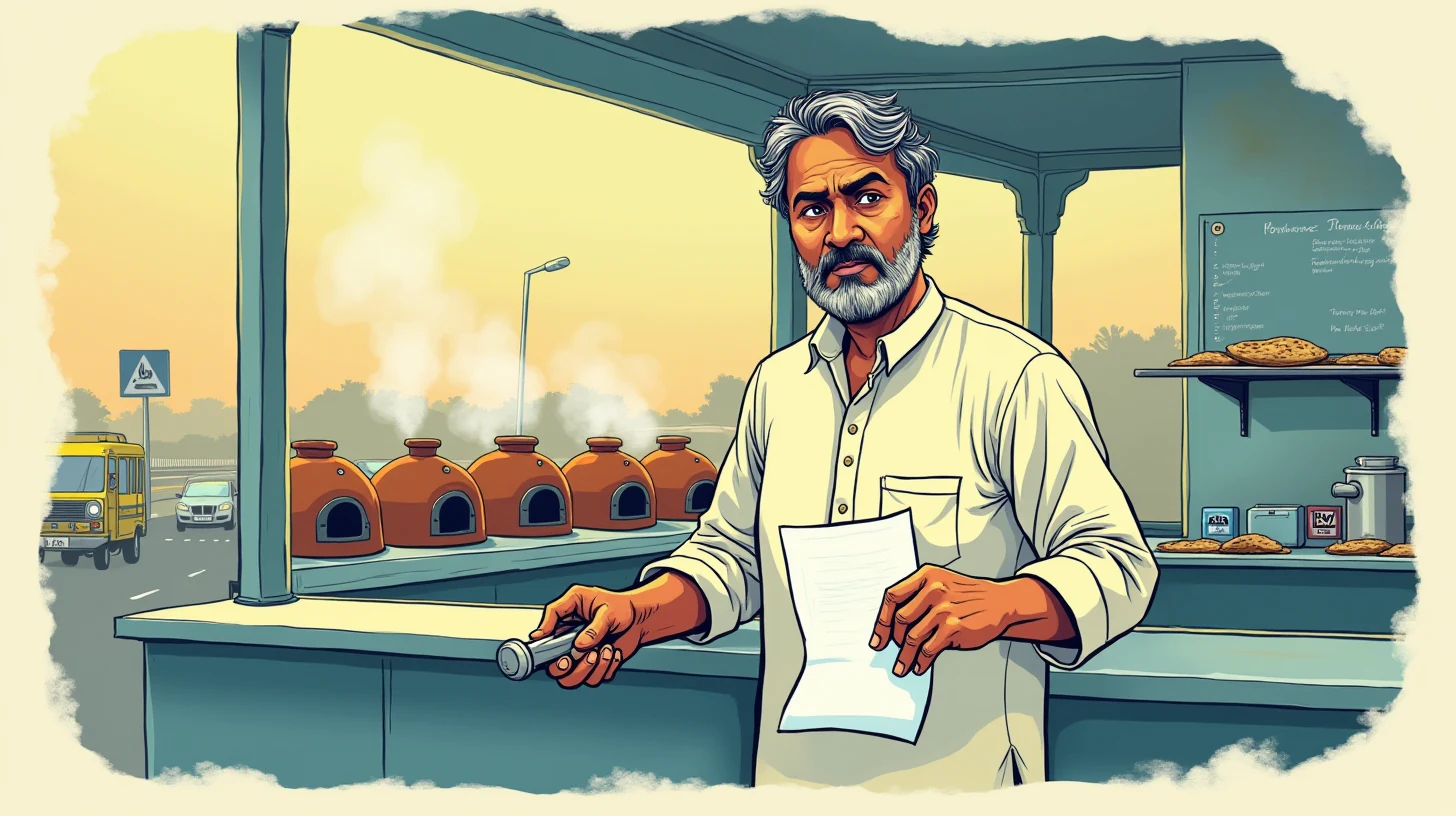
Balwan was fifty-two years old, born in a Haryanvi farming family in Jhajjar district, thirty kilometres away. He had worked on his father's fields for eighteen years before his father had taken a loan against the land, invested in the Murthal plot in 1993, and handed it to Balwan with a single instruction: "Feed people. Keep the tandoors burning." His father was now eighty-one and lived in a small room behind the kitchen. Balwan's wife managed the cash box and the cooking staff. Their son, twenty-eight, worked the front counter and managed online aggregator orders through Zomato and Swiggy.
The business fed eight hundred customers on an average day: truck drivers heading to Chandigarh, families travelling to the hills, construction workers, tourists. The dhaba's reputation was built on a single thing: the quality of the tandoor fire. A tandoor that is allowed to cool loses its character. A tandoor that is too hot cracks the paratha. Balwan had learned to read the temperature by the colour of the flame and the weight of the heat on his face. He had never used a thermometer.
In 2024, the dhaba showed a monthly cash revenue of approximately ₹2.8 lakh. This was calculated loosely: the dhaba did not maintain formal accounts. The business was not registered with GST or Udyam. It held an FSSAI State License that had been obtained through a middleman in 2019 for ₹8,000 and renewed every three years without much thought. The license sat in a plastic folder in the office. Balwan's son had taken a photograph of it and uploaded it to Swiggy's verification system.
For thirty-one years, the only government contact Balwan had experienced was an occasional municipal health inspector who would stop by, drink tea, and ask for a "donation" of ₹500. He had paid. The business had continued.
On the 8th of March 2024, a letter arrived.
🗓️ The annual ritual
A highway dhaba exists in a strange regulatory limbo. It is not a restaurant, because it has no lease and no permanent structure. It is not a street food vendor, because it serves more than a hundred customers daily. It is not a food processing unit, because it does not manufacture packaged goods. It is not a home kitchen, because it operates at commercial scale. This ambiguity had worked in Balwan's favour for thirty-one years. The ambiguity meant that most regulations could be read as not quite applying to him.
The Pollution Control Board had issued various notices over the years. Haryana State Pollution Control Board (HPCB), to be precise. The notices were always about wastewater discharge. The dhaba had a small open drain that carried its kitchen wastewater—water used for washing parathas, water from the cooking zone, the water in which utensils were cleaned—directly onto the roadside. This was standard on the Murthal stretch. Every dhaba, every restaurant, every small food establishment within five kilometres discharged its wastewater in the same way.
The HPCB had, in theory, required all food establishments to obtain "Consent to Operate" (CTO) for any discharge of wastewater into the environment. This requirement was stated in the Water (Prevention and Control of Pollution) Act and the Air (Prevention and Control of Pollution) Act. But the rules were written in English, published in gazettes, and posted on a website that Balwan did not know existed. The rule had been the rule for fifteen years. Nobody on the Murthal stretch had ever obtained it.
The ritual, such as it was, was the ritual of ignoring.
Then, in March 2024, the ritual changed.
⚠️ What very nearly happened
The letter arrived by email. Balwan's son, Arjun, received it because Arjun's mobile number was on the Swiggy account. The email came from the Haryana State Pollution Control Board, Regional Office, Faridabad, and it stated:
"RE: Non-compliance with environmental discharge requirements at M/s Balwan's Dhaba, NH-44, Murthal, Gurgaon district.
"This office has conducted an inspection of your food establishment on 5th March 2024. The site inspection revealed that your establishment is discharging wastewater into the environment without obtaining the mandatory Consent to Operate (CTO) under the Water (Prevention and Control of Pollution) Act, 1974. This constitutes a violation of Section 25 of the Act.
"You are hereby required to either:
- Obtain Consent to Operate within thirty days and submit proof, OR
- Install an Effluent Treatment Plant (ETP) within sixty days.
"In the event of non-compliance, your establishment will be liable to a penalty of up to ₹5 lakh and/or closure."
There was no fine mentioned in the letter. There was only the threat.
When Balwan read the letter, read aloud by Arjun, his first response was confusion. "Consent to operate? The dhaba has been operating for thirty-one years. What consent?"
His second response was fear.
The process of obtaining Consent to Operate, Arjun discovered by calling the HPCB office, required:
- An application to the HPCB
- Proof of eligibility—the nature of the business, the volume of discharge, the type of waste
- A site inspection by the HPCB officer
- A technical assessment of the wastewater treatment
- A fee (₹1,500–₹5,000 depending on category)
But there was a second path: install an Effluent Treatment Plant. An ETP is a mechanical system that filters and neutralises wastewater before discharge. For a dhaba producing two thousand litres of wastewater per day, the cost of an ETP would be approximately ₹6 lakh to ₹8 lakh for the equipment, plus ₹1.5 lakh to ₹2 lakh for installation. Annual maintenance would run ₹10,000–₹15,000.
Balwan could not afford ₹8 lakh. His annual savings were approximately ₹15,000–₹20,000. The MUDRA loan he would need would take months to process. And his bank account had never been formalised with Udyam or any government scheme.
But if he did not act within sixty days, the HPCB would issue a closure notice. The padlock would arrive. The tandoors would go cold.
On the 14th of March, the HPCB sent a second communication: a ₹3.5 lakh penalty notice for the thirty-one days of non-compliance already recorded. The notice said the penalty would be waived if proof of CTO or ETP installation was submitted within thirty days.
Balwan now faced a choice: pay ₹3.5 lakh to avoid closure, plus ₹6–₹8 lakh for the ETP, totalling approximately ₹11.5 lakh. Or obtain CTO, which seemed simpler—but the HPCB officer, when Arjun called, said that CTO could only be granted if the wastewater discharge was "minimal" and "compliant with standards." For a food establishment, this usually meant either zero discharge or treatment before discharge. A dhaba with four active tandoors and eight hundred customers per day had non-minimal discharge.
The officer said, "Install the ETP. That is the only path for a food business of this size."
The trap was complete.
- 🔍
5 March 2024 — HPCB inspection
Haryana State Pollution Control Board conducts a surprise inspection of the dhaba. Discovers no Consent to Operate for wastewater discharge. Issues initial notice.
- 📨
8 March 2024 — Compliance notice
Email arrives from HPCB Regional Office. Demands either CTO application within 30 days OR ETP installation within 60 days. Threat of closure and ₹5 lakh penalty.
- 💸
14 March 2024 — Penalty notice
HPCB issues ₹3.5 lakh penalty notice for thirty-one days of past non-compliance. Penalty waived only if CTO or ETP proof submitted within 30 days.
- ⏰
April–May 2024 — The two-month window
Balwan has sixty days to install an ETP (₹6–₹8 lakh) or prove that CTO does not apply. Otherwise, closure notice and padlock follow.
🌗 What changed
On the 17th of March, Arjun received a call from his bank manager. The manager was calling because Arjun worked in the bank's MSME department and had been trained on a new tool: a tablet-based compliance platform called GabFORGE. The bank was rolling it out to small business borrowers, and the manager thought Arjun's uncle's situation was exactly the kind of crisis the tool was designed to surface.
"Your uncle runs a food business?" the manager said. "And he just got a compliance notice?"
Arjun said yes.
"Send me his details. Let me run it through GabFORGE. There may be something in the exemption rules."
That evening, Arjun drove to the dhaba and brought Balwan's phone and the HPCB letter to the bank. The manager opened the GabFORGE app and navigated to "Food Business - Haryana." A form appeared with fields for business type, daily customer volume, annual revenue, and nature of wastewater discharge.
Arjun entered the information: dhaba, eight hundred customers daily, ₹2.8 lakh monthly (₹33.6 lakh annually), wastewater from cooking and cleaning.
The app paused. Then a result appeared on the screen:
"हरियाणा में खाद्य व्यवसायों के लिए PCB छूट नियम 2009 के तहत, एक खाद्य प्रतिष्ठान जो प्रति दिन 500 से कम ग्राहकों को परोसता है, को CTO की आवश्यकता नहीं है यदि अपशिष्ट जल को सार्वजनिक नाले में छुट्टी दी जाती है। आपका धाबा 800 ग्राहकों को परोसता है। लेकिन अगर आप औपचारिक MSME पंजीकरण के साथ और सार्वजनिक नाले के प्रमाण के साथ एक CTO आवेदन दाखिल करते हैं, तो CTO स्वचालित रूप से कम उत्पादन श्रेणी में आपको स्वीकृत हो सकता है।"
(Under Haryana State Pollution Control Board exemption rules 2009, a food establishment serving fewer than 500 customers per day does not require CTO if wastewater is discharged into a public sewer. Your dhaba serves 800 customers. However, if you file a CTO application with formal MSME registration AND proof of public sewer discharge, the CTO can be automatically approved in a lower production category.)
The app then displayed a second section:
"वैकल्पिक: आपकी अपशिष्ट जल को परीक्षण करें। अगर यह मानकों को पूरा करता है, तो PCB को मजबूर किया जा सकता है कि वह 'न्यूनतम अपशिष्ट' श्रेणी में आपको स्वीकृत करे, भले ही आप 800 ग्राहकों को परोसते हैं।"
(Alternatively: have your wastewater tested. If it meets standards, the PCB can be compelled to approve you in a "minimal waste" category, even though you serve 800 customers.)
Arjun read the screen aloud to Balwan. The manager then explained what the app was showing: the Haryana State Pollution Control Board had issued an exemption in 2009. The exemption applied to food businesses that either served fewer than 500 customers daily OR could prove that their wastewater met certain cleanliness standards (BOD, COD, suspended solids). Balwan's dhaba served eight hundred customers, but the wastewater from a dhaba—cooking water, vegetable washing water, oil separating naturally—was cleaner than wastewater from a full restaurant with a meat section or extensive kitchen.
The solution was not to build an ETP. The solution was to:
- Register formally with Udyam (the MSME scheme)
- Get a wastewater sample tested by an accredited laboratory
- File a Consent-to-Operate application citing the exemption rule and the water-quality test results
- Let the HPCB approve the application with "minimal discharge" status
The cost: wastewater testing ₹2,000–₹3,000, Udyam registration ₹0 (free), CTO application fee ₹2,500. Total: roughly ₹5,500, plus the labour of filing.
Balwan and Arjun looked at the screen in silence.
"This exemption has been in the rules for fifteen years?" Balwan asked.
"Yes," the manager said. "But it is written in a gazette document that is twelve pages long, and on page seven, in a subsection about 'category B dischargers,' it lists food businesses as potentially eligible. The HPCB's website mentions it but does not link to it directly. Most small food businesses do not know it exists."
What it does
- 🔍Searches exemption clauses in the Water Pollution Act and HPCB rules specific to Haryana food businesses
- 🗂️Cross-references Balwan's customer volume and discharge type against the 2009 exemption thresholds
- 📋Identifies the wastewater-testing approach as an alternative to the ₹8 lakh ETP investment
What it does not do
- 🔒Never submits the CTO application on Balwan's behalf; only provides the application link and checklist
- 💳Never arranges the wastewater testing; only identifies accredited laboratories and the typical cost
- 🚫Does not guarantee approval; only surfaces the pathway that HPCB rules permit, leaving the filing to Balwan
"तीस साल तक मैं यही सोचता था कि मुझे कोई नियम नहीं जानना पड़ता है। अब मुझे पता चल रहा है कि नियम थे, पर वे छिपे हुए थे। मेरा धाबा नष्ट करने के लिए नहीं, बल्चि मेरे जैसे आदमियों को बचाने के लिए।"— For thirty years I thought I did not need to know any rules. Now I am learning that the rules existed, but they were hidden. They were not written to destroy my dhaba, but to save men like me.
🧭 Why we built it
The exemption clause in Haryana's pollution control rules was not secret. It was published in the official gazette. It was, in principle, accessible to anyone with an internet connection and the patience to read a twelve-page technical document. But accessibility, for a man like Balwan, and accessibility in practice are different things.
Balwan had not gone to school past the tenth standard. He did not read English. His familiarity with government websites was limited to uploading his FSSAI license photograph to Swiggy. The phrase "Schedule 6, Category B Dischargers, Sub-clause 3.2.1" had no meaning to him. He knew parathas. He did not know Indian Standard IS 2296 (wastewater discharge limits for food businesses).
And even if Balwan had somehow found the rule, the next step would have been to interpret it. Does a dhaba count as a "food establishment"? Does a "public sewer" include the open drain that runs beside NH-44? Does the "minimal waste" category apply to four active tandoors? These are questions for a lawyer, or for someone familiar with how bureaucrats read rules. Balwan would have had to pay a fixer ₹10,000–₹15,000 to find the answers. Instead, he was staring at a ₹8 lakh ETP bill with thirty days left on the clock.
This problem—the gap between the rule as written and the rule as accessible to a small business owner—is not unique to Haryana. It repeats across India's regulatory system. Every state has exemptions, thresholds, and pathways that are technically available but practically invisible. A home chef in Mumbai may qualify for PM FME subsidies but has never heard of the scheme. A cloud kitchen owner in Bengaluru may qualify for reduced GST rates under specific conditions but files at the higher rate because the conditions are buried in a circular issued in 2019. A catering business owner in Delhi may have an FSSAI exemption available but is instead paying for a State License that is not mandatory.
The exemptions exist to protect small businesses. They exist because policymakers understood that regulation, indiscriminately applied, would crush the informal economy and eliminate livelihoods. The thresholds and pathways were written in. But the writing was done in the language and format of bureaucracy, not in the language of small business.
The agent—the tablet—closes this gap. It reads the rule, interprets it against the business's specific facts, and surfaces the pathway. It does not decide. It does not submit. But it tells Balwan, in Haryanvi-accented Hindi, exactly what the rule says and whether he qualifies for it. It provides the links, the checklist, the costs. It takes the invisible rule and makes it visible.
For food businesses, this becomes critical across multiple domains. A restaurant owner in Punjab may not know that the Pollution Control Board has a "small establishments" exemption. A dhaba owner in Uttar Pradesh may not know that FSSAI has a registration category for establishments below ₹12 lakh annual turnover, dramatically reducing compliance cost. A home chef in Haryana may not know that registering with Udyam unlocks priority lending from certain banks and reduces the interest rate on MUDRA loans by two percentage points. None of these pathways require the agent to do the work. They require the agent to surface the rule and let the owner decide.
🌱 What we hope happens
By the 25th of March 2024, eleven days after the HPCB compliance notice, Balwan had taken his first step. He registered formally with Udyam, the MSME scheme. The registration took twenty minutes on a government portal that Arjun navigated on his behalf. The certificate arrived by email within forty-eight hours. It listed Balwan as the owner of "Balwan's Dhaba, a micro-enterprise engaged in food service," with an MSME-UD number starting with 06 (indicating Haryana).
On the 28th of March, Arjun arranged for a wastewater sample to be collected from the dhaba's discharge line and sent to an accredited testing laboratory in Faridabad. The laboratory tested the sample against Indian Standards IS 2296 and IS 3307, measuring BOD (Biological Oxygen Demand), COD (Chemical Oxygen Demand), suspended solids, and pH. The results came back on April 2nd. The dhaba's wastewater was cleaner than the threshold for "minimal discharge" in three of four categories. The pH was slightly high (8.2 instead of the ideal 6.5–8.0), but this was correctable with simple alkaline dosing.
On the 3rd of April, Arjun filed a Consent-to-Operate application with the Haryana State Pollution Control Board, citing the 2009 exemption rule, providing the Udyam certificate as proof of MSME status, and attaching the wastewater test results. The application cost ₹2,500. It also included a request for the "minimal discharge" category based on the water-quality data.
The HPCB processed the application in seventeen days. On April 20th, the Consent to Operate was issued. It was a standard form—three pages, printed on HPCB letterhead—and it stated: "M/s Balwan's Dhaba, NH-44, Murthal, is granted Consent to Operate under the Water (Prevention and Control of Pollution) Act, 1974, Category C1 (Food Establishments, Minimal Discharge), valid for two years from the date of issue."
The ₹3.5 lakh penalty was waived because proof of compliance was submitted within thirty days of the penalty notice.
When the CTO arrived, Balwan posted it in the kitchen, next to the FSSAI license.
By June 2024, Balwan had also completed Udyam registration and applied to a MUDRA-linked bank for a ₹3 lakh Kishore loan to upgrade the dhaba's kitchen equipment: a new dishwashing station, an improved drainage system, and a water filtration setup. The loan was approved at 9% interest—lower than the 14% rate he would have paid as an unregistered business. He had no collateral to pledge. He had not needed to visit a bank office. The application was filed through the Udyam portal, and the bank's MSME officer processed it in eleven days.
"If the tablet had not shown me the exemption," Balwan said in Hindi, sitting at his favorite table in the kitchen, the CTO posted visibly behind him, "I would have started building an ETP. Eight lakh rupees I did not have. Or I would have closed the dhaba. That was the choice."
He was not wrong. The Haryana State Pollution Control Board rules were written to allow his business to operate. The exemption was there. But it was buried in the same bureaucratic pile that threatened to bury him. The difference between closure and survival was not regulation. It was visibility.
What we hope happens is that this reverses a million times over. Not that regulation disappears. Regulation protects water tables from poison. But the gap between the regulation and the regulated—the gap where a man with four tandoors and eight hundred customers falls through every day—shrinks. The rule is made visible. The pathway is clarified. The business survives.
The tandoors keep burning.
Where Balwan can take the next step:
If you operate a food business in Haryana and have received a PCB compliance notice, start by registering with Udyam—the MSME scheme—at https://udyamregistration.gov.in. This is free and gives you proof of formality that the HPCB recognizes. Then check the Haryana State Pollution Control Board portal at https://www.hspcb.gov.in for the exemption rules under Schedule 6, Category B. Have your wastewater tested by an accredited laboratory (search "NABL accredited labs Haryana" for a list). File your CTO application with the test results and your Udyam certificate. The cost is minimal. The risk of closure is real.
You are not alone. The rule was written for you. It just needed to be found.