
The Patna NH-31 dhaba owner and the trade license consolidation
Ramesh's dhaba sat on the stretch of National Highway 31 that bypasses Patna, roughly twelve kilometres south of the city limits. The building was modest: a front room with six wooden tables, a small kitchen visible through an open pass-through, and a cramped office behind that where his father had kept a leather-bound ledger for thirty years. The ledger showed cash sales, dated entries, the names of truck drivers who ate there twice a week. It did not show taxes.
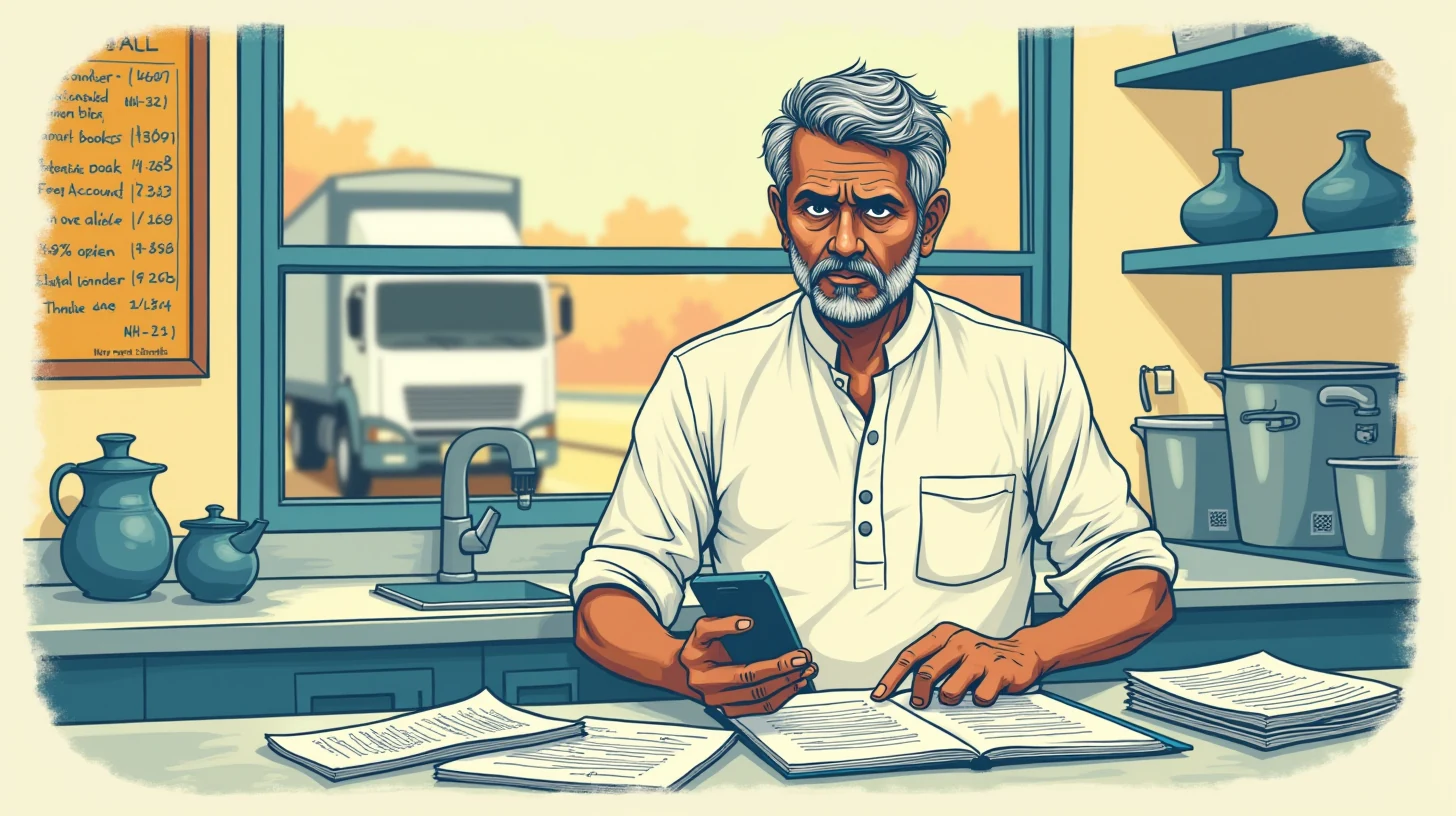
His father, Suresh, had run the place on a single trade license issued by the Patna Municipal Authority in 1999. One piece of paper. One renewal every three years. A payment to the tehsildar's peon, a stamp, and the license came back signed. That was the whole arrangement. Suresh had fed the family of six on that one license. His wife managed the cooking; his two sons worked the counter and the kitchen until Ramesh turned eighteen and decided to stay. His younger brother left for Mumbai. Ramesh never did.
When Suresh died in April 2022, Ramesh was forty-eight years old. He had been working the dhaba for thirty years—the same stretch of highway, the same parantha recipe, the same truck drivers ordering dal and rice. He inherited the business, the kitchen equipment, and the ledger. He did not inherit clarity.
Two weeks after Suresh's death, a municipal health inspector appeared without warning. The inspector had a clipboard. The inspector asked for five documents: the FSSAI license, the PCB consent for waste discharge, the fire NOC, the Shops & Establishments Act registration, and the GST certificate. Ramesh showed the trade license. The inspector shook his head. The rules had changed. The trade license was no longer enough.
What happened next was the reason Ramesh learned to fear bureaucracy.
🗓️ The annual ritual
A highway dhaba is not a restaurant. It does not have a lease that expires; it exists on the continuum of the national highway, serving the same traffic pattern year after year. The ritual of Ramesh's dhaba was the ritual of every dhaba: open at 5 a.m., close at 10 p.m., count cash, sleep four hours, repeat. The business model required no paperwork. Nor did it require permission. But that was when there was one rule.
By the time Ramesh inherited the business, the regulatory layer had multiplied. The government of Bihar, answering to the Food Safety and Standards Authority of India (FSSAI), had mandated food safety oversight. The municipal corporation had asserted its authority over waste and sanitation. The district fire officer had issued a NOC requirement. The PCB—Pollution Control Board—had required consent for any food business discharging water. The Shops & Establishments Act required registration of any business with staff. The GST system required registration of any business above a turnover threshold. The trade license remained, but it was now one among seven separate documents, each with a different validity period, a different issuing authority, a different renewal date, and a different penalty for lapse.
In the old system, Ramesh's father had renewed the trade license once every three years. In the new system, Ramesh would need to track:
- Trade license: renewal date in February 2023, then February 2026
- FSSAI State License (for a turnover between ₹12 lakh and ₹20 crore): valid 1–5 years, Ramesh chose 3 years
- PCB consent: annual renewal, always in June
- Fire NOC: issued for 5 years, but the SDM's office required periodic verification
- Shops & Establishments registration: annual, due in March
- GST: annual compliance filing, due by the 20th of each month
- Municipal eating house license: renewal every year or when the license was challenged by a competitor
Seven documents. Seven different renewal cycles. Seven different places to submit a form, seven different authority figures to appease, seven different deadlines.
The ritual became one of tracking. And tracking, for a man who had never held more than a ledger and a cash box, was not easy.
- 📜
1999 — Suresh opens the dhaba
One trade license from Patna Municipal Authority. Valid 3 years. Single renewal cycle, minimal bureaucratic overhead.
- 📋
2022 (April) — Suresh passes. Ramesh inherits.
Ramesh takes over the business, holds only the expired trade license. The ledger has no record of any other document.
- 🔍
2022 (May) — Inspector arrives unannounced
Municipal health inspector demands FSSAI, PCB, fire NOC, Shops Act, GST, municipal eating-house license. Ramesh has none.
- ⏰
2023–2024 — The renewal scatter
Seven renewal dates, seven authorities, seven deadlines. Ramesh misses the February 2024 trade license renewal and the June 2024 PCB consent.
- 🛑
August 2024 — SDM threatens closure
Sub-divisional magistrate issues a warning: non-compliance with regulatory requirements. Closure notice to follow if renewals are not completed within 30 days.
⚠️ What very nearly happened
The SDM's closure notice was not a friendly warning. It was a legal instrument. If executed, it would have meant that every morning Ramesh would wake up, walk to the dhaba, and find it padlocked by a municipal corporation official. The police would be standing there. The locks would be new. The padlock would be fastened with a red paper seal. His name would be on an order, and the order would cite "non-compliance with food safety and municipal regulations." The kitchen would be closed. The customers would not come back. The lease on his life would end.
Ramesh was not a stranger to hardship. He had lived through the liberalisation of India in the 1990s, the GST introduction in 2017, the chaos of demonetisation in 2016. But those were economy-wide shocks. This was personal. This was the threat that his father's business, the only thing Ramesh owned, would be seized because he had not known which form to fill or which date to remember.
The cost of missing a single renewal was estimated at ₹2–₹5 lakh in penalties, plus the cost of closure itself: the loss of daily revenue (approximately ₹8,000–₹12,000 per day), the loss of reputation if customers could not visit, and the cost of hiring a lawyer to appeal the order.
But Ramesh was one of millions. Every dhaba owner on every national highway faced the same multiplication of rules. Every small restaurant in Patna had to manage seven renewal dates. Most did not. Most missed at least one. Some, like Ramesh, faced closure. Others operated in the shadows, bribing the inspector ₹500 every few months to "look the other way," or they paid a fixer ₹3,000 per month to manage the renewals. Ramesh's income was ₹4,000–₹5,000 per month net. He could not afford the fixer.
The SDM's notice came in the second week of August 2024. Ramesh had thirty days.
🌗 What changed
On the 15th of August 2024, Ramesh's nephew, Arjun, who worked in a bank's MSME department in Patna city, came to visit. Arjun was twenty-six, college-educated, familiar with online portals. He had been reading about a new government tool—a tablet-based platform called GabFORGE that helped small business owners track regulatory compliance. His bank had begun offering it to MSME borrowers. Arjun thought of his uncle.
"Let me try it on the dhaba," Arjun said. "Show me the licenses you have."
Ramesh brought out a folder. Inside were photocopies: the expired trade license, the original FSSAI State License certificate (3 years, issued in December 2022), the PCB consent letter from 2023, the fire NOC from 2019, the GST registration certificate, a photocopy of the Shops & Establishments Act registration form from 2023. Each was in a different format. Each had a different date.
Arjun photographed each document with his phone. He opened the tablet, navigated to the GabFORGE app, and selected "Food Business" from a menu. A form appeared. He began entering information: the dhaba's name, the address on NH-31, the monthly revenue (approximately ₹1.2 lakh in cash sales, translating to ₹14.4 lakh annually), the state (Bihar), the district (Patna), the cuisine type (North Indian, Bihari, parantha-focused).
The tablet asked a series of questions, each with multiple-choice answers:
- Is your FSSAI registration or state license?
- Do you discharge wastewater into a municipal sewer or directly into the ground?
- Do you cook with gas, firewood, or electric appliances?
- Do you employ staff outside the family?
Ramesh answered each question. Arjun translated from Hindi to English where needed.
Then the tablet processed the answers. A status screen appeared:
"आपका व्यापार ₹14.4 लाख का सालाना राजस्व दिखाता है। आपको FSSAI स्टेट लाइसेंस चाहिए, न कि रजिस्ट्रेशन। अगला नवीकरण: दिसंबर 2025।"
(Your business shows ₹14.4 lakh annual revenue. You need the FSSAI State License, not Registration. Next renewal: December 2025.)
The tablet then displayed a calendar. Seven different lines, seven different colors. Each line represented a license. Each point on the line represented a renewal date.
"This is your calendar," Arjun said, reading the screen aloud. "Your FSSAI renews in December 2025. Your PCB consent renews in June 2025—that's in nine months. Your Shops Act registration renews in March 2025. Your trade license has already expired, but you can renew it now online through the municipal corporation portal."
The tablet was showing something Ramesh had never seen before: all seven deadlines, arranged chronologically, with the nearest deadline highlighted in red. PCB Consent in June. Shops Act in March. Trade License right now. FSSAI in December. Fire NOC in 2024 (already expired—needed immediate attention).
Arjun continued, reading from the tablet:
"आप छह महीने में तीन नवीकरण भूल सकते हैं। यह कैलेंडर आपको याद दिलाएगा। हर महीने एक SMS आएगा। हर नवीकरण का लिंक यहाँ है।"
(You could miss three renewals in the next six months. This calendar will remind you. Every month you will receive an SMS. Every renewal link is here.)
The tablet showed a list of direct links:
- Trade license renewal: Patna Municipal Authority portal
- PCB consent: Bihar Pollution Control Board online form
- Shops & Establishments: Bihar Labour Department e-service window
- Fire NOC: District Fire Officer, Patna
For each renewal, there was also a document checklist and an estimated cost: trade license ₹350, PCB consent ₹500, Shops Act registration ₹200, fire NOC verification ₹0 (free, but required police clearance).
Arjun said, "You have one license that has already expired. The fire NOC. The SDM will cite this in the closure order. You need to renew that first."
"How?" Ramesh asked. "I do not even know where the fire office is."
The tablet showed the address and a phone number. It also showed the form that had to be filled. Arjun took a photograph of it on his phone so Ramesh could show the fire office if they asked for a copy.
"We will start with the fire NOC tomorrow," Arjun said.
🧭 Why we built it
When Ramesh's story spread through his neighbourhood, he learned that he was not alone. The dhaba owner two kilometres up the highway had missed four renewals. The restaurant owner in Patna city had paid a fixer ₹36,000 in a single year just to track and manage seven dates. A home chef in a Patna suburb had been closed for six months when her FSSAI license lapsed because she conflated it with her municipal license and thought they renewed together.
The multiplication of licenses is not accidental. Each license serves a purpose: the FSSAI ensures food safety, the PCB ensures environmental compliance, the fire NOC ensures life safety, GST ensures tax collection, the trade license ensures that the business is registered with the municipality. These are legitimate needs. A dhaba does need to demonstrate that it is not poisoning customers, that it is not discharging sewage into the water table, that it will not trap customers in a fire.
But for a man like Ramesh—a second-generation dhaba owner in his fifties, educated to tenth standard, speaking Hindi and Bhojpuri, with no computer—the bureaucratic load is not a compliance obligation. It is an extinction-level threat.
A typical small restaurant or dhaba owner spends at least six to eight hours per month managing license renewals. That is one full working day per week. A cloud kitchen owner who runs three virtual brands must track twelve license expiry dates. A home chef trying to formalise must simultaneously navigate FSSAI, GST, Udyam registration, MUDRA loan paperwork, and potentially PM FME subsidy applications. Each system has a different portal, a different login, a different deadline, a different penalty.
Manual tracking
6–8 hrs/monthThe owner maintains a handwritten calendar. Missing at least one deadline per year is standard. Closure risk is real. Cost: zero rupees, but infinite stress.
Paid fixer
₹3,000–₹5,000/monthA middleman tracks renewals and submits forms on behalf of the owner. No closure risk, but the owner loses control of the process and pays ₹36,000–₹60,000 per year for a service that costs the fixer thirty minutes of work.
Guided calendar
10 min/monthA tablet or phone shows all renewal dates, sends SMS reminders, provides direct portal links, and flags documents needed. The owner acts, not the tool. Cost: zero, or a small subscription. Risk: near-zero.
"मेरे बाप ने एक लाइसेंस चलाया। मुझे सात हैं। मुझे नहीं पता था कि साड़ी दुनिया कब बदल गई।"— My father ran on one license. I have seven. I did not know when the whole world changed.
The agent—the tablet—does not solve this by doing the work. It solves it by making the invisible visible. It takes seven separate government systems and arranges them in a single calendar. It takes a rule that was issued in a gazette that Ramesh never read and surfaces it in Hindi. It takes a deadline that is buried in a portal and gives it a color, an SMS reminder, and a date.
For food business owners, the multiplication of licenses is structural. It will not go away. What changes is the labour of tracking. When Ramesh can see all seven dates in one place, he can renew them. He loses the excuse that he "did not know." But he also loses the threat that he will be surprised.
The same principle applies across millions of small food businesses in India. A woman running a tiffin service from her home in Bangalore needs to know that she is eligible for MUDRA, that PM FME has a ₹10 lakh subsidy for SHG members, that her GST registration can be automated. A cloud kitchen operator in Delhi needs to see that running three virtual brands means tracking twelve FSSAI dates, not three. A catering business owner in Mumbai needs to understand that outdoor catering has an 18% GST rate, not 5%, and that this means she is losing margin on every order.
The agent surfaces this. It says what changed, when it changes, and why.
🌱 What we hope happens
By September 2024, one month after Arjun's visit, Ramesh had renewed five of the seven licenses. The fire NOC came first—a verification form submitted to the district fire officer, a site visit by a junior officer, a certificate issued. The trade license followed, renewed online through the Patna Municipal Authority portal at a cost of ₹350. The PCB consent came next, submitted through an online form with a water sample photograph. The Shops Act registration was renewed with a ₹200 fee and a copy of his Aadhar. The GST was verified as active.
Two renewals remained: the FSSAI State License (not due until December 2025) and the municipal eating-house license (renewals requested informally but not yet formally processed).
The SDM's closure notice was withdrawn in mid-September. A letter arrived stating that Ramesh had "taken corrective action in compliance with regulatory requirements." The threat that had hung over him for one month was gone.
But something else had shifted. Ramesh now knew that the seven licenses were not random. They were a system. He knew the dates. He knew the portals. He knew the costs. When the June 2025 PCB renewal date arrived, he did not panic. He opened the tablet, saw the reminder, and submitted the form a week early.
Arjun suggested that Ramesh register formally with Udyam, the MSME scheme. Udyam would give him a certificate that unlocked priority lending from his bank, reduced interest rates on MUDRA loans, and participation in the government e-procurement platform (GeM). Ramesh filled out the online form. The certificate arrived in forty-eight hours. Three weeks later, he walked into the Patna bank branch where Arjun worked and applied for a ₹5 lakh MUDRA loan to upgrade the dhaba's kitchen: a new stove, new vessels, a proper sink for washing, and a small cold storage unit. The loan was approved at 7.5% interest—half the rate he would have paid as an informal business.
"The tablet showed me that I was not just running a dhaba," Ramesh said in Hindi, sitting at his favorite table in December 2024. "I was running a business that the government recognized."
He was not wrong. The seven licenses had not disappeared. The complexity had not simplified. But the difference between Ramesh in August 2024—scared, facing closure, convinced that the government existed to crush small people—and Ramesh in December 2024 was that he now had a calendar. He could see forward. He was not drowning in surprise.
This is what we hope happens a million times over. Not that regulation disappears. Regulation is necessary. Food safety is necessary. Environmental compliance is necessary. But the gap between the regulation and the regulated—the gap where a man like Ramesh falls through the cracks—closes. The dhaba remains open. The customers return. The business survives. And Ramesh sleeps.
Where Ramesh can take the next step:
If you are a food business owner facing similar challenges, the portals below are your official entry points. Every link leads to a government system, not a middleman. Start with FSSAI FoSCoS if your annual turnover is under ₹12 lakh; start with your state's FSSAI portal if it is higher. Register with Udyam to unlock formal credit. Check MUDRA for collateral-free loans, and PM FME if you are formalising food processing or running a home-based food business.
The calendar is yours to build. The dates are all there. You are not alone.