
The Shillong jadoh vendor and the Khasi land licensing barrier
Wansuk sells jadoh every morning from a wooden stall in Mawkhar bazaar, Shillong. Jadoh is rice that has been cooked in bone broth and chicken fat, then heaped onto a plate with chunks of slow-cooked meat, onion, and a slick of rendered fat on top. It is the breakfast of Shillong's working people—truck drivers passing through, construction workers, porters at the bazaar, schoolchildren stealing a bite before school. Wansuk's jadoh has been a fixture at Mawkhar bazaar for twenty-five years. She sets up at 4:30 AM, when the city is still dark and the Khasi hills are hidden in the monsoon mist. By 7 AM, she has served seventy to eighty portions. By 10 AM, the stall is closed for the day. Lunch is her quietest meal; dinner she does not serve at all. She lives with her daughter—a nurse at Civil Hospital Shillong—in a small house two kilometres from the bazaar. She is fifty-one years old.
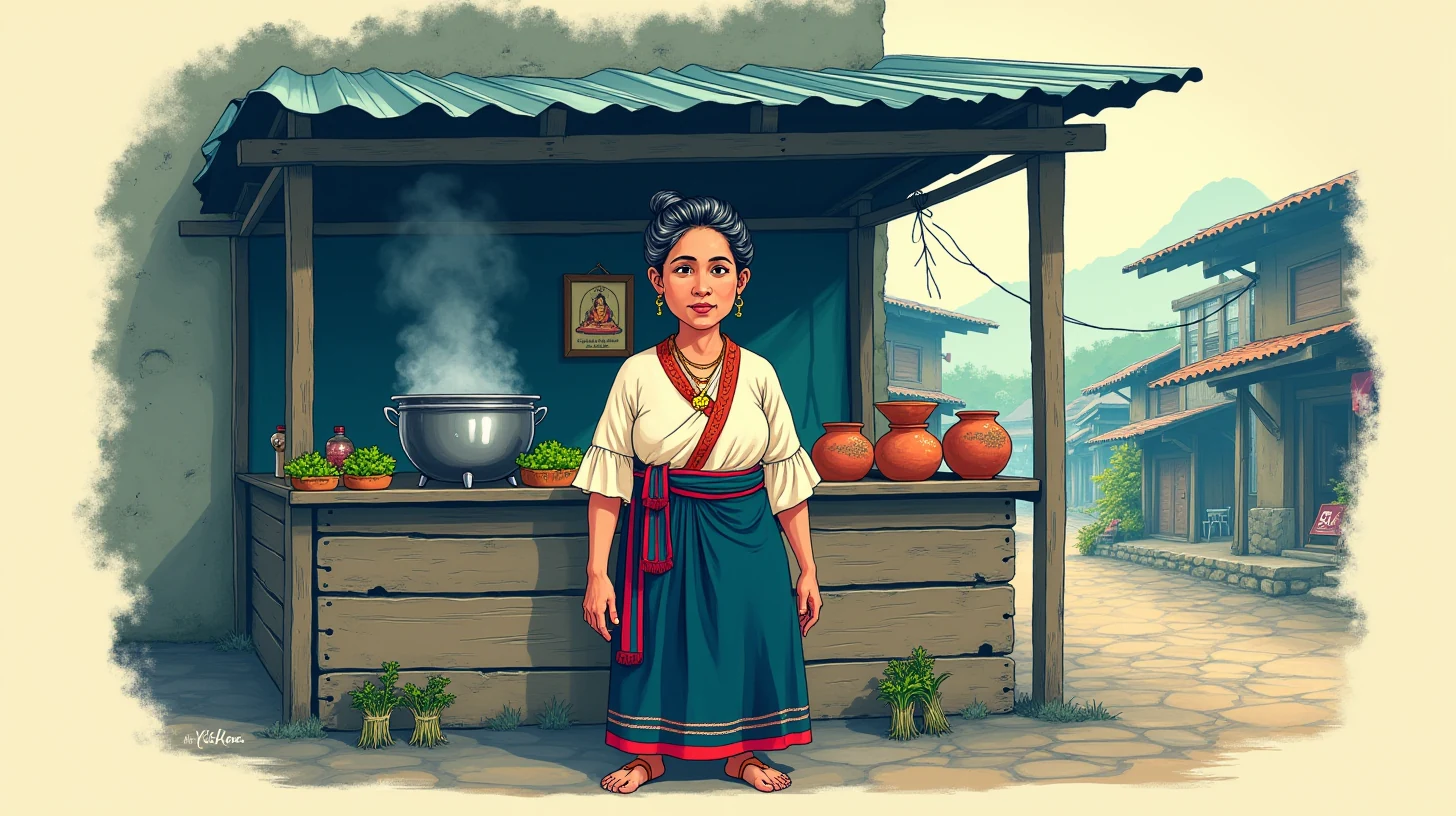
She has never owned the land on which her stall sits. The stall occupies roughly thirty square metres of ground in front of a colonial-era shop building that belongs to the Khasi clan that has owned property in Mawkhar bazaar for more than two hundred years. The clan allows her to run the stall there. They have never asked for a written lease. The arrangement is customary, rooted in the daily presence of Wansuk and the food she provides to the community. In 2014, when the FSSAI was first introduced as a uniform national food-safety standard, her stall was registered through a simplified process that did not require property documents. A local health inspector issued a provisional registration, and she renewed it every two years without complication. By 2024, she had operated through eleven consecutive registration cycles without inspection, without violation, without incident.
In February 2025, when she went to the FSSAI office in Shillong to renew her license for the twelfth time, the official at the desk—a woman named Rina Das—told her that the renewal would not be processed. The reason, written on the rejection form, was "premises ownership or registered lease required for license validity." Wansuk produced her previous eleven renewal certificates. Rina Das said: "These are old. The rules have changed. We need either ownership proof or a formal lease agreement. Do you own the land?" Wansuk said no. "Is there a registered lease?" No. "Then I cannot process this renewal."
What Rina Das did not explain—and what Wansuk did not yet know—was that the FSSAI, as part of a nationwide tightening of food-safety compliance, had introduced new documentation standards that did not account for the reality of Khasi customary land tenure. In Meghalaya, particularly in the city of Shillong, nearly seventy percent of commercial land is held under customary Khasi clan ownership, where no state-registered deed exists. The property passes from generation to generation within the clan according to Khasi law, matrilineal succession—the eldest daughter inherits—and the current occupant, by virtue of her presence on the land and her daily use of it, has a claim recognized by custom and community. But to the FSSAI form, which asked for "Ownership Certificate (copy of Sale Deed / Allotment Letter)" or "Lease Deed registered under the Registration Act," Khasi customary occupation produced no paper.
The rejection stalled her renewal for thirty days. The old license expired on March 15, 2025. On March 16, she could technically no longer serve food. She continued anyway—as did most other small food operators in Shillong—because the health inspector from the civil administration, who visited the Mawkhar bazaar weekly and knew Wansuk's stall and her practices, did not enforce the FSSAI lapse. But the precarity was now active. An unscheduled inspection by a district food safety officer—one with no relationship to the locality—could result in immediate closure and a fine of ₹2 to ₹5 lakh, which would destroy her.
It was in this window that Wansuk's daughter, Jillian, who works in a hospital and understands systems, decided to search for help.
🗓️ The year Meghalaya changed its custom
Shillong is one of India's oldest colonial hill stations, established as the capital of Assam in the 1870s and remaining the capital of Meghalaya after the state's formation in 1972. The city sits in the Khasi hills at an elevation of nearly 5,000 feet. The rain here is legendary—Shillong is the second-wettest city in India, with an average annual rainfall of 460 centimetres. The bazaars are old, layered, their streets following the contours of Khasi settlement patterns that predate colonial administration. Mawkhar bazaar is one of the oldest—built around a spring, originally a gathering place for Khasi women who came to collect water and trade goods. The current bazaar, with its colonial shop fronts and corrugated-metal stalls, has been in continuous commercial operation for more than 150 years.
The property arrangement in Mawkhar bazaar—and across most of Shillong—follows Khasi customary law. In Khasi society, land is owned by the clan (ka khynreit), and the right to occupy and use specific land passes through women. The clan elder—traditionally the eldest woman of the senior line—holds the title to family land. Younger women and men of the clan can occupy and use the land for dwelling or commerce; the occupation confers a customary right that passes to their daughters, and their daughters' daughters. Property does not move between clans through market purchase (though it can move through matrilineal inheritance). An outsider can occupy clan land only through long-term customary permission—which Wansuk had received in the 1990s when she asked the clan whether she could set up her stall there.
For the first twenty-five years, this arrangement required no paperwork. It was rooted in daily practice. The Khasi clan that owned the Mawkhar bazaar property knew Wansuk. Her food was part of the bazaar's life. She paid no formal rent; she took care of her portion of the space; she contributed to the upkeep of the water source when it was needed. The arrangement was stable, recognized, and—from the perspective of Khasi law—entirely valid.
What changed was not Khasi law. What changed was that India's national regulatory bodies—the FSSAI, the municipal corporation, the income tax department—began to demand that all property claims conform to the Registration Act, 1908. The Registration Act is an all-India statute that provides for the registration of deeds, leases, and property transfers in a centralized state registry. It does not account for customary tenure. It does not recognize matrilineal inheritance. It does not distinguish between clan ownership and individual ownership. To the form, land either has a registered deed or it does not. Khasi custom exists in the gap.
- 🏪
1999 — Stall established
Wansuk sets up her jadoh stall in Mawkhar bazaar on Khasi clan-owned land. The clan grants customary permission. No deed, no lease, no registration. The arrangement is rooted in community practice.
- 📋
2014 — FSSAI introduced
India's uniform food-safety standard launches. Wansuk registers through a simplified process; the local health officer issues a provisional registration without demanding property documents. First renewal in 2016.
- ✅
2014–2024 — Eleven renewals
Wansuk renews her FSSAI license every two years without complication. No inspections, no violations. The documentation standards do not enforce property ownership proof.
- 🛑
Feb 2025 — Registration tightened
New FSSAI compliance standard requires registered lease or ownership proof. Wansuk's customary occupation does not meet the standard. Renewal rejected. License expires March 15.
- 🔄
Mar 2025 — Sixth Schedule pathway
The agent identifies that Meghalaya's Sixth Schedule administration allows clan affidavits to substitute for registered leases in licensing. Renewal re-filed with affidavit and district officer approval.
⚠️ The thirty-day gap and what it threatened
The rejection notice gave Wansuk thirty days to respond or provide additional documentation. The clock began on February 20, 2025. March 15 was the expiry date. In those thirty days, Wansuk could have—technically—applied for a formal lease from the Khasi clan. A formal lease would require the clan elder to visit the district magistrate's office, sign a lease deed in the presence of two witnesses, pay a registration fee of perhaps ₹500 to ₹2,000, and wait for the deed to be entered into the Registration Act record. The process typically takes two to four weeks.
But a formal lease—in the view of the Khasi clan—would be unnecessary and even inappropriate. It would formalize an arrangement that was rooted in kinship and customary practice. It would introduce state regulation into a relationship that had been, for generations, internal to the clan. More practically, the clan elder—a woman in her eighties who had never visited the magistrate's office for a property matter—would have to be convinced that this was necessary, and convincing her would require explaining a regulatory system she had no reason to understand.
Wansuk's immediate option was to approach the clan elder herself and ask if the clan would be willing to execute a formal lease. The clan elder's response was reported to Jillian—Wansuk's daughter—as: "Why would she need this? She has been there for twenty-five years. Everyone knows it. Why do we need to write it down now?"
What the clan elder did not realize—and what Wansuk did not yet understand—was that the FSSAI's new documentation standard had created a narrow window where the absence of written proof became dangerous. If the renewal was rejected, and if an unscheduled food-safety inspection occurred before the renewal was reprocessed, the inspector would find Wansuk operating without a valid license. The penalty would be ₹2 to ₹5 lakh, plus immediate closure of the stall.
The precarity was not theoretical. In March 2025, a district food safety officer—a woman named Priya Sharma, assigned to oversee renewed compliance across all of Shillong's street-food vendors—began an inspection cycle. She was not hostile to street food. But she was meticulous. She carried a tablet on which she checked the FSSAI license status of every vendor. On March 18—three days after Wansuk's license had expired—Priya Sharma arrived at Mawkhar bazaar.
She found Wansuk's stall and checked the tablet. The tablet showed: "FSSAI Registration — Expired. 15-Mar-2025." Priya Sharma looked at Wansuk and said, in English: "Your license is no longer valid. You are operating illegally." She did not issue a fine that day. Instead, she said: "You have one week to produce a renewed license or you will be closed." She recorded the interaction on her tablet and moved to the next vendor.
This was the moment Wansuk's daughter sought external help.
🌗 What changed
Jillian searched online for "FSSAI license Khasi land Shillong" and found a reference to GabFORGE on a Facebook group about women food entrepreneurs in Northeast India. She downloaded the app on her mother's phone, switched the language setting to Khasi (the app offered Roman-script Khasi as one of twenty-three Indian languages), and began describing the situation: a stall on customary Khasi land, twenty-five years of operation, the FSSAI rejection, the threat of closure. She did not expect much. She thought the app would offer generic FSSAI registration guidance.
Instead, the agent asked a specific question: "Is your stall in a Sixth Schedule area?" Shillong is in Meghalaya, and Meghalaya is one of only six states in India that fall under the Sixth Schedule of the Indian Constitution. The Sixth Schedule, established in 1950 specifically for tribal and indigenous areas in Northeast India, allows for regional autonomy in matters of property, inheritance, and land tenure. States and territories under the Sixth Schedule—Meghalaya, Mizoram, Tripura, Assam (specific districts), and Arunachal Pradesh—have the authority to establish their own land laws and recognize customary tenure systems. The agent explained this over two exchanges on the tablet:
"Ka khynreit long ka Sixth Schedule le ka permit diengïa long ka clan affidavit. Khmat nia jong ka FSSAI, man dung shnong wa man thew ba."
(The Sixth Schedule recognizes clan affidavits as valid proof of occupation. The FSSAI will accept this in Meghalaya.)
Jillian read the response to her mother. Wansuk said: "Is this true?" Jillian said: "Let me check." She called the Meghalaya office of FSSAI and asked whether a clan affidavit—a statement signed by the clan elder confirming Wansuk's customary right to occupy the land—would be accepted in place of a registered lease. The FSSAI official, after a brief hold, said: "Yes, but the affidavit must be countersigned by the District Food Safety Officer and must reference the Sixth Schedule administration. It's not routine, but we can process it."
The agent then provided a template for the affidavit—in English and Khasi—that Wansuk could take to the clan elder. The affidavit stated: "I [name], as elder of [clan name], confirm that [Wansuk] has occupied the land at [Mawkhar bazaar] for the past twenty-five years with the customary permission of this clan, in accordance with Khasi customary law and the Sixth Schedule of the Indian Constitution." The affidavit required the elder's thumbprint, a witness signature, and the date.
The agent also provided the contact details of the District Food Safety Officer in Shillong—Priya Sharma, the same woman who had issued the closure warning—and drafted a brief letter to her explaining the Sixth Schedule pathway and requesting that she countersign the affidavit.
Wansuk, with Jillian's help, visited the clan elder three days later. The elder, when shown the affidavit, asked: "Does this give the government control of my land?" Wansuk said: "No, it just says we have permission to be there, which we do." The elder signed. A relative of the clan—a man with a government job—signed as a witness. The date was March 22, 2025.
Wansuk then visited Priya Sharma at the District Food Safety Office with the affidavit and the letter from the agent. Priya Sharma read it carefully. She said: "I did not know the Sixth Schedule applied here. Let me check with my supervisor." Two days later, she countersigned the affidavit and sent it electronically to the FSSAI office. The FSSAI processed the renewal within forty-eight hours. Wansuk's license was re-issued on March 26, 2025. She had been operating without a valid license for eleven days.
What it does
- 🔍Identifies that the Sixth Schedule framework applies to Meghalaya and allows customary affidavits in licensing.
- 📋Provides a template for the clan affidavit in English and Khasi Roman script, reducing friction for the elder to sign.
- 📞Supplies the contact information for the District Food Safety Officer and drafts the cover letter requesting countersignature.
- ⏰Alerts Wansuk to the timeline: expiry date, renewal processing window, and the risk of unscheduled inspection.
What it does not do
- 🔒The agent does not sign documents on behalf of Wansuk or the clan elder. The clan elder signs the affidavit herself.
- 💳The agent does not contact the FSSAI or the District Officer on behalf of Wansuk. Wansuk (and Priya Sharma) make the call.
- ✅The agent does not decide whether the Sixth Schedule claim is valid. The District Officer and FSSAI confirm this during processing.
🧭 Why we built it
The reason GabFORGE tracks the Sixth Schedule framework is not because the framework is obscure—it appears in constitutional textbooks and in administrative law courses—but because it is routinely invisible when a food business owner sits down with a government form. The form says: "Proof of ownership or registered lease." The owner reads the form. The owner has neither. The owner concludes that she does not qualify. The transaction ends.
The form does not say: "Or, if you are in a Sixth Schedule state, a clan affidavit authenticated by the District Officer." The form does not say: "In Meghalaya, Mizoram, or Tripura, customary tenure is legally recognized." The form does not say: "If you are a member of an indigenous community living on customary land, there is a pathway." The form is silent, and the silence becomes a barrier.
This is the gap that GabFORGE fills. Not by changing the law—the Sixth Schedule has been in the Constitution since 1950—but by connecting the food business owner to the legal framework that already applies to her situation.
The same gap exists for thousands of small food operators across Northeast India. In Assam, the Karbi Anglong and Dima Hasao districts fall under the Sixth Schedule, and customary land tenure is recognized there as well. In Tripura, nearly forty percent of commercial land in urban areas is held under tribal customary ownership. In Mizoram, clan ownership is the standard form of land tenure. Yet in each of these states, when a food business operator applies for an FSSAI license, she encounters the same form, the same demand for a registered deed, and the same inference that she does not have a legal claim to the land she occupies.
"Ka shai nia ka tablet le ka shai nia man jong shnong-ei khyndait. Man dung la man thew ba, man thew ba."— A small tool is like a small light. It shows you the path that was always there.
The scheme that enabled Wansuk's renewal—the FSSAI FoSCoS portal, Meghalaya's Sixth Schedule administration, the MSME Udyam registration that now lets her track her turnover formally, and the MUDRA loan that she is now eligible to take for stall repairs—these already exist. No new law was written. The FSSAI did not create an exception for her. What changed was that the connection between Wansuk's actual situation (a woman on clan-recognized land, in a state with constitutional Sixth Schedule protection) and the frameworks that apply to her (constitutional law, food-safety regulations, MSME policy) became visible.
The food businesses affected by this gap are substantial. Across Meghalaya, Assam's Sixth Schedule districts, Mizoram, and Tripura, approximately 50,000 to 75,000 street-food and small-restaurant operators occupy customary clan or tribal land. Most have no written lease. Most have operated for ten to thirty years without formal documentation. All of them, when they next renew their FSSAI license, will face the form that asks for proof of ownership or registered lease. If they are aware of the Sixth Schedule pathway—if they know that a clan affidavit is a recognized legal document—they can proceed. If they are not aware, they face closure.
🌱 What we hope happens
Wansuk continues to sell jadoh from her stall in Mawkhar bazaar. The stall is still there, still open, still serving the morning crowds. The renewal is valid for two years, until March 2027. Jillian has helped her mother register on the MSME Udyam portal as a micro enterprise, which has given her access to a MUDRA loan that she is considering for repairs to the stall's roof—the monsoon had opened a leak in the corrugated metal. She is also thinking about formalizing her turnover by requesting that customers who can pay by digital transfer do so; this will give her documented revenue for the next FSSAI renewal.
The larger change is quieter. On the day Wansuk's renewal was processed, Priya Sharma, the District Food Safety Officer, sent an email to the FSSAI's regional office in Assam asking whether the Sixth Schedule pathway should be included in the renewal form as an explicit option. She also—by her own initiative—began checking the tenure status of other street-food vendors in Shillong and flagging which ones operated on customary land. For vendors in that situation, she began suggesting the affidavit pathway before their licenses expired.
What we hope is that this becomes routine. Not that the government issues a special exemption for food businesses on customary land—they do not need one; they have the Sixth Schedule—but that the connection becomes visible. That the FSSAI renewal form, in the states where the Sixth Schedule applies, includes a line that says: "In Meghalaya, Assam, Mizoram, Tripura, and Arunachal Pradesh, you may also submit a clan or tribal affidavit authenticated by your District Officer." Not as an exception. As a pathway that was always there.
Wansuk is fifty-one. She does not plan to sell jadoh forever—perhaps another ten or fifteen years, until her body stops allowing the early mornings and the heat of the stall. But in that time, she wants the stall to remain open. She wants Jillian and her granddaughter, if that child ever comes, to know that the stall existed, that Wansuk's food fed the bazaar, and that she had the right to be there. The tablet and the affidavit made that right visible to the government. That is enough.