
The Vijayawada tiffin widow and the FSSAI registration she did not need
Lakshmi had been running a biryani-tiffin service from her home kitchen in Vijayawada's Krishna Nagar colony for eight years. Every morning at 5 a.m., she began. Soaking rice, grinding spices, marinating mutton. By 9 a.m., a dozen steel lunch boxes were packed—biryani, a raita pot, two dry curries—and loaded into cloth bags slung across the handlebars of her son-in-law's two-wheeler. The bags went to the Cyber Park complex on Survey Road, three kilometres away. By 10:30 a.m., software engineers were opening her tiffins on their desks.
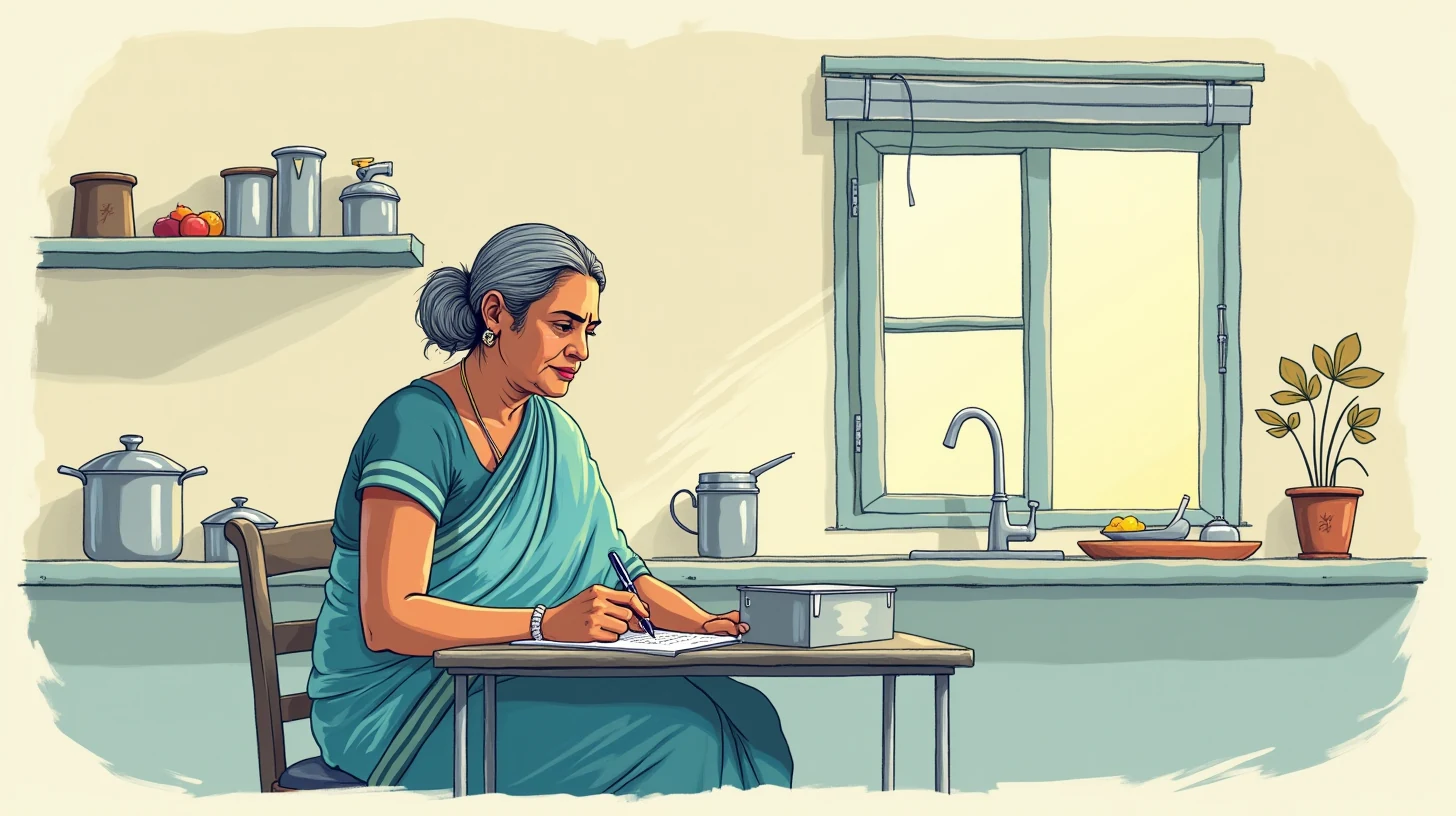
She charged ₹180 per biryani-lunch. Raita and curries included. No margin conversation. Just that price. She made roughly ₹2,160 on a full day from those dozen-odd boxes—about ₹4,32,000 across a year, never invoiced, never receipted. Cash in a cloth pouch.
Her late husband had left her the house and nothing else. No pension. No savings. Her daughter was married in Dubai. Her son worked for a courier company and gave her ₹5,000 a month when he could. The tiffin service was not a business idea she had written up in a PowerPoint. It was her livelihood. It was five rupees away from homelessness every single day.
Eight years. A dozen lunches a day. Not a single customer complaint. Not a single piece of paper with a government stamp.
Then, in the second week of March 2025, a man named Ramesh approached her after the delivery run, outside the Cyber Park gate. He wore a half-sleeve shirt and said he worked for a "food business consultant" in the city. He told her she needed an FSSAI license.
The crisis came three weeks later, when an inspector from the Vijayawada Health Department walked into her kitchen unannounced and told her to close.
🗓️ The annual ritual
The FSSAI—Food Safety and Standards Authority of India—divides food businesses into three categories based on turnover.
If your annual business is under ₹12 lakh, you need FSSAI Registration. It costs ₹100, applies for three years, and you can file it yourself on a portal called FoSCoS in 15 minutes. You need a photo of your kitchen, a copy of your ID, and that's it. No inspection. No middleman. Approved within two days.
If your annual business is between ₹12 lakh and ₹20 crore, you need FSSAI State License. This costs ₹2,500–₹5,000 depending on your state, requires an inspection, takes 30–45 days, and must be renewed every 1–5 years depending on the category. You can file it online but still need an inspection to prove the kitchen meets hygiene standards.
If you exceed ₹20 crore or operate in multiple states, you need FSSAI Central License—the same process but with FSSAI's central office in New Delhi.
On paper, it is crystal clear.
In the world that Lakshmi lived in—the world of cash-based, informal food businesses scattered across India—this distinction had become the perfect hunting ground for middlemen.
The middleman was a scam. Not an outright fraud; Ramesh would file the actual papers. But his value was selling confusion. He would arrive at the kitchen, tell the owner that the process was "very complicated," that inspectors required "connections," that the fees involved were much higher than they actually were, and that—for ₹15,000—he would "take care of everything." What he actually did was fill out a registration form (which costs ₹100) and file it on the government portal (which takes 15 minutes). He pocketed ₹14,900 and walked away. The owner got a legitimate FSSAI certificate, still filed at ₹100 cost, believing she had paid ₹15,000 and narrowly avoided "trouble."
Lakshmi's annual turnover was ₹4,32,000. She needed Registration, not State License. She qualified for the ₹100 portal, not the ₹15,000 intermediary.
But she did not know this. And that uncertainty was worth ₹14,900 to Ramesh.
⚠️ What very nearly happened
On the morning of March 21, 2025, at around 10:15 a.m., just as Lakshmi was prepping the final 20 biryani boxes, there was a knock on the kitchen door. Two men in khaki uniforms. The elder one was carrying a black folder.
"FSSAI inspection," he said. Or rather, health inspector. The distinction gets muddled in local enforcement. Sometimes they say FSSAI, sometimes "food license," sometimes "hygiene inspector"—but in practice, they all work for the State Health Department, answering to the Chief District Medical Officer's office. Their authority is the same.
Lakshmi's stomach did a flip. She had no documents. No registration. No license. No certificate on any government portal.
The inspector looked at the kitchen. He looked at the unmarked steel boxes. He looked at the steel pots and the open shelving. He opened her small account book—written in Telugu, mostly dates and quantities, no invoices.
"Where is your FSSAI license?" he asked.
"I do not have it yet, sir," Lakshmi said. Her voice was steady, which surprised her. "I was planning to apply."
The inspector did not smile. "You are running a food business without a license. That is a violation under section 31 of the Food Safety and Standards Act, 2006. The penalty is ₹2 to ₹5 lakh and business closure. I am issuing you a notice today. You have 15 days to produce a valid registration or license. After that, we seal the kitchen."
He handed her a notice in English. Lakshmi could read English, but not quickly. Her hands were shaking. The notice said: "NOTICE OF INTENT TO CLOSE: Food Business Operating Without FSSAI Registration/License. Violation Section 31, FSS Act 2006. Compliance required within 15 days. Penalty: ₹2,00,000 to ₹5,00,000."
She now had 15 days to prevent her livelihood from being sealed.
- 📋
March 21, 10:15 a.m. — Inspection notice issued
Inspector arrives unannounced at the kitchen. Finds zero documentation. Issues a closure notice effective in 15 days under Section 31 of the FSS Act 2006. Penalty threatened: ₹2–₹5 lakh.
- 💬
March 21, 11:30 a.m. — Ramesh returns
Middleman re-contacts Lakshmi the same morning. Suddenly, the ₹15,000 fee is 'urgent and non-negotiable.' Claims he has 'connections' to fast-track the registration. Pressure applied.
- 💳
March 23 — Lakshmi pays ₹15,000
Desperate, Lakshmi borrows ₹15,000 from a moneylender at 3% monthly interest (36% p.a.). Hands it to Ramesh. He files the standard ₹100 FoSCoS registration online—the same form Lakshmi could have filed herself in 15 minutes.
- ⏰
March 26–April 2 — Certificate arrives, crisis passes
FSSAI Registration certificate is issued (valid for 3 years). Lakshmi presents it to health department on April 1. Closure notice is waived. Kitchen remains open. But Lakshmi now carries a ₹15,000 debt at 36% p.a.—a debt that costs her ₹450 per month in interest alone.
By the evening of March 21, Ramesh had called her. He knew about the inspection within hours. She does not know how.
"The papers are urgent now," he said. "If you pay me today, I can file them tonight and you will have the certificate in three days. Otherwise, the inspector will come back."
Lakshmi did not have ₹15,000. She had ₹23,000 in savings—kept in a cloth pouch, slowly accumulated from eight years of a couple of thousand rupees a day in takings. She needed that cash for rice, spices, salaries for her kitchen helper, her electric bill.
But she also faced ₹2–₹5 lakh in penalties and business closure.
She borrowed ₹15,000 from a moneylender named Vikram who operated out of a small shop on Eluru Road. The interest: 3% per month, which is 36% per annum. Standard for informal lending in Krishna Nagar. Lakshmi signed a handwritten note on March 22. No document, just two signatures and a verbal agreement that she would repay ₹15,450 on April 22.
She gave the money to Ramesh that afternoon.
What he did next took him 45 minutes. He logged into the FSSAI FoSCoS portal on his phone. He entered Lakshmi's name, phone number, kitchen address, and a photo of her kitchen (which she had provided). He paid ₹100 from his own account and submitted the form. FSSAI's automated system reviewed it, found no issues, and issued a Registration certificate valid for three years. The certificate was emailed to Lakshmi's phone by March 25.
The entire process—the process Ramesh charged ₹15,000 for—cost ₹100 and took him less than an hour.
Lakshmi did not know any of this. When the certificate arrived in her email, she thought she had narrowly escaped catastrophe by paying a fixer. In reality, she had been charged ₹14,900 for a form that was free and a process that was automatic.
🌗 What changed
It was her son-in-law, Anand, who noticed something was wrong with the story.
Anand worked for the courier company and was reasonably literate. He looked at the certificate Lakshmi showed him on her phone. It was from FSSAI FoSCoS, the government's own portal. He asked her, casually, if she knew what the certificate cost.
"Fifteen thousand rupees," she said, "plus I borrowed it at 3% monthly."
Anand's face changed. He asked to see the certificate again and photographed it. That evening, he searched online for "FSSAI registration cost" and found the FoSCoS portal. He created an account with his own details and looked at the process. The portal took him 10 minutes to navigate. The fee was ₹100. There was no place to enter "middleman's commission" or "expedited processing"—the system was entirely automated.
He went to Lakshmi's house the next morning and showed her the portal. Together, they traced through the registration process for a hypothetical kitchen. The form was in English and Telugu both. The questions were simple: kitchen address, type of food prepared, storage facilities, water source, owner's ID. The government automatically issued a certificate once the form was submitted.
"You paid ₹15,000 for this?" Anand asked, pointing at the portal.
Lakshmi did not speak. She sat at her kitchen table, looking at the steel pots and the open shelving and the lunch boxes stacked in the corner. Eight years of cash-based income. Eight years of believing she was operating in a kind of shadow where the government did not reach. And now, the government had reached her—not to help her, but to frighten her into the arms of a middleman who had stolen ₹14,900.
Anand suggested checking if there was some way to recover the money or report Ramesh. But in the informal economy, there is no complaint mechanism. Ramesh had not signed a contract. Lakshmi had no receipt. Even if she had gone to the police, the case would have been: "A man charged me ₹15,000 to file a government form that costs ₹100." The local police station would have filed a case, probably asked for a bribe to "investigate," and achieved nothing.
There was another problem, though. Anand had looked at the registration again. It was legitimate. But Lakshmi's actual annual turnover—₹4,32,000—put her in the under-₹12-lakh category, which meant Registration (₹100) was correct. But inspectors sometimes ignore the turnover threshold. If she had applied for State License instead (₹2,500–₹5,000), she would have had a formal inspection, a more permanent certificate, and higher official standing.
The real question was: which type of license did she actually need? And how did she know?
That was when Anand mentioned the agent. A neighbour had told him about a system—a tablet that answered questions about government schemes. It was available to small business owners in Vijayawada. Anand did not know the details. He just knew it existed.
He took Lakshmi to the neighbour's house. The neighbour was a dhaba owner named Suresh, who operated a small roadside restaurant near the Toll Gate. Suresh had a tablet that ran a local app. He showed them how to ask questions in Telugu.
Lakshmi sat down in front of the tablet—she had used smartphones to check WhatsApp, but had never used one to "ask questions" of a machine—and typed slowly, in Telugu:
"నా ఆహారం వ్యాపారం సంవత్సర రూ. 4.32 లక్ష. నేను ఏ FSSAI సర్టిఫికేట్ అవసరం?"
(My food business annual turnover is ₹4.32 lakh. Which FSSAI certificate do I need?)
The agent replied, in Telugu:
"మీ వార్షిక టర్నోవర్ ₹12 లక్ష కంటే తక్కువగా ఉంది. మీకు FSSAI రిజిస్ట్రేషన్ అవసరం, ఇది ₹100 ఖర్చులో FoSCoS పోర్టల్లో నమోదు చేయవచ్చు. ఇది 3 సంవత్సరాలకు చెల్లుబాటు అవుతుంది. రాష్ట్ర లైసెన్సు అవసరం లేదు."
(Your annual turnover is below ₹12 lakh. You need FSSAI Registration, which costs ₹100 and can be filed on the FoSCoS portal. It is valid for 3 years. You do not need State License.)
Lakshmi did not move. She re-read the Telugu text on the screen four times. The machine was confirming what Anand had found: she needed the ₹100 registration, not ₹15,000 to a middleman. And it was confirming it in Telugu, her own language, in a calm and factual way.
She asked the agent another question:
"ఈ నమోదు చేయుటకు నన్ను ఇన్స్పెక్టర్ సందర్శించవలసిందిరా?"
(Will an inspector need to visit me to complete this registration?)
"సంపూర్ణంగా ఆన్లైన్ ప్రక్రియ. ఇన్స్పెక్టర్ సందర్శన లేదు. మీరు మీ పాకం ఫోటోను అప్లోడ్ చేయండి, మీ ఐడీ సమర్పించండి, ₹100 చెల్లించండి. రిజిస్ట్రేషన్ 2 రోజులలో ఇస్సు చేయబడుతుంది."
(Completely online process. No inspector visit. You upload your kitchen photo, submit your ID, pay ₹100. Registration is issued in 2 days.)
Lakshmi felt something shift. Not relief, exactly. But a movement from fear toward clarity. The machine was explaining something she had been too frightened to search for on her own. And it was doing it in her language, not in the English-language bureaucracy she had assumed was too complicated for her.
She had one more question:
"నేను ఇప్పుడు ₹15,000 ఖర్చు చేసాను. దీన్ని తిరిగి చెందించుకోవచ్చా?"
(I have already spent ₹15,000. Can I get this back?)
The agent's reply was honest:
"చట్టపరంగా, మీరు మధ్యవర్తిపై ఎటువంటి కోర్టు ఆదేశం లేకుండా రికవరీ చేయలేరు. కానీ మీరు జిల్లా పోలీసు ఆఫీసుకు ఫిర్యాదు చేయవచ్చు, కానీ సాఫల్యం సంభవం లేనిది. మరించ, MUDRA లోన్ ఐచ్ఛికం లేదా PM FME సబ్సిడీ మీకు కొత్త పరికరాలకు అర్హతను కలిగిస్తుంది."
(Legally, you cannot recover from the middleman without a court order. You could file a complaint with the district police, but success is unlikely. However, a MUDRA loan option or PM FME subsidy may make you eligible for new equipment.)
"నేను 8 సంవత్సరాలు ఈ ఉపయోగం చేసిన కోసం నిరీక్ష్కుడను సిద్ధం చేసాను, కానీ సర్టిఫికేట్ కోసం ఎటువంటి గుడ్ఝెక్ కలిగిలేను."— I spent eight years preparing for this business for an inspector I never met, but I had no check on a certificate I was forced to buy.
🧭 Why we built it
Lakshmi's story is not unique. It is the dominant story of India's informal food economy. Seven million food businesses operate in the country. An estimated 70% run without formal FSSAI licenses. Not because they disrespect food safety—Lakshmi's kitchen was spotless, her customers had never fallen ill—but because the boundary between "what I must legally do" and "what a middleman is telling me I must do" has been erased by information asymmetry.
A home chef in Mumbai does not know if she needs Registration or State License. A tiffin service in Hyderabad does not know the process costs ₹100, not ₹12,000. A cloud kitchen in Bengaluru does not know that MUDRA Shishu loans (₹50K collateral-free) can cover the entire compliance cost if she formalises. And because they do not know, they either skip licensing (and risk closure), or they pay a middleman who extracts ₹14,000–₹20,000 per transaction.
The cost to the operator is direct: ₹14,900 stolen from Lakshmi's earnings, now a ₹15,000 debt at 36% annual interest.
The systemic cost is larger. Every rupee extracted by a middleman is a rupee not invested in the business itself. Lakshmi could have used ₹15,000 to upgrade her kitchen—buy a commercial stove, install proper ventilation, formalize her supply chain—and moved into State License territory, where she would have higher standing with government buyers and aggregator platforms. Instead, the money evaporated into a middleman's pocket. The kitchen remains the same. The risk remains.
Multiply this across 5 million informal food businesses in India, and the extraction reaches ₹7,500 crore per year in middleman fees alone.
The agent's role is translation. Not legal advice—the agent never recommends what Lakshmi "should" do—but clarification of what actually exists.
The agent reads the FSSAI regulations and maps them to Lakshmi's actual business: a dozen lunches per day, ₹4,32,000 annual income. The regulations say Registration (not State License). The agent confirms it. The agent also surfaces the cost: ₹100, not ₹15,000. It reads the FoSCoS portal and explains the process step-by-step: photo, ID, payment, 2-day turnaround. No interpretation. No "connections required" myth. Just the facts, in Telugu.
The agent also surfaces what Lakshmi did not know existed. MUDRA Shishu loans. PM FME subsidies. MSME Udyam registration. Stand-Up India. These are real schemes, with real money, designed for exactly her situation—women-owned micro food businesses formalising for the first time. But they are buried in government portals that assume the operator has already navigated FSSAI, already has a bank account, already knows what to search for. The agent surfaces them. It tells Lakshmi: "You qualify. Here is the application. Here is what you need."
The schemes are not a solution by themselves—Lakshmi still has to fill the forms, still has to get a bank account, still has to travel to a bank branch. But the agent removes the first barrier: the confusion about whether these schemes exist at all.
In a business model where margins are 15–20%, the difference between a ₹100 registration and a ₹15,000 middleman fee is existential. It is the difference between a growing business and a business that stays small, trapped by an arbitrary debt that feeds a parasite.
🌱 What we hope happens
Lakshmi still owes ₹15,450 to the moneylender Vikram. She will finish repaying in June 2025, thirteen months of ₹1,200 per month taken from her lunch-box revenue. By June, the interest alone will have cost her ₹1,450. The principal ₹15,000 will have paid Ramesh for a ₹100 form.
But the FSSAI Registration certificate sits in her phone now, valid for three years. If another inspector arrives, she can show it. The threat is gone.
What we hope happens is quieter than that.
We hope Lakshmi learns that the systems—the schemes, the portals, the certificates—were designed for her, not against her. She was operating in the shadow of the law for eight years, not by choice, but by default. The system was incomprehensible. The moment someone made it comprehensible—in her language, with her numbers, without charging her ₹14,900—she moved into the light.
We hope other tiffin services, other home chefs, other roadside dhabas discover the same thing. That Registration is ₹100, not ₹15,000. That MUDRA Shishu loans are collateral-free, not impossible. That PM FME subsidies exist, and women-owned micro food businesses qualify. That you do not need connections or fixers or intermediaries. That the government system, when clarified rather than obscured, actually works.
And we hope that clarity spreads backwards to the middlemen themselves—that the market for confusion collapses, and with it, the parasites.
Middleman Path
₹15,000 cost + 36% interestMiddleman charges ₹15,000 to file ₹100 form. Operator pays 36% annual interest on borrowed debt. Kitchen remains unchanged. Operator gains zero knowledge of system. Risk: next inspection, operator still confused.
Self-Guided Path
₹100 cost + 20 hoursOperator searches online in English, finds FoSCoS portal, navigates form, pays ₹100. Possible but operator must: read English, trust government website is real, know which form to file, navigate payment system. Literacy barrier: high.
Agent-Guided Path
₹100 cost + 15 minutesOperator asks agent in Telugu: 'Which certificate do I need?' Agent clarifies Registration vs. State License. Operator confirms ₹100 cost. Agent walks through process, surfaces PM FME and MUDRA eligibility. Cost is clear. Pathway is clear.
Lakshmi is 54 years old. Her hands carry the smell of turmeric and mutton. She wakes at 4 a.m. and does not sleep until the dozen lunch boxes are packed. She has fed nearly twenty thousand meals across eight years without a single official receipt, a single stamp, a single certificate—until an inspector's unannounced visit made her terrified and a middleman made her desperate.
But that was March. It is now May. The certificate is on her phone. The moneylender will be paid off in four months. And on her kitchen table, printed from an online search Anand did for her, is a form for MUDRA Shishu Loan: ₹50,000 collateral-free. She has not filled it out yet. But it is there. The possibility is there.
The machine—the tablet, the agent—made the possibility visible.