
Aizawl graduate and the Mizoram EPFO–NCS gap: UAN linked to a ghost account
Lalthansangi Pachuau sat on the concrete steps outside the Ramhlun Vengthar colony post office, the morning sun warming her shoulders, a printed error message in her hand. She was twenty-three, a BA in Economics from Mizoram University Tanhril, and she had spent the last twenty-four hours trying to understand three words that appeared on her Nokia Android phone: "Incomplete EPFO account." The message came from the National Career Service portal, the government site where she had just registered for the Mizoram Rozgar Mela—a job fair her college had announced would take place in Aizawl in June, bringing employers and skill-training schemes to her doorstep. But the NCS system would not let her register. It said her EPFO UAN account, created during a three-month NGO internship the year before, was incomplete. Without clearing it, she could not appear at the mela, and she could not access the PMKVY skill-training referral that the NGO coordinator had promised might fund her digital marketing certification.
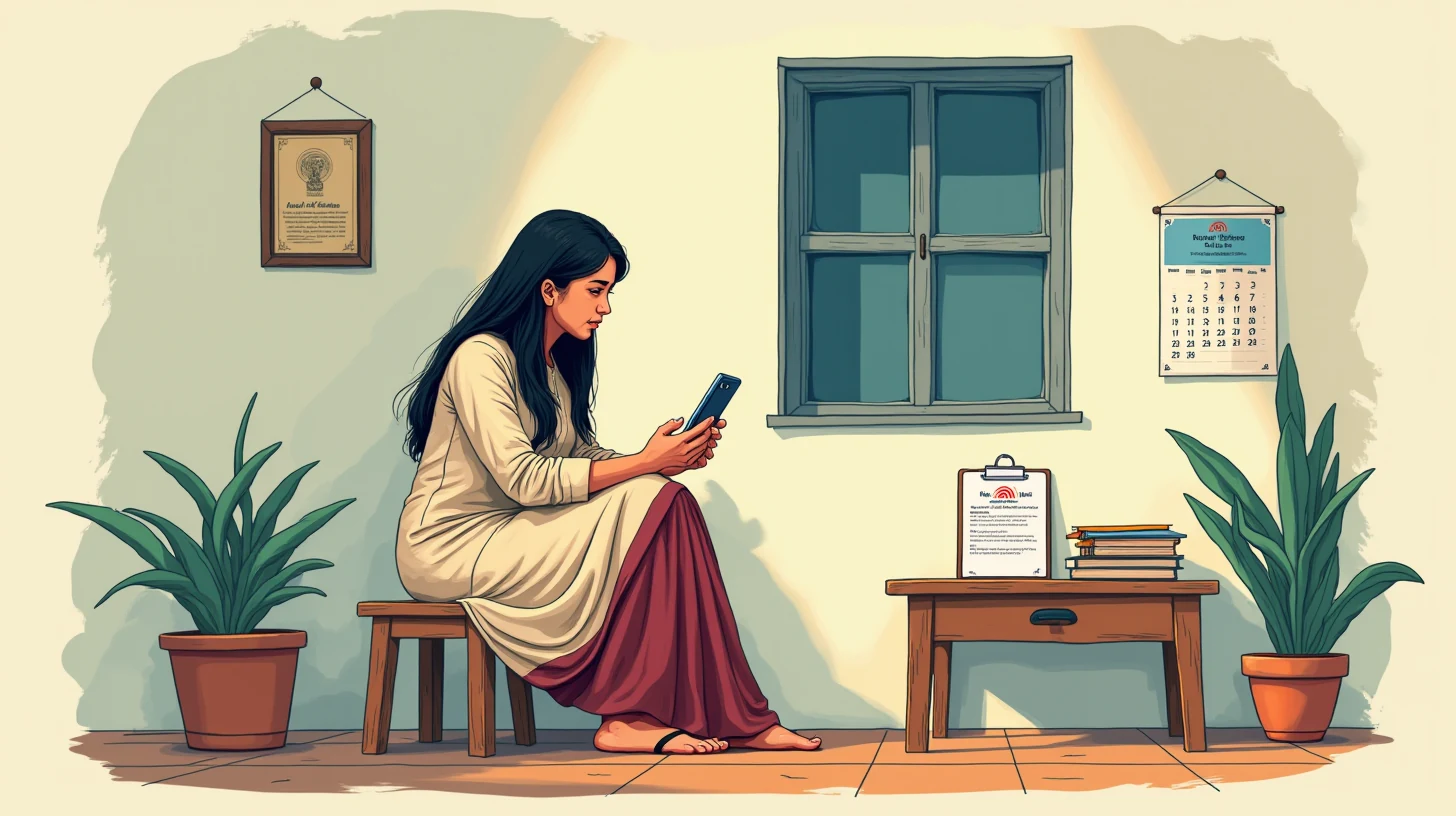
Her father, a church deacon and part-time carpenter who earned inconsistent money from both vocations, had advised her not to panic. But Lalthansangi had learned, over the past year of tracking job announcements, application windows, and deadline notifications on a secondhand phone, that panic was the right response. Every portal had a rule no one explained. Every government scheme had a form that didn't quite ask what your situation was. And every time she asked at the employment exchange office in Aizawl, the clerk behind the desk looked at her with the mild fatigue of someone who had given the same explanation three hundred times to people who still didn't understand.
She had registered the UAN during the internship because the NGO supervisor had asked her to—it was part of their process, he said, for formal employees. The internship itself was unpaid; her job was to help organize workshops and track participant data. When the NGO enrolled her in the system, a UAN was generated. She had received a printout with her UAN number and her name. But she had never been asked to link it to her Aadhaar number, and she had assumed it would happen automatically, the way most things in government documentation were supposed to.
Now, sitting on the post office steps, she was learning that assumption was the enemy of every job seeker in India.
🗓️ The internship-to-mela pipeline and the silent account gap
The Mizoram Rozgar Mela was scheduled for the first week of June, organized by the state employment exchange, the Ministry of Labour and Employment, and the EPFO itself. It was one of the few state-level job fairs that guaranteed access to PMKVY skill-training slots—certificates in hospitality management, entrepreneurship, and digital marketing. For graduates from state universities who had spent the previous year watching SSC exam notification windows open and close, or waiting for state PSC announcements that never came, the Rozgar Mela was the interval where something could actually happen.
NCS was the portal through which all registrations passed. Every applicant had to create an account, upload a resume, and verify their employment history. For anyone who had ever held a formal job, an internship, or even been briefly enrolled with EPFO, the system would run an automated integration check: it would query the EPFO's database and see whether the applicant's UAN matched a complete, linked account.
The problem was invisible until it wasn't. Lalthansangi's UAN existed on the EPFO ledger—her name, the internship dates, the employer's registration number. But her Aadhaar number had never been seeded into that account. In the EPFO's system, her UAN had a name and a date, but no biometric identity. When NCS ran its integration check, the system flagged the account as "incomplete" and blocked her registration.
She discovered this not through a letter or an email, but through an error code that appeared when she submitted her form.
- ⚖️
June 2024: NGO internship begins
Supervisor asks Lalthansangi to register formally. She receives a UAN number and a printout. No mention of Aadhaar linking. She assumes the account is complete.
- 📨
June–August 2024: Silent account creation
The UAN appears in EPFO records but Aadhaar field remains blank. No system sends her a notification. No reminder arrives in her email or SMS.
- ⏰
April 2025: Rozgar Mela announcement
Mizoram Rozgar Mela scheduled for June 2025. NCS opens registration. Lalthansangi creates her profile and attempts to link her historical EPFO account.
- 🛑
May 2025: Integration check fails
NCS portal returns error: 'Incomplete EPFO account. Please link Aadhaar to UAN before proceeding.' Her Mela registration and PMKVY referral are now locked.
⚠️ The locked portal and the mela window closing
By the time she received the error message, it was May 15th. The Mizoram Rozgar Mela was scheduled to begin on June 2nd. The NCS registration deadline was May 31st—sixteen days away.
Lalthansangi had made phone calls. She had called the NCS support line and been transferred to three different people, none of whom could tell her anything beyond "Contact your EPFO office in Aizawl." She had called the EPFO regional office. They confirmed that her UAN existed, that the account was hers, and that yes, it was not linked to Aadhaar. When she asked how to link it, they gave her a phone number for the Member Verification helpline.
She called the helpline. The agent asked her which district she was in, took her UAN, and told her that she could link her Aadhaar through the EPFO member portal online, or by visiting the EPFO sub-office in Aizawl with her original documents. When she asked how long it would take for the NCS system to recognize the change, the agent said, "Maybe one or two working days. Or maybe more. The systems don't always talk to each other right away."
Maybe. In sixteen days, maybe was not a useful answer.
She visited the EPFO sub-office on May 17th. The office was in a rented commercial building off Lamsual Road, staffed by two people. One was on leave. The other, a data entry operator named Anurag, explained that he could help her file a UAN–Aadhaar linking request, but it had to be done through the EPFO portal. He could not do it for her in the office; he could only guide her through the steps.
Anurag pulled up a chair next to his desk and walked her through the EPFO member portal on his computer. He showed her where to find the "KYC Update" section. He showed her the field where she could enter her Aadhaar number. He told her to go home and do it from her phone, and to save the confirmation number when it appeared.
She did. She entered her Aadhaar. The portal accepted it and issued a confirmation number: AADH-2025-05-17-8847. The screen said "Request submitted for processing. Aadhar seeding may take 48 hours."
She waited two days. She checked the NCS portal on May 19th. The error persisted.
🌗 The pivot: a classmate who had already failed
On May 20th, her classmate Zuliani messaged her on WhatsApp. Zuliani had graduated a year earlier and had spent the past twelve months working part-time at a call center in Guwahati, enrolled in EPFO through their contractor system. When Lalthansangi asked if she had tried registering for the Rozgar Mela, Zuliani's response came in three sentences:
"Aah, I tried last year for the Assam mela. Same thing happened to me. EPFO account not linked to Aadhar. NCS doesn't let you in. I filed a grievance through EPFiGMS. It took six weeks."
Lalthansangi had never heard of EPFiGMS. But Zuliani, who had spent six weeks chasing the same error, knew the acronym: EPFO Grievance Management System. She sent Lalthansangi the link: https://epfigms.gov.in.
Zuliani also sent her a longer message, in Mizo: "Ka hnuai a awm lo. Grievance filing a zan a nih. Portal atang ghin ka la tlanglak thim thim a, naupang tho ka sawi a, a hmachhuan a accept a nih leh a hmasa hliam."
— It''s frustrating. Filing a grievance takes time. I searched the portal on my own, and even when I explained my situation clearly, they accepted it slowly.
Lalthansangi pulled up EPFiGMS. The interface was similar to NCS—a government form portal with fields for UAN, Aadhaar, grievance type. There was a dropdown: "UAN-Aadhaar linking not completed" was one of the options. She filled in the form. She uploaded a screenshot of the NCS error. She submitted.
The system returned a grievance ticket number: GMS-2025-05-20-34892. The portal said: "Your grievance has been registered. Average resolution time is 15 working days. You will receive an SMS and email update every 3 days."
She had filed the grievance on May 20th. The Rozgar Mela deadline was May 31st. Fifteen working days would take her into mid-June, well after the registration window closed.
That evening, Lalthansangi typed a question into the government helpline app on her phone: My EPFiGMS grievance is pending. Can I still apply for NCS jobs?
"NCS (ncs.gov.in) portal-ah profile register thei i nih — EPFiGMS grievance pending a ni a, NCS registration a chawl lo. I UAN number leh qualification details register rawh. Aadhaar-UAN link hnu ah NCS profile activate theih a ni tih. Grievance ticket number GMS-2025-05-20-34892 nei zawh reng rawh — ni 15 chhung EPFO office chuan chhawp zui an tih."
(You can register your NCS profile at ncs.gov.in — a pending EPFiGMS grievance does not block NCS registration. Register with your UAN number and qualifications. Once the Aadhaar-UAN link is confirmed, you can activate your NCS profile. Keep your grievance ticket number GMS-2025-05-20-34892 — the EPFO office will follow up within 15 days.)
🧭 Why this gap exists, and who it traps
The problem was not that EPFO accounts and NCS registrations were incompatible. The problem was that they were supposed to be connected but were not obligated to stay connected.
Here was how it actually worked: When an employer filed an ECR (Electronic Contribution Return) with EPFO, their new employee's name was recorded. If the employer had the Aadhaar number, it went into the filing. If not, the UAN account was created with incomplete data. The employee received a UAN number—often via their employer, sometimes via SMS—and assumed they now had a "complete" account.
But in India's government systems, "complete" did not mean "verified." It meant "has an identifier." A UAN could exist in the EPFO database for years without ever being linked to Aadhaar. The linking was supposed to happen during annual KYC updates, through the member portal, or through an EPFO office visit. But there was no automatic reminder. There was no notification that said "Your account is incomplete. Please link your Aadhaar within 30 days or face a registration block."
Instead, the block appeared only when the job seeker tried to use it. For Lalthansangi, it happened during a Rozgar Mela registration. For others, it happened during loan applications, pension claims, or unemployment benefit registrations.
What it does
- 🔍NCS queries EPFO and flags accounts with missing Aadhaar seeding
- 📋EPFO member portal accepts Aadhaar submissions and issues confirmation numbers
- 📞EPFiGMS accepts grievances and assigns ticket numbers with average 15-day resolution
- ✅Member can verify status via helpline or EPFO office visit
What it does not do
- 🔒Never automatically links Aadhaar without member action; never sends reminder about incomplete accounts
- ⏰Does not guarantee that NCS will recognize the Aadhaar link within 48 hours (or any deadline)
- 📨Does not notify job seeker that their account is incompatible with Mela/skill-scheme registration until they apply
- 💸Does not allow grievance expediting; cannot skip the 15-day queue even for deadline-driven job seekers
The casualty list was long. It included all first-generation graduates—those whose parents had no experience navigating labor department forms, whose family circles had no one who had ever filed an EPFO grievance. It included graduates from small towns and state universities, people whose only portal literacy came from SSC exam sites and college admission links. It included people like Lalthansangi, whose three-month internship had seemed like a bureaucratic formality until suddenly it blocked her path to a job fair.
"Aadhaar seeding a se a nih ngaihin a se chu, portal atang thil tithui lo in a sawi ang thlauhna. A hmachhuan ka zuk ka ti a, mi a awm lo in ka lo zuk nual ka ti a, zukmun a lo hniam hniam zawk a nih."— Aadhaar seeding is something you do not think about until a portal demands it. I thought I had registered properly, so I did not follow up, and the process moved much more slowly.
🌱 The quiet cost of invisible boundaries
Lalthansangi did not know what would happen to her Rozgar Mela registration. The grievance she had filed might clear her account in time, or it might not. The 15-day window was nominal; the actual resolution could be faster or slower, and no one in the system had discretion to expedite. She had written an email to the NCS support address asking if there was an appeals process, and she had not received a reply.
But something had shifted in how she understood the portals. They were not indifferent to her circumstances. They were indifferent to deadlines. They operated on bureaucratic time, where "48 hours" meant 48 hours of system processing, not 48 hours of wall-clock waiting, and where "15 working days" was a guide, not a guarantee.
She had learned something that many Indian job seekers learn too late: that the systems designed to help you find work can themselves become work. That a single missing field in a government database could erase a month of planning. That there was a difference between having access to portals and having access to opportunity—and that the systems did not always recognize the difference.
The Mizoram Rozgar Mela would happen with or without her. Employers would come. Skill-training certificates would be offered. But she would watch it from outside the digital perimeter, waiting for her UAN to be recognized as real.