
Daman Graduate and the EPFO UAN Factory Closure — When Your First Job Vanishes Before Your Certificate Arrives
Mihir Patel sits on the narrow bed of his rented room in Nani Daman, a printout of his EPFO UAN in one hand and his phone in the other. He is 24 years old, a BSc graduate from a state college in nearby Vapi, Gujarat — close enough to home, far enough to feel independent. His father works steadily in a plastics manufacturing unit in the Daman industrial estate, a familiar rhythm of factory life that Mihir once thought he might avoid. But graduate jobs in Daman are rare, and his father had a contact: the Daman Polyester Mills garment division was hiring for a four-month contract in 2025. One shift per day, basic wages, a foot in the door. Mihir took it.
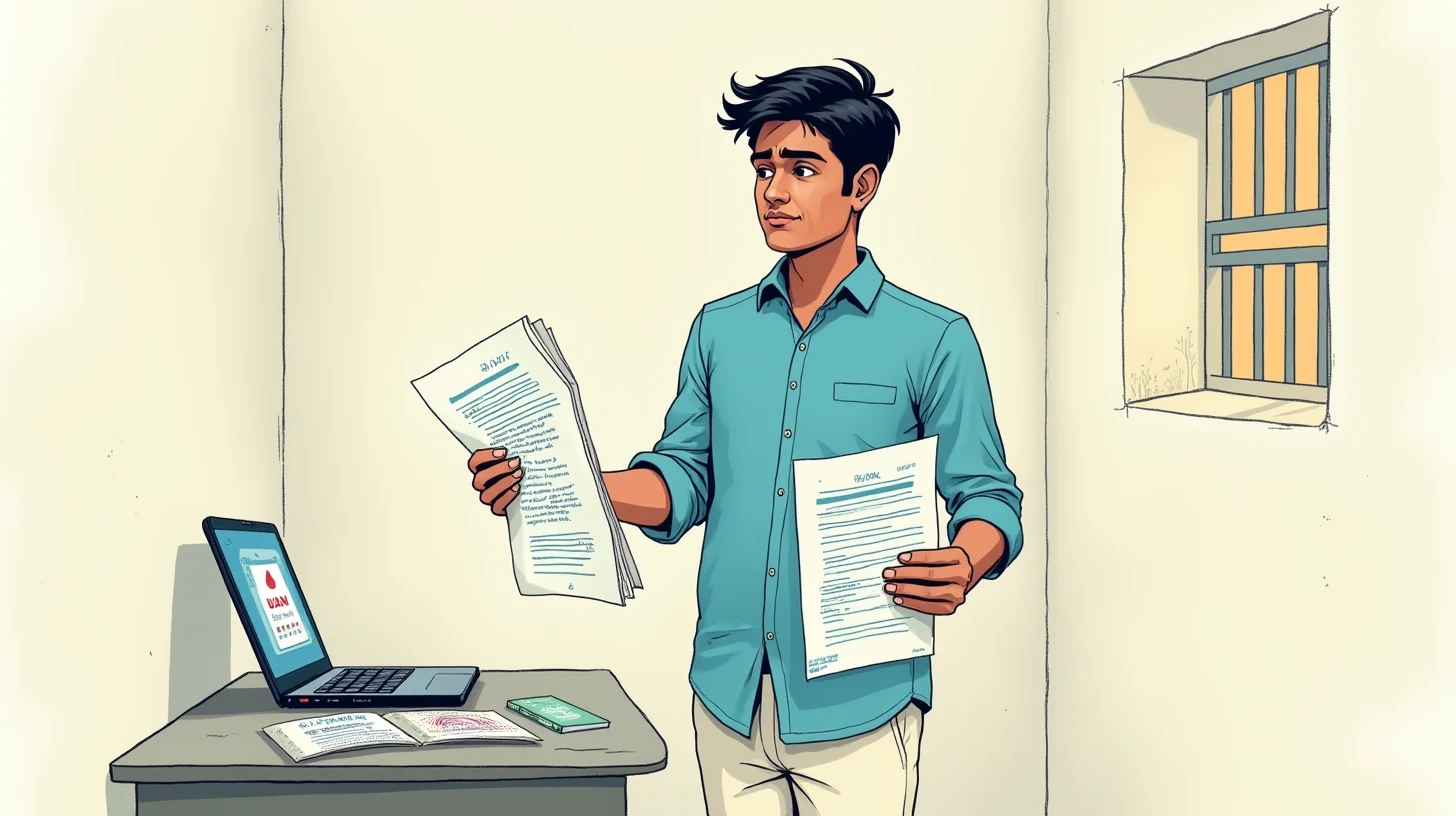
The contract ended cleanly in June. The factory paid on time, deducted the statutory EPFO contribution, and issued a letter stating his employment dates. What happened next should have been straightforward: the factory would upload his employment record to the EPFO system, link it to his Aadhaar, and generate an official employment certificate. He would have proof of organized-sector work — the kind that opens doors to government competitive exams, the kind that signals stability to employers. He would have a UAN (Universal Account Number), his entry into India's pension system.
Instead, he has a UAN printout that says "Aadhaar seeding: Not Completed" and no path to fix it.
Mihir is a first-generation graduate in a UT where most entry-level jobs come through either the state PSC (which Daman & Diu does not have, and relies on Gujarat or the central exam cycle) or the National Career Service portal. Six months into this stalemate, he has filed a grievance with the EPFO, received an auto-generated SMS confirming receipt, and waited through two monsoons with no reply. He cannot apply for SSC CHSL — which specifically asks for an employment certificate from his last employer — without that certificate. He cannot prove he worked. The factory is still running, but it is now directly managed by the EPFO after the original trust dissolved. The Daman EPFO sub-regional office has no dedicated helpline, and the toll-free line connects him to agents in New Delhi who repeat that "you must contact your employer's PF trust."
Mihir is not looking for charity. He is trying to follow every official rule and has hit a wall that the rules themselves created.
🗓️ The Second-Tier Job-Search Cycle
Daman operates in what you might call the shadow of the exam calendar. There is no Daman PSC, which means government jobs come through three channels: the SSC (Staff Selection Commission) competitive exams, the UPSC Union Public Service Commission for high-level posts, and the occasional special recruitment drive from state governments in Gujarat or Maharashtra or central ministries. The SSC calendar is precise and relentless — CHSL exams announced in January, application windows closing 30 days later, interviews six months later, posting six months after that. For a 24-year-old graduate, SSC CHSL (Combined Higher Secondary Level) is the most accessible path, offering clerk and data-entry roles at ₹20,000–₹25,000 per month after five years. The quota structure reserves seats for reserved categories and candidates with lower-family-income thresholds.
Mihir completed his BSc and spent twelve months looking for a private-sector graduate role — marketing coordinator, accounts assistant, junior analyst. The jobs existed, mostly in the informal textile and gems sectors, with take-home pay around ₹15,000. His father's contact at the polyester mills offered something better: a fixed-term contract with EPFO coverage. It felt like a stepping stone. Factories that contribute to EPFO suggest organizational maturity; the UAN number would be evidence of formal employment, a credential to carry forward into either the private sector (where a UAN = a pension trail = stability) or the government exam circuit (where many advanced roles require proof of prior organized-sector work).
The four-month term was March–June 2025. The factory was honest about the expiry date and paid on schedule. It was what it claimed to be: a temporary contract to meet seasonal demand.
But the EPFO system that the factory feeds into operates on a calendar that has no concept of a "temporary" worker. When a worker's Aadhaar is not seeded into the UAN at the time the employment record is created, the system suspends the whole file. The record exists, but the certificate cannot be generated. It is the bureaucratic equivalent of a letter written in disappearing ink.
⚠️ The Missing Aadhaar Link
In late August 2025, Mihir discovered the problem. He logged into the EPFO Member Portal (unifiedportal-mem.epfindia.gov.in) to download his employment certificate for the SSC CHSL application window, which was closing on 15 September. The portal showed his UAN, his employer code, his contribution history — everything correct. But under "Aadhaar Status" it said: "Not Completed. Please contact your employer to update Aadhaar details."
He called the factory's HR office. They told him they had submitted the data to the EPFO. He should contact the EPFO. When he called the national EPFO helpline (listed on the portal, operating 8 AM–4 PM, Tuesday–Saturday), the agent informed him that his employer's PF trust had not linked his Aadhaar. The agent could not process it himself. "Ask your employer to log in and re-submit your Aadhaar," the agent said.
Mihir went back to the factory. The HR manager, polite but overwhelmed, told him that the trust had been closed and that all member records were now transferred to the Daman EPFO sub-regional office. "The office should have your file," he said. "You need to go there directly."
The Daman EPFO sub-regional office is understaffed and operates without a member-facing helpline. Mihir visited it in person on a Tuesday morning. He brought the employment letter, his Aadhaar, his identity documents. The staff member he met nodded, took photocopies, and said that the Aadhaar-seeding request had been sent to Ahmedabad EPFO (the regional office). "It takes time," she said. She could not expedite it. She did not know how long "time" meant.
The SSC CHSL application window closed on 15 September. Mihir could not apply.
The next SSC CHSL window would open in January 2026, with application closure in February. It was still six months away, and he had no certainty the issue would be resolved by then. He filed a grievance through EPFiGMS (epfigms.gov.in), the EPFO's online complaint system, on 10 September. The system issued a grievance registration number (GRN) and sent him an SMS: "Your complaint has been registered. You will receive an update via SMS and email within 90 days."
Ninety days passed. No update came.
- ⚖️
March–June 2025: Factory Contract + EPFO Enrollment
Mihir completes his four-month contract at Daman Polyester Mills. Factory deducts EPFO contributions and issues employment letter. UAN is created, but Aadhaar-seeding is not completed at enrollment time.
- 📨
August 2025: Discovery of Missing Certificate
Mihir logs into EPFO portal to download employment certificate for SSC CHSL application. Portal shows ''Aadhaar Status: Not Completed.'' Factory HR says the PF trust has been closed and files transferred to EPFO sub-regional office in Daman.
- 🛑
September 2025: SSC Application Window Closes
Mihir visits Daman EPFO office, files EPFiGMS grievance (GRN issued), but cannot complete SSC CHSL application before 15 September deadline. No helpline exists to expedite. He begins waiting for grievance resolution (promised 90 days).
- ₹
December 2025: No Update, No Certificate, No Exam
90-day window passes with no resolution. Mihir enters the NCS portal to search for new jobs but finds limited opportunities in Daman outside textiles and informal retail. The next SSC CHSL window is January 2026.
🌗 The Shift
It was his cousin Vivek, working in a back-office firm in Surat, who asked the right question. Vivek had navigated a similar mess with a prior employer and knew the labyrinth of EPFO grievances. Over a December phone call, he told Mihir, "You need to show the agent the exact rule. The EPFO has a policy on Aadhaar-seeding for closed trusts. You cannot just wait."
Vivek walked Mihir through the EPFiGMS portal, showing him how to search for precedent grievances and how to check the EPFO's official FAQ. They found it: an EPFO circular stating that for members whose employers have dissolved, the EPFO sub-regional office is responsible for completing Aadhaar-seeding after verifying documents. The process should take 10–15 days. Mihir's 90-day grievance period had passed with no acknowledgment.
The shift came when Vivek told Mihir to go back to the Daman EPFO office with the circular printout and ask to speak to the supervisor. Bureaucracies move when the person asking knows exactly which rule they are invoking.
On 8 January 2026, Mihir returned to the EPFO office. This time, he had printed copies of the circular, his grievance registration number, the EPFO FAQ, and a letter requesting expedited Aadhaar-seeding under the closed-trust protocol. He asked specifically for the supervisor. It took an hour, but the supervisor reviewed the file and agreed that the case had stalled. She promised to send a message to the verification team in Ahmedabad and asked him to return in five days.
Five days later, Mihir downloaded his employment certificate from the EPFO portal. It was dated 9 January 2026 and signed with a digital stamp.
By 12 January 2026, he had filed his SSC CHSL application for the February 2026 exam window.
"Kaam khatam hua tha, lekin record idhar-udhar tha. Jab tak sahi circular nahin mili, koi sunta nahin tha — document ke bina main kuch bhi nahin hun. Galti factory ki thi, lekin EPFO ke paas jawab nahin tha."— The job had ended, but the records were scattered. Until I found the exact circular, no one listened — without the document, I was nothing. The fault was the factory's, but the EPFO had no answer.
"Humne circular dekhi, aur tab samajh aaya ki yeh EPFO ke rules mein likha tha — hamara fault nahi, sirf complaint aur wait karna sahi nahi tha. Vivek ne bataya ki supervisor ko rules batao, certificate milega."
(We read the circular, and then we understood that this was written in the EPFO''s own rules — it wasn''t our fault, it wasn''t enough to just file a complaint and wait. Vivek told me that if you show the supervisor the rules, you''ll get the certificate.)
🧭 The System That Fails First-Generation Graduates
Mihir''s crisis is not a rare edge case. It is a systematic fracture in India''s job-search and pension infrastructure that hits hardest at first-generation, non-urban graduates.
The problem sits at the intersection of three broken assumptions:
First: The government assumes that Aadhaar-seeding will happen automatically when an employer enrolls a worker in EPFO. In organized sectors (IT, banking, large manufacturing), this is true. The employer''s HR systems are mature enough to collect Aadhaar at enrollment. But in smaller factories, especially those with high turnover, Aadhaar collection often happens through a separate, delayed process — sometimes weeks after the employment record is created. For a four-month contract worker, this delay can mean the window closes before the link is completed. The employment record is marked as incomplete and then locked in limbo.
Second: The government assumes a worker in crisis will have a point of escalation. The EPFO helpline exists, but it does not have the authority to un-lock a frozen record. The factory is supposed to fix it, but if the factory has closed or dissolved its trust (as happened in Mihir''s case), no one is accountable. The EPFO sub-regional office is technically responsible, but it has no dedicated member helpline. Escalation requires a physical visit and knowledge of which supervisor to ask and which circular to cite.
Third: The government assumes a worker has time to absorb delays. The SSC exam calendar is rigid. An application window closes on a fixed date. If you miss it, you wait six months for the next one. Mihir lost one entire exam cycle — a year of his career — because an Aadhaar-seeding error was not resolved within 90 days. He is 24 now. Each missed cycle is a year. By 25 or 26, the competitive exams become harder (age relaxation drops, alternative candidates have more experience). The cost of a bureaucratic stall is not abstract; it is measured in career momentum.
Thousands of graduates from Dadra & Nagar Haveli, Gujarat, and the North-East face similar delays. The UT of Daman & Diu has no state PSC. Its graduates must compete nationally through SSC or UPSC — both brutal exams with limited seats. An EPFO documentation error or a closed-trust record transfer can mean the difference between a government job at 25 and unemployment at 28.
The National Career Service (ncs.gov.in) platform offers an alternative path: job matching against registered employers and private-sector roles. But Daman''s NCS node is underfunded and lists mostly textile and informal retail jobs. Mihir registered there in July 2025, received two SMS job alerts (both day-wage casual roles), and then nothing for five months. The portal did not fail Mihir — the local labour market did. NCS works in Bangalore and Mumbai. It does not work everywhere.
What Should Happen
Ideal ScenarioEmployer collects Aadhaar at enrollment. EPFO system links it within 3 days. Worker downloads certificate within one week. No delays, no bureaucratic friction.
What Usually Happens (Organized Sector)
CommonEmployer''s HR delays Aadhaar collection. EPFO takes 2–4 weeks to process. Worker can still download certificate before competitive-exam deadlines (usually 4–6 weeks out).
What Happened to Mihir (Small Employer + Closure)
CatastrophicFactory does not collect Aadhaar at enrollment. PF trust closes after contract ends. Aadhaar-seeding responsibility falls to EPFO sub-regional office. No helpline. No escalation path. 90-day grievance cycle with no resolution. Worker misses exam deadline.
🌱 Knowing the Rules Before the Rules Know You
The photograph on Mihir''s EPFO employment certificate is blurry — a poor photocopy of the copy his factory provided. It is signed by a supervisor whose name he will never meet. It cost him nothing to obtain, and it cost him a year to get.
What strikes him now, sitting in that rented room in Nani Daman, is not the certificate itself but the knowledge that broke the deadlock: the circular. The EPFO had already written the rule. The institution knew the problem and had issued a protocol. But the protocol lived in a PDF on a government server that a factory worker does not know to search for. The rule was there. It just did not know how to find him.
This is the texture of first-generation job searching in a UT without a state PSC, where every job must be competed for nationally, and every credential must be certified by a system that assumes you know how to read its own bureaucracy. The agent — the phone, the voice on the helpline, the cousin who had read the circular — is the translator between what the system says and what a graduate can actually do.
Mihir is waiting for the SSC CHSL results now. He is also registering for NCS notifications and exploring private-sector accounts roles. The certificate in his hand is not a guarantee. It is a proof that he followed the rules correctly, that he worked, that he belonged to the formal system for four months. What he does with it depends on whether the system itself sees him as part of that belonging — and whether the next deadline gives him enough time to matter.