
Delhi Graduate and the DSSSB Domicile–OTP Failure
Arun Kumar sat on the edge of his bed in his Dwarka Sector 7 rental, phone in one hand and the printed DSSSB notification in the other, reading the domicile requirement for the tenth time that morning. Ten years continuous residence in Delhi. His family had moved to the capital eight years ago when his father got a job at a construction site in Gurgaon. They had rented the same two-room flat ever since—concrete walls, a window that rattled when the traffic spiked on the ring road, rent paid by cheque every month, all traceable. But eight years was eight years. Two years short.
He was twenty-three, with a BA in Political Science from a Delhi University South Campus affiliated college. His shift work tutoring junior students at a coaching centre near the metro station paid him 15,000 rupees a month—enough for his phone bill and chai, not enough to feel secure. The DSSSB clerk exam was supposed to be his escape route: 47,000 rupees basic pay, government benefits, stability. The application deadline was six days away.
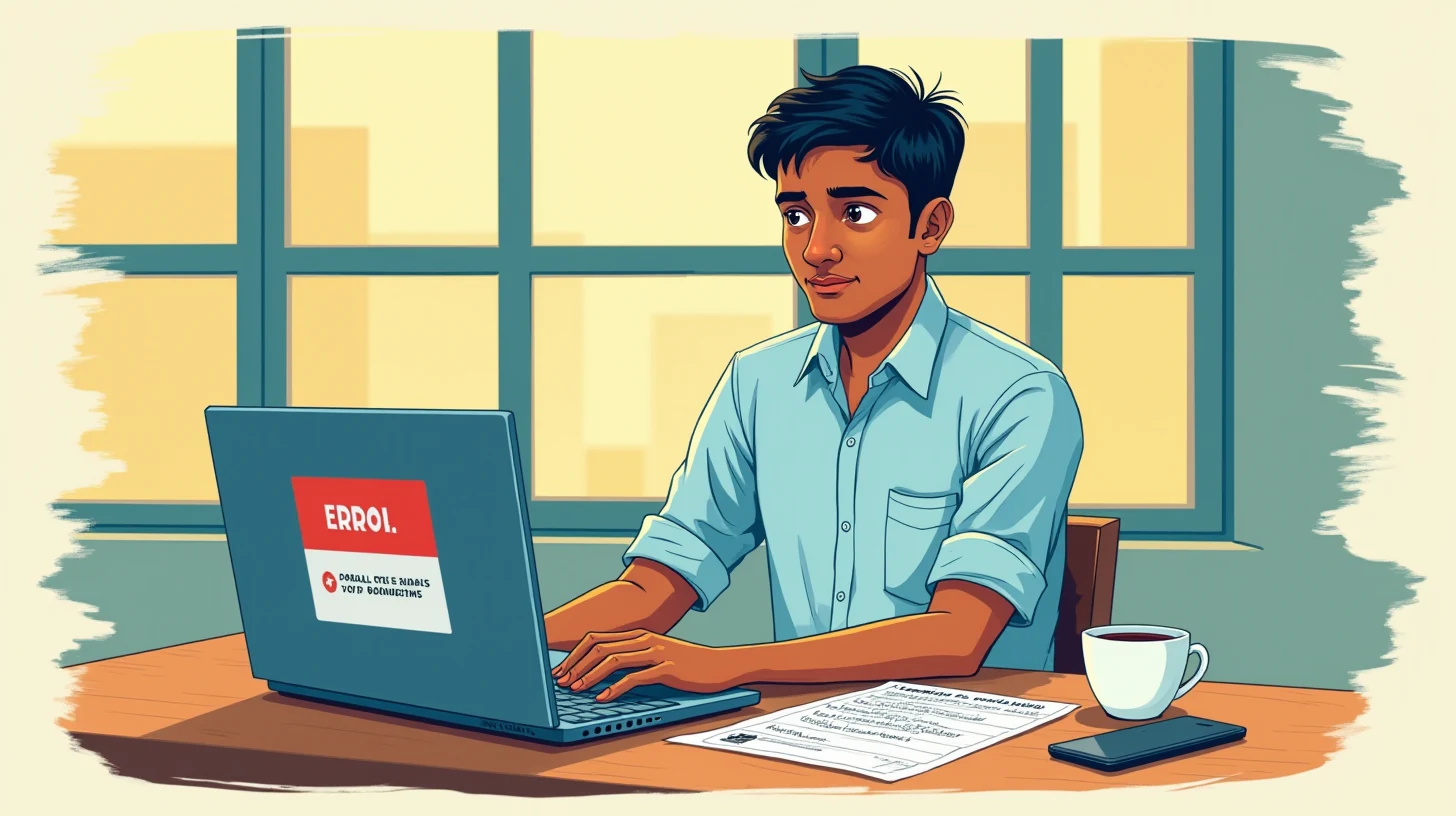
At the same time, he had begun filling out his profile on the DTTE apprenticeship portal at tte.delhi.gov.in, a quieter path that required only a basic qualification and proof of age. The apprenticeship would give him practical experience, maybe 8,000 rupees a month as a stipend, and a certificate. Safer than coaching, more certain than waiting for exam results. But when he tried to verify his phone number that morning—a basic Nokia inherited from his mother—the OTP text arrived, he entered it, and the portal said "Invalid OTP. Try again." He had tried six times. The portal refused to move forward. His DTTE deadline closed at 11:59 PM the same day the DSSSB application window shut.
Arun had no backup plan. He had no cousin in the public sector to ask. His parents spoke Hindi and Punjabi, neither fluent in the language of government portals. And he was running out of minutes.
🗓️ The Bureaucratic Calendar Collides
Delhi's administrative year is a maze of overlapping deadlines, each one closing a different door at a different speed. The DSSSB (Delhi Subordinate Services Selection Board) runs a perpetual recruitment cycle—vacancies are advertised, applications open, a window closes, then silence for months while the board processes forms. For clerk positions, the cycle typically runs on a two-to-three-year refresh. The current batch had opened on 12 May 2026, with a hard close at 11:59 PM on 19 May—exactly one week.
Parallel to this, the DTTE apprenticeship intake works on a different rhythm. DTTE, the Directorate of Training and Technical Education, manages Delhi's technical workforce pipeline: ITI graduates, apprentices, diploma holders, trade certificates. Each year, around mid-May, the apprenticeship portal opens for registration—a shorter window, usually ten days. This year's close was also 19 May at 11:59 PM. Coincidence or administrative oversight, no one knew.
The DSSSB portal, hosted on dsssb.delhi.gov.in through the OARS (Online Application Registration System) interface, required applicants to upload three categories of proof: identity, education, and domicile. The domicile certificate—officially known as a Delhi Residence Certificate or DRC—had to show ten years of continuous residence within the National Capital Territory. Arun's family had arrived in August 2018. If he calculated forward, he would qualify in August 2028. In May 2026, he was exactly twenty-two months short.
Many applicants in his position simply uploaded old documents from their previous state—a utility bill from the landlord, a municipal tax receipt from the locality, a school leaving certificate from a Delhi-based college. The portal did not verify real-time against the municipal property registry. If the documents looked plausible and the file size was under 5 MB, the system accepted them. Thousands of students from UP, Rajasthan, and Punjab who had moved to Delhi for college did the same thing without a whisper of consequence. Arun had heard the stories in the hostel, the coaching centre, the metro queues. Jis ke paas certificate ho, upload kar do. Whoever has the certificate, just upload it. No one checks.
But Arun did not have the certificate. His family's move was relatively recent, informal, undocumented. There was no electricity bill in his name—his father paid the landlord, and the landlord's account carried the bill. There was no property tax receipt. He had never registered for a Ration Card under his own name. The only proof of residence was his college admission record from 2020 (which only proved he was in Delhi, not that his family was), a mobile phone bill in his name from a local number registered in 2019, and rent receipts in his father's handwriting. The DSSSB portal would likely flag these as insufficient. Or it might accept them and then trigger a document-verification stage six months later, after which he would be disqualified mid-cycle.
That gamble lived in his chest like a stone.
The DTTE apprenticeship route seemed simpler. Less scrutiny. But it depended on a portal that, at that moment, was refusing to accept his phone number.
⚠️ The Deadline Strangulates
At 4:47 PM on 17 May, Arun sent an email to the DTTE helpdesk from the cyber café near his flat. The email address was dirtte[dot]delhi[at]nic[dot]in, copied from the tte.delhi.gov.in contact page. He wrote, in Hindi and broken English mixed: Mera OTP portal par fail ho raha hai. "Invalid OTP" error aa raha hai, phir bhi sahi number daala hai. Please fix this. (My OTP is failing on the portal. I keep getting "Invalid OTP" error even though I''m entering the correct number. Please fix this.)
The email delivery succeeded. No automatic response came back. No acknowledgement. No ticket number. At the cyber café, the owner shrugged. Sarkari website. Kal dekh lenge. Next week maybe. Government website. We''ll look at it tomorrow. Maybe next week.
By 6:15 PM, with sixty hours left until both portals closed, Arun walked to a second cyber café across the street—a different owner, different machines. He tried the DTTE portal again on a different device, logged out and logged back in, cleared the browser cache, switched from Chrome to Firefox, and updated his phone number. The OTP text arrived on his Nokia at 6:43 PM. He typed it in. Invalid OTP. Try again. This time, he tried a landline number instead—his coaching centre''s phone, which had a functioning SMS service. The portal would not accept it. Only mobile numbers allowed, the interface said in a tooltip.
He had one mobile number. It was not working.
The DSSSB path, meanwhile, had its own suffocation point. At 11 AM on 18 May—one day before both deadlines—he called the DSSSB helpline, listed on dsssb.delhi.gov.in as a Monday–Friday, 10 AM–5 PM service. He reached a voice on the other end, a junior clerk who had handled domicile queries before.
"Sir, mera family 8 saal se Delhi mein hai. Kya main apply kar sakta hoon?" Sir, my family has been in Delhi for 8 years. Can I apply?
The response came in rapid Hindi: "Certificate ke bina, nahi. Koi bhi exception nahi. Aur jo bhi galatly upload karega, wo baad mein disqualify ho jayega. Sab portal verify karti hai." Without the certificate, no. No exceptions. And whoever uploads fake documents will be disqualified later. All portals verify. Then the line went dead. Disconnected, not by Arun but by the system—the helpline''s call timer had hit five minutes, the maximum allotted per caller.
He had no callback number. The website offered no chat support, no ticket system, no follow-up mechanism.
- 📨
17 May, 4:47 PM — DTTE helpdesk email
Arun emails tte.delhi.gov.in about OTP failure. No automatic acknowledgement. No ticket number. No ETA for response.
- 📱
17 May, 6:43 PM — OTP retry across multiple devices
Tries Firefox, different cyber café, browser cache clear, landline workaround. Portal consistently rejects valid OTP. Only mobile accepted, but mobile does not work.
- ☎️
18 May, 11:00 AM — DSSSB helpline call
Reaches live clerk. Confirms: no domicile certificate, automatic disqualification. No exceptions. Call auto-cuts at 5-minute timer. No callback mechanism.
- 🛑
19 May, 11:59 PM — Both portals close
DSSSB window closes. DTTE window closes. Neither application submitted. Arun has zero credentials moving forward.
🌗 The Agent Enters via a Younger Cousin
On the evening of 18 May, at 8:30 PM, Arun''s younger cousin Priya—who had left Dwarka to study at Ashoka University in Sonepat—texted him a screenshot of a gabforge.in article about a girl from Gurgaon who had solved an EPFO UAN mismatch. The article, titled "Gurgaon Software Tester and the EPFO UAN Seed Failure," showed how an agent—accessed via a basic Android phone—had walked her through the Unified EPFO Member Portal step by step, verified documents in her local script, and helped her track the grievance reference number.
Arun opened the link. The article was specific. It named an actual portal (unifiedportal-mem.epfindia.gov.in), gave actual form field names, explained why the system had rejected the document, and described what the woman should do next—not in English corporate jargon, but in Hindi transliteration. The woman had a basic education. She had made mistakes. She had been scared. And the agent had stayed with her through it.
Priya''s text said: Maybe something like this can help with your OTP? And maybe there''s something about the domicile certificate too. Worth asking.
Arun went to gabforge.in. He scrolled through the jobseeker articles—there were dozens by now, each one about a different crisis, a different portal, a different graduate trapped between the system and the deadline. At 9:15 PM, he typed his first question into the chat interface on his Nokia, using the browser''s voice-to-text. The prompt was messy, rapid, in Hinglish:
"Mereko DTTE apprenticeship portal par OTP fail aaraha hai. Aur DSSSB clerk exam mein domicile certificate ke 2 saal short hoon. Dono portals ek hi din band honge. Kya main fake certificate upload kar sakta hoon ya koi aur raasta hai?" Can I upload a fake certificate, or is there another way?
An agent appeared almost immediately.
"Fake certificate? Nahi bhai. Wo toh permanent disqualification hai. DSSSB ne post-verification ka process hai—3–6 mahine baad wo check karega. Agar certificate fake mila, toh naam permanent list se remove hoga, aur baad mein aur exams mein bhi eligible nahi hoga. Aur OTP? DTTE portal par wo technical glitch common hai agar phone number naya register hua ho. Tum try karo ek kaam: DTTE ke helpdesk ko SMS bhejo, document number likha hua. Sath mein, NCS portal par chale jao. DSSSB ke baad jo ho sakta hai wo try karo."— Fake certificate means permanent disqualification. The DSSSB has a post-verification process—they check after 3–6 months. If they find a fake certificate, your name goes off the permanent eligible list, and you won''t qualify for any exam again. But the OTP? That''s a common glitch on the DTTE portal when a phone number is newly registered. Here''s what to try: SMS the DTTE helpdesk with your document reference number. And go open a profile on NCS right now. It won''t solve today''s problem, but after the DSSSB closes, whatever you can do, do it.
The agent gave him specific steps:
- Retrieve his DTTE application reference number from his browser history.
- Draft a short SMS to the DTTE helpdesk ([email protected] does not accept SMS, but the switchboard at 011-20817224 might have an on-call officer with a work phone).
- Register immediately on ncs.gov.in with his full name, qualifications, and location—Delhi. The NCS (National Career Service) was the national fallback for job seekers, free of charge, no domicile restriction, no OTP (it uses Aadhaar-based login or email/password).
- For the DSSSB: do not submit until he had confirmed that his residence proof was acceptable. The agent said: Aapka college certificate hai 2020 se. Aur mobile bill 2019 se. Delhi mein study kaarne gaye, to residence proof ho sakta hai. Lekin sure nahi. Ek baar RTI file karo DSSSB ko—ask them: agar student ho ke aaya hoon, to kya college certificate + mobile bill + rent receipt, ye three, sufficient ho sakta hai? 3–4 din mein answer aa jayega. Phir upload karna.
The agent was saying: your college certificate from 2020 and mobile bill from 2019 might count. But don''t guess. File an RTI (Right to Information) request with DSSSB asking if those three documents together would be sufficient. You''ll get a response in 3–4 days.
Arun had never heard of an RTI request before.
"RTI matlab request for information. DSSSB ko likha padta hai—'Main aapne kis document ko domicile proof maan rahe ho? Mera college certificate, mobile bill, aur rental agreement—kya ye teeno mila kar sufficient hai?' Aur unhe 30 days dena padta hai written answer dena. Zyada tar boards 5–6 din mein dete hain. Phir aap uska screenshot proof mein attach kar sakte ho."
(RTI means a request for information. You write to DSSSB asking: "Which documents do you accept as domicile proof? Will my college certificate, mobile bill, and rental agreement together be sufficient?" They have to give you a written answer within 30 days—usually in 5–6 days. Then you can attach their response to your application as proof you asked.)
Arun opened a second browser tab. He navigated to dsssb.delhi.gov.in and found a contact form buried in the "Grievances" section. At 9:47 PM, he wrote a formal RTI request, uploaded it as a PDF, and submitted it. The portal gave him a reference number: RTI/DSSSB/2026/047382. It said: Response expected within 30 calendar days.
🧭 Why the System Fails First-Generation Graduates
Arun''s double bind—one year short of domicile, one portal broken—is not rare. It is the statistical norm for thousands of Delhi graduates every cycle.
The domicile requirement exists by design. State governments, especially in metros, restrict certain government jobs to residents to protect local employment and ensure tax money flows back to local citizens. The logic is not wrong. But it creates a perverse timeline: a student from UP or Rajasthan arrives at Delhi University at age nineteen. They study for three years, graduate at twenty-two, and now apply for government jobs. If their family also immigrated after the student arrived—as is common when a parent finds work—the clock resets. The domicile clock counts from when the family first lived in the state, not when the student arrived. Arun''s family came eight years ago. The rule says ten years. He is locked out, as are thousands of students whose parents arrived in Delhi in the mid-2010s to take construction, retail, or service jobs.
The system does not offer a pathway for proving "ancestral residence" or "childhood residence" the way some immigration systems do. It does not allow for provisional entry pending verification, the way competitive exams in other states do. It is a hard gate: either you have ten years or you don''t. The exceptions committee, if one exists, operates invisibly. No applicant has ever reported getting an exception grant.
The OTP failure on the DTTE portal is a different symptom of the same disease: lack of redundancy and lack of customer support. Most government portals in India use two-factor authentication (OTP via SMS) as the baseline security measure. When that breaks—when the SMS gateway is down, when the database is stale, when the phone number validation logic has a bug—the entire application closes. There is no fallback to email-based OTP, no voice call option, no alternative authentication method. And the support infrastructure is thin: a single email address checked maybe once a day, a helpline with a five-minute call timer, no live chat, no escalation protocol. A glitch that takes a private company four hours to fix can take a government portal four weeks.
What it does
- 🔍Verify the exact language of the rule on the official portal
- 🗂️Map out all acceptable document types (college certificate, mobile bill, rent receipt, etc.)
- 📋Explain how to file an RTI request with the correct format and expected timeline
- 📞Surface alternative schemes and portals (NCS, PMKVY, state employment exchange)
- ✅Help track reference numbers and document submission history
What it does not do
- 🔒Never decides if a document is sufficient—always verifies with the agency first
- ✅Never submits a form or enters credentials on behalf of the applicant
- ⚖️Never encourages fake or misleading documents
- 💳Never charges a fee or asks for payment details
For Arun, the domicile loophole is known: students can and do upload certificates from older family members, or ask landlords to back-date documents, or use a relative''s address. Thousands do it quietly every year and face no consequence. But Arun''s agent did not offer that path, and Arun did not ask for it again. The RTI route—asking the government directly what documents would be acceptable—is technically slower (4–6 days vs. immediate submission), but it is the only path that does not carry permanent risk.
Thousands of graduates from migrant families are in his shoes. A student whose parent arrived in Bangalore five years ago, chasing a job at an IT company. A graduate from Pune whose family moved from Maharashtra because his mother found work in a hospital. A woman whose husband relocated to Gurgaon for a startup role, and she followed a year later but still needs to apply for a teaching job requiring nine years of residence. They are not marginal. They are the children of India''s internal migration wave, and the state''s domicile rules were written before that wave reached critical mass.
The OTP failures, meanwhile, compound across ten thousand applications per cycle. The DTTE portal failure is not unique—it is a familiar pattern. A government portal is built, tested in a small cohort, deployed to hundreds of thousands of users, and breaks under load or due to a database issue no one anticipated. The helpline is flooded. Support staff are untrained in escalation. And by the time a fix rolls out, the deadline has passed.
Arun''s agent had no power to change either system. But it had the power to show him the actual rules (via the official portal), the actual timeline (RTI: 4–6 days), the actual risk (permanent disqualification for fake docs), and the actual alternatives (NCS, which has no domicile requirement, and is also free).
🌱 The Quiet Close
By 11:58 PM on 19 May, Arun had done three things. He did not submit the DSSSB application—the RTI would take a few more days. He did not submit the DTTE apprenticeship application—the OTP was still broken, and he had not been able to reach the helpdesk. But he had registered on ncs.gov.in with his full credentials, his BA in Political Science, his Delhi location, and his coaching-centre phone number. The National Career Service portal had no deadline. It had no domicile requirement. It was not glamorous—no government job guarantee, no stable pay scale—but it was open, and it was searchable, and employers used it.
On 20 May, at 8 AM, a response came back to his RTI request. The DSSSB said: College certificate + mobile bill + rental agreement together are NOT individually sufficient under the domicile rule. A Delhi Residence Certificate (issued by the municipal corporation or the gram panchayat office) or a property tax receipt in the applicant''s name is required. It was a hard no. But it was an answer. And it was official.
Arun spoke to his father that evening. His father made a phone call to the municipal property office in Dwarka Sector 7. The office said that a property tax certificate could be issued in the landlord''s name (which already existed) or in a tenant''s name if the tenant filed a form and provided proof of rental. The cost was 500 rupees. The processing time was 15 days. Arun was locked out of the DSSSB cycle for this round. He would have to wait for the next recruitment, in 2028 or 2029, and file the property tax certificate by then.
Meanwhile, the DTTE apprenticeship portal remained closed. Arun emailed the helpdesk again on 20 May, copying the email to a second address found buried in the DTTE website''s "Branch Details" page. No response came. The window had shut.
He did not become desperate. He did not fake the domicile. He did not try another portal under a false name. Instead, he stayed on NCS, added his coaching experience to his resume, began to see job alerts in his email every three days—roles in contract teaching, retail management, data entry, even a few calls from small employers looking for a BA. He was not in the government queue anymore. But he was in a queue. He was still moving.
The agent—accessed once, for a critical hour, on a basic Nokia phone—had not solved his immediate problem. But it had shown him the difference between a rigged game and a delayed game. Between a permanent scar and a setback. He would apply for DSSSB again in two years, with the property tax certificate in hand. Until then, he had somewhere to go.
The system that had failed him remained broken: domicile rules unready for the nation''s internal migration, government portals without redundant authentication, helplines with call timers that cut off mid-query. None of that would change because one graduate had taken a slightly slower route. But Arun had learned something that many do not: the moment between desperation and clarity is sometimes just the moment of asking the right question, of an official, in writing, before submission.
And that moment can arrive via the corner of a screen on a phone that costs less than the month''s rent.