
Imphal Graduate and the Manipur NCS Address Mismatch
Sangeeta Thoudam was 23 when she opened her laptop to check the National Career Service (NCS) portal verification email that had arrived three days earlier. She'd submitted her profile two weeks before—BA in History from Manipur University, completed in 2023, no job yet—and the portal had asked for address verification through Aadhaar. She'd provided her Aadhaar number. Within 48 hours, the reply came: verification failed. Her Aadhaar address was listed as Senapati district, in a village her family had left two decades ago when she was a small child. But Sangeeta had lived in Imphal for as long as she could remember—in a rented room in Kwakeithel, near the Ima Keithel market where her mother, Inthoi, sold cotton cloth and polyester from a cloth stall. The mismatch was bureaucratic; the consequence was immediate and absolute. NCS locked her out.
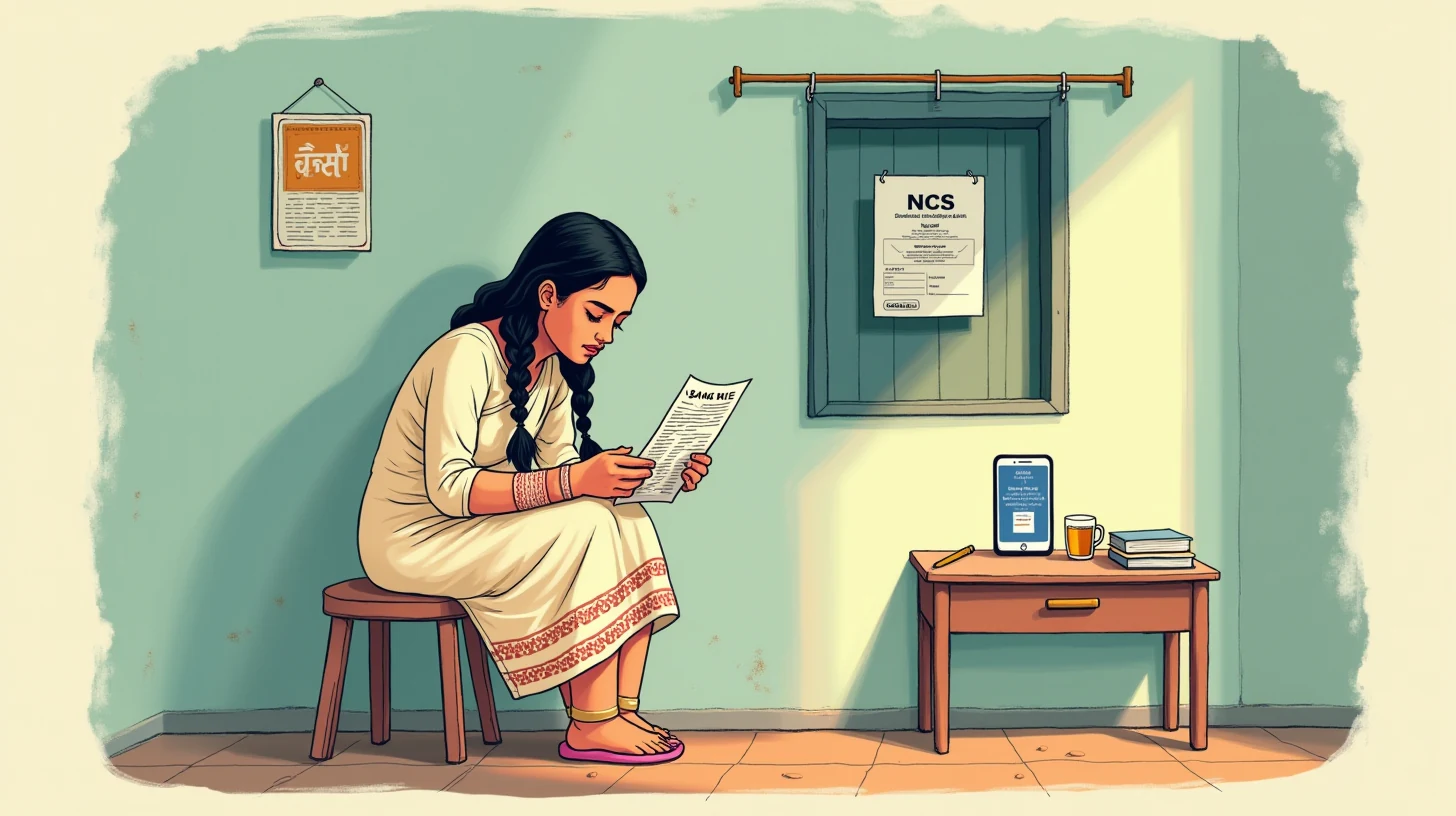
She'd opened the portal that morning with a specific goal: to register for the upcoming district Rozgar Mela, the job fair organised by Manipur Employment Exchange in Imphal next month. Three companies were scheduled—a pharmaceutical firm, a government office, and a private security agency. She also wanted to explore PMKVY, the Pradhan Mantri Kaushal Vikas Yojana, which offered free hospitality and healthcare training courses through approved skill centres in Imphal. Both required her NCS profile to be verified. Both were blocked now. She sat in the small room, her phone on the wooden table beside her notebook titled "Job tracker"—eight pages of handwritten applications, portal logins, rejection dates, coaching centre advertisements—and reread the error message. It was the same in English and Hindi. Meitei translation was nowhere.
Over the next week, she called the NCS helpline twice. The first time, the line cut after she explained the problem; the second, an agent told her to contact the Manipur Employment Exchange directly. She had a copy of her Aadhaar on her phone and a printed version from home, both showing the same village address. She also had her lease agreement, an electricity bill, and a letter from her landlord—all listing her room in Kwakeithel, Imphal. She didn't know which document would matter, or to whom. Her mother asked if she should pay someone to "fix it fast." Sangeeta had heard of consultants in Imphal who claimed to resolve Aadhaar-address mismatches for a fee. She had no money to spare. Her mother's cloth-stall income was irregular, and Sangeeta had been studying, then job hunting. She couldn't afford shortcuts—and she wasn't sure they were safe anyway.
The real question was simpler: How could a government portal lock her out based on an address her own Aadhaar registered but where she no longer lived?
- 🎓
June 2023 — BA Graduation
Sangeeta completed her BA in History from Manipur University. By then, she'd lived in Imphal (Kwakeithel) for 18 years. Her Aadhaar still carried her family''s ancestral Senapati address.
- 📨
April 2026 — NCS Profile Created
Sangeeta registered on the National Career Service portal, entered her education details and current Imphal address, and uploaded her mark sheet.
- 🔐
May 2026 — Aadhaar Verification Fails
NCS matched her Aadhaar against her profile. Aadhaar address: Senapati village. Profile address: Imphal. System rejected verification automatically. Profile locked.
- 🛑
May 2026 — PMKVY and Rozgar Mela Blocked
Sangeeta cannot register for PMKVY courses or sign up for the upcoming Imphal district Rozgar Mela. Both require verified NCS profile.
- 📞
May 2026 — Helpline Loop
NCS helpline suggests contacting Manipur Employment Exchange. Employment Exchange staff are unfamiliar with NCS portal procedures. No clear path forward.
- ⏳
Current — Rozgar Mela Deadline Approaching
Mela registration closes in 10 days. Sangeeta still cannot verify her profile.
🗓️ The NCS Cycle and Aadhaar Seeding
The National Career Service portal exists because the Ministry of Labour & Employment recognised that India's job-search process was fragmented. Employment exchanges operated state-by-state. Job notifications came through SMS, newspapers, notices pinned to exchange walls. A graduate in Imphal had to visit the employment exchange in person, wait in line, provide documents, and hope to hear about a vacancy that matched their qualification and district. NCS was meant to centralise all of this: one portal, one database, job notifications online, applications submitted without leaving home. The portal went live nationally around 2015; Manipur's state employment exchange joined the network in 2016. For the first time, a first-generation graduate in a small state could log on and see jobs across India, or at least across Manipur and neighbouring states.
But NCS had two hard dependencies: Aadhaar and address verification. The logic was reasonable in theory. Aadhaar was meant to be the single source of truth for identity. If someone registered for a job in Manipur, they should actually be in Manipur, not a fraudster using a stolen identity from another state. Address verification through Aadhaar would prevent duplicate registrations, job fraud, and false claims. The system worked fine for people whose Aadhaar address matched their present address, or for people who'd formally updated their Aadhaar address after moving. It collapsed for everyone else.
And there were many others. Internal migration within India was not uncommon. A family might have ancestral land or property registered at their village address in Aadhaar. When children grew up—some staying in the city for school, others working in another state—their Aadhaar address remained the same. Updating Aadhaar required an offline visit to an Aadhaar centre, a proof of address document (lease, utility bill, bank statement), and 2–4 weeks for processing. For young people in rented rooms—common in job-seeker cohorts—the process was harder. Many landlords were unwilling to sign lease agreements. Utility bills might be in a previous tenant's name. A bank statement required a bank account to have been opened at the current address, and banks themselves often required proof of address. The cycle locked in: Aadhaar address not updated → NCS portal blocks you → you can't register for government job schemes → you can't access PMKVY skill training → you can't apply for the Rozgar Mela.
This had become the invisible wall that first-generation graduates in state cities faced. No one talked about it because the problem was too specific and too humiliating: you had the education, the ambition, and the address to prove your eligibility, but a bureaucratic match-failure had rendered you invisible to the system.
"Aadhaar ba imaagi leikhabada, eigi reason-di verification fail hoina, eigi reason-di job search adinabasing"— Her Aadhaar still says the old place; because of that, verification failed; because of that, I can''t search for jobs.
⚠️ The Closing Window
The district Rozgar Mela in Imphal was scheduled for mid-June. Sangeeta had marked the dates on her wall calendar in red. Three companies meant three chances. The pharmaceutical firm was recruiting for store assistants and junior administrative roles—both a fit for her education level. The security agency was looking for female personnel, and she had read online that the job paid ₹12,000–₹15,000 a month, better than anything she'd applied for so far. The government office was hiring for a junior position, and government jobs in Manipur were stable, with pension and medical benefits. Her mother had said, "Go to the mela. Even if you don't get the job that day, at least they'll know your face." Sangeeta knew this logic. In Imphal, in her experience, knowing the right person mattered. A face remembered at a Rozgar Mela could lead to a call a month later.
But the mela required a verified NCS profile to register. When she'd checked the Manipur Employment Exchange portal three days ago, it had stated clearly: "NCS profile must be verified for Rozgar Mela entry." There was no exception clause for address mismatches. The system didn't allow for exceptions.
She also had a private goal, unspoken even to her mother. A skill training course in hospitality—offered through PMKVY at the Manipur Institute of Hotel Management, a five-week course, free—would add a credential to her CV. She'd heard that hotels in Imphal's emerging tourism sector were expanding. The course was practical, and it would show employers that she was actively upskilling, not just waiting. But PMKVY referral also required NCS verification. She couldn't do it. Every path led back to the same lock.
She had ten days until Rozgar Mela registration closed. After that, the next Rozgar Mela in Imphal was listed as August. Two months was too long to wait.
🌗 The Agent's Approach
Sangeeta's cousin, Nidhi—two years younger, still in college—was the one who first suggested using a phone-based research agent. Nidhi had used the same approach to find the correct online form for her college fee reimbursement the year before. "Ask it what you should do. It knows the government portals." Sangeeta was sceptical. She'd grown up in a household where government solutions had to be in-person, documented, and witnessed. An agent on the phone was abstract. But Nidhi lent her an old Android phone with the agent accessible via a simple SMS link, and Sangeeta tried.
She described the problem in detail: her Aadhaar address was from Senapati district, she'd lived in Imphal for 18 years, her lease and utility bill proved her current address, NCS verification had failed, and she needed to register for Rozgar Mela in ten days. She asked: "What can I do?" and sent the message.
The agent's first response was a map. It showed the Manipur Employment Exchange office in Imphal (on Khuyathang Road), and it listed two things Sangeeta could do immediately. The first was in-person: take her lease agreement and Aadhaar to the employment exchange office and request a manual address correction. The second was to email the NCS helpdesk ([email protected]) with her Aadhaar, her current address documents, and a request for manual profile verification.
The agent's second response was a timeline. It explained that manual corrections typically took 5–7 business days if done in person, or 7–10 days if done by email. Sangeeta had ten days. In-person was safer. The agent provided the office phone number (from the Manipur Employment Exchange website) and the hours of operation.
The agent's third response was a link to the NCS helpline page, which confirmed the toll-free number: 1514 (available Tuesday to Sunday, 8 AM to 8 PM). The agent explained that she should call the helpline first, before visiting the office, to ask specifically about address-correction procedures for Aadhaar-mismatch cases. Asking first would save her a wasted trip.
Sangeeta read through these responses on the small Android screen. None of it was magical. None of it changed the system. But it was clearer than what she'd gathered from two calls to a helpline and an employee at the employment exchange who'd seemed uncomfortable with the question. The agent had name it a specific process (manual correction), given her specific numbers (5–7 days), and suggested a specific first step (call the helpline).
"Aapni Manipur Employment Exchange office ge direct phone number call kare. 'Aadhaar address mismatch, NCS verification fail hoina' bole. Bolish ki in-person address correction possible ase ki nai. Agar hae, lease agreement le office ge poi manpower department ke dekhabi. Agar e-mail option ase, [email protected] ge detailed email pele, 7-10 din lagi saktey."
(Call the Manipur Employment Exchange office directly. Tell them your Aadhaar address doesn't match, and NCS verification has failed. Ask whether you can do an in-person address correction. If yes, take your lease agreement to their office and show it to the manpower department. If email is an option, a detailed email to [email protected] with your documents might resolve it in 7–10 days.)
She decided on the in-person route. The next morning, she called the employment exchange office at 10 AM. The officer who answered had heard of Aadhaar-address mismatches before. He said the office could issue a manual correction letter if she came in person with her Aadhaar and proof of current address. The letter would then be forwarded to NCS for profile update. It would take a day to prepare, and she'd need to return to collect it. Two days total. That left her eight days before Rozgar Mela registration closed.
🧭 Why This System Fails First-Generation Graduates
Sangeeta's case was not unique. Across India, hundreds of thousands of job seekers faced the same Aadhaar-address mismatch when they registered on NCS or state employment exchanges. The problem had become systemic enough that some state employment exchanges had created informal workarounds, but there was no national protocol. Each state had a different procedure. Some would issue a manual verification letter; others would refuse. Some would ask for additional documents; others would only accept in-person visits. The lack of standardisation was itself a barrier.
The deeper issue was that NCS had been designed with an implicit assumption: that most users would have their Aadhaar address updated to their present address. This assumption was reasonable for government employees or people in formal employment, who might have updated their Aadhaar as part of onboarding. It was false for first-generation job seekers, especially those in interstate migration, who often didn't know they could update Aadhaar or didn't have the documents to do so quickly.
There was also a secondary assumption built into the system: that users would be able to call a helpline during business hours, wait on the line, and get an answer. But helplines in India were often overloaded. The NCS helpline 1514 served all of India. Getting through was luck. When you did get through, the agent on the other end might not know the procedure for your state. Some state employment exchanges were more organised than others; Manipur's was mid-range. The system had no redundancy for people who fell through.
Sangeeta's education level—a BA in History from a state university—also meant she was over-qualified for some job-search channels and under-qualified for others. She couldn't compete on the SSC or UPSC exams without months of coaching she couldn't afford. She was eligible for state government jobs, but those came through state PSC exams or local recruitment drives, neither of which Manipur had conducted in the past year. She wasn't trained for private-sector IT or BPO roles, which required specific certifications. She was eligible for PMKVY training, which would certify her in a specific skill, but she couldn't access PMKVY without NCS verification. She was in a gap.
For Sangeeta's mother, the logic was simple: "Why should government make it hard for our daughter to search for work?" The answer was bureaucratic, not intentional cruelty. NCS had tried to automate address verification to prevent fraud and reduce paperwork. In doing so, it had automated away the flexibility that humans needed. The system couldn't say, "Your Aadhaar is old; we'll accept your lease agreement." It could only say, "Mismatch. Blocked." The law-and-order logic that had built NCS didn't account for the reality of internal migration.
Interstate Migrants
Estimated 1–2M annually in IndiaMoved to another state for education or work; Aadhaar registered at home state. NCS portal locks them out unless they update Aadhaar first, which requires in-person visit to home state and 2–4 weeks.
Rented-Room Dwellers
Common in cities; 40–60% of young job seekersLive in informal rental housing without lease agreements or with bills in previous tenant''s names. Cannot prove current address to Aadhaar authorities, so cannot update Aadhaar, so cannot verify NCS profile.
Rural-to-Urban Graduates
10–15% of state-university cohortsMigrated from village to city for college or first job. Aadhaar shows village address; job search is in the city. Employment exchanges sometimes accept manual corrections; sometimes they don''t. No national standard.
🌱 The Quiet Necessity
Two days after calling the employment exchange, Sangeeta returned with her original Aadhaar, her lease agreement, and a printed copy of her NCS profile showing the failed verification. The office issued a manual address-correction letter. Four days later, NCS confirmed her profile was updated. Her address now showed as Imphal, Kwakeithel. The verification flag was cleared.
She registered for the Rozgar Mela the same day. She also applied for the PMKVY hospitality course, which would start in late June. Neither registration guaranteed a job or a certificate, but both were now possible.
What struck her, in the quietness of the week that followed, was not the relief but the fragility of what had just happened. She'd gotten through because she'd made a phone call, because the employment exchange office had been cooperative, because the agent had given her a specific next step instead of telling her the system was broken. But the system itself remained broken. The next graduate with the same problem would not automatically know to call in-person first, or what documents mattered, or that there was a workaround at all. They might assume the NCS lock was permanent. They might pay a consultant a sum they couldn't afford. They might give up on PMKVY and Rozgar Mela altogether and try SSC or state PSC exams instead, which were even harder, even longer.
The truth that Sangeeta had learned was simple and grim: government portals were often designed as if everyone's bureaucratic life was straightforward, as if addresses never changed, as if you always had the right document, as if you lived in a place where the rules were simple. For everyone else—and there were millions of them—the portal became a barrier that felt personal even though it was systemic. It felt like a mistake you'd made, when it was a mistake the system had made about you.
She would start the PMKVY course in four weeks. She would attend the Rozgar Mela. Neither would solve her job search, but both were now open. And she'd learned something quieter: that sometimes, the only way through a locked door was to find a person, ask them how to open it, and believe that the answer was possible before the system told you it wasn't.