
Kohima Graduate and the Nagaland NPSC Domicile Conflict — When Tribal Council Authority Meets Government Forms
Kevichusa Rhakho sat in his rented room in Naga Colony, Kohima, a Samsung Galaxy A12 propped against a chai cup on his wooden desk, the screen glowing with the NPSC portal login page. He was twenty-five, a BA graduate from Nagaland University's Lumami campus in Political Science, the first in his family to finish a four-year degree. His father, now retired, had spent thirty-two years in the Nagaland Police as a constable—a steady paycheck, a pension, a lifelong identity. Kevichusa had imagined a similar arc: take the Nagaland Public Service Commission Civil Services exam, secure a government job, anchor his family's middle-class foothold in Kohima's crowded hills.
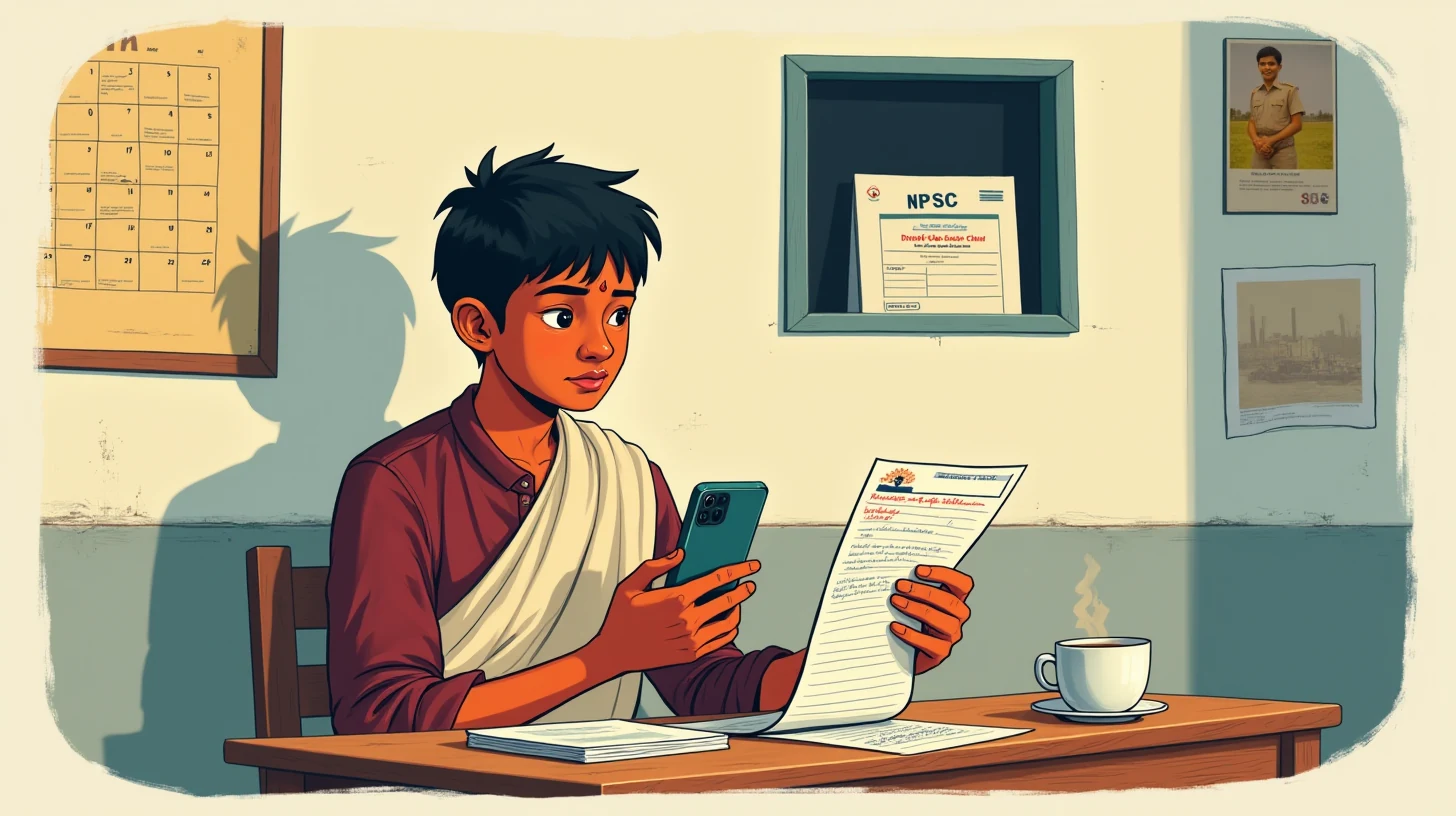
For eight months, between private tuition shifts (he coached high-school students in English and history for ₹500 per hour, earning ₹12,000 some months), Kevichusa had accumulated exam prep materials—photocopied study guides passed hand-to-hand among coaching-institute friends, a dog-eared copy of the NPSC syllabus downloaded from a cybercafe, WhatsApp groups where candidates shared notes. On a Tuesday in late April, the NPSC notification for the Common Educational Services Examination (CESE) 2026 appeared in his inbox: applications open May 12, deadline May 30. One hundred and seventy-eight vacancies. PGT (Post-Graduate Teachers), Lecturers, and Administrative Officers. He was eligible. He began the application form that same afternoon.
Everything moved smoothly until Section 4: "Domicile and Nativity Certificate." The form demanded a certificate issued by the "Deputy Commissioner of the applicant''s district" or, in alternate cases, "Sub-Divisional Officer, with original stamps and signatures." Kevichusa had one domicile certificate. It was issued by the Village Council Chief (also called the Village Headman) of his ancestral village, authenticated in Kohima district''s traditional system—the Angami Naga tribal authority. His mother kept it in a cloth folder. The Chief had signed it himself, affixed a traditional seal, and it had served for previous government applications. But when Kevichusa uploaded the image to the NPSC portal, the form would not accept it. No error message appeared. The portal simply refused to move forward, a silent wall between him and the rest of the application.
A single sentence in that refusal—the silence itself—would shape the next three weeks.
🗓️ The Annual Exam Cycle and the Domicile Bottleneck
Nagaland''s Public Service Commission sits within an intricate federal framework. The state, nestled in India''s Northeast, has a unique constitutional position: it retains tribal customary law alongside Indian civil law. Villages are governed by hereditary councils (Angami council, Lotha council, etc.), and traditional authorities issue identity and nativity certificates for personal records, land claims, and marriage registration. The government recognizes these documents in many administrative contexts. But the NPSC, when it wrote its eligibility rules, drew from a national template: domicile certificates must originate from government officials, not traditional authorities.
The CESE exam cycle follows a rigid annual rhythm. Notification in mid-May. Application window: eighteen days. Results published in September or October. Interviews in November. Appointment letters in January or February. For a candidate, the eighteen-day application window is the chokepoint. Miss it by a single hour—the portal closes at noon on the deadline—and you wait another year. Kevichusa, like thousands of Nagaland''s job-seeking graduates, had locked his calendar around that deadline. He had borrowed ₹325 from his younger sister for the application fee (₹300 examination fee plus ₹25 convenience charge). He had taken a leave from his tuition schedule on the morning he planned to submit.
The domicile certificate issue was not unique to Kevichusa. Across Nagaland''s districts—Kohima, Dimapur, Mokokchung, Phek, Tuensang—graduates from Angami, Lotha, Nagamese, and other tribal communities carried domicile documents issued by village councils. Many had used these same certificates for passport applications, driver''s licenses, and university enrollments. The government rarely objected. But the NPSC portal was an automated gatekeeping system. It did not have a "submit alternate documentation" option. It did not have a phone line. It did not have an email address for clarifications. It had a form, a set of rules, and a submit button.
⚠️ The Portal''s Silence and the Deadline Closing In
By May 19, Kevichusa had made four attempts to contact the NPSC. On May 13, the day after applications opened, he visited the NPSC office in Kohima in person. A clerk told him to check the website FAQ. The FAQ listed document requirements but did not address tribal council certificates. On May 15, he sent an email to the NPSC help address listed on the website. No response by May 18. On May 17, he called the Nagaland government''s main help line—a number from the DPAR (Department of Personnel & Administrative Reforms) website. The operator transferred him to an extension, which rang without answer. He called back twice. On the third call, someone picked up and asked him to "submit your documents as required and come back if there''s a problem."
Kevichusa considered applying for a new domicile certificate from the Deputy Commissioner''s office in Kohima district. But the DC''s office typically required a month to process new applications, and the NPSC deadline was eleven days away. He also suspected—correctly—that the DC would ask for proof of residence and would likely refer him back to the village council anyway. His father offered to use his police-era contacts to "push the certificate through." Kevichusa refused. He did not want to owe favours. By May 19, late evening, Kevichusa sat in his room with the phone and the unsigned application form, the chai gone cold, the deadline now visible on his calendar like a closing door.
- 📨
May 13: NPSC applications open
Kevichusa begins filling the form. Reaches Section 4 (Domicile). Portal rejects village council certificate silently.
- 📞
May 15–17: Four contact attempts
In-person visit to NPSC office (no resolution). Email to help address (no response). Phone calls to DPAR help line (transferred, no answer). No guidance on what ''other'' proof of domicile might be accepted.
- ⏰
May 19: Deadline clock at 11 days remaining
Kevichusa weighs applying for new DC certificate (4-week process), deferring to next year''s cycle, or attempting to submit with alternate proof. All options risk rejection.
- 🌗
May 20: A younger classmate suggests the agent
A WhatsApp message from a coaching friend mentions an AI agent that helps job seekers navigate portal rules. Kevichusa downloads the required app and navigates to his problem.
🌗 A Classmate''s Message and the Agent Arrives
Kevichusa''s younger cousin, Visii, was two years behind him in college. She had followed him into the coaching circuit and was preparing for the same CESE exam, though she wouldn''t be eligible for another year. On May 20, at around 11 p.m., Visii sent him a WhatsApp message: "Kevi, I found something on NCS. They have like a helpbot or something. Someone in my coaching group used it for EPFO problems. Try it for your NPSC thing." The link she sent pointed to the National Career Service portal''s integration with an agent service.
By midnight, Kevichusa had installed the required application and logged in using his Aadhaar number. The agent responded to his first query—"NPSC domicile certificate village council rejected by portal"—with a series of follow-up questions: What is the document issued by? What authority signed it? Have you contacted NPSC? Do you have any government-issued identity proof (driver''s license, Aadhaar, passport)? Kevichusa answered in Hindi and English, typing carefully on the phone''s small keyboard. The agent, working in real time, then did something the NPSC website had not: it asked him to describe the exact wording of the rejection message (or lack thereof), the fields on the certificate, and whether any other candidates from his village had faced the same issue.
By 2 a.m., the agent had identified the core problem: Nagaland''s tribal certificate system was not recognized by the NPSC''s automated form parser, but the NPSC''s eligibility rules, when read carefully, permitted "nativity certificates issued by competent tribal or customary authorities" in states where such authorities held constitutional recognition. The complication was that the NPSC portal''s form did not have a separate upload field for such alternate proofs. The agent suggested three pathways:
- Contact the NPSC directly before the deadline, request a manual review, and submit the original certificate under registered post.
- Obtain a supplementary affidavit from the District Commissioner certifying that the village council certificate met Nagaland''s constitutional requirements, and attach it to the application with a letter.
- Reach out to an NPSC commissioner directly via the contact details listed in the DPAR office directory (a public document the agent pulled from the Nagaland government website).
The agent also warned: "The portal may still reject the application at submission if the certificate is not uploaded in the expected format. If this happens, the commission is likely to have a manual review process for appeals after the deadline, but this is not guaranteed and you would be waiting until June or July."
"Aapka certificate sahi hai, par NPSC ke portal mein toh department se issued certificate expect karta hai. Aap Deputy Commissioner ko contact kijiye, aur bataaiye ki tribal authority certificate acceptable hai Nagaland mein. Unhe keh sakta hain na ek letter de do jo approve kare?"
(Your certificate is correct, but the NPSC portal expects one issued by the government department. Contact the Deputy Commissioner, and explain that tribal authority certificates are acceptable in Nagaland. You can ask them to give you a letter that approves it.)
Kevichusa read the message twice, then called his father. It was 4 a.m. His father, a light sleeper, was awake. They discussed the options. The safest route, they agreed, was to get the Deputy Commissioner''s office involved—not to issue a new certificate, but to authenticate the existing one. By 6 a.m., Kevichusa had drafted a formal letter (using a template from an online document library) requesting the DC to issue a "certificate of acceptance" confirming that the village council domicile certificate met Nagaland''s constitutional and NPSC eligibility requirements.
🧭 Why the System Fails First-Generation Graduates and What It Costs
The NPSC domicile-certificate issue is a microcosm of a larger bureaucratic friction that ensnares first-generation job seekers across India''s Northeast. Government exams are designed around national templates—forms, rules, portals—that assume a certain baseline: that applicants come from states where tribal customary law is not constitutionally embedded, or where it is treated as separate from government administration. In Nagaland, Mizoram, Meghalaya, and parts of Arunachal Pradesh, this assumption is wrong. Tribal councils are not informal or extra-legal; they are recognized authorities under state and central constitutional law. Yet the automated gateways—SSC portals, state PSC portals, even national schemes—do not always account for this reality.
For Kevichusa, the cost of this friction was not just bureaucratic delay. It was psychological. For two weeks, he existed in a state of applied uncertainty. He did not know whether the NPSC was rejecting him because his certificate was fundamentally ineligible (in which case pursuing the application was futile) or because the portal was technically incapable of recognizing valid alternate documents (in which case there was a workaround). No one at the NPSC could clarify. The agent''s intervention—providing him with three concrete pathways and, crucially, the constitutional and administrative reasoning behind them—shifted him from paralysis to agency. He was no longer guessing; he was navigating.
But Kevichusa was also aware that he had an advantage many of his peers did not: a younger cousin in a coaching group, a WhatsApp network, and access to a smartphone with data. Candidates from remote villages, or those without tutoring connections, might not find the agent. They might submit a rejected application, see it bounce back on May 31, and then assume they were ineligible—when in fact the problem was technical, fixable, and solvable by a single letter from the Deputy Commissioner.
The broader consequence is a selection bias: government exams in India''s Northeast inadvertently screen for applicants with social capital (family contacts, coaching networks, prior government experience) rather than for merit alone. Kevichusa''s father''s police background gave him an intuitive understanding of how to escalate a problem within bureaucracy. For a graduate whose parents had no government experience, that intuition would not exist.
What it does
- 🔍Verified that tribal council certificates are constitutionally recognized in Nagaland and cross-referenced this with NPSC eligibility language.
- 📋Identified three alternate pathways (DC letter, supplementary affidavit, direct commissioner contact) and explained the tradeoffs of each.
- 📞Provided specific contact details from public government directories so Kevichusa could escalate independently.
- 🗂️Helped Kevichusa draft a formal letter using public templates, ensuring it met government letter conventions.
What it does not do
- 🔒Never entered his NPSC account or attempted to submit the application on his behalf.
- ✅Never promised a specific outcome — only that these pathways existed and came with known risks.
- 💳Never suggested paying extra fees or contacting unofficial ''certificate agents.'' (Such services exist in India''s bureaucratic underground and almost always signal fraud.)
- 🛑Never decided for Kevichusa which option to pursue. The choice remained his.
By May 24, Kevichusa had printed and signed his letter, paid ₹100 to a courier service, and sent it registered post to the Deputy Commissioner''s office with a request for a same-day or next-day reply. He also visited the office in person to confirm receipt. The DC''s administrative assistant, when shown the letter and the village council certificate, said she would "flag it for the officer." On May 26, two days before the deadline, Kevichusa received a call. The DC''s office had issued a one-page letter on official letterhead: "This is to certify that the domicile certificate issued by the Village Council of [village name] is recognized by the Government of Nagaland as proof of nativity and domicile, and meets the eligibility requirements set forth by the Nagaland Public Service Commission." It was signed and stamped.
With the supplementary letter in hand, Kevichusa logged into the NPSC portal on May 27 at 10 a.m. He uploaded the village council certificate in the designated field. The portal accepted it. He then uploaded the Deputy Commissioner''s letter as "supporting documentation." He filled in the remaining sections—examination centre preference (Kohima), general category, English as the medium of examination—and submitted the form at 10:43 a.m. The portal generated a confirmation page: Application received and under review. Reference ID: NPS-2026-74821.
Kevichusa took a screenshot. He sent it to Visii in a WhatsApp message. He called his father. By noon, he had called the tuition center and confirmed his schedule for the next week. By evening, he was back in his room at his desk, marking English essays from his coaching students, the NPSC exam cycle no longer a blocker but now, for him, a completed step.
🌱 The Quiet Aftermath: Knowledge Spreads, System Remains
Three weeks after submitting his application, Kevichusa was sitting in a chai shop in Kohima with Visii and two other coaching-group friends, all preparing for the same CESE exam. He told them what had happened. One of them—a candidate from a neighbouring village with the same domicile-certificate issue—immediately went to the Deputy Commissioner''s office and got a similar letter. Another, a candidate from Dimapur whose father worked in a bank, realized that he could ask his father''s government contacts for guidance. Word spread in the coaching institute. By mid-June, at least six other applicants had obtained supplementary letters from their respective district commissioners. None of them had known this option existed. All of them thanked Kevichusa.
But the system itself did not change. The NPSC portal still did not have a separate upload field for tribal authority documents. The NPSC FAQ still did not mention this pathway. No official communication from the NPSC acknowledged that the portal''s design excluded a valid category of applicants. The next batch of candidates, in the 2027 exam cycle, would encounter the same wall. Some would find agents or coaching networks or government contacts. Many would not. They would assume they were ineligible. They would defer. They would take private-sector jobs, or they would sit for multiple years, cycling through exam prep, accumulating exam fees, waiting for a system that was not built for their context.
Kevichusa, in the weeks before the exam, did not feel victorious. He felt aware. He had the same four months of study time as everyone else. He had the same examination date. But he had also crossed a threshold that many of his peers had not: the realization that government bureaucracies in India''s Northeast are not monoliths. They are layered systems, with constitutional recognitions and official channels that sit beneath the surface of the portal. You cannot see them from the form. You have to be told. And once you know they exist, you can move through them.
"Domicile certificate maan raha tha, par portal ne reject kar diya. Maine socha ki exam ke liye eligible hi nahi hoon. Par actually, system alag tha, rule nahi."— The certificate was valid, but the portal rejected it. I thought I wasn''t eligible for the exam at all. But actually, it was the system that was different, not the rule.
In the months between submission and results, Kevichusa continued his tuition shifts, added a small home-based test-preparation group (which earned him ₹8,000 a month with four students), and studied for the CESE exam. His friends from coaching did the same. By September, when the NPSC published its results, Kevichusa was among the three hundred and forty candidates who qualified for the interview round—a selection ratio of roughly 2:1. He had passed the written exam.
For now, that was enough. The system had let him in, once he understood how to move through it. Whether he would be appointed depended on the interview, the final ranking, and the flow of vacancies in the coming weeks. But the domicile question—the one that had nearly stopped him—was resolved. And the knowledge of how to resolve it, once shared among the coaching group, had become a quiet form of currency: a piece of information that helped others move forward, one person at a time, through a bureaucracy that had been designed without them in mind.