
Ludhiana Graduate and the PSSSB Name–Aadhaar Mismatch
Gurpreet Kaur lived in a rented ground-floor flat in Dugri, a densely packed neighborhood of Ludhiana where the sound of industrial looms hummed through the day and into the night. She was twenty-four, with a BA in Punjabi from a college affiliated with Punjabi University—the kind of degree that felt solid in hand but diffuse in the job market. Her father worked in one of Ludhiana's many hosiery factories, a shift worker who came home with lint in his hair and the smell of machine oil on his hands. Her mother looked after the flat and did piecework stitching when orders came. The household income was steady but tight. Gurpreet's degree was the first in her immediate family. She was expected to find a government job.
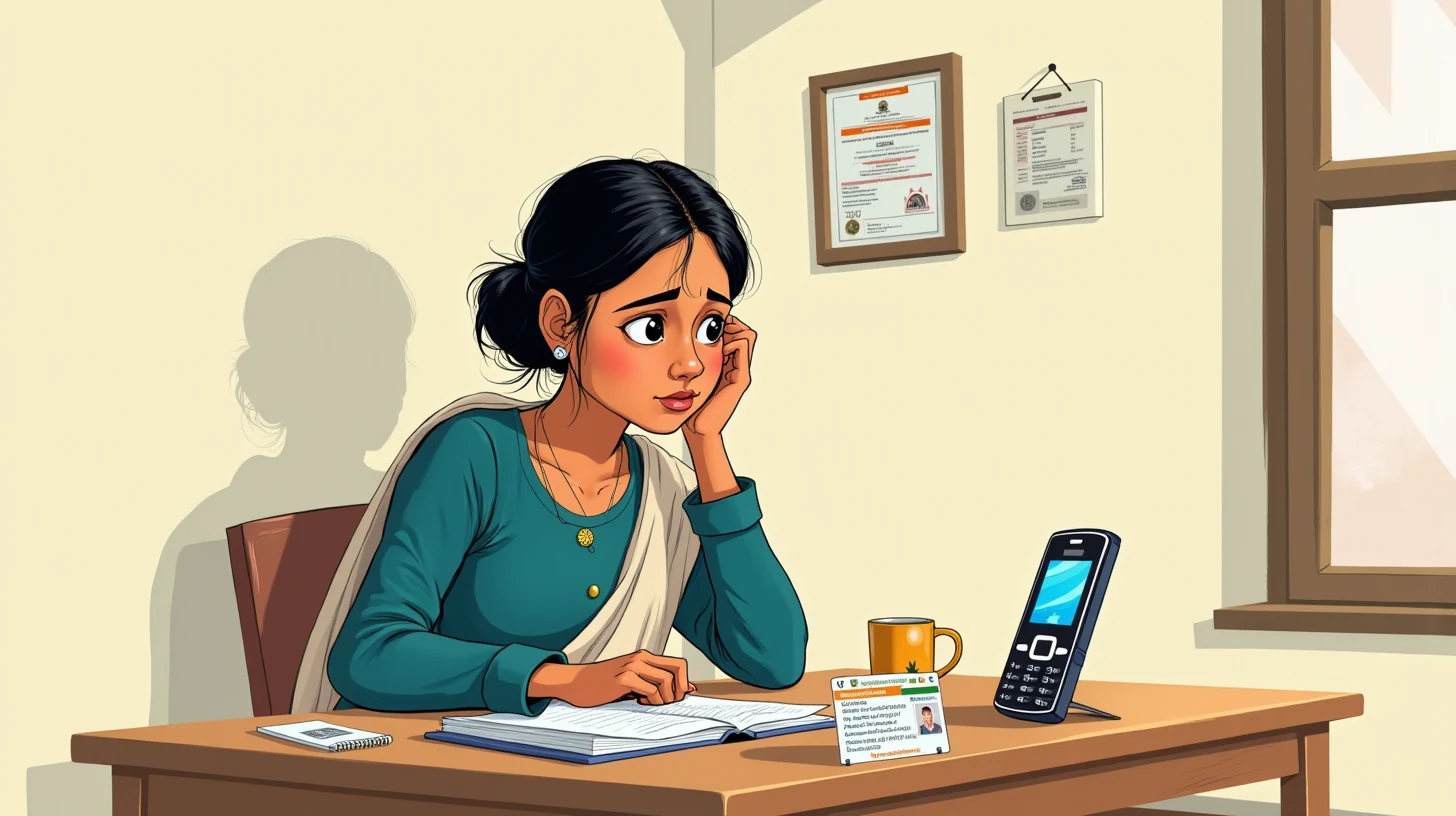
For six months, she had been tracking recruitment announcements with the intensity of a hunter. Every notification from the Punjab Subordinate Services Selection Board—the SSSB, or Bharti Board as locals called it—went into a small green notebook where she tracked deadlines, exam dates, and the salary brackets of clerk, constable, and junior engineer posts. The clerk position paid ₹18,000 per month, with pension and benefits. For her family, it was the threshold between precarity and stability. She had cleared the preliminary exam in February. Now came document verification—the moment when all her papers had to align perfectly.
The rejection SMS arrived on a Tuesday afternoon, while she was home. Application rejected at document verification stage. Name mismatch between SSSB application and Aadhaar card. Please contact helpline. She read it three times. Her name on the SSSB application was "Gurpreet Kaur." Her name on her Aadhaar—the digital ID that now governed everything in India—was "Gurpreet K." Four characters shorter. Four characters that would cost her the job.
Gurpreet had gotten her Aadhaar in 2016 when she was eighteen. Her father had taken her to the enrollment center at the municipal office, and she'd gone through the biometric scan—fingerprints and iris—and answered questions about her name and address. The enrollment assistant had entered her name as "Gurpreet K." The Kaur had been abbreviated, whether by haste or by his assumption that "K." was sufficient. At eighteen, she didn't question it. Aadhaar was still new, still a novelty. She used it occasionally for bank account openings and travel documents. By 2024, when government job applications linked directly to Aadhaar verification APIs, the abbreviation had hardened into official record.
🗓️ The Exam Cycle and the Verification Wall
The PSSSB Clerk examination ran on a yearly cycle, advertised in November, applications open from January to February, preliminary exam in April, document verification in May. Gurpreet had marked each date in her notebook, had taken leave from the private tuition she did (teaching Punjabi and English to middle schoolers for ₹100 per hour) to prepare. The preliminary exam—two hours, 100 multiple-choice questions on reasoning, aptitude, and general knowledge—she had passed. Hundreds did. The document verification step, though, was a narrows. The SSSB's verification system cross-referenced applicants' names against multiple databases: Aadhaar, PAN, election voter ID, educational certificates. A mismatch in any field could trigger automatic rejection.
The Aadhaar-name discrepancy was, technically, a mismatch that machines could not overlook. The SSSB portal's verification algorithm was blunt: exact string match or rejection. There was no tolerance for abbreviations, no human operator to sign off on "Gurpreet K. = Gurpreet Kaur." The system saw them as different people. Automatic rejection, within forty-eight hours of submission. Gurpreet was not alone. Across Punjab, hundreds of applicants faced similar barriers: names shortened at enrollment, surnames transliterated inconsistently, addresses that had shifted between Aadhaar and the education board records. The bureaucracy had fragmented, and the job seeker bore the cost.
Gurpreet had assumed, until the SMS arrived, that clarity would be assumed. She was the same person. She knew her own name. But the state does not assume. The state verifies. And the state's verification was now a digital apparatus that had no ears, no judgment, no flexibility. It had only rules and databases. She had failed the rule.
⚠️ The Deadline Closes
The rejection came on the twenty-second of May. The deadline to appeal the rejection—to submit a written application to the SSSB's document verification cell—was the twenty-eighth. Six days. Gurpreet had to prove, in writing, that she was a single person with two names in two systems. The appeal required a letter stating the discrepancy, copies of her Aadhaar and her application, her BA marksheet, and a notarized affidavit.
An affidavit required a notary, and a notary in Ludhiana charged ₹500 to ₹1,200 depending on the document's complexity. She had ₹3,000 in her savings account. Her tuition income was sporadic. She asked her father for ₹600 for the notary. He gave it to her without asking why. She didn't tell him the application had been rejected. He was already waiting for the news that she had cleared document verification, already imagining the stable income.
She photocopied her Aadhaar and application at a shop near the market (₹20). She printed a letter she drafted in the cybercafe where a friend's brother worked, explaining her situation in Hindi formal style: "The undersigned is the same person as named in SSSB application [Application No.], and the abbreviation in Aadhaar document is a clerical error made during enrollment." The letter was two paragraphs, careful and dull. She had the notary stamp it. Then she bought an envelope and a stamp (₹25) and walked to the post office to send the appeal via registered post. The post officer weighed it, filled in the tracking slip, promised delivery within four days.
Then she waited. The tracking slip showed delivery on the twenty-sixth. The SSSB website gave no confirmation of receipt. The helpline number listed on the portal went to a voicemail that never returned calls. Days passed. No SMS. No email. The silence was its own kind of rejection.
- 📋
February 15 — Application deadline
Gurpreet submits online application for PSSSB Clerk post with name 'Gurpreet Kaur' and all supporting documents.
- ✅
April 10 — Preliminary exam passed
Gurpreet clears the preliminary exam with a score of 68 out of 100. She enters the document verification stage.
- 🛑
May 22 — Automatic rejection via SMS
SSSB portal flags name mismatch: 'Gurpreet Kaur' (application) vs. 'Gurpreet K.' (Aadhaar). System rejects without human review.
- 📨
May 26 — Appeal reaches SSSB office
Registered post with notarized affidavit, photocopies, and appeal letter arrives at SSSB. No confirmation system exists for appeals.
🌗 The Pivot: A Younger Cousin and the Aadhaar Portal
Gurpreet's younger cousin Simran worked in a call center in Chandigarh, handling customer service for a telecom company. She visited Ludhiana on weekends. When Gurpreet mentioned the situation—not the full situation, just that she was stuck with some document issue—Simran asked questions the way customer service agents do: What system? Which portal? What was the exact error message? Within ten minutes, Simran had pulled up the myAadhaar portal on her phone and was walking Gurpreet through what she saw.
"You can correct it," Simran said, swiping through the portal. "You go here—myaadhaar.uidai.gov.in—and you can update your name. Not even just Aadhaar. They have a whole correction section. Look, you need your Aadhaar number, your phone number linked to Aadhaar, and your identity document." Simran was reading the portal instructions aloud, translating them into plain speech. The UIDAI (Unique Identification Authority of India) offered free name corrections if the error was acknowledged to be a data-entry mistake at enrollment. The correction took five to seven working days once submitted.
"But won't that take too long?" Gurpreet asked. "The appeal to SSSB is already there."
"Maybe," Simran said. "But here's the thing—if you correct Aadhaar, then any new search the SSSB does will find 'Gurpreet Kaur,' not 'Gurpreet K.' The system will match. And you can send another email to SSSB saying the Aadhaar is being corrected, that you've submitted the request, show them the reference number."
The logic made sense. Gurpreet took the phone and opened the myAadhaar portal on her own. The instructions were in Hindi and English. To update her name, she had to verify her identity via OTP sent to her registered mobile number. She entered her Aadhaar number—which she knew by memory after years of forms—and the portal sent an OTP. She entered it. A screen appeared asking her what information she wanted to update. Name correction. She chose it. A new form appeared: original name in Aadhaar, corrected name, the ID document she was using to prove her identity (BA certificate would work, as would a voter ID), and a brief reason for the correction: "Data entry error at enrollment."
She filled in the form. It took five minutes. She uploaded a photo of her BA degree certificate—which had her full name printed clearly—and a photo of her Aadhaar. Then the portal generated a reference number: AADHAAR-CORR-2026-05-27-8847. Submitted.
The UIDAI portal showed a status page: Request received. Processing time: 5–7 working days. Gurpreet screenshotted it. She sent an email to the SSSB grievance address ([email protected], which she found buried in the SSSB portal's FAQ) attaching the screenshot and a brief explanation: "My Aadhaar name is being corrected from 'Gurpreet K.' to 'Gurpreet Kaur' per UIDAI reference [number]. Once corrected, the mismatch will be resolved."
She didn't know if it would matter. But she had done something. The feeling of doing something, even something this small, was its own kind of relief.
🧭 Why the System Fails First-Generation Graduates
Gurpreet's problem was not unique to her. Across India, hundreds of thousands of first-generation graduates faced similar friction between official record systems that had grown up in silos and were only now being forced to integrate. Each government database had been built at a different time, to different standards, with different tolerance for error correction. The Election Commission's voter ID used full names; Aadhaar had more space constraints and defaults to abbreviation; educational boards sometimes used formal transliterations, sometimes local spellings. Banks had their own systems. The railways had theirs. And now, when government recruitment portals began enforcing exact-match verification across all these databases, the accumulated errors surfaced as automatic rejections.
The system assumed accuracy upstream. It assumed that the first time a citizen's name was entered into any government database, it was entered correctly, fully, and consistently. But citizens do not create these records voluntarily. A nineteen-year-old showing up for Aadhaar enrollment cannot be expected to police the data-entry operator's abbreviations. A recent graduate submitting an education board form does not know which transliteration will later be matched against other systems. The citizen does not know the system; the system simply expects the citizen to have been known correctly from the start.
For first-generation graduates, the consequence was exclusion from the very mechanism designed to help them: government employment. The job board, the exam, the credential check—all of it funneled through these databases. A single clerical error, made by someone else, at a moment when the graduate was not present to verify, could lock them out. And the correction pathway, while it existed on paper—Aadhaar has a correction process; SSSB has an appeal process—was slow, opaque, and required the graduate to navigate multiple portals, email addresses, and reference numbers.
Consider who could navigate this easily: someone whose parents worked in an office setting, who had an older sibling or cousin in a call center, who had access to smartphones and reliable internet, who had the time and money to send registered post and pay notaries. Gurpreet had these things, barely. Many did not. A graduate without a smartphone, without a cousin in a call center, without ₹600 for a notary, would simply get the SMS, not understand it, and lose the opportunity. The system was designed as if clarity and access were free. They were not.
What it does
- 🔍Verify exact URLs of government portals (SSSB, UIDAI, NCS) and confirm they are official .gov.in sites.
- 🗂️Help locate the correct government portal for corrections and explain the process step-by-step.
- 📋Identify which documents (Aadhaar, BA certificate, voter ID, PAN) qualify for identity verification in corrections.
- 📞Summarize official helpline numbers and email addresses from government portals for follow-up.
What it does not do
- 🔒Never enters OTP, never submits a form on the jobseeker's behalf, never decides the outcome.
- ✅Never promises a specific timeline or outcome. Correction processes are opaque; the agent can only point to official timelines.
"Ghar pa meri mataji ne keha, 'Naam vich jo likya sa, ohi sach hunda ae. Dukh ta baad vich hunda ae."— My mother said at home, 'Whatever is written in your name, that is true. The suffering comes later.'
🌱 The Wait and the Cost of Invisibility
By the end of May, Gurpreet was in a state of suspended uncertainty. The UIDAI correction request was processing. The SSSB appeal was somewhere in an email inbox or a filing cabinet. Her preliminary exam score was on record, but her clearance was not. Every morning, she checked her email. Every afternoon, she asked her father how long he thought it would take. He had no idea. No one in her family had navigated government systems from the job seeker's side. They paid taxes (via factory deductions), they received government benefits (her mother's subsidized rice ration). But they had never had to appeal a bureaucratic decision.
What became clear to her, in those days of waiting, was that the system assumed you already knew it. It assumed you had a cousin in a call center, or a friend whose brother worked in IT, or a WhatsApp group where people shared tips. It assumed you would be patient, and would check portals repeatedly, and would translate help text from Hindi formal style into action. The system was free—the SSSB application was free, the Aadhaar correction was free, the appeal was free. But the labour of navigating the system, of understanding what each acronym meant, of finding the right email address or helpline—that labour was not zero. That labour fell on the job seeker alone.
For Gurpreet, the bigger cost was temporal. Every day the appeal remained unresolved was a day she was not in another job's pipeline. There were other SSSB positions coming in the autumn. There was the NCS portal (ncs.gov.in), the National Career Service, which listed clerk positions from other states, though applying across state lines was its own bureaucratic maze. There was the SSC (Staff Selection Commission) for federal government jobs. But she was thirty days into this single attempt. Thirty days that had not moved her closer to a salary, closer to the stable income, closer to the moment when she could rent a larger flat for her parents and buy her mother a washing machine.
The quiet cost of bureaucratic friction is that it taxes your future. Every moment spent navigating an error you did not make is a moment not spent on preparation, not spent on earning, not spent on the other things that make a life. Gurpreet had found something useful in Simran's intervention—a clear next step, a portal to use, a reference number to track. But she also understood, by late May, that the system was not designed for quick resolution. It was designed for those who could afford to wait.
"Pehle Aadhaar fix karo, phir SSSB nu email bhej, phir wait karo. System ta ehnoon intermediate score raakha ae—you passed exam, but documents locked. Sometimes it takes one month. Sometimes six weeks, depending on how busy verification cell is. Best thing: write to grievance email every two weeks, include your reference numbers, keep a copy of everything."
(Fix the Aadhaar first, then email SSSB, then wait. The system keeps you in an intermediate state—the exam is passed, but documents are locked. Sometimes it takes a month. Sometimes six weeks, depending on how busy the verification cell is. The best approach: write to the grievance email every two weeks, include all your reference numbers, and keep copies of everything.)
Gurpreet's story is one of competence meeting an incompletely knit system. She had the degree, the exam score, the family support. She had done everything right. But the state's bureaucracy, while it offered pathways for correction, did not offer clarity, speed, or visible progress. She existed in a gap between systems: her name was simultaneously "Gurpreet Kaur" and "Gurpreet K." and "Gurpreet" and she had to resolve this contradiction not by asking for help, but by finding the portals, the reference numbers, the email addresses, on her own. The system worked, eventually. But it worked in a way that required luck, patience, and a cousin in a call center. Not everyone had that.