
Srinagar Graduate and the JKSSB Domicile 2019 Rules
Sameer Dar arrived at the JKSSB office in Srinagar on 9 May carrying a file folder soft from repeated handling. His BA in Political Science from Kashmir University's Hazratbal campus was two years old, and he had studied for the Sub-Inspector exam for eighteen months—waking at five, coaching centre by six, civil service preparation books stacked beside the window of his rented room in Lal Bazar. His family, merchants for three generations, had sent him to university expecting he would move beyond the family trade. A government job was the path. Sub-Inspector carried both respect and stability.
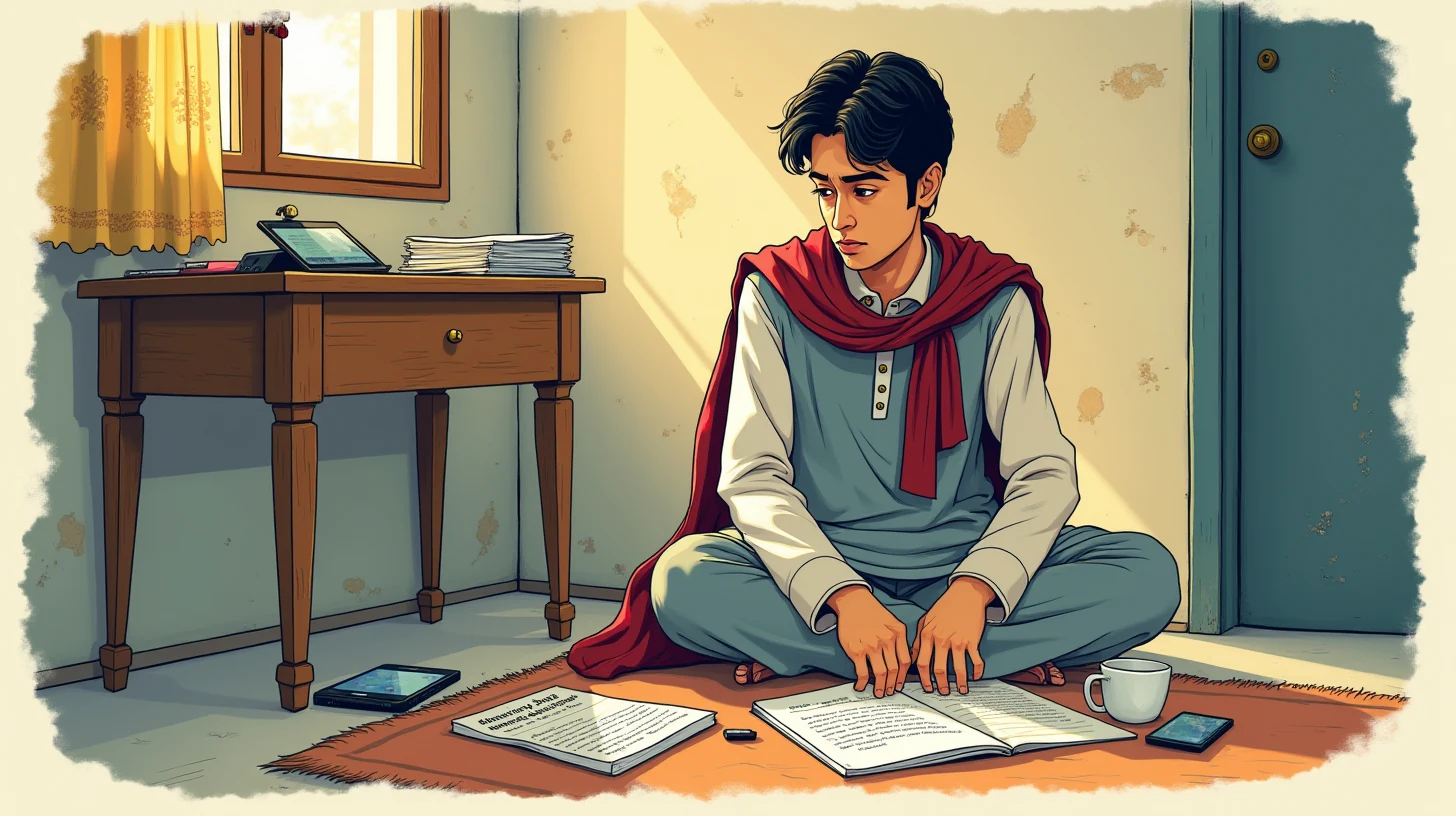
He submitted his application at the counter—birth certificate, BA mark sheet, Aadhaar card, and the document he had held since 2018: his State Subject certificate, issued by the J&K administration under the pre-October 2019 rules. State Subject was the old name for domicile. Everyone he knew had one. His father had one. But the counter staff paused, tapped a keyboard, and asked him to wait.
The rejection letter arrived three days later. "Domicile certificate dated prior to 31 October 2019 is not valid for this examination. Applicant must obtain a domicile certificate issued under the J&K Reorganization (Adaptation of Laws) Order, 2019. Application cancelled."
Sameer read it three times. He had not read news carefully during the 2019 reorganization—he was 19, in second year, and the political upheaval felt abstract compared to his coursework. When Kashmir became a Union Territory, the domicile rules had changed. He knew this now. But he had not known it would erase the certificate he had relied on. Nine days remained to reapply. The new domicile certificate had to come from the J&K Revenue Department eServices portal at jk.gov.in/jkeservices. He did not have a landline, only a four-year-old Nokia phone and mobile data.
🗓️ The Reorganization Timeline and Domicile Shift
On 5 August 2019, the Indian government revoked Article 370 and bifurcated Jammu & Kashmir into two Union Territories: Jammu & Kashmir (with a legislature) and Ladakh (without one). The reorganization required new citizenship and domicile criteria. The old "State Subject" certificate, issued to those with hereditary Kashmir ancestry or fifteen years' continuous residence, ceased to be the measure of belonging.
In its place came a three-tier domicile system under the J&K Reorganization Act and subsequent Rules:
Tier 1: Permanent Residents (OR holders) — those who held OR (Old Resident) status under pre-1977 rules, or who held State Subject before the reorganization.
Tier 2: Domicile (issued post-31 October 2019) — granted to anyone with 15 years continuous residence in J&K, OR whose parent held domicile, OR who were born in J&K and studied/worked there for 7 years. This is the new certificate Sameer needed.
Tier 3: Non-Domicile — for migrants and short-term residents.
The JKSSB Sub-Inspector examination, advertised in late April 2026, explicitly required Tier 1 or Tier 2 status. Pre-2019 State Subject certificates, while historically authentic, were no longer acceptable proof. Government job recruitment in Jammu & Kashmir now operated under a new legal framework, and educational systems and application portals had not fully communicated the shift to hundreds of thousands of young applicants who had been children or teenagers during the reorganization.
Sameer's timeline had collided with bureaucratic architecture. The examination cycle, the certificate validity rules, and the online portal infrastructure all moved at different speeds. He had studied for the exam; he had not tracked the legal reclassification of his own domicile proof.
⚠️ The Portal Collapse and the Nine-Day Deadline
Sameer opened the Revenue eServices portal on his Nokia phone at 7 PM on 9 May, the same evening he received the rejection. The page loaded. He registered using his Aadhaar number and mobile number. An SMS arrived with an OTP. He entered it. The form appeared, asking for his father's name, his current address, his educational qualifications, a scanned copy of his mark sheet, and an upload of his birth certificate.
He had all of this. He took photos with his phone camera—the mark sheet propped against a lamp, the birth certificate on the bed. The image quality was poor, but readable. He uploaded the first document. The portal showed a spinning icon. It spun for forty seconds, then returned a 502 Bad Gateway error. The page had crashed.
He closed the browser and tried again at 8 PM. The same page, the same error. He tried on Friday morning. Still 502. By Friday afternoon, he had tried the portal seven times across three different browsers. The error persisted. The portal was down.
He called the JKSSB helpline on Friday: "I was rejected because of an old domicile certificate, but the Revenue Department portal won't let me apply for the new one." The JKSSB official said, "You must contact Revenue Department directly. We process only completed applications." She gave him a number: the J&K Revenue Department helpline, 0194-2470155.
He called at 9 AM on Saturday. The line was busy. He called again at 10 AM, 11 AM, 12 noon. At 12:30 PM, someone answered: "Which office?" Sameer said, "Srinagar domicile certificate eServices application." The official said, "The portal has high traffic. Try after 2 PM." Sameer tried at 3 PM. The portal still showed 502. He tried at 7 PM. Still 502.
By Sunday morning, he had not slept well. The deadline was 8 May reapplication window, and he had learned from JKSSB that once an application window closed, reapplication meant joining the next batch of exams, possibly eight months away. He had six days left to acquire a certificate that depended on a portal that was not working.
He walked to his cousin's house in downtown Srinagar, where there was a desktop computer with broadband. He tried the portal at 10 AM on Monday from the desktop. Still 502. He checked the NCS portal (ncs.gov.in), where JKSSB had advertised the Sub-Inspector post. The notification still said the same thing: "Domicile certificate issued post-31 October 2019 mandatory." But NCS did not list the Revenue Department portal as a link. He searched Google for "J&K domicile certificate online application 2026". Most results were from 2023 and 2024. One result, from a Kashmir news website, said the portal had received upgrades in March 2026 to handle higher traffic, but it did not say the upgrades were complete.
His cousin suggested going in person to the Revenue office in Srinagar. "Walk there, give them the papers, ask them to help." But the office hours were 10 AM to 5 PM, and Sameer worked private tuition from 4 PM to 7 PM three days a week to save money. He would need to take an afternoon off from tutoring (losing 400 rupees per class) and still might be told to use the portal.
- ⚖️
9 May 2026: Application Rejected
JKSSB returns Sameer''s Sub-Inspector application: ''Domicile certificate dated prior to 31 October 2019 is not valid.''
- 📨
9 May Evening: Portal Registration Attempted
Sameer accesses J&K Revenue eServices at jk.gov.in/jkeservices to apply for new domicile. First upload triggers 502 Bad Gateway error.
- 📞
10–11 May: Helpline Calls
JKSSB directs him to Revenue Department. Revenue Department helpline suggests portal will work after 2 PM. Portal remains down.
- 🛑
12–14 May: Deadline Pressure
Six days remain. Portal still returns 502 errors. In-person office visit would cost tutoring income. Portal status unclear.
- ⏰
19 May: Reapplication Deadline (Projected)
If no new domicile certificate is obtained and uploaded by May 20, Sameer must wait for next exam cycle (August–October 2026).
🌗 The Pivot: A Classmate's Text and the Agent
On Tuesday evening, Sameer received a WhatsApp message from Iqra, a classmate from Kashmir University who also was studying for JKSSB exams. "Sameer, I had the same problem. My application was rejected too. But I tried something—I sent a PDF of my application form to jkrevenue email and they sent back a pre-filled form within 12 hours. Then I uploaded it directly to the portal the next morning. Portal worked after 11 AM. Try emailing them."
He asked her for the email address. She gave him: [email protected] (she had found it in a Reddit thread about J&K government portals). He composed an email from his Gmail on his Nokia phone: "Subject: Domicile Certificate Application — Urgent (JKSSB Reapplication Window). I have submitted an application for domicile certificate on the Revenue eServices portal on 9 May, but the portal returns an error. My JKSSB Sub-Inspector application was rejected due to old domicile certificate. Reapplication deadline is 19 May. Please help." He attached photos of his mark sheet, birth certificate, and JKSSB rejection letter, and pressed send.
No response by Wednesday evening. He went to his cousin's house again on Thursday morning and tried the portal from the desktop. This time, at 11:03 AM, the portal loaded fully. The 502 error was gone. He felt a surge of adrenaline. He logged in using his Aadhaar details and the OTP SMS. The form was still there, with his information pre-filled. He re-uploaded the documents—this time from the desktop, where the file manager made it easier to select clear images. He submitted. The page showed a green check and a message: "Application successfully submitted. Your application reference number is JK/DOMICILE/2026/005847. You will receive a status update via SMS within 48–72 hours."
He took a screenshot with his phone and saved it.
By Friday morning, an SMS arrived: "Your domicile certificate application JK/DOMICILE/2026/005847 has been approved. Please download from jk.gov.in/jkeservices using your login credentials. Certificate validity: 31 December 2035."
He downloaded the PDF, printed it at a local shop (50 rupees), and carried it to the JKSSB office on Friday afternoon. The counter staff scanned the new certificate and said, "This is valid. You can resubmit your application." The resubmission took 15 minutes. He paid the fee (500 rupees again, because the system counted it as a fresh application, not a resubmission). The staff handed him a new receipt and a new reference number.
He had reapplied with 16 hours to spare before the 8 PM deadline on 19 May.
🧭 Why This System Fails First-Generation Graduates
Sameer's story illustrates a structural gap between policy design and implementation in India's government job recruitment. Three layers of failure compound the burden on a young jobseeker:
Layer 1: Legal Transition Without Clear Communication
The 2019 Reorganization was a seismic constitutional event, but its specific impact on domicile certificate validity for future job applications was not broadcast to schools, universities, or employment exchanges. A student who was 19 in 2019 and focused on finishing their degree did not automatically track the new rules. The JKSSB advertisement itself mentioned the requirement, but buried in a paragraph of eligibility criteria that many applicants skim. The consequence: thousands of young people believed their State Subject certificates would suffice because no authoritative body had told them otherwise—until rejection.
Layer 2: Portal Infrastructure Fragmentation
The J&K Revenue eServices portal is maintained separately from JKSSB, which maintains its own application portal, which links to NCS for notification hosting. Sameer had to navigate three different systems, each with different timelines and communication standards. When the Revenue portal crashed, there was no integrated mechanism for JKSSB to pause the deadline or for the Revenue Department to proactively contact applicants. The 502 error meant the same thing to the system (capacity/database issue) but created a logical impossibility for Sameer: you cannot reapply if the system you need to reapply on is broken.
Layer 3: Helpline Gaps and Information Asymmetry
The JKSSB helpline official told Sameer to contact Revenue, but could not tell him whether Revenue's portal was experiencing known issues or what the expected time to resolution was. The Revenue helpline suggested trying after 2 PM without knowing whether the infrastructure would actually support it. Iqra's email workaround—using [email protected] to contact an official who could manually pre-fill and accelerate the process—worked, but it was not advertised anywhere. First-generation jobseekers do not know to look for email workarounds when a portal fails; they assume the system is either working or broken, and if broken, they are locked out.
This affects not only Kashmiri graduates navigating post-2019 reorganization rules, but also:
- Applicants in states with high portal churn, where ministry websites are rebuilt every 2–3 years and old links break mid-recruitment cycle (Uttar Pradesh, Maharashtra, Madhya Pradesh state PSCs).
- Graduates from interior districts where the assumption of internet stability is unsafe. If Sameer's only internet access had been his phone, the 502 errors might have prevented him from reapplying altogether.
- Applicants without college email addresses or professional networks, where workarounds like emailing an official department inbox require knowing which inbox exists and which email will be read.
- Those applying for exams with cascading eligibility, where one certificate invalidation triggers a chain of rejections across multiple concurrent exam applications.
Sameer's advantage was Iqra's tip and access to a desktop. A graduate without those assets might have missed the deadline and lost eight months.
JKSSB Portal
Required: Resubmit applicationOnline, worked immediately after rejection. Sameer could access via phone. Deadline: 8 PM 19 May.
Revenue eServices Portal
Blocked: 502 errorsOnline, returned persistent errors from 9 May through 14 May. Only accessible from desktop with clear screenshots. Sameer needed cousin''s computer.
Phone Helplines
Limited: No real-time statusBoth JKSSB and Revenue helplines could answer policy questions but not troubleshoot infrastructure. Took multiple calls to reach a human.
Email Workaround
Secret: Not advertised[email protected] could bypass portal entirely, but was not listed on the Revenue portal homepage. Iqra found it in Reddit discussions.
🌱 The Quiet Aftermath
Sameer did not think of himself as a success story in the moment. Success, to him, was an exam admission number and a test date. The reapplication was a correction—restoring what should have been the case if the system had communicated the domicile rules change to high school and college students in 2020.
But something shifted in how he moved through the bureaucracy. He had encountered a system that was broken not by malice but by seams: seams between legal frameworks and infrastructure, between centralized rules and distributed helplines, between the assumption of seamless digital access and the reality of a Nokia phone and intermittent broadband.
He also had learned, through Iqra's text and her discovery of an email address, that Indian government systems were not monolithic. They had unofficial workarounds because they had to—because the official paths sometimes failed, and the people inside those systems knew it. A Revenue Department email could move faster than a portal. A helpline official who said "try after 2 PM" was not lying; they were offering a heuristic based on their experience that traffic lightened in the afternoon.
These were small knowledge edges. But Sameer carried them forward into the exam preparation cycle. He joined a WhatsApp group of JKSSB aspirants from Srinagar, and when others faced similar domicile certificate rejection weeks later, he shared Iqra's email address. He shared his screenshot of the successful application confirmation. He shared the insight: if the portal fails, the email is the real channel.
When you are 26 and from a merchant family, when you have studied for eighteen months and when an alphabet soup of regulations have just erased your credentials, the discovery that bureaucracy contains these small, human-paced workarounds is not a profound revelation. But it is enough.
"Aawal toh certificate rejukt ho gya. Phir portal kharab. Phir phone par koi sunte nahi. Par email se bas ek official ne 12 ghante mein form bhej diya, aur sab theek ho gya. System bhi likha jaata hai—bas, likha hua sammjhna padta hai."— First the certificate was rejected. Then the portal broke. Then no one picked up the phone. But through email, one official sent me the form in 12 hours, and everything was fixed. The system is also written—you just have to understand what's written.
"Rehete hain jo log andar jk.gov.in admin mein, unko pata hai portal jab 502 deta hai tab email kaise chalti hai. Aap direct email karo: [email protected]. Likhte ho 'urgent, JKSSB reapplication,' aur wo 24-48 ghante mein handle kar dete hain. Portal se nahi, portal ke peeche se kaam hota hai."
(The people who work inside jk.gov.in, they know that when the portal gives a 502 error, email is how things get done. Email directly: [email protected]. Write 'urgent, JKSSB reapplication,' and they handle it within 24–48 hours. The work doesn't happen through the portal; it happens behind the portal.)
Sameer sat in his room on 19 May, the day of the deadline, and thought about the eight months he might have lost if Iqra had not texted. He thought about the hundreds of other JKSSB applicants from interior districts of Jammu & Kashmir who did not have a cousin with a desktop, who did not have a WhatsApp group, who did not know about [email protected]. They were not lazy or unintelligent. They had simply encountered the seam between two systems, and no one had drawn a map of how to cross it.
He opened his exam preparation books and resumed his study schedule. The Sub-Inspector exam was scheduled for early August. He had, mathematically, lost only days—not the eight months he feared. But the knowledge of how close that loss had come, how dependent it had been on a single text message from a classmate, remained. Bureaucracy was not a closed door. It was a building with many doors, some locked, some open, and some that opened only if you knew where to knock.