
The Agartala father and the enrollment number that looked different on two forms
Sukumar Das sat on the concrete step outside his small house in the Battala Bazar area of Agartala, holding his daughter Priya's school enrollment form in one hand and his BSNL phone in the other. The form promised something he had not dared hope for—a government scholarship that could carry his daughter through the rest of her education without breaking his carpenter's income. The amount was modest by city standards, but it meant something different to a man who earned ₹58,000 a year in Agartala's uneven construction work.
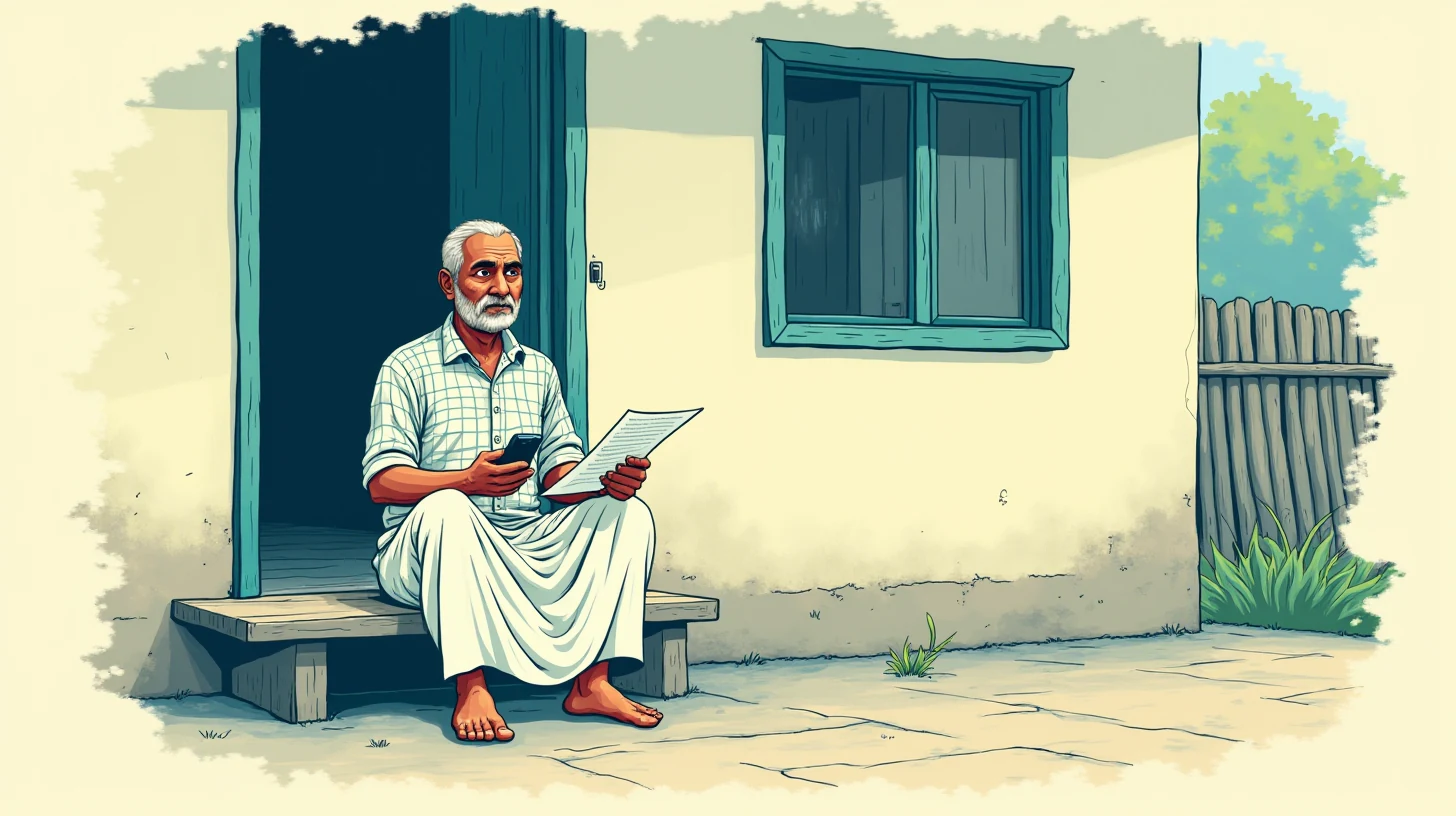
His wife Pratima had walked past an hour ago with chai, saying nothing, knowing that this form meant college fees might not fall on him alone. Priya, their daughter, was in Class 9 at Government High School, Agartala, bright enough to finish high school and perhaps go further. She belonged to a Scheduled Caste community—SC—which meant she qualified for the Tripura Post-matric SC Scholarship under the National Scholarships Portal. The income ceiling was ₹2.5 lakh per year. Their family's ₹58,000 was well below that.
But on the phone screen, the NSP portal's Tripura state module was showing him two walls he had not expected to find.
🗓️ The OTP That Went to Someone Else
The first problem was simple in outline, impossible in practice. The NSP Tripura system wanted to send him a one-time password to verify the application. But the mobile number registered on the scholarship database—the one Sukumar had given years ago when NSP accounts were new and scattered across different government websites—was a BSNL connection that no longer belonged to him.
BSNL, the state telecom company, had restructured its rural towers in 2022. Agartala's coverage had shifted, and Sukumar's old number had been reassigned to someone else. When the NSP portal sent an OTP to that number, it went to a stranger's phone. Priya's application was frozen in a state between submitted and verified. Without OTP confirmation, the portal would not let him proceed to the final section.
He had called the NSP help line number once. The voice on the other end spoke Hindi and fast. The operator asked him to visit the official NSP portal and use the "Update Mobile Number" feature. Sukumar tried. The Update Mobile Number button required—he had checked four times—entry of an OTP from the old registered number. The OTP he could not receive.
Practical gridlock. The system wanted him to prove he owned the old number by entering an OTP sent to that number. But the number belonged to someone else now.
⚠️ The Enrollment Number That Changed Its Face
The second problem was stranger in a different way. Priya's school had issued her an enrollment form showing her TBSE (Tripura Board of Secondary Education) number in one format: "TRP/9/2024/XXXXX"—slashes dividing the state code, grade, year, and sequence.
But when Sukumar entered this same number into the NSP Tripura module's enrollment lookup field, the portal returned a red error message: "Enrollment number not found in TBSE records."
He had written it carefully, letter by letter. He had checked the form again. The number was there. Priya's school confirmed it. Yet the NSP portal's own Tripura state system would not recognise it.
He tried typing it with spaces. The portal rejected it. He tried removing the slashes and entering "TRP92024XXXXX" as a continuous string. The portal still rejected it. In a moment of frustration, he had asked his cousin Bimal—who worked as a peon at the Block Office in Agartala and knew something of how government systems communicated—if he had ever heard of this problem.
Bimal had a phone with an agent installed on it.
🌗 The Agent Reveals Two Separate Paths
Bimal showed Sukumar the agent and explained that it had helped other families in Agartala who were stuck on NSP applications. What emerged from the conversation with the agent was that these two problems, while they felt like one overwhelming blockage, were actually two different journeys into the system.
The agent spoke in Bengali, the language Sukumar used at home and in the streets of Agartala:
"দুটি সমস্যা আছে এবং দুটি আলাদা সমাধান আছে। প্রথমত, আপনার পুরনো মোবাইল নম্বর—সেটা NSP ট্রিপুরা স্টেটে পরিবর্তনের জন্য আপনি সরাসরি ট্রিপুরা শিক্ষা বিভাগের NSP কোঅর্ডিনেটর অফিসে যেতে পারেন। সেখানে একটা লিখিত আবেদন, আপনার আধার, আপনার স্কুল এনরোলমেন্ট, এবং পুরনো আবেদনের রিসিট নিয়ে যান। তারা ৫ থেকে ৭ দিনের মধ্যে আপনার নম্বর পরিবর্তন করবে। দ্বিতীয়ত, এনরোলমেন্ট নম্বর—TRP/9/2024/XXXXX এবং TR-9-24-XXXXX এটা একই নম্বর, শুধু দুটো ভিন্ন ফরম্যাটে দেখা যাচ্ছে। NSP পোর্টালে যখন এন্ট্রি করবেন, তখন সব স্ল্যাশ এবং হাইফেন বাদ দিয়ে শুধুমাত্র সংখ্যা দিয়ে লিখুন—TR924XXXXX—তখন পোর্টাল এটা স্বীকার করবে। যদি না হয়, তাহলে TBSE অফিস—যেখানে আছে AG অফিস রোডে—সেখান থেকে 'Enrollment Number Confirmation Letter' ম্যাংগাতে পারেন, ২-৩ দিনে পাবেন।"
(Two separate problems, two separate solutions. First, your old mobile number—to change that in NSP Tripura State, go directly to the Tripura Education Department NSP Coordinator's office. Bring a written application, your Aadhaar, your school enrollment form, and your original application receipt. They will change your number within 5 to 7 days. Second, the enrollment number—TRP/9/2024/XXXXX and TR-9-24-XXXXX are the same number, just in two different formats. When you enter it into the NSP portal, remove all slashes and hyphens and write only numbers—TR924XXXXX—then the portal will accept it. If not, the TBSE office on AG Office Road—you can get an 'Enrollment Number Confirmation Letter' from them, you'll get it in 2-3 days.)
In English, what the agent had said was this: two separate paths. First, for the old mobile number issue: visit the Tripura Education Department, Education Complex, Agartala, where the NSP state coordinator sits. Bring a written application, your Aadhaar, the school enrollment form, and the receipt of your original NSP application. They process mobile number updates in 5 to 7 working days. Second, for the enrollment number: the format "TRP/9/2024/XXXXX" and "TR-9-24-XXXXX" are the same number rendered two ways. Enter the number without slashes or hyphens into the NSP lookup field—just digits, "TR924XXXXX"—and the portal should recognise it. If it still does not, the TBSE office on AG Office Road in Agartala issues an "Enrollment Number Confirmation Letter" in 2 to 3 working days.
One was immediate. One required a trip to the Education Complex.
The Format Trick and the Coordinator's Desk
Sukumar tried the digit-only entry that same afternoon. He removed every slash and hyphen from Priya's enrollment number, entering it as a continuous string of numerals into the NSP Tripura lookup field. The page refreshed. The red error disappeared. The portal returned a green confirmation: "Enrollment number verified."
The second problem was solved in minutes without leaving Battala Bazar.
Three days later, he made the journey to the Education Complex in central Agartala. He carried:
- A written application requesting mobile number update on file
- His Aadhaar card
- Priya's school enrollment form bearing the enrollment number
- The NSP application receipt from when he had first submitted it
He arrived at the NSP state coordinator's desk on a Tuesday morning. The official was a woman in her fifties who had processed hundreds of these requests. She looked at his documents, asked why the old number no longer worked, listened to the story of BSNL's restructuring, and nodded in the way that suggested she had heard it before. "Five to seven working days," she said, and took his application.
On the sixth working day, an SMS arrived on his new BSNL number: "OTP for NSP Tripura scholarship verification: 847293." The portal accepted it. The verification light turned green. Sukumar was able to proceed to the final section—income declaration, bank account, submission.
The Scholarship Arrives
The NSP application for Priya's Tripura Post-matric SC Scholarship was processed and approved within three weeks of the mobile verification. The first installment of ₹5,800 was disbursed directly into the bank account Sukumar had nominated on the form.
It was not a life-changing sum in the way that lottery windfalls are, but it was a sum that moved something in his daily mathematics. It meant that Priya's books, uniform, and exam fees for the rest of Class 9 and beyond were not a conversation that would happen between him and Pratima late at night. It meant that his work at construction sites—heavy, uneven, dependent on weather and contractor whim—did not have to stretch as far.
What made the difference was not just the scholarship itself, but the two-fold resolution. Without the digit-only format trick, he would still be hitting the enrollment error. Without the state coordinator's office processing the mobile update, he would have been locked out of submission. Both gates were real. Both required different answers.
In Bengali: "আমার মেয়ে স্মার্ট। তার পড়াশোনার দিকে মনোযোগ আছে। এখন যখন স্কলারশিপ পেয়েছে, তখন আমি নির্মাণ কাজে দিনে যেতে পারি বই কেনার চিন্তা ছাড়াই। আমার হাতে একটা স্কিল আছে—ছাদ বানানো, দেয়াল ভাঙা। কিন্তু সরকারি কাগজপত্র সেটা আলাদা দক্ষতা। যখন একটা এজেন্ট বলে দেয় যে নম্বরটা একই শুধু ফরম্যাট অন্য, তখন সবকিছু বদলে যায়।"In English: "My daughter is smart. She pays attention to her studies. Now that the scholarship has come through, I can go to construction work during the day without worrying about book costs. I have a skill—roof-making, wall-breaking. But government paperwork, that's a different skill. When an agent tells you the number is the same, only the format is different, everything changes."
🧭 Sukumar's Path Was Specific, But the Problems Are Shared
The story is Sukumar's, but the problems are not unique to Agartala or Tripura. Across India's scholarship systems—NSP Tripura, NSP Maharashtra, NSP Uttar Pradesh, NSP West Bengal—there are families stuck on the same two bottlenecks: OTPs on outdated phone numbers, and enrollment number format mismatches between school records and government portals.
Most families do not have a cousin at the Block Office. Most do not find an agent quickly. Most do not try a digit-only format entry on instinct. They wait. They call help lines that speak fast and in a language not their home language. They give up, or they delay, or the application window closes while they are still trying to verify the first hurdle.
Sukumar's advantage was Bimal's phone. But the information Bimal's agent offered—the two separate paths, the format trick, the specific office address and timeline—that information should not require a connection. It should be documented, searchable, and specific enough that any parent in Agartala can follow it without personal contacts inside the government.
The NSP portal itself does not explain that TBSE enrollment numbers in the digital system are stored without slashes. It does not tell you that your five-to-seven-day wait for a mobile update is normal, not a sign that your application is lost. It does not tell you where to go or what to carry or who to ask for by name.
An agent can. And it did.
🌱 The Architecture of a Small Win
What Sukumar experienced is what scholarship systems look like when seen through the eyes of a carpenter in Agartala. The scholarship itself—₹5,800—is real. The policy is real. The board, the portal, the coordinators are all real. But between Sukumar and the scholarship sat a gap filled with format differences, old phone numbers, and portals that do not explain themselves to people who do not speak the language of IT systems.
Two pieces of information closed that gap. One was tactical—remove the slashes, enter digits only. One was structural—there is a named office that handles mobile updates, and it takes 5 to 7 working days, and you can walk there.
Neither piece of information required government change. Neither required a new portal, a new database, or a rewrite of how TBSE numbers are stored. What they required was someone who could read Sukumar's problem in Bengali, who could connect it to the specific machinery that exists in Agartala, and who could translate that machinery into a step-by-step path forward.
That is what the agent did. That is what made the difference.
Priya will complete her Class 9 exams this year without her father having to take extra hours away from his family to cover her fees. She will move into Class 10, a Scheduled Caste girl in Agartala with a scholarship covering her education, and a father who now knows how to navigate NSP forms and state coordinators and enrollment formats.
Sukumar keeps the NSP confirmation email on his phone. He has shown it to two other families in Battala Bazar who are starting their own scholarship applications. "The digit-only part," he tells them. "Try that first. Do not type the slashes."
It is a small win. But small wins are how families move forward.