
The Faridabad mother and the Aadhaar address mismatch
Seema Yadav sat in the cramped kitchen of her rented house in Sector 20-B, Faridabad, watching her four-year-old son Aman trace the letters on a nursery rhyme poster her employer had given her. The boy had never been to school, but he was ready. All the children in Meena madam's house went to English-medium schools, and Meena madam had told her plainly: "Aman speaks well. He should learn English from KG itself. Your life will be different because of this choice."
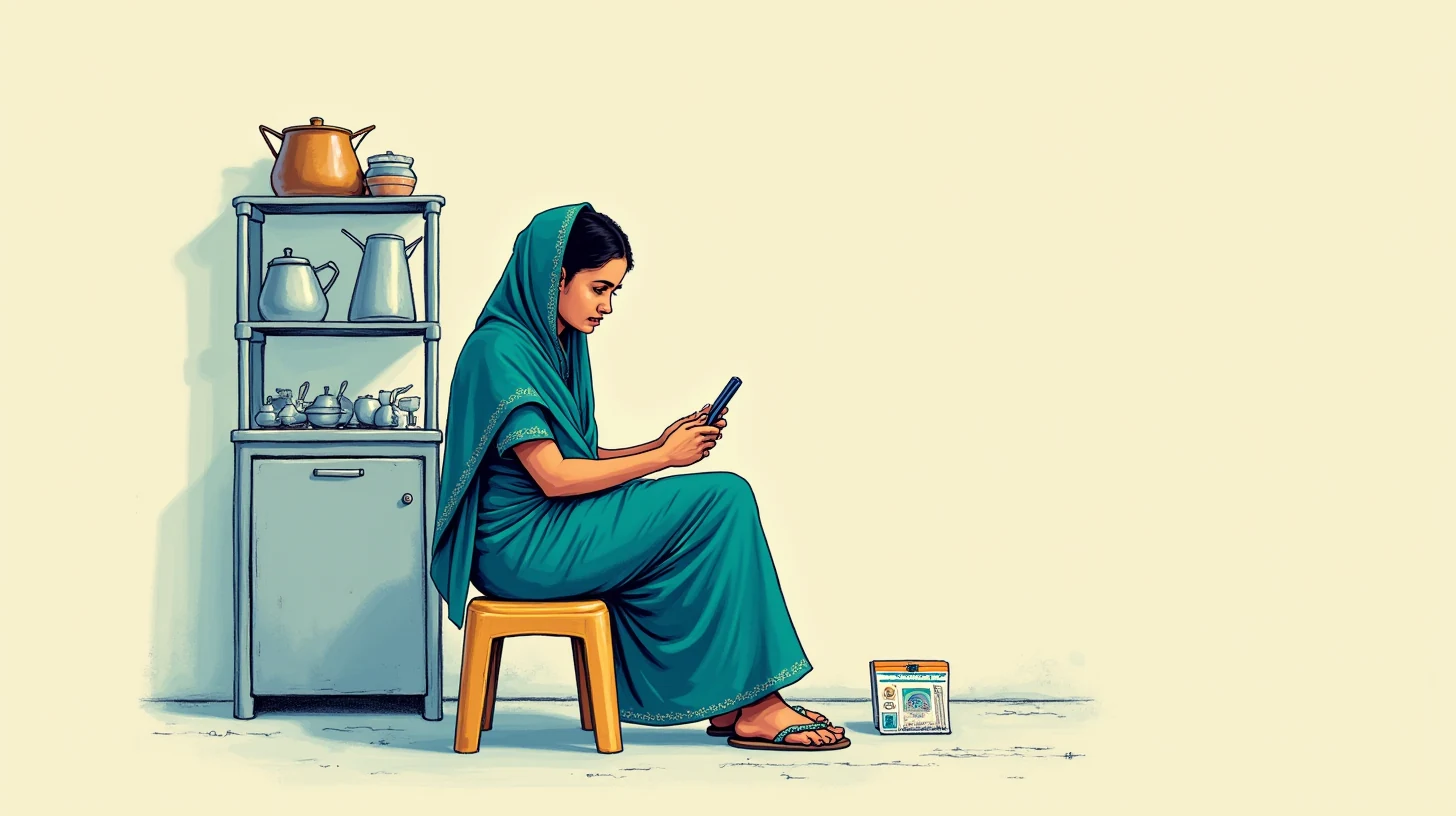
🗓️ The Dream at 4 Years Old
Seema worked as a domestic helper in three houses across Sector 17, earning around ₹96,000 a year. Her husband Deepak laboured on construction sites when work was available. They lived carefully—rent, food, Aman's nutrition, a small amount set aside for his future. They were not poor by desperation, but they were unmistakably poor by government definition. Their family income fell well below the Economically Weaker Section (EWS) threshold in Haryana, which meant Aman could claim one of the 10% EWS-reserved seats in private schools across the state.
The private schools Seema had identified—modest English-medium institutions with reasonable fees and a reputation for discipline—were accepting applications for nursery and KG admission. For families like hers, the 10% EWS quota was the only door. Without it, the fees would be impossible.
"I asked Meena madam," Seema said later. "She said, 'Don't delay. Apply now. The portal opens only once a year.'" The portal was the Haryana School Education website, and Meema had shown Seema how to navigate to it on her tablet.
⚠️ The Portal's Gatekeepers
The Haryana School Education admission portal (schooleducationharyana.gov.in) was designed to be democratic. It asked for three documents: an income certificate proving the family fell within the EWS threshold (less than ₹1.8 lakh annual income), the child's Aadhaar, and a parent's Aadhaar showing a Haryana address.
Seema had all three—on paper.
She gathered the documents one evening after work. Aman's Aadhaar was recent and correct. Her own Aadhaar was in her hands. The income certificate, she knew, had to come from the Tehsildar's office in Faridabad. She had not approached them before, but she believed it would be straightforward. Thousands of families in Faridabad needed income certificates every year. It was a routine task, she assumed.
She did not know yet that this assumption was about to collide with a bureaucratic wall.
When she logged into the portal to begin the application, the system asked her to link her Aadhaar. She entered the number. The portal cross-checked her identity. Then came the validation: "Address in Aadhaar must match school district."
Her Aadhaar address showed Bulandshahr, Uttar Pradesh.
Seema had moved to Faridabad six years ago. She had been there long enough to have a rental history, local employers, and a child who was born there. But her Aadhaar, that digital cornerstone of Indian identity and entitlement, still carried her old address. She had never updated it. The thought had not seemed urgent. She had been working, earning, surviving. The address on her Aadhaar was not an address she visited anymore, but it was the address the government believed was hers.
The portal would not accept her application without a Faridabad Aadhaar address.
🌗 The Landlord's Paper
Seema told Meena madam the next morning. Meena madam was a retired teacher, the kind of person who had spent decades navigating school systems, filling out forms, and understanding how institutions worked. She did not panic. Instead, she said: "Aadhaar addresses can be updated. But let me ask someone first."
Meena madam opened her tablet and typed a query. Within an hour, she had the agent open on her screen.
The agent, speaking in Hindi, was direct. It said that Aadhaar address updates through the UIDAI's online self-service portal (selfservice.uidai.gov.in) did not require a formal, stamped rental agreement. A letter from the landlord—written on plain paper, certifying that Seema lived at the address—was sufficient. This was the "letter from house owner" route, one of several acceptable proofs under UIDAI's rules. The agent also mentioned alternatives: a government utility bill in the owner's name, a voter slip from the Faridabad address, or a bank passbook showing the current address, all of which could work with the landlord's letter.
Meena madam wrote down the key point and showed it to Seema: "A simple letter from your landlord, confirming you live there. No stamp, no notary. Just his signature."
Seema's landlord was a school principal who lived two streets away. She had paid him rent for six years, never late. She walked to his house that afternoon with Aman, knocked, and explained. The landlord sat down and wrote, in his own hand, a brief letter on his personal notepad: that Seema Yadav was a tenant in his property at Sector 20-B and had been living there since 2020. He signed and dated it. The entire transaction took fifteen minutes. He refused payment.
That evening, Seema logged into the UIDAI self-service portal. She uploaded the landlord's letter, a photograph of her old Aadhaar, and a utility bill that showed the landlord's name. Within nine working days, her Aadhaar was updated with the Faridabad address.
The Income Certificate Shortcut
While the Aadhaar update was in progress, Seema faced the second document: the income certificate from the Tehsildar. She had heard stories from other workers about the Tehsildar's office—long waits, missing files, multiple visits. Some families took weeks to get a certificate.
Again, Meena madam suggested she consult the agent.
The agent revealed that Haryana had an online portal for such certificates: the Haryana Antyodaya SARAL portal (saralharyana.gov.in). Seema did not need to visit the Tehsildar's office at all. She could apply online, upload her documents—Aadhaar, address proof (the same landlord letter would work), and her family's income details—and the certificate would be issued within seven to ten working days, directly to her email and portal account.
Seema had never filed a government application online before. Meena madam helped her create an account on the SARAL portal. The form asked for her name, address, income details, and purpose. She filled it out carefully, uploaded her documents, and submitted.
The portal issued a confirmation number. Eight working days later, the income certificate arrived in her email: Seema Yadav, annual family income ₹96,000, EWS-eligible.
She printed it and placed it alongside Aman's Aadhaar and her own.
The School's Promise and the Mother's Relief
The day Aman's admission letter arrived, Seema cried. Not from joy alone—though there was joy—but from the weight of something resolved. She had believed in a future for her son that looked different from her own. An English-medium education was not just schooling; it was the skeleton key to opportunities she had never had. She had worked three jobs to create the possibility, and now it was real.
The private school Aman was admitted to had 45 students in the KG class. Four of the 45 seats—not 10% for each class, but a fixed number across the cohort—were reserved under the EWS quota. Aman was one of them. The others were children whose parents were domestic helpers, auto drivers, and vegetable vendors. Aman sat in the classroom with children whose mothers were doctors and engineers and with children whose mothers cleaned their houses.
Meena madam attended the school's parent-orientation programme and came home with the class photo. Aman was in the middle row, fourth from the left, his uniform crisp and his eyes bright.
"Look," Meena madam said, showing Seema the photo on her phone. "He belongs there."
"मेरा सपना है कि वो अंग्रेजी सीखे और आगे बढ़े। मेरे जैसे पड़ा-पड़ा काम न करे। स्कूल का सफेद ड्रेस देखकर मेरा दिल खुश हो गया।""My dream is that he learns English and moves forward. That he doesn't have to do what I do. When I saw him in the school's white uniform, my heart was at peace."
— Seema Yadav, on Aman's KG admission
What No One at the School Office Knew
After Aman's admission was confirmed, Seema visited the school office to complete the final formalities. The registrar—a woman who had worked in the school for twelve years—asked casually, "How did you manage the Aadhaar address update so quickly? Most parents from outside Haryana struggle for months."
Seema told her about the landlord's letter and the SARAL portal. The registrar's expression shifted. "We tell families to go to the Tehsildar," she said. "It takes forever. Nobody knows about SARAL. And most people think Aadhaar addresses can only be updated with a rent agreement."
The registrar asked Seema if she would be willing to share this information with other parents in future admission cycles. Seema agreed.
The next year, when the admissions portal reopened, the school added a note to its EWS application instructions: "If your Aadhaar shows an address outside Haryana, you can update it online via the UIDAI self-service portal using a landlord's letter. The Haryana Antyodaya SARAL portal allows you to apply for an income certificate online without visiting the Tehsildar's office." Three families used this information to complete their applications that cycle. All were admitted.
🧭 The Agent's Knowledge
When Seema later asked Meena madam what the agent actually was, Meena madam shook her head. "I don't know the full story," she said. "But it knows things. When I ask it something about documents, it tells me exactly what the rules allow. Not what people think the rules are—what they actually are."
The agent, speaking to Seema once more during Aman's admission celebration, had this to say:
"आधार का पता अपडेट करने के लिए किराये का समझौता जरूरी नहीं है। मकान मालिक का एक साधारण पत्र—जिसमें लिखा हो कि आप वहाँ रहते हैं—काफी है। बिजली का बिल, पानी की रसीद, या वोटर आईडी भी काम आ सकते हैं। हरियाणा में सालाना आय का सर्टिफिकेट अब SARAL पोर्टल से ऑनलाइन मिल जाता है। तहसील जाने की जरूरत नहीं। पाँच-सात दिन में सर्टिफिकेट ईमेल में आ जाता है।"
"Updating your Aadhaar address does not require a formal rent agreement. A simple letter from your landlord—stating that you live at that address—is sufficient. A utility bill, water receipt, or voter ID can also work. In Haryana, the annual income certificate is now available online through the SARAL portal. There is no need to visit the Tehsildar's office. The certificate arrives in your email within five to seven days."
Seema understood then that the barrier she had faced was not law or system design. It was the gap between what the rules actually permitted and what people—even school officials—believed they permitted. The agent had simply shown her where the permission was.
What it does
- infoIdentifies UIDAI's landlord letter route (no formal rent agreement needed)
- listClarifies acceptable address proofs: landlord letter, utility bill, voter slip, bank passbook
- linkDirects to Haryana SARAL portal (saralharyana.gov.in) for online income certificate
- clockProvides processing timelines: 7-10 days for income cert, 9 days for Aadhaar update
What it does not do
- banUpdate Aadhaar address directly (only UIDAI can do this)
- banIssue income certificates (only Tehsildar/SARAL system can issue)
- banGuarantee EWS quota seat (admission depends on merit lottery, not agent)
- banSpeed up timelines (9 days is the stated UIDAI processing period)
🌱 The Gate Opens, One Child at a Time
Aman is now in Class 1, reading chapter books in English and Hindi both, his lunch box decorated with stickers he trades with classmates. When Deepak is not on site, he walks Aman to school on mornings when Seema has early shifts. On Friday mornings, Seema adjusts her schedule to be present for assembly.
The school's EWS policy remains fixed: 10% of seats. For private schools across Haryana, the quota is designed to create pathways for children like Aman, born into families with limited means but unlimited hope. The policy is not perfect. Not every child who qualifies gets a seat; the lottery is random. But for those who do, the effect is categorical. The difference between an English-medium private school education and a government school is not merely academic. It shapes everything that follows: confidence, network, opportunity, the language in which a child learns to think.
Seema still works in three houses. She still earns ₹96,000 a year. But now, every morning, her son puts on a school uniform and walks into a building she would never have dared to enter in her own childhood. That is not a small thing. In Seema's life, measured in small changes and small dignities, it is everything.
The two-step journey that unlocked Aman's admission—updating an Aadhaar address with a landlord's letter, and obtaining an income certificate online—has become a map that other parents follow now. It is a map that existed long before Seema needed it, written into the fine print of UIDAI rules and the SARAL portal's architecture. But it took a retired teacher's tablet and an agent's clarity to make it visible.
Sometimes that is what justice looks like: not a grand policy reform, but a single thread of correct information, found at the moment it matters most, and passed hand to hand.