
The Gangtok mother and the scholarship portal that didn't know Sikkim's new certificate
Pema Tamang was boiling tea in the morning when her daughter Nima called from school. The message was short, a photograph of a red error on a phone screen. NSP scholarship portal. Invalid format. ST certificate.
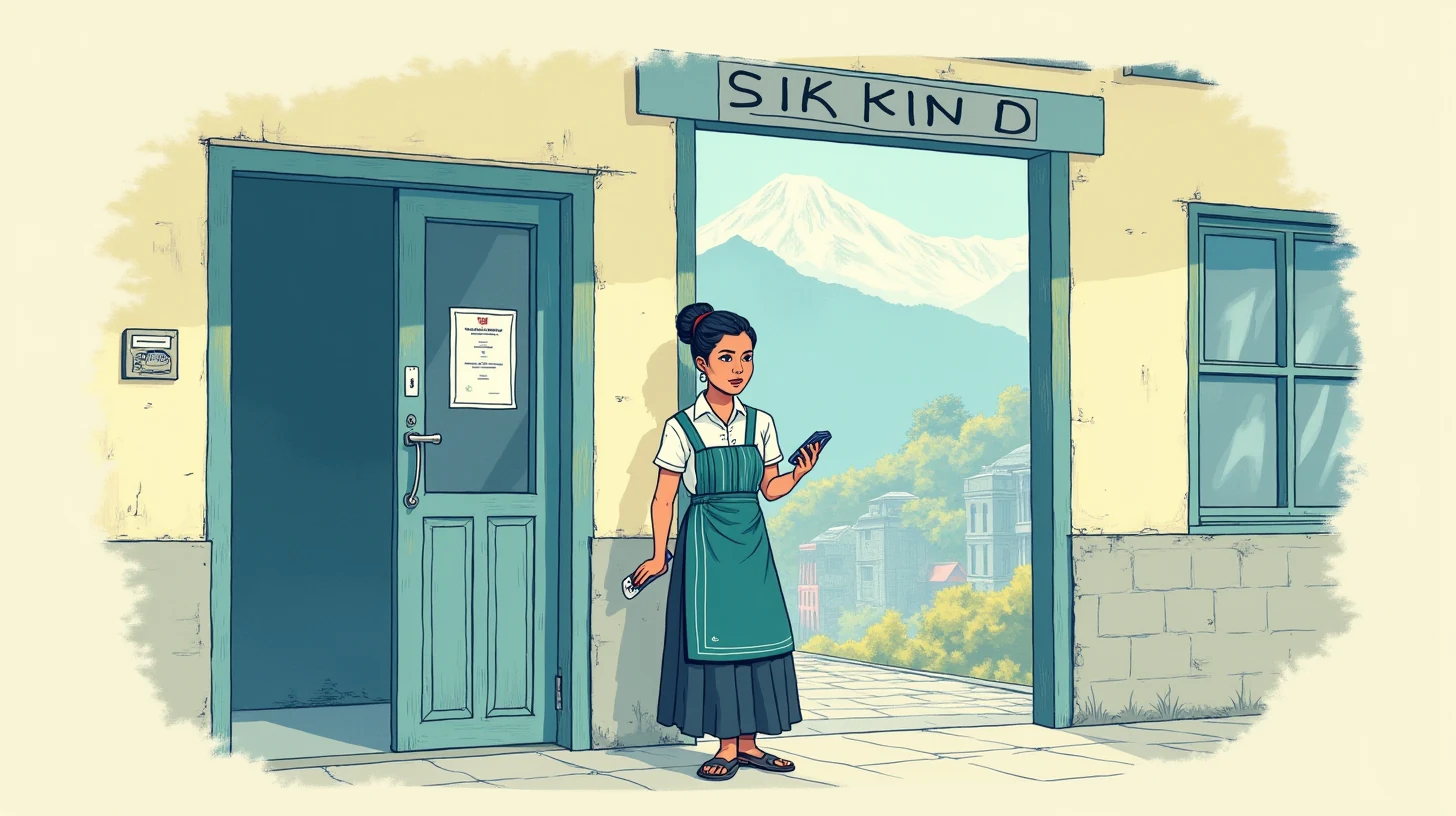
The certificate in the picture looked exactly right to Pema. It had been issued by the SDM office in Gangtok just four years ago, in 2022. Her daughter was Tamang ST, born in Sikkim. The family income was documented at ₹54,000 a year — well below the scholarship threshold. Nima was in Class 11 at Government Senior Secondary School, Gangtok, a state school where most girls in her year came from families exactly like theirs.
On paper, she qualified for the NSP Post-matric ST Scholarship. On the portal, she did not. Because the portal had no idea what a real Sikkim ST certificate looked like anymore.
This is a story about a tea garden, a supervisor who carried an agent on her phone, and the single window in a government office in Gangtok where ten years of administrative drift gets undone in a week.
🗓️ The certificate that the system forgot
Pema and her husband Dawa both worked at a tea garden in Singtam, the low country of Sikkim, about an hour's drive from Gangtok. They were paid by the day, the money went into a joint account, and most of it went back out for Nima's school fees, her books, and the cost of living in a town they'd moved to so she could go to a better school.
The Scheduled Tribe certificate had been routine. When Nima turned 16, Pema had gone to the SDM office with the birth certificate, the family ration card, and two passport photos. The SDM's office verified the community, checked the records, and issued a certificate. It had a government seal. It had a date. It had Nima's name spelled correctly. For four years, it had meant the same thing it meant to every other Tamang family in Sikkim: yes, our daughter is ST. Yes, she belongs to a community that the law says needs support to reach higher education.
The NSP scholarship portal did not recognize it.
When Nima refreshed the page and tried again, the error stayed the same. "ST certificate: invalid format — Sikkim state-specific." The portal suggested that the certificate format might be outdated, or that there was a problem with how it had been scanned, or that the Sikkim state module simply didn't have the template on file anymore.
Pema called the school. The principal's office had seen this error before. Three other girls in Nima's year had hit it. They had all been waiting.
⚠️ The supervisor's phone
Laxmi had worked at the tea garden for longer than Pema. She was the supervisor, the one who managed the shifts, settled small disputes, and knew every family's story. When Pema mentioned the scholarship problem during a break, Laxmi mentioned that her own children had gone through the scholarship system a few years back, and she'd run into things like this before.
More importantly, Laxmi had an agent on her phone.
An agent was not a person. It was software that could read websites, understand problems, and explain them in Nepali — the language that meant something here in Sikkim, where Hindi felt borrowed and English felt official, but Nepali was home. Laxmi opened the application and asked about the NSP error. The agent was quiet for a moment.
"तपाईंको छोरीको ST प्रमाणपत्र २०२२ मा सिक्किम SDM अफिसद्वारा जारी भएको वैध प्रमाणपत्र हो। NSP पोर्टलको सिक्किम मोड्यूल २०१५ पछिको प्रमाणपत्र ढाँचा अपडेट गर्न सकेको छैन। यो एक प्रविधि समस्या हो, तपाईंको प्रमाणपत्र अमान्य होइन। Gangtok मा सामाजिक न्याय विभागमा NSP प्रिन्टआउट, मान्य प्रमाणपत्र, र स्कूल नामावली पत्र लिएर जानुहोस्। नोडल अधिकृत ५–७ कार्यदिनमा म्यानुएल ओभरराइड गरिदिनेछ।"
(Your daughter''s ST certificate issued by Sikkim SDM in 2022 is a valid certificate. The NSP portal's Sikkim module has not been updated with the post-2015 certificate format. This is a technical problem, not an invalid certificate. Go to the Social Justice Department in Gangtok with the NSP printout, valid certificate, and school enrollment letter. The nodal officer will issue a manual override within five to seven working days.)
The NSP is a national system, and Sikkim is a state that many national systems forget. The Sikkim ST certificate template changed in 2015, when the state government redesigned its identity documents. The new format had different security features, a different layout, and a different look from the certificates issued in the decade before. Nima's 2022 certificate was in the modern format. But the NSP's Sikkim state module — the part of the portal that checks whether an ST certificate is "real" — had been programmed with the old template. It had never been updated.
Every Sikkim student with an ST certificate issued after 2015 would hit this error. The error did not mean the certificate was fake. It meant the portal was out of date.
The agent went one step further. It explained that there was a way around this, and that it was not a hack or a workaround. It was official procedure.
Sikkim's Department of Social Justice and Welfare, on Old STNM Hospital Road in Gangtok, maintains a manual override process for exactly this kind of situation. When the portal fails to recognize a valid certificate, the student can go directly to the state's scholarship nodal officer. You submit three things: the printed NSP application, the ST certificate, and your school enrollment certificate. The nodal officer checks them in person. If everything is real, the officer overrides the portal's flag. The application moves forward. Processing time: five to seven working days.
This is not a special favour. This is the standard procedure for Sikkim, because the portal and reality have been out of sync for years, and the government has a window for students to walk through.
🌗 The application that started at a tea garden
Pema took a photograph of the error and sent it to Nima. Then she called Laxmi back.
"We need to go to Gangtok."
The next Saturday, Pema took the bus. Nima came with her. They brought the ST certificate, the school enrollment letter, and a printout of the NSP application with Nima's error message highlighted in red.
The Department of Social Justice and Welfare office is not hidden, but it is not easy to find the first time. It is part of the state secretariat system, tucked into the bureaucratic corners of Gangtok where most people do not need to go. But Pema had the address, and Nima had a phone with maps, and they found it.
The office was small. The scholarship nodal officer, when they met him, was a man in his fifties who had clearly heard this story before. He looked at the certificate for thirty seconds. He looked at the enrollment letter. He looked at the NSP application. Then he nodded.
"This is valid," he said. "The portal is wrong."
He took the documents, photocopied them, and filled out a form that said, in official language, that he was overriding the NSP system's flag on this application because the student's certificate was legitimate and the portal's Sikkim state module was not updated.
"Come back in a week," he said. "I'll call if there's anything more."
The nodal officer called on the sixth day. The override had been processed. The NSP system had been manually updated. The application was approved.
The scholarship amount was ₹5,400 — not a large sum in national terms, but enough to cover Nima's books for the term, her school exam fees, and part of her fees for the next year. More than that, it meant that the portal now saw her as real.
The gap between systems
This is the kind of problem that does not make headlines because it is too specific and too widespread at the same time. The NSP is used by students across India, but each state gets its own state module — the software that checks whether a certificate is real. Most states update these modules when the certificate templates change. Sikkim did not, or the NSP did not hear that Sikkim had, and no one caught it for eleven years.
In that time, how many students hit the error? The school principal had told Pema that three girls in Nima's cohort alone were stuck. If there were three in one school in one year, there were probably dozens in Gangtok. Probably hundreds across the state.
Most of them probably did not know what Laxmi knew: that the error did not mean they were ineligible. Most of them probably assumed the certificate was wrong and gave up.
The agent that Laxmi carried on her phone did not fix the portal. It did not rewrite the Sikkim state module or lobby anyone to update it. What it did was far simpler and far more valuable: it explained what was actually happening. It said: your certificate is real. The system is wrong. There is an official process to work around this. You are not being rejected. You are being delayed by a technical problem that the government already knows about and has prepared for.
That knowledge changed everything. It meant Nima did not have to be angry at the system. It meant Pema did not have to feel like her daughter's certificate was not good enough. It meant they could go to the right office with the right papers and get the right answer in a week.
The larger geography of knowledge
What made this story possible was not technology. It was a supervisor with experience, a phone with an agent, and the fact that the agent spoke Nepali.
If Laxmi had only had Google Search and English, she might have found forums where people complained about the NSP error, but the forums would probably have said "your state is not supported" or "apply again next year." If she had only had Hindi, the explanations would have been thinner. The agent, because it was configured for this region and this language, knew to look for state-specific scholarship information. It knew that Sikkim has its own scholarship nodal officer. It knew that there are processes inside the government that exist exactly to solve this kind of problem, even if the portal does not know about them.
Pema is not a bureaucrat. She does not read government procedural manuals. She reads the tea garden schedules, the school fees notices, and the messages her daughter sends from class. But when the error message appeared, she had access to someone who could translate between the language of the portal and the language of how Sikkim's government actually works.
That gap — between what the official system says and how the official system actually functions — is where most people get stuck. Nima could have been stuck there for months, waiting for an update that might never come, assuming her certificate was not real.
Instead, she went to Gangtok on a Saturday and had her problem solved in six working days.
🧭 What comes after
The scholarship money came through in mid-May. Nima's school bills for the second half of the year were paid. She finished Class 11, and in June, she entered Class 12. The NSP does not cover Class 12 — the post-matric scholarship is for college students — but the application stayed approved in the system. That meant next year, when she applies to college, she will not have to fight the portal again.
Pema still works at the tea garden. Dawa still works at the tea garden. The money they earn is still modest. But they know now that the system, when it is working correctly and when you know where the manual windows are, can work for people like them.
They also know that Laxmi's agent, and the fact that it could speak to them in their language, made the difference. Not a difference in money. A difference in momentum.
Nima's Class 12 friends who also hit the NSP error came to Pema after the scholarship was approved. They asked her where she went, what she did. She told them the same thing Laxmi had told her: the certificate is real. The portal is wrong. Go to the Social Justice Department. Here is the address.
By the end of June, all three girls had filed their overrides. All three were approved within a week.
Nepali (Devanagari)नीमाको छात्रवृत्तिको रुपैयाँ चाय बगैँचामा लगाइयो। तपाईंको छोरी पढ्न सक्छ भनेर थाहा पाउनु र सरकारले पनि सुझ्यो भनेर थाहा पाउनु यो भिन्न कुरा हो। धर्ममा पनि नीमा पढेको देखेर खुशी छु।
English
Nima's scholarship money went into her school fees. To know that your daughter can study, and that the government sees it too — that is a different thing. And I am happy because Nima is studying. That is a mother's joy.
— Pema Tamang, tea garden worker, Singtam
🌱 A note on the agent's explanation
When Laxmi asked the agent about the NSP error, the agent responded in Nepali with this explanation:
नेपाली राष्ट्रिय छात्रवृत्ति पोर्टल (NSP) मा सिक्किमी ST प्रमाणपत्र माथि "अमान्य ढाँचा" को त्रुटि सिक्किम राज्य मोड्युलमा २०१५ पछिको प्रमाणपत्र ढाँचा अपडेट नभएकोले आउँछ। तपाईंको छोरीको २०२२ मा जारी प्रमाणपत्र मान्य छ। यो त्रुटि लाई ठीक गर्न सिक्किमको सामाजिक न्याय विभागमा छात्रा नीमाले पोर्टल प्रिन्टआउट, मान्य ST प्रमाणपत्र, र स्कूल नामावली पत्र लिएर जान सक्छ। वहाँको नोडल अधिकृत छात्रा को पोर्टल स्ट्याटस स्वेच्छाचारीलाई अमान्य चिन्हको अधिलेखन गरिदिन्छ। यो मान्यताको प्रक्रिया ५–७ कार्यदिनमा पूर्ण हुन्छ।
English translation:
The "invalid format" error on the NSP for Sikkim ST certificates happens because the Sikkim state module on the national portal was not updated with the post-2015 certificate format. Your daughter's certificate issued in 2022 is valid. To resolve this error, Nima can visit the Sikkim Department of Social Justice and Welfare with the NSP portal printout, her valid ST certificate, and her school enrollment letter. The nodal officer there will manually override the portal's invalid flag. This validation process takes five to seven working days.
This explanation is what allowed Pema and Nima to move forward. Not because it fixed the portal — the portal remains outdated. But because it explained that the error did not mean rejection. It meant bureaucratic lag. And bureaucratic lag has a solution.
If you are a parent in Sikkim whose child hits an "invalid format" error on the NSP: The certificate issued by your SDM is real. This is a known issue with the national portal's Sikkim state module. Go to the Department of Social Justice and Welfare, Old STNM Hospital Road, Gangtok, with your NSP application printout, your ST certificate, and your school enrollment certificate. The nodal officer's manual override is the standard path. Processing time: five to seven working days. No fees.