
The Guwahati father and the scholarship OTP that couldn't arrive
Bipul Borah was forty-three years old and had owned exactly two mobile phones in his life. The first came in 2010, a Nokia with a blue screen that his employer had given him to coordinate deliveries at the rice mill. He kept that number registered with everything — the ration shop, the cooperative where his wife sold gamosa, the government office where he paid property tax. In 2018, the phone died. Bipul bought a secondhand Android. The new SIM card went into that phone. The old number drifted into silence.
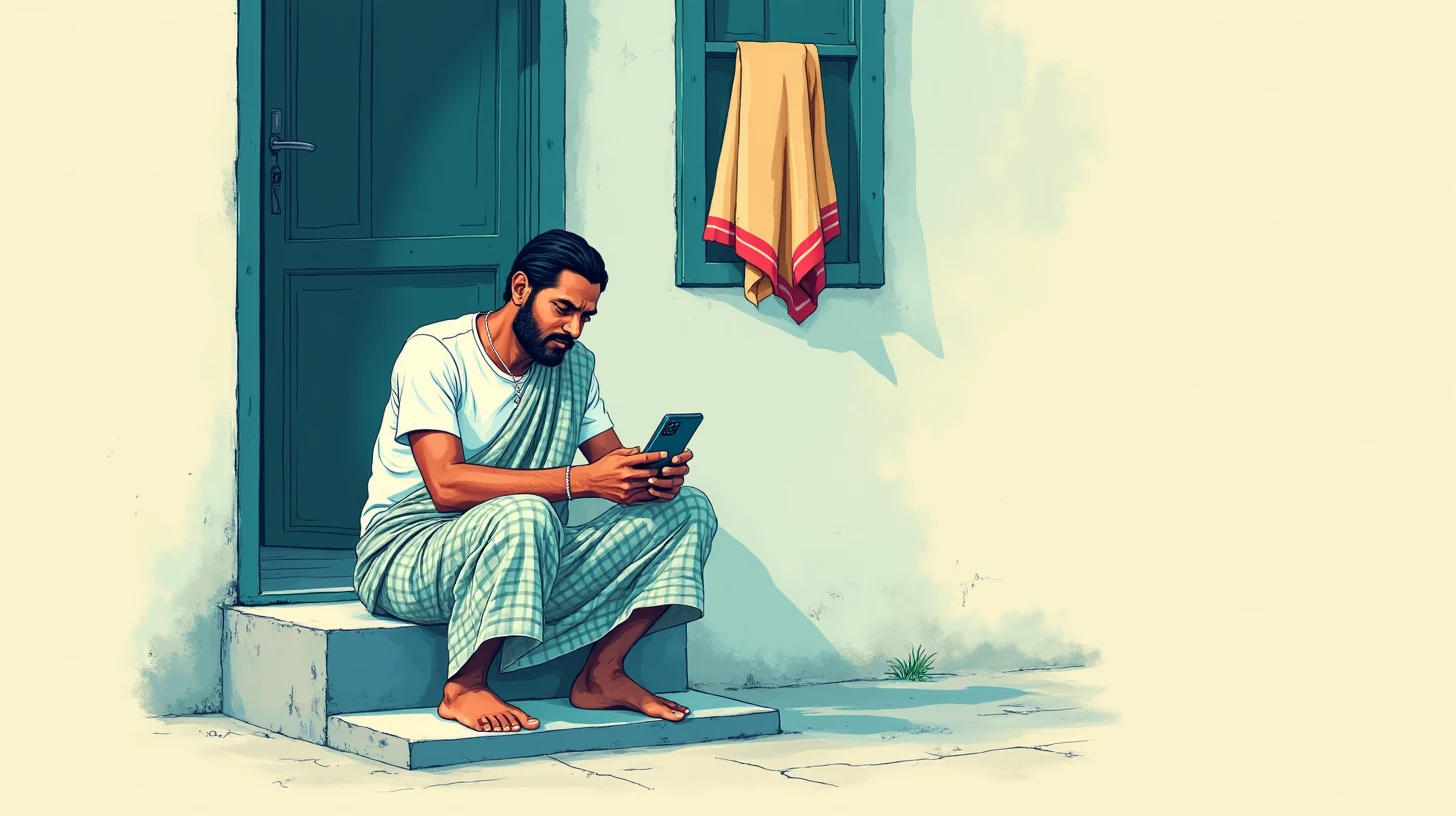
🗓️ The First Phone, Long Silent
The telecom company, like all telecom companies, recycled that number. Someone else owned it now. Bipul never thought about it.
His daughter Priya was fourteen and in Class 9 when she learned that she qualified for a post-matric scholarship. The Assam Post-matric OBC Scholarship was designed for students like her — from families earning less than a lakh per year, belonging to an OBC community, studying in a government school. Priya was all three. The scholarship would pay ₹7,400 a year toward her education. In their house in Dharapur, Guwahati, that was significant money. Her mother Purnima had woven perhaps thirty gamosa that year for the local cooperative, earning just over ₹3,000. Bipul's wage at the rice mill came to ₹87,000 annually. They were living on the border of comfort and precarity. The scholarship was real.
Bipul went to the Circle Office and obtained an OBC income certificate without trouble. The documents were ready. Priya created an account on the National Scholarship Portal — scholarships.gov.in — and filled out the application form. Everything moved forward until it stopped.
The portal required OTP verification to complete the registration. It sent an OTP to the mobile number on file. That number was the old one. The Nokia's number. The one that no longer belonged to them.
The portal showed the masked number: "OTP sent to XXXXXXX72." Bipul stared at it. He did not have that phone. He had never had a way to intercept a message sent to a number that had been someone else's property for six years.
⚠️ The Catch-22 That Keeps Families Out
Bipul tried the obvious thing first. The National Scholarship Portal has a "change mobile" option. He clicked it. The system asked for the current mobile number to be verified. To change it, you must first prove you own the current one. You must answer the same OTP that you cannot receive.
He tried to find a helpdesk number. The NSP website listed a phone line. Bipul called it three times over two days. Nobody answered. The line rang and rang into silence.
He asked Purnima if she knew anyone who could help. She suggested the government office — perhaps the same people who issued the income certificate. Bipul went back to the Circle Office. The clerk who had helped him with the OBC certificate was sympathetic but outside his scope. "This is a central government portal," the clerk said. "The state office might know, but honestly, I have never seen this problem before."
Bipul told Priya to wait. He told her the scholarship was still coming; the system just needed time. Inside, he was beginning to wonder if the system had locked them out permanently. The scholarship money would be good for the family, but more than that, it felt like the system was working against him. He had the documents. He had the proof. He had the daughter. But the system had built a wall made of digits and codes, and there was no human being who seemed able or willing to climb over it to let them through.
This was late September. The NSP scholarship deadline was in November.
🌗 The Brother's Phone, the Agent's Answer
In October, Dhiren arrived from Guwahati. Dhiren was Bipul's older brother, working at the Guwahati Tea Auction Centre where he managed correspondence and records. He had been using an agent on his phone — not the government kind, but a digital one, a generative AI that lived in an app and answered questions in Assamese.
Over tea on the veranda, Dhiren showed Bipul the phone. He asked the agent about scholarship problems. The agent listened to the NSP story and gave back a clear, actionable path.
In Assam, the District e-Governance Centre operates out of the office of the Deputy Commissioner — in Guwahati's case, the DC office in Dispur. This centre has a dedicated liaison for the National Scholarship Portal. The liaison handles mobile number updates for locked-out accounts. The path does not go through the NSP helpdesk in Delhi. It goes through the district office, 15 kilometres away.
The process requires a written request, signed by the applicant or parent, along with four documents: the student's Aadhaar, the school enrollment certificate, the income certificate, and the original NSP application receipt (printable from the portal, even without logging in fully). The liaison at the e-Governance desk accepts these, processes the request, and updates the mobile number in the NSP database within 5–7 working days. The NSP then sends a fresh OTP to the new number.
Dhiren wrote down the name of the desk and its location. He told Bipul which documents to bring. And he made one more call to the agent, to confirm the exact address and the working hours, because getting it wrong would mean a wasted trip.
The agent responded with the address: District e-Governance Centre, Deputy Commissioner's Office Complex, Dispur, Guwahati. Open 10 a.m. to 4 p.m., closed Sundays. The liaison's name was available on the centre's noticeboard.
The Journey to Dispur
Bipul gathered the documents on a Tuesday morning. Priya's Aadhaar came from their locked drawer. The school enrollment certificate came from the high school in Azara, where Priya studied. The income certificate was already months old. And Bipul printed the NSP application receipt from a cybercafe near the rice mill — the receipt showed the application saved but not completed, the date stamped in October, waiting for mobile verification.
He and Priya took a shared auto-rickshaw from Dharapur. The journey to Dispur took forty minutes through the city traffic and the scattered sprawl of suburbs. Bipul had never been to the DC office complex. When they arrived, a guard at the gate directed them through corridors lined with government employees moving between rooms with files and clipboards.
The District e-Governance Centre occupied a small office off the main corridor. There was no queue. A woman at the desk looked up from her computer.
Bipul explained the situation. He placed the four documents on the desk. He explained that his daughter qualified for the scholarship but could not access her account because the portal was sending the OTP to a number that had not been theirs for six years. His phone was different now. Could they help?
The woman nodded. She had seen this before. She took a form from a drawer, asked Bipul to write the new mobile number he wanted registered — his current Android phone — and asked him to sign and date the form. She made a photocopy of each document. She stamped the form with the centre's seal. She gave Bipul a receipt with a date six working days in the future, when the change would be complete.
"After that date," she said, "the NSP system will have your new number. You can receive the OTP on that phone."
Bipul and Priya left the office. The visit had taken twenty-five minutes.
The Waiting, Then the Relief
Six working days passed slowly. Bipul did not check the NSP portal every hour, but he thought about it often. Priya asked once, then left the subject alone. Purnima wove gamosa and asked Bipul each evening if there was news. He said no, not yet, but soon.
On the seventh day, in the afternoon, Bipul tried logging into the National Scholarship Portal on Dhiren's phone. He clicked "Change mobile." This time, instead of requesting an OTP to verify the old number, the system asked for the new number. It sent an OTP to his current phone. He received it in thirty seconds. He entered it. The system accepted it. The mobile number was updated.
He logged into Priya's scholarship application. The form was still there, all the fields filled as they had left them. The only thing missing was the final verification. He clicked "Submit." The portal accepted it.
The application was complete.
The scholarship was processed in the third week of November. The NSP deposited ₹7,400 into the bank account Bipul had listed during the application. In their house in Dharapur, that money covered Priya's school books and uniform for the entire year. It covered a portion of the rice and dal that would feed the family through the winter months.
Bipul did not forget the agent. He told Dhiren that if Dhiren ever had a friend or relative who faced a government portal problem, the agent could help.
"দিস্ট্রিক্ট e-গভর্ননেন্স সেন্টার হ'ল ডিস্পুৰ অফিসৰ ভিতৰত। তাত এজন লিয়েজ আছে যি National Scholarship Portal ৰ কাৰণে মোবাইল নম্বর আপডেট কৰে। তাই আপুনি NSP হেল্পডেস্কৰ পৰা পৰামৰ্শ নালাগে। আপোনাৰ ডকুমেন্ট সেই ছোট অফিসটিত দিব লাগে। পাঁচ দিনৰ পৰা সাত দিনত নম্বর সলনি হৈ যাব।"
"The District e-Governance Centre is inside the DC office in Dispur. There is a liaison officer there who updates mobile numbers for the National Scholarship Portal. So you don't need to call the NSP helpdesk in Delhi. You submit your documents at that small office. In five to seven days, your number will be updated."
What it does
- locationIdentifies District e-Governance Centre in Dispur as the correct path (not NSP national helpdesk)
- listConfirms exact documents needed: Aadhaar, school enrollment cert, income cert, NSP receipt
- mapProvides DC office address and working hours (10 a.m.–4 p.m., closed Sundays)
- clockClarifies 5–7 working day processing timeline for mobile number update
What it does not do
- banUpdate the mobile number directly (only the District e-Governance Centre liaison can)
- banVerify Priya's OBC status or scholarship eligibility (that is NSP's role)
- banProcess the scholarship payment (happens after application is accepted)
- banGuarantee the timeline (5–7 days is the stated estimate; results vary by district)
🧭 The Knowledge That Saves Time
In India, government platforms are rarely equipped with the redundancy that private companies build in as standard. There is usually one way to solve a problem. If you find it, the problem dissolves. If you do not find it, you are stuck.
Bipul's problem had a solution. It existed, documented, in a process established by the Government of Assam's e-Governance framework. The NSP platform was designed to allow legitimate account recoveries through the district e-Governance liaison. This was the backup when the helpdesk could not help. It was not a secret. It was bureaucracy operating as intended.
But Bipul did not know it existed. He could have found it if he had the time and language skills to navigate government websites, or if he had a friend working in government, or if his lucky meeting with a brother had not happened to coincide with the season when Dhiren had recently adopted an agent for work.
The scholarship money meant that Priya would not have to cut classes to work at the cooperative with her mother. It meant she would have the books and materials her school required. It meant her father could stop carrying the weight of a problem that the system had created and the system seemed unwilling to untangle.
The agent had not written the check. The NSP had not waived the OTP requirement. The District e-Governance Centre had not invented a shortcut. But the agent had stitched together information that existed in separate places — the knowledge of the liaison's existence, the address of the office, the documents required, the timeline — and had handed it to Bipul in a voice he understood, Assamese, clear and without jargon.
That stitching was the leverage point. That was what made the difference.
"Priya asked me once when she would know if the scholarship came through. I said, 'When the money is in the bank, you will know.' When it came through, I did not spend it on anything else. I asked her what she wanted first — the books or the uniform. She said the books, because she could not study without them. I saw her open the book the next day with a look on her face. That was what the ₹7,400 was for."— Bipul Borah, translated from Assamese
🌱 The One Path That Worked
After Priya's scholarship was approved and the money arrived, Bipul did not need to think about the NSP again. But the memory of the problem stayed with him. He thought about all the other families in Guwahati, in other states, who might have the same phone number problem. He thought about how the NSP helpdesk had not answered his calls. He thought about how if Dhiren had not visited in October, if Dhiren had not been using the agent, Priya would not have a scholarship.
The agent had not solved the problem by hacking the portal or bypassing verification. It had solved the problem by knowing the path that the government had built for exactly this kind of jam. The path existed. It worked. It just required someone to tell Bipul where to walk.
When Purnima asked if he would use the agent again, Bipul said yes. When their neighbor's son faced trouble with a bank loan application, Bipul shared Dhiren's phone number. The agent had shown him that in the complexity of government systems, there was usually a door. You just had to ask the right question, to someone who might know where that door was.
The scholarship had arrived. The OTP no longer mattered. Priya's Class 9 books sat on a shelf that had never held much before, and that was enough.