
The Jaipur father and the income certificate he didn't need
It was 9:47 in the morning on February 18th when Deen Dayal Meena pulled the white token from the wall dispenser at the Tehsildar''s office in Jaipur. Token 238. The board showed that they were currently serving token 197. He looked at Lakshmi, his five-year-old daughter, who was swinging her feet on the plastic chair next to him and singing a Hindi alphabet song under her breath.
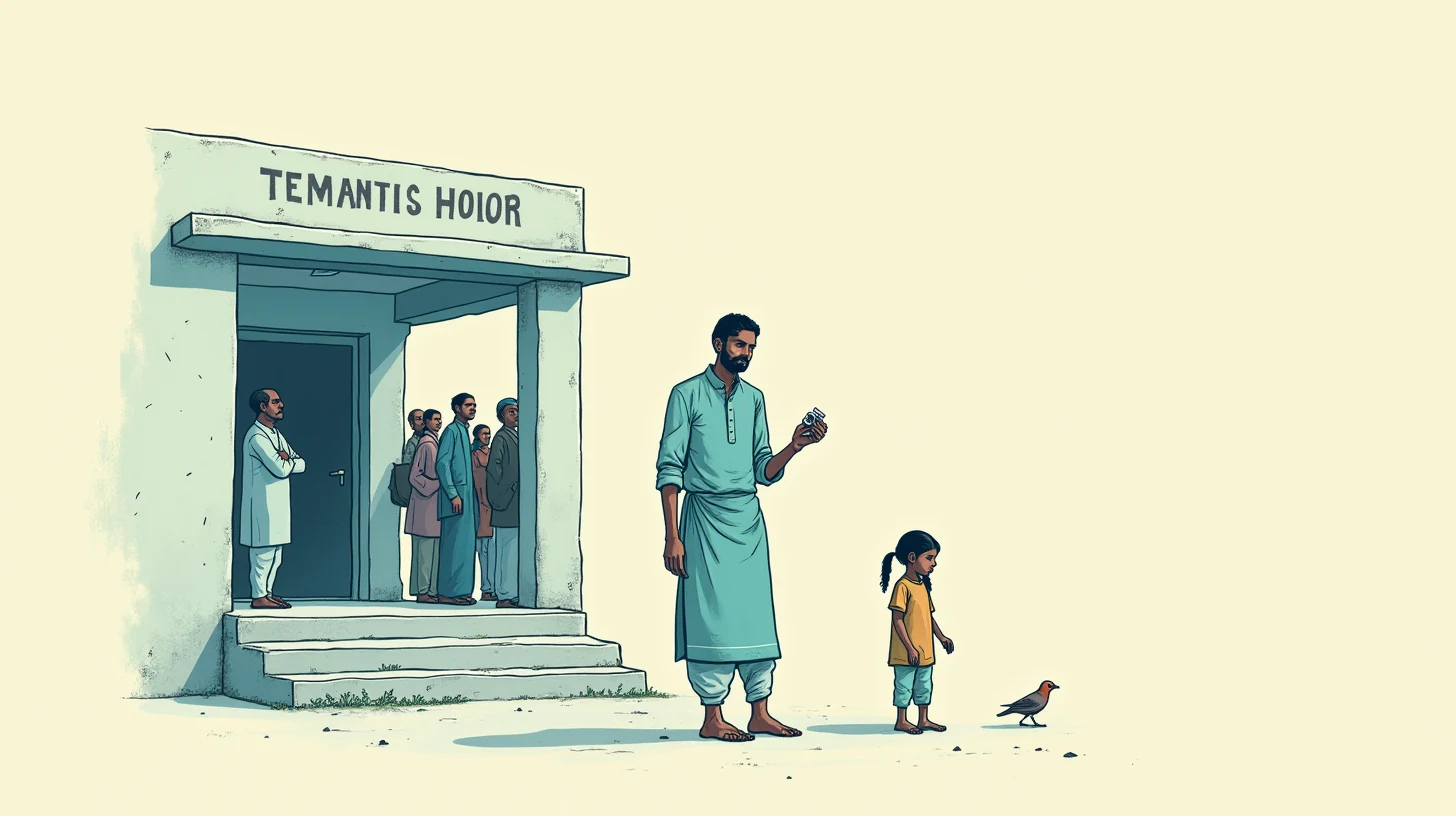
🗓️ The Token and the Timer
"It will take time, beta," he told her, more to reassure himself than her.
Deen Dayal is thirty-six years old, a daily wage mason who has worked on construction sites across Murlipura and the older areas of Jaipur for the better part of two decades. His wife, Kamla, works at a small pickle-making unit near the neighbourhood market, rolling mustard seed into jars for ₹450 a week. Together, their household earned just over ₹1.1 lakh in the previous financial year — enough for rent, rice, and a school uniform if the stitching could wait a month or two.
Lakshmi's KG admission marked a moment he had been preparing for: the Right to Free and Compulsory Education Act, Section 12(1)(c) — the RTE law that reserves twenty-five percent of private school seats for families like his. Rajasthan had launched the state RTE portal on February 1st. The application window would close on March 2nd. Exactly thirty days.
He knew he qualified. The law was clear: families with annual income under ₹3.5 lakh, or belonging to Scheduled Castes and Scheduled Tribes, had the right to apply. The Meena community, to which Deen Dayal and his wife both belonged, was listed as an ST — a Scheduled Tribe. Lakshmi had her Aadhaar card in a plastic file folder. He had Kamla's Meena caste certificate from 2020, issued by the Tehsildar's own office.
But as he waited in that chair on February 18th, with the token in his hand and forty-one numbers still ahead of him, he was convinced he needed something else: an income certificate. The RTE portal, when he had looked at it the night before on his neighbor's phone, had mentioned income. EWS. Economically Weak Section. He assumed — as so many parents do — that if you were poor, the first thing government offices wanted to know was exactly how poor you were, in writing, with a signature.
Token 223 was called. He waited.
⚠️ The Detour No One Warned About
By early afternoon, when token 237 was finally called, Deen Dayal had shifted Lakshmi to his lap. She was no longer singing.
He walked up to the counter with her in his arms. The clerk — a woman of perhaps fifty, with reading glasses on a chain and a expression that suggested she had seen approximately twelve thousand versions of his exact question — looked at him briefly.
"Income certificate ke liye kya chahiye?" he asked. What do you need for an income certificate?
She handed him a form. It was yellow. It required: proof of residence (electricity bill, ration card), Aadhaar, and the "prescribed affidavit" on twelve rupees stamp paper. She told him to come back once he had collected everything.
"How long will it take?" he asked.
"Process time is forty-five days," she said, already turning to the next person.
Deen Dayal had performed arithmetic quickly enough on construction sites all his life. Forty-five days from today, February 18th, would be sometime in early April. The RTE portal window closed March 2nd. He was looking at the mathematics of missed opportunity.
He left the office and stood in the courtyard, still holding Lakshmi, and thought about what to do.
Over the next six days, he gathered the documents. He found the electricity bill. His ration card was expired, so he went back to the distribution centre and collected a new one. Kamla's Aadhaar had arrived in a letter two months earlier. He copied it, along with his own, at a shop near the market. For the affidavit, he paid a local scribe — a man who wrote legal documents from a folding table in the corner shop — thirty rupees to prepare the twelve-rupee stamp paper. The scribe spoke in Hindi interspersed with English words that Deen Dayal didn't entirely understand. Something about "self-declaration" and "domicile." He signed where he was told to sign.
On February 25th, he returned to the Tehsildar''s office with the folder. Same counter. Different token number: 312.
This time, the clerk looked at his stack of papers and said: "This form is old. You need the new form. Come back with the new form."
He left again, defeated, and walked home in the afternoon heat wondering how a form could become obsolete in a week. When he arrived, he asked his neighbor — the one with the phone — to check if there was a "new form" online. The neighbor scrolled for a few minutes and found something called "Form D" on the Rajasthan government portal. It was dated January 2025. Deen Dayal printed it at the shop (five rupees) and began again.
By March 1st — the day before the RTE portal window closed — Deen Dayal was still waiting for the Tehsildar''s office to process his income certificate application. He had not logged into the RTE portal. He did not have the income certificate he believed he needed. And he was running out of time.
🌗 The Coaching Class Connection
That same afternoon, March 1st, Deen Dayal was sitting outside his rented room in the Murlipura neighbourhood, braiding Lakshmi's hair before dinner, when Kamla came home from the pickle unit with news. One of the women who worked with her, Preeti, had mentioned that her grandson had gotten into a good school through the RTE lottery. Preeti's son had talked to someone called a "sarkari agent" — a government-adjacent helper — through a community contact at the local temple.
"There is a coaching class that meets there," Kamla said. "Sharma ji, the retired teacher, he runs it. Preeti said he had helped three families already with this RTE business."
Deen Dayal knew of the temple — the Hanuman Mandir in the neighbourhood where he had taken Lakshmi once, on a Sunday, to do a small puja before school season. He did not know Sharma ji. But he did know that Lakshmi had one day left, and that his folder of incomplete paperwork was not going to help.
On the evening of March 1st, he walked to the coaching class.
Sharma ji was seventy-two years old, a former Hindi and Marathi language teacher who had taken voluntary retirement from a government school in 2008. He ran a small informal tutoring operation from a room adjacent to the temple, where he helped neighbourhood children with their reading and their arithmetic. He was thin, with white hair, and he wore a gamcha around his neck in the way of older men from that part of Rajasthan.
When Deen Dayal explained his situation, Sharma ji listened without interrupting. Then he said something that shifted the entire conversation.
"Let me speak to the agent first. Come tomorrow morning."
Deen Dayal slept poorly that night.
The Category He'd Overlooked
Sharma ji had used the agent — a digital intermediary that could be accessed through a simple interface and communicated in Hindi — to help other families navigate government portals and procedures. The agent was a kind of guide, trained on the actual rules and requirements of these systems, that could explain in plain Hindi what forms meant, what deadlines applied, and what documents were actually necessary versus what people thought was necessary.
On the morning of March 2nd, at seven o'clock, Sharma ji connected with the agent via the interface in his phone. Deen Dayal and Lakshmi sat in the small coaching room while Sharma ji asked the agent, in Hindi, about the RTE process.
"आप मीणा ST सामुदायिक समूह के अंतर्गत आते हैं। EWS की आवश्यकता नहीं है। आपको केवल आधार और जाति प्रमाण पत्र चाहिए। आपका 2020 का प्रमाण पत्र काम करेगा। आय प्रमाण पत्र ST कोटा के लिए आवश्यक नहीं है। और यह आवेदन आज ही हो सकता है।"
(You fall under the Meena ST community category. EWS is not needed. You only need Aadhaar and the caste certificate. Your 2020 certificate will work. An income certificate is not required for the ST quota. And you can apply today itself.)
What came back, explained slowly and clearly by Sharma ji, was this: Deen Dayal felt something in his chest loosen. The folder of forms and affidavits became, all at once, unnecessary.
"Can I apply now?" he asked Sharma ji. "Right now?"
Sharma ji nodded. "The window closes tonight, at 11:59 PM. You have time. Go home, login to the portal with your Aadhaar, and fill the form under ST quota. Attach Lakshmi's Aadhaar and your Meena certificate. Submit."
The portal address was written on a piece of paper: rajpsp.nic.in/rte/
The Application That Was Never Supposed to Happen
Deen Dayal did not own a smartphone. He had a basic button phone for calls and messages. But he had seen the portal on his neighbor's screen, and he knew that his neighbor would help him again.
By late afternoon on March 2nd, he was sitting in his neighbor's room with his neighbor's phone, the Meena certificate held in his other hand. The portal's interface was in both Hindi and English. He chose Hindi.
The form had sections: child's name (Lakshmi Meena), date of birth (August 12, 2020), child's Aadhaar (scanned image), parent details (Deen Dayal, Aadhaar, Meena caste certificate), school preferences (he had researched and chosen five schools in and around Murlipura that had good reputations and reasonable commutes). He uploaded the 2020 caste certificate as a PDF image. He left the income certificate field empty.
He did not understand all the words on the form, but his neighbor read them aloud, and together they moved through each section. By 8:47 PM, the application was complete. Deen Dayal clicked "Submit."
The portal returned a confirmation message: Application submitted. Reference number: RJ-ST-224678. Status: Awaiting lottery.
He had made it with exactly 3 hours and 12 minutes to spare.
🧭 The Relief and the Lottery
Three weeks later, on March 23rd, the Rajasthan RTE portal released the lottery results.
Lakshmi's name appeared on the list for admission to Vidya Vihar English Medium School, a small private school run by a trust three streets over from where they lived. The school had a playground, a library, and a uniform that was navy blue with a white collar. The admission fee was waived under the RTE rule. The monthly fee — ₹600 for tuition and books combined — was within what Deen Dayal and Kamla could manage if they budgeted carefully.
Lakshmi started in April. Deen Dayal took a photograph of her on her first day, sitting on the school step in her new uniform, holding her lunch container. Kamla had made her a tiffin of rice and moong dal. He still had the folder of the old forms, the yellow one and the new one, and the affidavit on the twelve-rupee stamp paper. He had thrown them away, but he remembered the weight of carrying them.
When he saw Sharma ji at the temple the following month, he touched his feet in the traditional way of showing respect and gratitude.
"The agent told me something important," Deen Dayal said, in Hindi. "I thought being poor meant I had to prove it to the government in writing, on forms, with waiting. But the law does not ask that if you belong to a community the law protects. The law already knows."
Sharma ji smiled. "That is the thing about the law. Sometimes it is written more fairly than we know. We just have to read it properly."
In Hindi: "मेरा बेटा... नहीं, मेरी बेटा लक्ष्मी को स्कूल मिल गया। लेकिन अगर उस एजेंट और शर्मा जी नहीं होते, तो मैं अभी भी तहसीलदार के दफ्तर में बैठा होता, अपने पुराने फॉर्म के साथ, जो किसी काम का नहीं था। मुझे नहीं पता था कि ST और EWS अलग हैं। मुझे नहीं पता था कि मेरे समुदाय के लिए, सरकार पहले से ही जानती है कि मैं कौन हूँ।"In English: "My daughter Lakshmi got admitted to school. But if not for the agent and Sharma ji, I would still be sitting in the Tehsildar''s office with old forms that were worthless. I didn't know that ST and EWS were different categories. I didn't know that for my community, the government already knows who I am."
🌱 The Category Matters
The RTE law in Rajasthan, and across India, exists specifically because of this: the recognition that some children are born into circumstances that the state has, through reservation and protection, acknowledged in its laws. The Scheduled Tribes and Scheduled Castes were not separate categories by accident. They were named as such because the constitution recognized that certain communities had faced systematic exclusion, and that education was one of the most powerful tools to change that.
The Meena community, spread across Rajasthan and Madhya Pradesh, has been listed as ST since the 1950s. Lakshmi, by virtue of being born into that community, carried that recognition with her. She did not need to prove that her family was poor — though they were. The law already held a place for her in the school system.
What Deen Dayal had learned, through Sharma ji and the agent, was that the different categories — EWS and ST/SC — were not simply bureaucratic subdivisions. They were different kinds of recognition. And understanding which category applied to your family changed everything about how you applied, how long you waited, and whether your daughter got to start school on time.
The income certificate remains in the Tehsildar''s office, never submitted, never processed. It would have arrived sometime in April, weeks after the portal closed, a government document for a category Deen Dayal never actually needed to use.
Today, Lakshmi comes home with stories of the playground and the teacher who taught them a new song in English. On her school day, Deen Dayal packs her lunch the night before and makes sure her uniform is clean and pressed. And when people ask him how his daughter got into a private school, he tells them: I have a community, and the law protects my community. That is how.
Resources for RTE admission in Rajasthan:
- Portal: https://rajpsp.nic.in (official Rajasthan RTE portal; applications open on announced dates, typically February-March)
- Key distinction: If you belong to a Scheduled Caste (SC) or Scheduled Tribe (ST) community, apply under the ST/SC quota — you need only Aadhaar and caste certificate, no income certificate. If you belong to an Economically Weak Section (non-SC/ST), you must apply for the EWS quota and provide a current income certificate from the Tehsildar.
- Caste certificate validity: A caste certificate issued by any State Tehsildar is valid across all RTE applications in that state. Most states accept certificates that are 5-10 years old, but it's best to verify with the portal or your state government.
- Admission timeline: Once applications close, the portal conducts a computerized lottery draw for each school. Results are published on the portal; families are notified via email/SMS.