
The Kanpur mother and the income certificate that spelled her name wrong
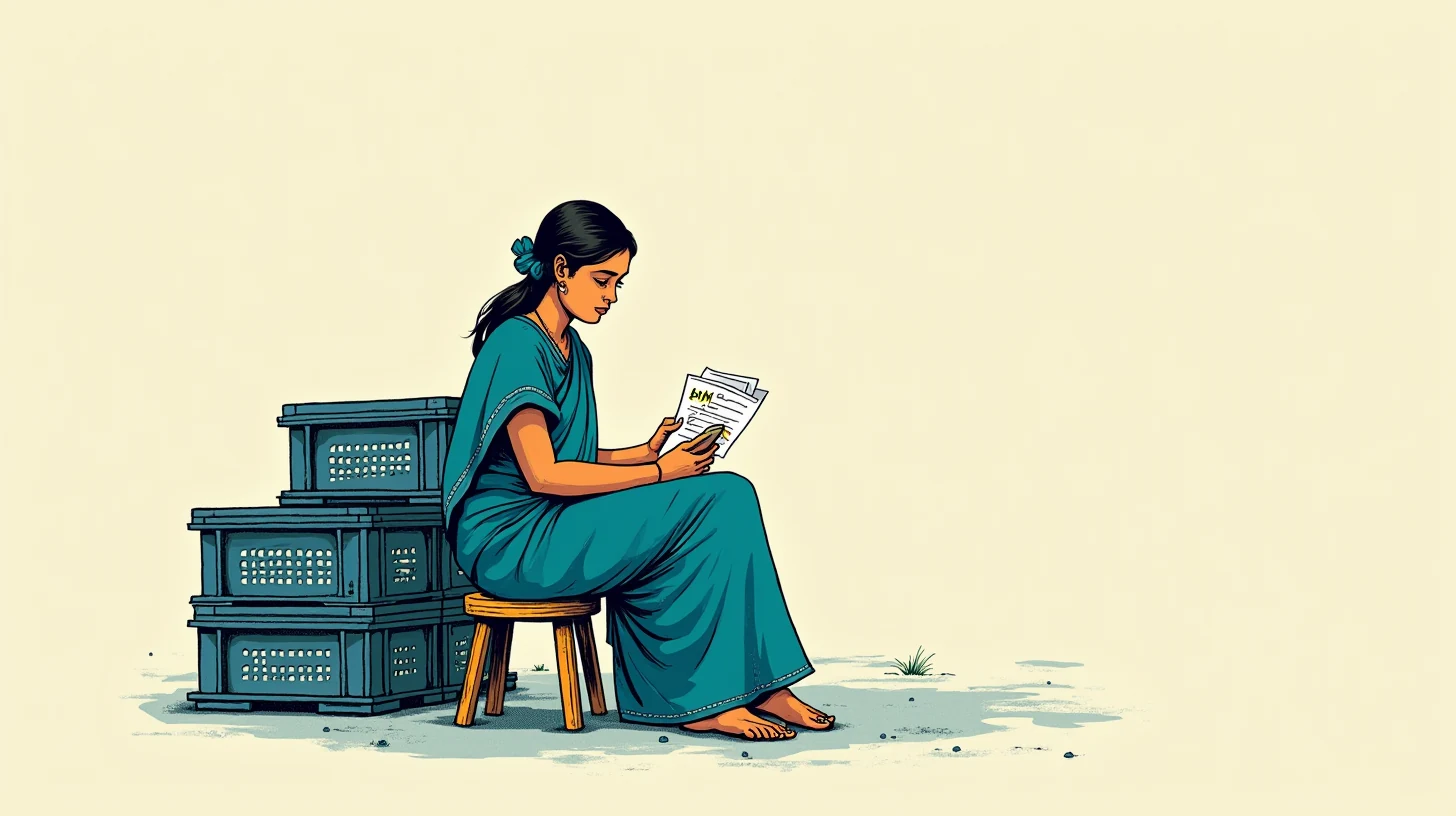
Mala Devi arrives at Gwaltoli sabzi mandi in Kanpur before five in the morning. She unloads tomatoes, onions, and leafy greens from a borrowed cart, arranges them on a low platform, and settles into the rhythm that has sustained her family for fifteen years. By seven, customers crowd around her stall. By noon, her hands are stained with soil and her back aches. By four in the afternoon, she packs up what remains and walks home to cook for her husband Ramkhelawan, who drives a rickshaw through the city's narrow lanes.
Pinki, their daughter, is in Class 10 now. At fifteen, she sits at a wooden desk in Government Girls' Higher Secondary School, Gwaltoli, writing notes in her Hindi textbook. She is bright, careful, and hungry to stay in school—not to drop out like so many of her classmates. Mala's income from the market barely stretches to ₹64,000 a year after expenses. Yet she has never asked Pinki to choose between books and the family's needs.
In February 2026, Pinki's class teacher Kavita madam called parents to a school meeting about scholarships. The UP Pre-matric OBC Scholarship, administered through the National Scholarship Portal (NSP), offered ₹5,000 to OBC students in Classes 9 and 10 from families earning less than ₹1 lakh annually. Pinki met every criterion. Mala felt something settle in her chest—a small possibility.
She obtained an income certificate from the local Tehsildar's office. She filled out the NSP application form carefully, using Pinki's Aadhaar number as the portal instructed. And then, on the day the application was submitted, the portal returned an error: Name mismatch. Aadhaar name: MALA DEVI. Income certificate name: Malati Devi. Application rejected.
The mistake was small but absolute. A clerk at the Tehsildar's office had typed "Malati Devi" instead of "Mala Devi." No one caught it before the certificate was issued. Now the NSP system, which cross-checks documents against the Aadhaar database, saw two different names and flagged the application as fraudulent or invalid. The scholarship window remained open for another three weeks. But Mala did not know how to fix it.
🗓️ The Problem: A Name Split Across Two Worlds
In UP, the income certificate is as crucial as it is fragile. Issued by the Tehsildar or a subordinate lekhpal at the block revenue office, it serves as proof of family income for scholarships, fee waivers, and government assistance. Mala's certificate was genuine. Her Aadhaar was correct. But the NSP portal operates on zero tolerance for discrepancies. Its algorithm matches names character by character. "MALA" does not equal "MALATI." The application stopped.
Mala is not literate in English. She reads Hindi fluently but has never navigated government portals. Ramkhelawan works twelve-hour days and returns too tired to think. The Tehsildar's office, when Mala visited, told her that issuing a corrected certificate would take two months. The scholarship deadline would pass. She felt the possibility begin to slip away.
It was Kavita madam—the class teacher who had helped other families navigate scholarships—who suggested something Mala had not considered. Kavita had the agent installed on her phone in Hindi. One afternoon, when Mala came to the school to pick up Pinki, Kavita showed her how to ask it.
⚠️ The Agent's Answer: Two Paths Forward
The agent, speaking in Hindi, laid out the situation with clarity:
"आप दो रास्ते अपना सकती हैं। पहला: तहसील में जाएँ और 'नाम सुधार आवेदन' दे दें—आधार की कॉपी के साथ जो सही नाम दिखाए। तहसीलदार फ़ाइल सुधार करके नया सर्टिफिकेट बीस दिन में दे देंगे। दूसरा, और तेज़: छात्रवृत्ति.up.gov.in पर जाएँ, NSP राज्य समन्वयक का 'आवेदक शिकायत' विकल्प खोलें। आधार, पुराने सर्टिफिकेट, और एक आत्मनिवेदन दें कि दोनों नाम एक ही व्यक्ति हैं। राज्य समन्वयक तीन से पाँच दिन में नाम का मेल कर देंगे। यह तेज़ है।"
(You have two paths. First: go to the Tehsildar and file a "Name Correction Application"—with an Aadhaar copy showing the correct name. The Tehsildar will correct the file and issue a new certificate in about twenty days. Second, and faster: visit scholarship.up.gov.in, open the NSP state coordinator's "Applicant Grievance" option. Submit your Aadhaar, the old certificate, and a self-declaration stating both names refer to the same person. The state coordinator will reconcile the name within three to five days. This is faster.)
The agent also explained that UP's NSP state portal specifically allows for grievances when documents match in substance but differ in spelling or minor details. The state coordinator—a real person assigned to the scholarship program—has the authority to override a name mismatch if other documentation confirms identity. Mala did not need a new certificate. She needed to tell the state coordinator the truth.
Kavita helped Mala draft the self-declaration in Hindi. Mala wrote that she was "Mala Devi, also known as Malati Devi" and that both names referred to her identity as recorded in her Aadhaar. She printed her Aadhaar, the mismatched income certificate, and the declaration. Together, they uploaded them through the NSP state coordinator grievance portal on a Saturday morning.
🌗 Timeline: From Error to Resolution
Three weeks remained on the clock when Mala uploaded the documents. Four working days later, the NSP portal sent a notification. The grievance had been resolved. The state coordinator had manually matched Mala's Aadhaar identity to her declaration and updated the scholarship system. Pinki's application moved forward.
By the end of February, the scholarship was approved. ₹5,000 was marked for Pinki's account. It would be disbursed directly to her school account by late March.
The Boundary: What NSP Allows, What It Doesn't
The NSP grievance system exists because the government acknowledges what Mala discovered: bureaucratic error is common, and zero-tolerance systems can exclude deserving families through no fault of their own. However, there are strict boundaries.
The state coordinator can reconcile a name mismatch if:
- The Aadhaar is correct and authentic
- The mismatch is a spelling or minor transcription variation
- Other documents (income certificate, school records, self-declaration) corroborate the same identity
- No fraud is suspected
The state coordinator cannot override:
- A completely wrong identity (e.g., another person's name entirely)
- A forged or invalid Aadhaar
- Caste claims without OBC certificate
- Income claims that contradict multiple official documents
Mala's case was clean. Her Aadhaar name matched her identity. The income certificate name was a clerical error, not fraud. The self-declaration tied them together. The state coordinator had the authority and the justification to act.
The Broader Reality: Why Names Matter in Government Systems
In India's scholarship and benefits ecosystem, the name is the key that unlocks every door. It must match across Aadhaar, income certificate, caste certificate, school records, and bank account. A single mismatch can derail months of waiting.
For families like Mala's, the stakes are not abstract. A delayed or rejected scholarship means Pinki might have to leave school. It means the difference between a year of tuition and supplies paid for by the market stall, or that money going to the family's rent and food. Scholarships are not luxuries for students in Mala's income bracket. They are the margin between education and dropout.
Many mothers in UP face this problem every year. Some get trapped by:
- A nickname used in school records but a formal name on Aadhaar
- A misspelled surname on the income certificate that no one corrected
- A name change on marriage that was registered with the municipality but not updated in official revenue records
- Abbreviations in one document and full names in another
The NSP grievance system exists to catch these cases. But families must know to use it. And they must be able to access it—either through their own knowledge or through help from a teacher, an NGO, or an agent that can explain the process in their language.
🧭 What Pinki Gained: The Scholarship and Beyond
When the ₹5,000 credit appeared in Pinki's school account in late March, she told Mala immediately. Mala's hands were wet from washing vegetables, and she sat down on a stool and cried for a few minutes. Not from shame or overwhelm, but from the unclenching of a tension she had carried for two months.
The money meant Pinki would not drop out. It meant books, school uniforms, and a small buffer for exam fees. It meant Mala could tell her daughter: You can stay. Your education is secured, at least for this year.
Mala does not have illusions about what one scholarship can fix in a family's life. Ramkhelawan will still pull a rickshaw. She will still wake before dawn to sort vegetables. But Pinki will be in Class 11 next year, and the year after that, she will have her XII certificate. She will have choices that Mala never had.
The agent that Kavita madam showed her did not write the scholarship rules or correct the income certificate. It simply explained the rules that already existed and pointed to the path that was already open. That made all the difference.
"अगर मला उस समय बैठा करके सोचा होता, 'यह तो गलत है, मैं कर ही नहीं सकती,' तो पिंकी की छात्रवृत्ति यहीं खत्म हो गई होती। लेकिन दुर्भाग्य को समझ कर आगे बढ़ना—यह सीख गई हूँ। और पिंकी के लिए, एक साल का पैसा हाथ में है।"(If I had simply sat and thought, "This is wrong, I cannot do this," then Pinki's scholarship would have ended there. But I learned to understand the obstacle and move forward. And for Pinki, we have a year of tuition secured.)
— Mala Devi, February 2026
🌱 The Lesson for Other Parents: Know the Grievance Path
If your child's NSP scholarship application is rejected for a name mismatch:
- Do not panic. A spelling discrepancy is fixable.
- Check if your Aadhaar is correct. If it is, and the other document has a typo, the grievance path will work.
- Go to scholarship.up.gov.in. Login, find the "Applicant Grievance" or "Complaint" section (sometimes labeled as "Shikayat" in Hindi).
- Upload: Your Aadhaar, the rejected document (income certificate), and a self-declaration (in Hindi or English) stating that both names refer to the same person.
- Wait 3–5 working days. The state coordinator will review and either approve the grievance or request clarification.
- If approved, your scholarship application will move forward with the corrected identity.
This process is free. You do not need to hire anyone or visit an office. You do not need a new income certificate (unless the document is actually fraudulent, which yours is not).
If the state coordinator asks for clarification—perhaps a school record with your name, or a bank statement, or a local notary's statement—provide it promptly. The coordinator wants to help. The system is designed to work.
Mala's error was not her fault. But her solution was her own—with one small gift from Kavita madam: knowledge that the path existed, and a tool that could explain it clearly.
Next steps for your child's scholarship: Check the NSP state portal (scholarship.up.gov.in) for your state's specific grievance process. Some states process grievances slightly differently. But the principle is the same: if your documents are genuine, the government wants to fund your child's education. The system sometimes needs help finding you.