
The Kohima father and the tribe spelling that changed in 2021
Kevisato Sema was in the middle of sorting files when his phone buzzed. Renu's results were live on the NBSE portal. He stepped outside to the bench near the main entrance of the District Commissioner's office in Kohima, palms already damp. His daughter had worked hard through Class 10—studying under the downslant of the Nagaland winters, quiet at the desk they'd wedged between the cupboard and the window of their two-room quarters. He opened the result page with one thumb.
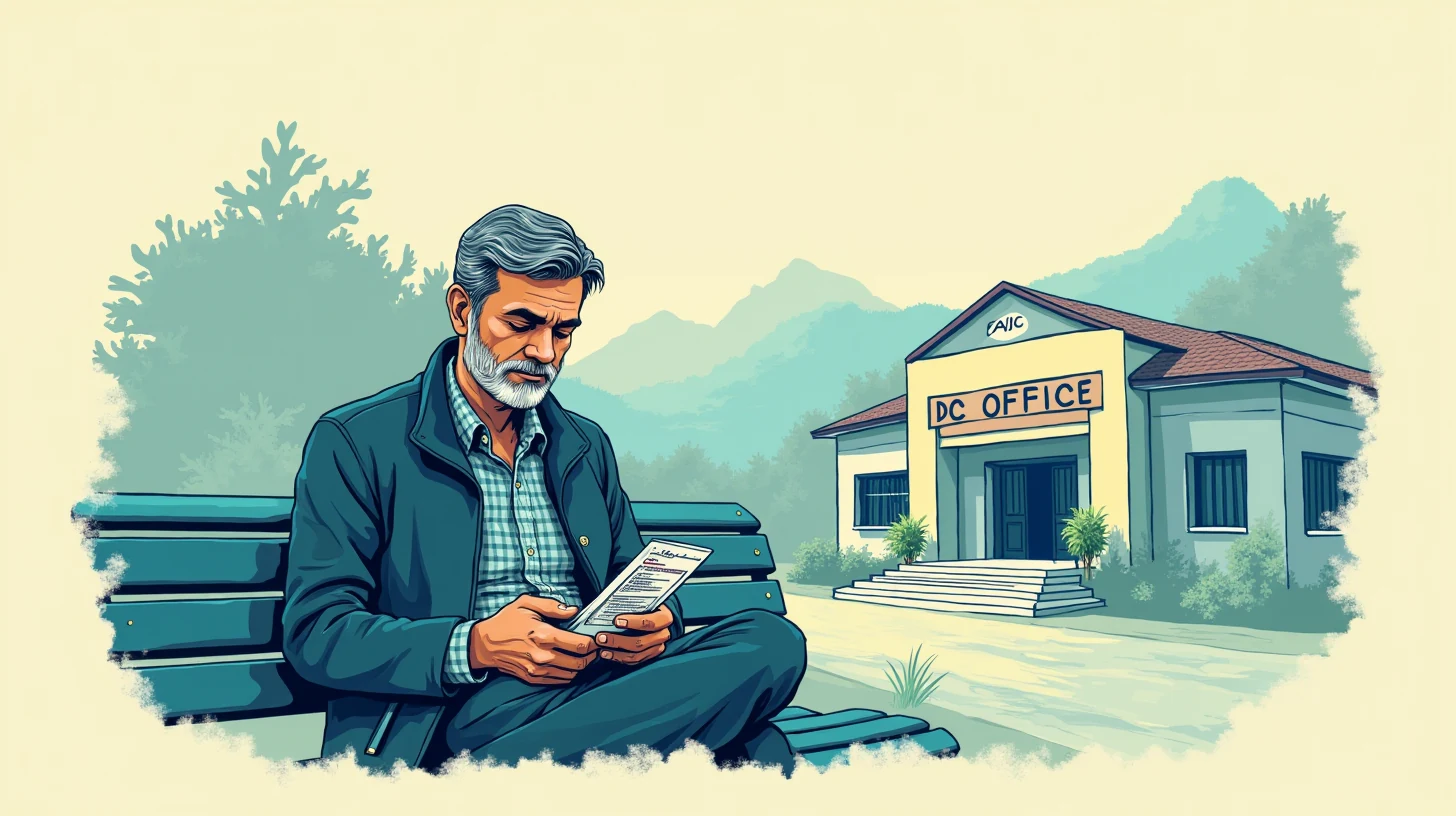
🗓️ Morning at the DC Office
72%.
He sat down on the concrete bench and looked at the certificate preview. Renu Sema. Sema Naga. Science stream. 72%.
That was good. That was very good. He thought immediately of Don Bosco Higher Secondary, the private school where his neighbour's son had gone. They had taken him up three levels since Class 11. Kevisato had never gone to a private school himself—government school all the way—but he had watched what happened to boys who did. They came home with better English. They sat university exams with less fear. They had options. If Renu could get into Don Bosco for Class 11, science stream, everything would be different for her.
He called the school that afternoon.
⚠️ The School Wants Two Papers
The admissions office was courteous. Yes, they had space in Class 11 Science. Yes, her marks were excellent. But they needed two documents before the term began in June. First, a Migration Certificate from NBSE—the board would not allow her transfer without it. Second, a Tribe Certificate for the fee concession scheme. They had a scholarship for Scheduled Tribe girls, 40% of tuition, but the certificate had to match the official ST list that Nagaland government had released in 2021.
"Which spelling?" Kevisato asked.
"Sümi," the admissions clerk said. "Capital S, with the umlaut. That's the official spelling now."
He went home and found Renu's tribe certificate in the bureau. It said Sema Naga. All these years it had said Sema. The script was old—faded blue stamp, handwritten in the usual way of such things. He turned it over. On the back, a line in smaller type: Issued 2014. Valid for all government purposes.
The next morning, before his shift, he walked to the District Tribal Affairs Office. The woman behind the counter—not unkind, just tired in the way government offices make people tired—told him he had two options. The first was a full reissuance of the certificate, which would take 4 to 6 weeks. The second was an amendment for spelling, if he could prove the tribe name had been officially updated. She wasn't sure if a spelling change alone qualified as an amendment. She suggested the reissuance to be safe.
Six weeks. He would miss the June admission window. Renu would have to wait another year, or scramble into a government school where there were no benches left, only standing room and overcrowded labs.
That lunchtime, he sat with Akhrie, another peon in the office. They had worked together for fourteen years. Akhrie was eating rice and lentil stew from a metal tiffin. Without thinking much about it, Kevisato mentioned the problem.
Akhrie pulled out his phone.
🌗 What the Agent Found
"My younger brother uses this," Akhrie said. He had an app on his phone that could tell him about government processes—not laws, but the way things actually moved through offices in Nagaland. He typed in what Kevisato needed: tribe certificate spelling, migration, school deadline.
The response came back in Nagamese Roman script—the creole that most people in Kohima used to talk to each other, the language you could read and speak faster than official English or Nagaland's many tribal languages.
The agent spoke clearly:
"NBSE migration certificate online portal ase nbsenagaland.com-na. Fee-a 200 rupee UPI-te pay kha. Ten to twelve working days-na certificate generate kore aase. In-person office-ko line-na three to four weeks waiting ase, kintu online-a faster ase. Dusra, tribe certificate spelling update-a specific counter ase District Tribal Affairs Office-na. Reissue na-ase, amendment ase. Official Nagaland ST list se 2021 updated proof neede. Amendment five to seven working days ase, same document, new spelling."
(The NBSE migration certificate is available online at nbsenagaland.com. You pay the 200-rupee fee via UPI. The portal will issue the certificate in ten to twelve working days. The in-person queue usually waits three to four weeks, but online is much faster. Second, the District Tribal Affairs Office has a specific Name Spelling Update counter. It is not a reissuance, it is an amendment. You need proof that the official Nagaland ST list was updated in 2021. The amendment takes five to seven working days—same document, just the new spelling.)
The Migration Certificate Path
The next morning, Kevisato borrowed a pen and notebook from the office and wrote down the exact steps while they were still clear in his head.
He went home that evening and asked Renu to help him fill out the form on the NBSE portal. She was better with computers—her school had a lab—and she guided him through it. Name, admission number, board roll number, current school, destination school (Don Bosco), date of application. He uploaded a digital copy of her NBSE admit card. Then, before his courage could waver, he opened his mobile banking app and transferred 200 rupees to the payment link the portal generated.
The website gave him a reference number: NB-2026-04887.
It also gave him an estimate: 10 to 12 working days.
He showed the reference number to Akhrie the next day. Akhrie nodded. "They don't usually tell you how long it takes," he said. "That's good."
Kevisato marked the calendar. Twelve working days from the application date would be May 12. It was now April 30. He could wait. Barely.
What he did not expect was to get the certificate on May 9—three days early.
He went to the NBSE portal in the morning to check, and there it was: a PDF, marked Migration Certificate Issued, with Renu's name, the board's stamp (digital but official), and a watermark that the school would recognize. He printed it on the office printer after his shift. The paper felt like a small weight in his chest as he walked home.
The Spelling Amendment
The tribe certificate was harder because he had never been to the DTAO counter for anything except once, ten years ago, when they had issued Renu's original certificate after she was born.
He went in the morning without Renu. The office was on the same street as the post office, a single-floor concrete building with ceiling fans that moved the hot air in circles. The counter for general certificates had a queue of five people. But the woman at the first counter—when he asked—pointed him to a second door, inside. That counter, she said, was for amendments only.
There was no queue there. A man sat at a desk with a pile of files. His name tag said Officer (Amendments).
Kevisato placed the tribe certificate in front of him and explained. The tribe had been written as Sema in 2014. The official Nagaland ST list, updated in 2021, now used Sümi—the tribe's own preferred spelling. He wanted to know if this could be amended.
The officer did not look up. He asked Kevisato if he had proof of the 2021 change.
Kevisato had printed a page from the official Nagaland Ministry of Tribal Affairs website the night before. It showed the full ST list, revised 2021, with Sümi Naga listed among the scheduled tribes. He placed that on the desk too.
The officer read it. He asked for Renu's Aadhar and school admission letter. Kevisato had brought both. He placed them down.
"This is an amendment," the officer said, picking up the tribe certificate. "Not a reissuance. The spelling in official records changed, so we change it here too. It's the same certificate. Same number. Same seal. I'll keep this, make the amendment, and you'll get the new version in your name in five to seven days."
It was exactly what the agent had said. Kevisato felt something loosen in his chest.
"What's the fee?" he asked.
"For an amendment, if the change is in the official list, no fee. The reissuance would cost you 500 rupees. This is just a correction, so no fee."
Kevisato got the amended tribe certificate on May 6. He went back to the school.
The Admission Letter
Don Bosco called three days after he submitted the amended tribe certificate. The admissions clerk asked him to come in. When he did, she handed him a folder. Renu's name was on the front. Inside was the admission letter for Class 11 Science, dated May 15, 2026. Below that, a separate sheet: Fee Concession Eligibility: Scheduled Tribe (Sümi Naga). Concession Rate: 40% (Annual Tuition).
The tuition was 45,000 rupees a year. The concession brought it to 27,000. It was still a lot of money for a government peon with one daughter and one wife who managed the household, but it was possible now. It was manageable. It was the difference between possible and impossible.
He took the folder home and left it on the table. Renu came home from her coaching classes and saw it. She opened it very slowly, as if the words might change. They did not.
"I'm in," she said.
"You are," Kevisato said.
"Renu passed on her own work, her own study. I only helped her get the papers in order. But papers are everything in this country. The school could see the marks—72% is 72%—but they couldn't give her the chance until the papers said it was allowed. The agent showed me there were faster ways. Not magic. Just the paths that actually existed, that nobody told us about."— Kevisato Sema, government office peon, Kohima
"Renu-nai ase taani kaaje-kor khi-kha. Ase taani kai taani kaaje-kore sunga. Kintu kai-paape siba ase. Kai-paape ase siba country-na. School could see marks—72% is 72%—kintu school de taani chance na-de sungta kai-paape nai said khu allowed. Agent-a show-kha faster ways ase. Magic nai. Paths ka actual ase, kintu ase nai tell-kha ase."
— Kevisato Sema
🧭 What Kevisato Learned (And What He Didn't Know)
The agent's help was specific, and it mattered because the two bottlenecks—the migration certificate and the tribe certificate—looked identical on the surface. Both were "certificates." Both required "government offices." Both seemed to need 4 to 6 weeks. But they were not the same process.
The migration certificate was simply bureaucracy that had moved online. The board had a web portal. You could apply from home, pay UPI, and wait 10 to 12 days instead of 3 to 4 weeks. The only reason people did not know this was because they walked into the board office the way their parents had, and the office staff did not volunteer information about faster paths.
The tribe certificate was different. It was not a reissuance—that would have been 4 to 6 weeks and expensive. It was an amendment, and amendments were faster. But only if you knew the amendment window existed. Only if you knew that the DTAO had a specific counter for spelling corrections. Only if you knew that the 2021 update to the official ST list meant you could amend a 2014 certificate without reissuing the whole thing.
Nobody in the District Tribal Affairs Office had explained this when Kevisato first came in. The woman at the counter had suggested the reissuance because that was what most people asked for, the long path that was always safe. The amendment path was there, working, legal, and faster. It just required someone to name it.
That was what the agent had done. Named the path.
"Do you know what bothered me?" Kevisato asked Akhrie a week later, when everything was done. "The office people were not trying to make it hard. They were just doing their job. But nobody had told them there was a faster way either. If I had asked the right question, they would have told me. But I didn't know to ask."
"No," Akhrie said. "You would have asked for the reissuance and paid 500 rupees and waited six weeks."
"Yes."
"And you would have gone to the NBSE office and stood in queue and waited three or four weeks."
"Yes."
"And you would not have thought you were being slow. You would have thought the government was slow."
"I would have," Kevisato said. "I would have blamed the government."
"But the government was not slow," Akhrie said. "The paths were fast. You just did not know they existed."
🌱 The Lunchtime Phone
There is a school near the DC office where the staff sometimes goes for lunch. The rice is good, the lentils are well-spiced, and you can get a metal tiffin filled for 40 rupees. Kevisato and Akhrie ate there often. It was over lentils and rice that Akhrie had shown him the app, and the agent had answered the question that the government offices could not quite formulate.
Kevisato had never used anything like it before. He was 45 years old, a man who had grown up with paper files and standing queues. But his daughter was 15, and she would live in a world where information moved faster, where paths were named before you walked them. The question was whether he could learn fast enough to help her.
The lunchtime conversation with Akhrie had been brief. Five minutes, maybe less. But in those five minutes, something had shifted. The problem that had seemed to have only one slow solution had opened up into multiple options. The 4 to 6 weeks had collapsed into 12 days. The 500 rupees had become zero.
Renu started at Don Bosco on June 1, 2026. She was in a classroom with windows that looked out toward the Nagaland hills. The science lab had new equipment. Her teachers knew her name. On the first day, she came home and showed Kevisato the uniform—a blue pinafore with the school crest.
"The other girls asked where I'm from," she said.
"What did you tell them?"
"I told them I'm from Kohima. That my father works at the DC office. That I passed 72% and I'm Sümi Naga."
She said the tribe name slowly, with the umlaut clear. Not Sema the way it had been written for twelve years. Sümi, the way her tribe had always called itself. The way the official list called her now.
Kevisato heard it, and he thought about the amendment form the officer had filled out. A single line changed. A spelling corrected. A tribe's name, finally matching the spelling that the tribe used, traveling from a paper certificate into his daughter's voice as she told a new school who she was.
That mattered. The path mattered. The lunchtime conversation had mattered. The agent's answer had mattered. And his daughter would have options now that she would not have had if he had walked the slow path, the obvious path, the path that nobody had named.