
The Kolkata mother and the bank account that was the wrong kind
Soma Ghosh stands in the Kasba branch of State Bank of India on a Tuesday morning in April, her 14-year-old daughter Rupa beside her. Rupa is in Class 9 at Government Girls' High School, Kasba. Both are quiet. Soma works as a domestic helper at three houses in the neighbourhood. Her husband Subal is a security guard. The family's daily margins are thin but intentional: Rupa stays in school.
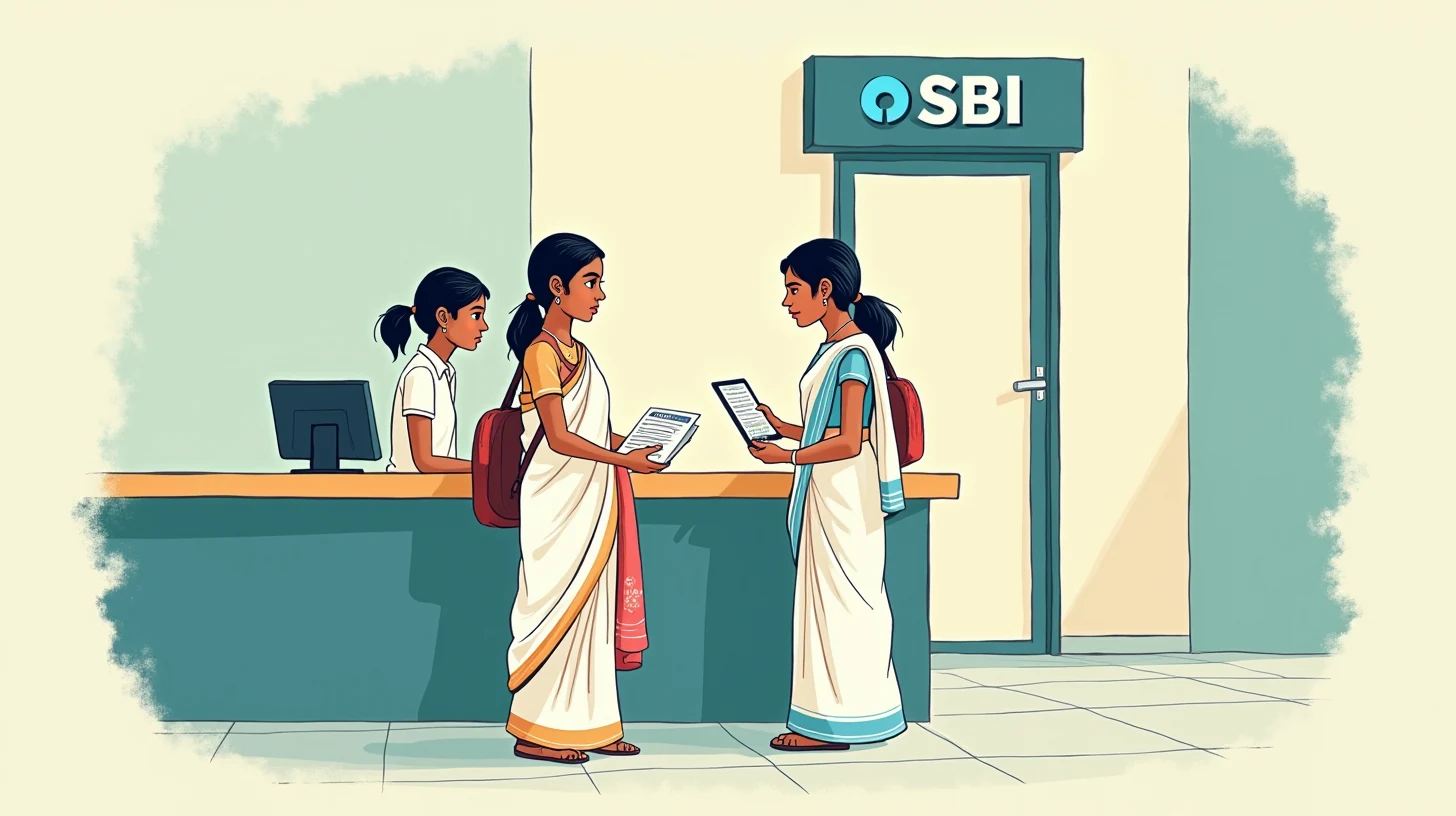
Three days ago, the school sent a notice home. Rupa qualifies for the Kanyashree Prakalpa K-1 scheme — an annual stipend of ₹1,000 from the Government of West Bengal for unmarried girls aged 13–18 enrolled in school. The money isn't large, but for a family balancing school fees and household costs, it matters. The school's message was clear: to apply, Rupa needs a bank account in her own name.
Soma knows the bank. She has had a savings account there for seven years. This should be simple. She fills out the form for a Jan Dhan Yojana account in Rupa's name — the bank teller had suggested it as the easiest option for a minor. The paperwork moves through: Rupa's Aadhaar card, her school enrollment certificate, Soma as the legal guardian signing the minor account authorization form. The bank staff mention that Soma's own Aadhaar must be seeded into the system as well for the stipend to disburse.
Within two days, Rupa has a passbook. The account number is 5014729834. Both Soma and Rupa feel relief.
Then comes Friday morning. Soma sits at the school office to file the Kanyashree K-1 application through the school's online portal. The portal asks for the account number, the bank branch, the account holder's name. Soma enters everything carefully.
A red error appears on the screen.
"Bank account: PMJDY minor — not accepted. Please open standard SB account."
Soma reads it twice. Rupa leans in. Neither understands what has happened.
🗓️ H2: The Wrong Product in the Right Bank
The system showed that Rupa's account was classified as a Pradhan Mantri Jan Dhan Yojana (PMJDY) minor account. The school's Kanyashree portal rejected it. PMJDY accounts are designed to provide financial inclusion at the broadest scale — zero-balance, no-frills accounts that prioritize access. They serve many government benefit schemes. But the Kanyashree K-1 scheme, it turns out, has a specific requirement buried in its technical documentation: the account must be a standard savings (SB) account in the girl's name, not a PMJDY account.
This distinction exists because different benefit schemes have different disbursement rules and account management protocols. PMJDY accounts are used for other West Bengal schemes, including the K-2 component of Kanyashree itself — a larger benefit available at age 18 for girls who marry after 18 or pursue higher education. But K-1, the school-years stipend, routes its payments through standard SB accounts. The school portal's validation is strict: it cross-checks the account type against the state's banking classification system.
Soma had done nothing wrong. The bank had done what it thought was right — offering the simplest account type available for a minor. But the simplest account was not the one the government stipend required.
The confusion runs deeper. At most SBI branches across West Bengal, PMJDY accounts for minors are promoted as the default for government schemes. Bank staff see the Aadhaar, the minor's age, and the mention of a government benefit, and they reach for the Jan Dhan form. Few branches actively distinguish between K-1 and K-2 requirements, because the distinction isn't part of their daily workflow. It lives in the school portal's validation rules, not in the bank's opening procedures.
Soma has the account, but she cannot use it. The school portal will not accept it. The stipend cannot be processed. Rupa remains enrolled but unbenefit.
⚠️ H2: The Woman in the Queue
On Monday morning, Soma returns to the bank with Rupa. She plans to explain the error and ask for a solution. The queue at the SBI Kasba branch is long — it usually is on Mondays. Soma and Rupa stand together, the passbook in Soma's hand, the error message screenshotted on her phone.
Next to them stands a woman in her fifties, also waiting. Her name is Dipti. She is checking her account balance, and she has her phone open. On the screen is the same kind of agent interface that many people now use — a conversational tool, running in Bengali, helping with questions about banking and government schemes. She had been asking it about account conversions.
Dipti overhears Soma explaining her situation quietly to Rupa. She doesn't interrupt immediately. But when the conversation pauses, she leans over gently.
"Is your daughter's account a Jan Dhan?" she asks in Bengali.
Soma nods, surprised.
Dipti explains what she has just learned through the agent on her phone. The account type can be changed. It is not permanent. At this very branch, the staff can convert a PMJDY account to a standard SB minor account using an internal product conversion form. The account number stays the same. The classification changes. Once it changes, the school portal should accept it.
Soma's face shifts. "The bank can do that? Here?"
"The bank opened the wrong kind. They can fix it," Dipti says. She shows Soma the agent's explanation on her phone — a few lines in Bengali, describing the SBI product conversion process and the timeline. "Ask the staff for the product conversion form. It takes one to two working days after they submit it."
Soma thanks her. Dipti's name is noted, though neither woman expects to meet again.
When Soma reaches the teller's window, she asks directly: can they convert the PMJDY account to a standard SB minor account?
The teller is quiet for a moment. Then nods. It is possible. It requires a form — sometimes called Form F-1 or a variant, depending on the branch's internal numbering. The teller fetches a supervisor, who confirms: yes, they can process this. It is a product reclassification, not a new account. They will need Soma's and Rupa's presence, some basic verification, and they will submit it to the branch's backend system.
The form is filled out that morning. The supervisor says: "We will notify you when it is complete. Two working days, usually."
"সোমা, একটি Jan Dhan অ্যাকাউন্ট এবং একটি স্ট্যান্ডার্ড সেভিংস অ্যাকাউন্ট একই ব্যাংক থেকে আসে কিন্তু সরকারের সিস্টেমে তারা আলাদা পণ্য। Kanyashree K-1 এর জন্য তোমার SBI শাখায় একটি 'প্রোডাক্ট কনভার্শন' ফর্ম খোলার প্রয়োজন — এটি একটি অভ্যন্তরীণ ফর্ম, সাধারণত F-1 নম্বর দেওয়া হয় বা শাখার নিজস্ব নাম থাকতে পারে। অ্যাকাউন্ট সুপারভাইজরকে বলবে, 'আমার মেয়ের Jan Dhan অ্যাকাউন্ট স্ট্যান্ডার্ড SB মাইনর অ্যাকাউন্টে কনভার্ট করতে চাই, কারণ সরকার Kanyashree K-1 এর জন্য এটি চাইছে।' ব্যাংক এটি তাদের সিস্টেমে সাবমিট করবে। এক বা দুই কাজের দিন লাগবে। অ্যাকাউন্ট নম্বর একই থাকবে, শুধু ধরনটি পরিবর্তিত হবে। তারপর স্কুলের পোর্টাল এটি গ্রহণ করবে।"
(Soma, a Jan Dhan account and a standard savings account come from the same bank but are different products in the government system. For Kanyashree K-1 at your SBI branch, you need to open a "product conversion" form — it's an internal form, usually numbered F-1 or the branch may have its own name for it. Tell the account supervisor: "I want my daughter's Jan Dhan account converted to a standard SB minor account because the government requires it for Kanyashree K-1." The bank will submit it in their system. It takes one or two working days. The account number stays the same; only the type changes. Then the school portal will accept it.)
🌗 H2: The Technical Boundary Between Two Government Schemes
Soma does not yet fully understand the technical reason for the difference. But she understands the practical one: Rupa's account was classified under the wrong scheme's routing. The bank's product conversion form will change that classification. The school portal will then see it correctly.
🧭 H2: Two Working Days, and the Message That Matters
On Wednesday morning, the SBI branch calls Soma's phone. The conversion is complete. Rupa's account is now classified as a standard SB minor account. The account number remains 5014729834. The passbook will be updated at the next statement cycle, but the internal banking system has already registered the change.
Soma returns to the school office the same afternoon. She opens the Kanyashree K-1 portal again and reenters the account details. This time there is no error message. The portal accepts the account. The application is filed. Status: pending state processing.
By the following week, the state system processes the application. ₹1,000 is transferred to account 5014729834. Rupa's name appears in the Kanyashree K-1 beneficiary list.
For Soma, the relief is specific. The ₹1,000 will go toward Rupa's school supplies, books, and tuition support in the coming year. It is not life-changing money, but it is meant money — a government recognition that girls in school matter, that families in Kasba matter, that a mother's effort to keep her daughter enrolled is seen by the state.
For Rupa, the stipend is a small affirmation. She was 13 when she became eligible, and she will receive it each year until she turns 18 or leaves school. By the time she finishes Class 12, if she stays enrolled, the scheme will have provided ₹6,000 across six years. In the context of a family where daily wages can be unpredictable, that accumulation is significant.
The barrier was not the scheme itself. It was the gap between what the bank offered and what the government system required.
Bengali: "আমি জানতাম না যে একই ব্যাংক দুটি ভিন্ন ধরনের অ্যাকাউন্ট খুলতে পারে যা দেখতে এক কিন্তু সরকারের কাছে আলাদা। রুপা এখন যে টাকা পাবে তা তার বইয়ের জন্য, পরীক্ষার খরচের জন্য। ছোট অংক, কিন্তু যা আমাদের এক মাসের খরচ সামলাতে সাহায্য করে। এবং সবচেয়ে বড় কথা — এটি মানে আমাদের মেয়ে স্কুলে আছে, সরকার লক্ষ্য করছে, এবং সেই লক্ষ্য একটি সংখ্যা।"English: "I didn't know the same bank could open two different types of accounts that look the same but are different to the government. The money Rupa gets now is for her books, her exam fees. It's a small amount, but it helps us manage one month's expenses. And most of all — it means our daughter is in school, the government sees her, and that seeing becomes a number that reaches us."
— Soma Ghosh, domestic helper, Kasba, Kolkata
🌱 H2: What Soma Learned, What the System Shows
This story illustrates a boundary that exists in Indian government benefit schemes but is rarely visible until you cross it. The boundary is not between eligible and ineligible. Rupa was always eligible for Kanyashree K-1. The boundary is between the bank's operational default and the government scheme's technical requirement.
When Soma opened the Jan Dhan account, the bank was following a well-intentioned protocol: Jan Dhan Yojana is the government's flagship financial inclusion scheme. It is promoted at every bank counter. It is the easiest account to open. Most bank staff are trained to recommend it for minors seeking government benefits. And for many government schemes, Jan Dhan is acceptable or even preferred.
But Kanyashree K-1 is different. Its validation rules are strict. It was designed to work with standard savings accounts because the school's disbursement infrastructure was built to interface with a specific account classification. This specificity was probably not documented at the bank-counter level. It lives only in the school's online portal — a rule that activates only when an application is actually submitted.
For Soma, the resolution required three things: information (learning that conversion was possible), agency (asking the bank to perform the conversion), and time (waiting two working days). A woman in a bank queue, with access to an agent in Bengali, provided the information. The SBI branch provided the agency. Time, as always, was simply necessary.
The ₹1,000 that Rupa receives each year is not large enough to change her family's economic status. But it is deliberate enough to affirm that girls in school are seen by the state, and that the machinery of Indian government — despite its complexity, despite its gaps — has the capacity to route that affirmation into actual money in the right account.
For Soma, that capacity is what Kanyashree means.
What it does
- 🔍Identifies the product classification mismatch between Jan Dhan and standard SB accounts
- 🗂️Locates the exact form (product conversion form) needed at the SBI branch
- ⏰Confirms the 1-2 working day timeline for product reclassification
What it does not do
- 🔒Never accesses Soma's bank account or portal login — the credentials remain with Soma
- 💳Never submits forms or applications on Soma's behalf — she visits the bank directly
- ✅Never guarantees the portal will accept the account — the final decision rests with the school's Kanyashree system