
The Nagpur father and the CBSE Verification-of-Marks window
Anil Marathe, 47, manages sales and accounts at a pesticide distributor on Wardha Road in Nagpur. He has kept ledgers all his working life — cost per litre, margin per trip, numbers that balance or don't. His wife Sushma teaches Marathi at a primary school in Kalamna. Their daughter Riya, 16, had been expecting her CBSE Class 10 results to arrive sometime in May, and they had arrived on May 13.
Science 88. Maths 91. Social Studies 85. English 82. Overall 84. A solid result. College entries would open soon. Anil had already begun thinking about the forms, the merit lists, the admission counselling calendar that comes after boards.
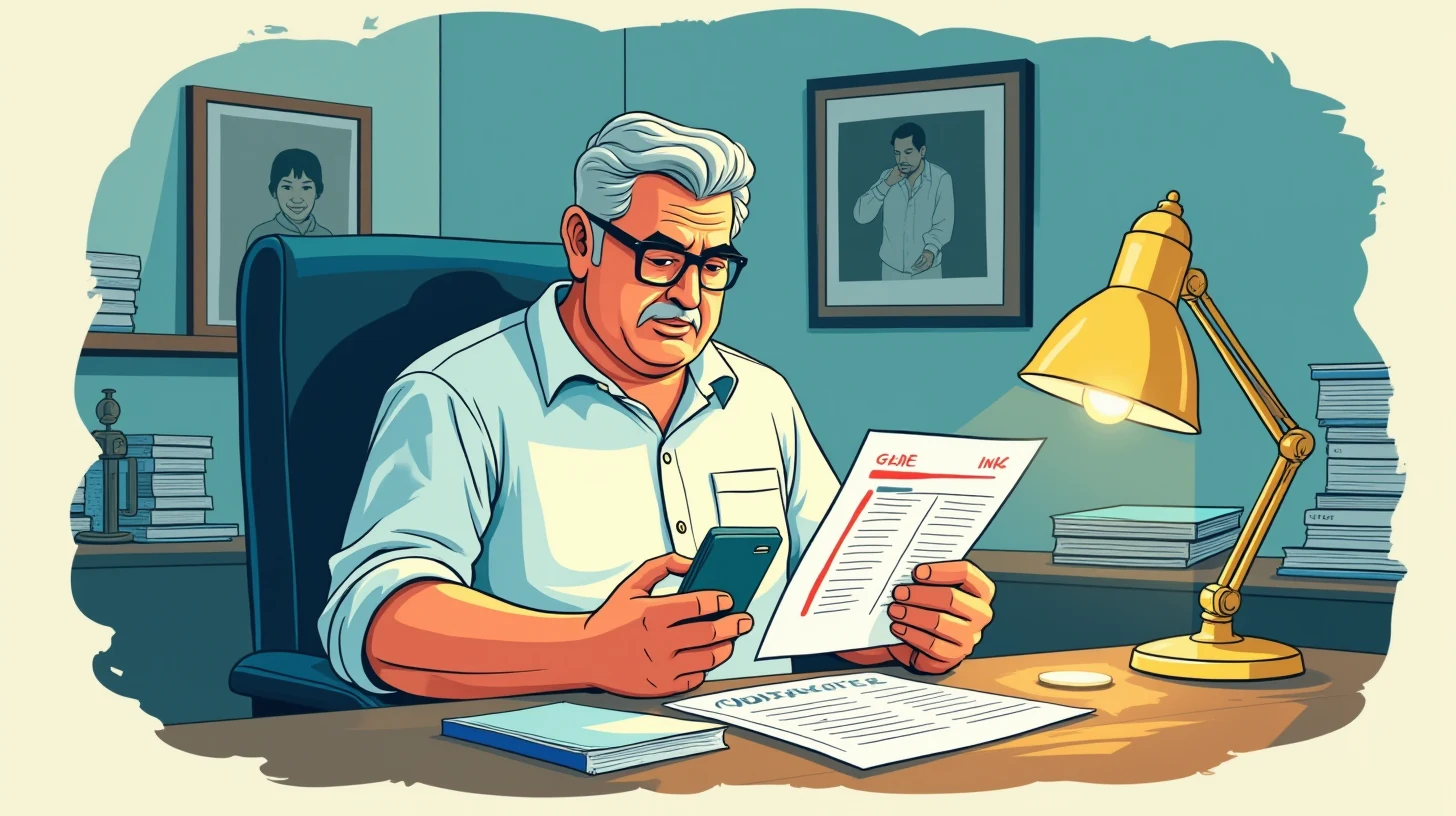
Then he saw the Hindi score. 64.
He looked at it for a long time. Riya had been prepared by Mrs. Agrawal, a retired KV teacher from Dharampeth with 22 years of classroom time behind her. In the pre-board exams six weeks earlier, Riya had scored 92 in Hindi. Mrs. Agrawal had said — without any hedging — "Is bacchi ko Hindi mein nahi roke. Score sure hai." This girl will not be held back in Hindi. The score is certain.
And yet here was 64. The gap between 92 and 64 was 28 marks. In a 100-mark paper, 28 is not a margin of error. It is a chasm.
Sushma sat with the marksheet. She had taught language long enough to know that second-language learners sometimes made unforced errors under exam pressure. But the pre-board had been real too. Riya's answers had been good. The two scores did not live in the same sentence.
By evening, Anil had received four WhatsApp PDFs from the parent group — "CBSE Verification Process," "CBSE Re-evaluation vs Verification," "Important Dates," and one screenshot of an unreadable government website. He had also heard two voice notes from Ramesh, a neighbor whose son was in Class 12, explaining the difference between something called "verification of marks" and something else called "re-evaluation," and then contradicting himself three minutes into the second message. The net result was that Anil understood less than when he had started.
He knew that there was a deadline. Somewhere, a window was closing. The FYJC Maharashtra college admissions portal would open on June 5. The gap between May 13 and June 5 was not large. And somewhere in that gap was a sequence of forms, fees, and processes that the WhatsApp group could not quite agree on.
By 10 PM, Anil had a headache.
🗓️ The seventeen-day window
CBSE's post-result services exist because no marking system is perfect. Evaluators work through thousands of papers. Arithmetical errors happen. Borderline answers get borderline treatment. The board has built in three formal paths to challenge or correct a result.
The first is Verification of Marks. This is a totalling check. The evaluator marks each question out of its allocated points — a 6-mark question receives 0 to 6, a 2-mark question receives 0 to 2. At the end of the paper, these are added up. Verification checks whether that arithmetic was done correctly. It costs ₹500 per subject. It does not re-read the answers. It does not revisit the evaluator's judgment. It only counts.
The second is Photocopy of Evaluated Answer Book. For ₹700 per subject, the student receives the scanned pages of their actual evaluated paper through DigiLocker. They can see the marks written against each answer. They can see what the evaluator wrote in the margins. They can read the paper they wrote and understand why they got the marks they got.
The third is Re-evaluation. For ₹100 per question, a student can ask for specific questions to be re-read by a different examiner. This is not a second look at the whole paper. It is a targeted intervention: "I believe the answer to Question 7 was undermarked. Please re-evaluate it." The student cannot access this service until after they have received the photocopy. They cannot, in other words, ask for re-evaluation without first knowing what their answer actually said and what marks it received.
The sequence is mandatory. Verification can be filed immediately. Photocopy can be filed immediately alongside it. But re-evaluation cannot be filed until the photocopy has arrived and been reviewed.
The window for Verification and Photocopy is seventeen days from result declaration. May 13 plus seventeen days is May 30. The Maharashtra government's FYJC college admissions portal opens June 5. In that gap — five days between the Verification/Photocopy window closing and FYJC opening — re-evaluation results do not arrive.
Anil understood, reading the agent's reply, that he could not wait for re-evaluation to decide which college to apply for. He would have to apply with whatever Riya currently had: 84 percent.
The Nagpur parent group, however, was still debating. One member had called a "CBSE re-evaluation agent" who operated from a shop in Itwari and been quoted ₹5,000 to "navigate the whole process." Another had received a PDF claiming that verification and re-evaluation were the same thing, just with different terminology. A third insisted that re-evaluation results usually came within five days. (They do not. Usually, results come within 30 days. Sometimes they come within 14. The variability creates anxiety.)
By the time Anil had read through a dozen messages, the consensus had inverted three times.
The structural problem was this: three services with similar names. Three different fees. A mandatory sequence that no one explained clearly. An information ecosystem of PDF screenshots and voice notes, each one slightly wrong or incomplete. And a deadline that bore no relation to when the actual results came back.
Anil needed clarity. The agent had given it.
⚠️ What the WhatsApp group couldn't clarify
Past 11 PM, Anil was still at the desk. Riya was in the other room with her rough notes from the pre-board exam, cross-referencing her memory of the Hindi paper question by question, trying to remember what she had written. Sushma sat at the table with her. She did not have the answers. She had come to understand, over many years of teaching, that a daughter cross-referencing her own exam paper is a task that requires someone nearby but not necessarily someone who knows the answers.
The WhatsApp maze had left Anil with fragments: — Verification only checks addition. That much was clear. — Re-evaluation was "very expensive" — though ₹100 per question seemed modest compared to the ₹5,000 fixer fee. — Something about SMS confirmations going to the school, not the phone. — Something about DigiLocker that he did not have an account for. — A cutoff list from Hislop College Commerce that suggested the 86.4% merit score. Riya's 84% would not make it. But 85% might. 86% would be safe.
The arithmetic mattered because the colleges that Anil and Sushma had researched — places where a student with Riya's temperament and aptitude could be happy — were not the colleges that would bend merit cutoffs by half a point. One or two marks could be the difference between a college list that included Hislop and one that did not.
The agent's reply had organized this chaos. Here is what the agent had said:
"Verification of Marks sirf totalling check karta hai — evaluator ne marks sahi se jode ya nahi. Answers dobara nahi padhta. Photocopy aapko actual answer book ki scanned copy deta hai, DigiLocker ke through — wahan aap dekh sakte hain ki har question ko kitne marks mile aur evaluator ne kya socha. Re-evaluation tabhi file hoti hai jab photocopy dekh lo — specific questions identify karo jahan galti lagi. Teen cheezein alag hain, ek hi order mein karni hain. Ek important baat: confirmation SMS school ke registered number pe jaata hai, aapke phone pe nahi — kal subah class teacher ko call karke SMS forward karwa lena."
(Verification of Marks only checks totalling — whether the evaluator added the marks correctly. It does not re-read the answers. Photocopy gives you the actual scanned answer book via DigiLocker — there you can see how many marks each question received and what the evaluator thought. Re-evaluation is filed only after seeing the photocopy — identify the specific questions where an error seems to have occurred. Three different things, in one fixed order. One important thing: the confirmation SMS goes to the school's registered number, not your phone — call the class teacher tomorrow morning to get it forwarded.)
The next morning, Anil called Riya's class teacher and got the SMS by 9 AM. He opened the CBSE portal, applied for Verification of Marks in Hindi and Photocopy of Evaluated Answer Book in Hindi simultaneously, paid ₹500 + ₹700 = ₹1,200 by UPI, and completed the application by 10:30 AM.
He also applied to FYJC on June 5 with Riya's current 84 percent, listing Hislop College as the first preference and Sevadal Junior College as the second.
The agent had reminded him, unprompted, to apply before the window closed. Do not wait for re-evaluation results. The timeline will not permit it.
- ⚖️
Step 1 — Verification of Marks (₹500 per subject)
The board rechecks whether the evaluator's marks per question were totalled correctly on the marksheet. It does NOT re-read or re-assess the answers. Window opens with result declaration; closes in 17 days.
- 📨
Step 2 — Photocopy of Evaluated Answer Book (₹700 per subject)
The scanned pages of the actual evaluated answer book are delivered via DigiLocker. You can see exactly how many marks each answer received and where the evaluator wrote their notes. Must apply after Step 1 (can be simultaneous).
- 🔍
Step 3 — Re-evaluation (₹100 per question)
After reviewing the photocopy, the student identifies specific questions where the evaluator appears to have made an error. Re-evaluation is applied to those questions only — not the whole paper. Cannot be filed before receiving the photocopy.
- ₹
Total worst-case cost: ₹2,000
Verification (₹500) + Photocopy (₹700) + Re-evaluation of 8 questions (₹800). Less than a quarter of what 'CBSE re-evaluation agents' in Nagpur charge families for navigating the same portal form.
🌗 What the agent clarified
The answer book arrived via DigiLocker twelve days after the application. Anil and Riya sat together and read through the scanned pages. Most of the marks were legitimate. The evaluator's notes made sense for most answers. But one question — a 6-mark question about textual references in Hindi literature — had been marked as 2 out of 6. Reading the question again and Riya's answer, it seemed that the textual references were embedded mid-paragraph rather than at the beginning of the answer. The evaluator, reading at speed, might have missed them.
Anil showed the question to Sushma. Sushma read it twice. She thought the references were there. They were just not where a tired evaluator, racing through the 95th answer of the day, would expect to find them.
Anil applied for re-evaluation of that one question: ₹100. He filed it on the CBSE portal the same day the photocopy arrived.
On July 8, the re-evaluation result came back. Three marks had been recovered on the 6-mark question (6 minus 2 = 4, but re-evaluation gave 5, so +3). And in the totalling verification, a small error had been found — one mark had been dropped in an earlier calculation. Together, these added 4 marks: 64 became 68.
Riya's overall percentage rose from 84 to 85.
Hislop College's cutoff that year was 86.4 percent. Riya did not make it.
What it does
- ⚖️Explains the three CBSE post-result services, their fees, and their mandatory sequence in the language the parent thinks in
- 🗂️Reviews the photocopy answer book with the student and identifies which questions have arguable mark deductions
- ⏰Flags parallel deadlines — FYJC or equivalent college admission portals that close before re-evaluation results arrive
What it does not do
- 🔒Never logs into the CBSE portal — the parent's roll number, date of birth, and account remain private
- 💳Never makes the ₹500/₹700/₹100 payments on the parent's behalf
- ✅Never predicts how many marks will be restored — re-evaluation outcomes are decided by a second CBSE examiner
🧭 Who else this happens to
Anil and Sushma are not unusual. Every year, approximately 1.5 million students appear for CBSE Class 10 and Class 12 exams. A small percentage — a few thousand families each year — believe their marks contain an error serious enough to question. Most do not. Of those who do, a significant fraction do not know that a formal process exists, or understand that the process has a mandatory sequence and a seventeen-day window.
The CBSE post-result system is not opaque by design. The rules are published. The portal is functional. The fees are modest. But the information gap between the rules and the families who need them is real. It lives in WhatsApp groups where PDFs contradict each other, in fixers who charge ₹5,000 for portal navigation that costs ₹1,200 in official fees, and in the gap between May 13 and June 5 — the dates that no one had mapped for Anil before the agent did.
That is the problem this agent was built to close: not the bureaucratic system itself, but the layer of confusion between the system and the families who have the most at stake in navigating it correctly.
"मुझे पता था मैंने वो question ठीक किया था। अब मुझे वो भी पता है कि evaluator ने कहाँ भूल की। वो बहुत बुरा नहीं लगता।"— I knew I had answered that question correctly. Now I also know where the evaluator made the mistake. That doesn't feel as bad.
🌱 What arithmetic can and can't do
Riya enrolled at Sevadal Junior College. On a weekend in June, Anil and Riya visited the campus together. It is a quieter place than Hislop — fewer students, more green space, a campus that feels manageable rather than overwhelming. The commerce faculty is solid. The placement record is good. It is not the college they had first chosen, but it is a college where Riya could build something.
One afternoon, weeks after the re-evaluation results had arrived, Riya was reviewing the photocopy of her own answer book again. She was reading the 6-mark question that had been marked as 2, then re-evaluated to 5. Anil asked her what she thought.
Riya said: "Mujhe pata tha mein woh question theek kiya tha. Ab mujhe woh bhi pata hai ki evaluator ne kahan bhool ki. Woh bahut bura nahi lagta."
I knew I had answered that question correctly. Now I also know where the evaluator made the mistake. That doesn't feel as bad.
Anil is not certain whether this is a good outcome. The marks that were genuinely wrong came back. The family did not pay ₹5,000 to a fixer operating from a shop in Itwari. A sixteen-year-old girl read her own evaluated paper, understood why she scored what she scored, understood where the evaluator had erred, and went to college without bitterness. She knew she had not failed the question. She knew the arithmetic now.
Sushma, when Anil told her what the agent had said that first night — marks recovery is usually 1 to 4, rarely 14 or more — had nodded and said: "Accha kiya bata diya." Good that it told us. The expectation was adjusted. The emotion was rational. The family had not arrived at the result with the fantasy that 14 marks would come back.
Anil thinks that this is something. Not everything. Something.
The window is seventeen days from result declaration. The ledgers on his shelf all balance to the rupee. This one will not balance to 86.4. But the path was clear. The costs were visible. The sequence made sense. And a daughter knows, now, that when an evaluator marks her paper too fast, there is a way to ask for a second look.
That is what the information asymmetry robbed families of. Not the marks themselves. The clarity that a mark could be asked for in the first place.