
The Port Blair mother and the NVS domicile wait
Leena Biswas stood in the kitchen of Government Senior Secondary School, Phoenix Bay, ladling sambar into aluminum containers for the lunch service. It was a Tuesday in December 2025, and her hands moved through the familiar rhythm — chop, stir, taste, adjust. At thirty-five, she had spent more than two decades in this job, feeding schoolchildren, known by name to every canteen staff member and half the teaching staff. She lived three kilometers away, in a rented house near the water. Her life in Port Blair was not grand, but it was rooted.
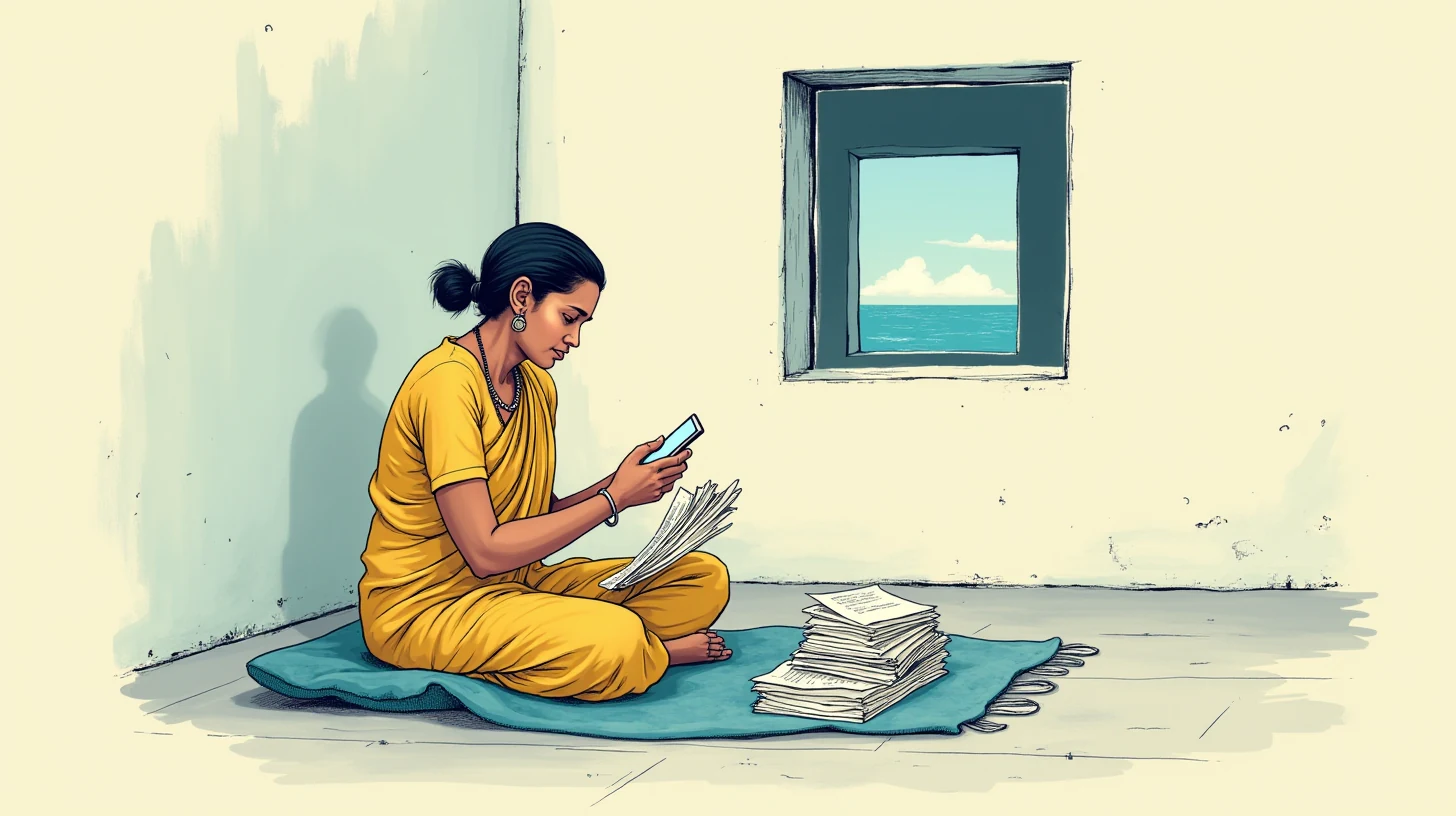
🗓️ The Quiet Victory in a Pile of Papers
That afternoon, a message reached her phone. Rohan, her eleven-year-old son, had qualified for the Jawahar Navodaya Vidyalaya (JNV) Class 6 entrance examination. The JNVST — the national selection test held once a year — had chosen him. He would study in English, board at a residential school, everything free. The letter from navodaya.gov.in said the next step was a domicile certificate from the District Collector's office in Port Blair.
Leena read the message twice. She showed it to her sister at the stove. Then she called her husband Subhash, who was out on the water that day, and told him the news. By evening, she had printed the JNV letter and placed it on the table in her living room. Rohan sat beside it, grinning. He had studied hard for the exam. Now, the school had noticed.
But what came next was not the smooth path she imagined.
⚠️ The Domicile Wall
The District Collector's office sat on the ridge above Port Blair's harbor, a compound of older buildings and newer extensions. Leena had never been there before. On a Saturday morning, she dressed carefully — a printed cotton saree, her good sandals — and took Rohan with her. They carried the JNV letter, her ration card, and a hope that the process would be simple.
It was not.
The clerk at the domicile counter was matter-of-fact. Yes, she needed a domicile certificate. Yes, she lived in Andaman & Nicobar Islands. But she had one problem: her 2021 ration card — the only document she had brought — showed her state of origin as "West Bengal," not Andaman. The clerk explained that the rules required a 15-year residential proof plus an affidavit to correct any ambiguity. Leena had lived in Port Blair since 2001, so she had the years. But she did not have the documents to prove it.
The clerk handed her a checklist. She needed to submit:
- An affidavit on 10-rupee stamp paper, sworn before a notary, declaring her 24-year residence in Port Blair.
- At least two supporting documents showing her address in Andaman — such as a voter ID, electric bill, bank passbook, or Aadhaar card.
- A character certificate or letter from her employer.
Leena looked at the list. The affidavit alone required a visit to a notary. The voter ID on her list was from 2015 — she had never updated it, and the address showed her old home in Delanipur, not her current address in Phoenix Bay. The electric bill she had at home was from December 2025. The bank passbook, if she could find it, might have the 2001 account opening. She had no Aadhaar card yet.
The window closed after six weeks from the JNVST results. In December, that meant early February.
🌗 When the Agent Arrived
A few days later, Leena's sister-in-law's daughter Priya visited from the mainland. Priya was eighteen, had just finished Class 12, and spent more time on her phone than in conversation. She was the kind of young person Leena found both baffling and useful. While waiting for lunch, Priya noticed the pile of documents on the table — the ration card, the blank stamp paper, the JNV letter, and the DC office checklist.
"Aunt, what is all this?" Priya asked.
Leena explained the domicile certificate, the voter ID problem, the timeline. Priya listened, scrolling through her own phone. Then she said, "I know something that might help. There's an app called the agent. It understands legal stuff. Let me install it."
Leena was skeptical. She had heard of other people's children downloading things that "helped," and nothing ever came of it. But Priya was already setting it up on an old phone she left behind. She opened the app, found the language toggle for Bengali, and explained: "Just tell it what you need. It will explain in Bengali."
Leena tried it that evening, sitting at her kitchen table with Rohan doing homework next to her. She typed in Bengali: "মেরে ছেলে জেনভি অ্যাডমিশনের জন্য ডমিসাইল সার্টিফিকেট দরকার। কিন্তু ভোটার আইডি তে পুরনো এড্রেস আছে। কি করব?" (My son needs a domicile certificate for JNV admission. But the voter ID has an old address. What should I do?)
The agent replied in Bengali, explaining the voter ID update process — she could file online through the CEO Andaman portal or physically at the Electoral Registration Officer's office. It would take 30 to 45 days. Then it said something else, something Leena had not heard at the District Collector's office:
"আপনার ভোটার আইডি আপডেট করতে পারেন। কিন্তু আরও সহজ পথ আছে। জেনভি শুধু ভোটার আইডিতেই আটকে নেই। যদি আপনি তিনটি ডকুমেন্ট দিয়ে দেখাতে পারেন যে আপনি ১৫ বছর পোর্ট ব্লেয়ারে থাকেন — যেমন ব্যাংক অ্যাকাউন্ট, ইলেক্ট্রিসিটি বিল, আধার কার্ড — এবং স্কুল থেকে বোনাফাইড সার্টিফিকেট নিয়ে যান, তাহলে ডিসি অফিস সেটা গ্রহণ করবে।"
(You can update your voter ID. But there is an easier way. JNV is not stuck on the voter ID alone. If you can show with three documents that you have lived in Port Blair for fifteen years — such as a bank account, electricity bill, Aadhaar card — and bring a bonafide certificate from the school, the DC office will accept it.)
The agent had found an alternative path. JNV often accepted a school bonafide certificate from the child's current school as address proof in lieu of the voter ID, if the parent could show residential proof through any combination of three documents. The DC office had never mentioned this.
Leena stared at the phone. The window that seemed to be closing had just opened wider.
The Three-Document Path
The next morning, Leena gathered the documents that mattered:
Her bank passbook, opened in 2001 in Port Blair, with the Phoenix Bay address printed on it. Her husband's name was there beside hers. Every deposit, every withdrawal, twenty-four years of transactions in one small book.
Her electric bill from December 2025, showing her current address in Phoenix Bay and her account number.
Her Aadhaar card, issued in 2021, with her biometric and her current address.
Three documents. Combined, they told the story of a woman who had arrived in Port Blair as a newlywed in 2001, opened a bank account, built a life, stayed. The voter ID did not matter, not if she could show this instead.
She still filed the affidavit. A notary in the market near the harbor took her thumb impression on a 10-rupee stamp paper, and she paid him 200 rupees. She also took a letter from her school — the principal, who knew her well, wrote on school letterhead that Leena Biswas had worked in the canteen since 2005 and had always given her address as Phoenix Bay.
Then she went to Rohan's current school, St. Jude's Higher Secondary, and requested a bonafide certificate. The school issued it in two days. It stated that Rohan was enrolled as a student, that his mother's address was Phoenix Bay, and that the certificate was issued to support an educational application.
With the three documents, the affidavit, the character letter, and the bonafide certificate, Leena returned to the District Collector's office on a Thursday morning. She was nervous. The clerk who received her seemed new, or perhaps indifferent — he took the stack without comment, stamped each document, and placed them in a file.
He said, "We will call you in two weeks."
Leena had not expected a call. She had expected another visit. But she went home and waited.
The Window Closes and Opens
The call came in eleven days. The District Collector's office had approved the domicile certificate. It was ready for collection.
Leena took an auto-rickshaw to the office on Saturday morning, stood in a queue for twenty minutes, and received a single document — the Andaman & Nicobar Islands Domicile Certificate, issued by the Government of India, in her name, confirming her residential status in the Union Territory. The certificate was printed on white paper and felt official, with the state seal and the Collector's signature.
She held it in her hands as she left the office. The sea was visible in the distance, beyond the harbor, the same water her husband worked on every day.
That afternoon, she submitted the domicile certificate and the bonafide certificate to JNV Port Blair through their online portal. The portal showed her application as "received" and "under review." She marked the date in a small notebook she kept.
One week later, an email arrived. Rohan had been accepted. Admission confirmed. Class 6. English medium. Residential campus. Hostel and meals included. The session would begin in April 2026.
Leena printed the email. She showed it to Subhash. She showed it to Rohan, who punched the air and grinned wider than she had seen in months. She showed it to her sister, who cried a little.
What the Agent Did — And Did Not
:::infographic timeline The JNV Domicile Timeline: Leena's Path
December 2025: Rohan qualifies in JNVST exam ↓ (same week) Leena visits DC office; learns 15-year residential proof + affidavit required; voter ID shows old address ↓ (3 days) Priya installs the agent; Leena learns the bonafide certificate alternative ↓ (1 week) Leena collects bank passbook, electric bill, Aadhaar card; files affidavit with notary; obtains school character letter ↓ (1 week) Requests and receives bonafide certificate from Rohan's school ↓ (10 days) Submits three documents + affidavit + character letter + bonafide to DC office ↓ (11 days) DC office approves; Leena collects domicile certificate ↓ (3 days) Submits domicile + bonafide to JNV through portal ↓ (7 days) JNV confirms Rohan's admission; Class 6 begins April 2026
Total time: 6 weeks | Window remaining: 2 weeks :::
:::infographic boundary What the Agent Revealed — And What It Could Not
The agent showed Leena:
- The voter ID update process (online CEO portal + Electoral Registration Officer; 30–45 days)
- The alternative bonafide certificate path that the DC office had not mentioned
- The specific documents that JNV accepts as residential proof (bank passbook, electric bill, Aadhaar)
- How to frame the affidavit and which documents to pair with it
The agent did not:
- Collect the documents (Leena had to find the bank passbook, pay the notary, visit the school)
- Predict the DC office's approval timeline (11 days was faster than expected)
- Guarantee JNV acceptance (the final decision was JNV's)
- Eliminate the need for her to visit the DC office and JNV portals herself
- Change the fundamental rules (15-year residential proof was still required)
The difference: knowing what was allowed versus knowing what was possible in the rules that existed. :::
In Leena's words:"রোহান অনেক পড়ে। ক্লাসে সবসময় ভালো নম্বর পায়। আমি ভাবিনি ও জেনভিতে যাবে। এখন ও ইংরেজি মাধ্যমে পড়বে, থাকবে স্কুলে। আমি গর্বিত। এবং ভাগ্য যে খুব খারাপ নয়, এটাও ভাবি। পুরোনো ভোটার আইডি যদি এক্সাকট ম্যাচ করতে হতো, তাহলে শেষ হয়ে যেত। কিন্তু অন্য পথ ছিল। তা আমরা জানতাম না।"
"Rohan studies a lot. He always gets good marks in class. I never thought he would make it to JNV. Now he will study in English medium, live at the school. I am proud. And I think that luck is not entirely against us. If the old voter ID had to be an exact match, it would have been over. But there was another way. We just did not know it."
🧭 The Agent's Words: What Changed
When Leena first spoke to the agent about the voter ID problem, it responded in Bengali with a specific insight. Here is what it said:
"আপনার ভোটার আইডি আপডেট করতে পারেন। কিন্তু আরও সহজ পথ আছে। জেনভি শুধু ভোটার আইডিতেই আটকে নেই। যদি আপনি তিনটি ডকুমেন্ট দিয়ে দেখাতে পারেন যে আপনি ১৫ বছর পোর্ট ব্লেয়ারে থাকেন — যেমন ব্যাংক অ্যাকাউন্ট, ইলেক্ট্রিসিটি বিল, আধার কার্ড — এবং স্কুল থেকে বোনাফাইড সার্টিফিকেট নিয়ে যান, তাহলে ডিসি অফিস সেটা গ্রহণ করবে। প্রকৃতপক্ষে, নিয়ম এটাই অনুমতি দেয়।"
"You can update your voter ID. But there is an easier way. JNV is not stuck on the voter ID alone. If you can show with three documents that you have lived in Port Blair for fifteen years — such as a bank account, electricity bill, Aadhaar card — and bring a bonafide certificate from the school, the DC office will accept it. In fact, the rules permit this."
That single insight changed everything. It was not that the rules had changed. It was that Leena — and the DC office clerk — had not known what the rules actually allowed. The agent had read the same rules, traced the same pathways, and found a route that did not require a 30–45 day wait for a voter ID update.
Leena had no formal education beyond Class 10. She worked with children and kitchens, not documents and portals. The agent spoke her language, Bengali, and it explained not just what was wrong, but what was possible. That distinction was the entire story.
🌱 Rohan Packs for Hostel
By late March 2026, when JNV began its pre-admission orientation, Rohan was ready in a way that surprised Leena. He attended the online sessions, watched videos about the hostel, read the handbook. He had never been away from home for more than a night. The school was on the outskirts of Port Blair, but boarding meant staying there six days a week.
On a Sunday in April, Leena and Subhash drove him to the campus. The buildings were newer than Leena expected, with green spaces and a large play area. Other families were there too — parents checking in their children, some nervous, some excited. The hostel warden shook Rohan's hand and showed him to his room. He would share it with three other boys from Class 6.
Leena unpacked his clothes and his two new school uniforms. She organized his toiletries and his books. Rohan sat on the bed and looked out the window at the campus and, beyond it, the Port Blair sky. When it was time to leave, he stood up and hugged her. He did not cry. She almost did.
In the auto-rickshaw on the way back, Subhash held her hand. They did not speak much. Leena was thinking about the pile of documents on the table, the clerk at the DC office, the phone with the agent, the moment when she realized there was a way forward when it seemed there was none.
By evening, she was back in the school kitchen, ladling sambar, living the same hours she had lived for twenty years. But something had shifted. Her son was at a good school, learning in English, and she had navigated a system that was never built for someone like her. The agent had opened the door, but Leena had walked through it.