
The Raipur mother and the scholarship bank name mismatch
Sunita Netam sat in the waiting area of the Arang Government Higher Secondary School, watching buses rumble past the dust-covered gates. It was October 2025, nearly two months since her daughter Kavita had submitted the scholarship application online. In Arang block, just 45 kilometres southwest of Raipur, the monsoon had left the fields waterlogged and her husband Budha's day-wage earnings spotty. Every fortnight without word from the scholarship portal felt like a missed harvest.
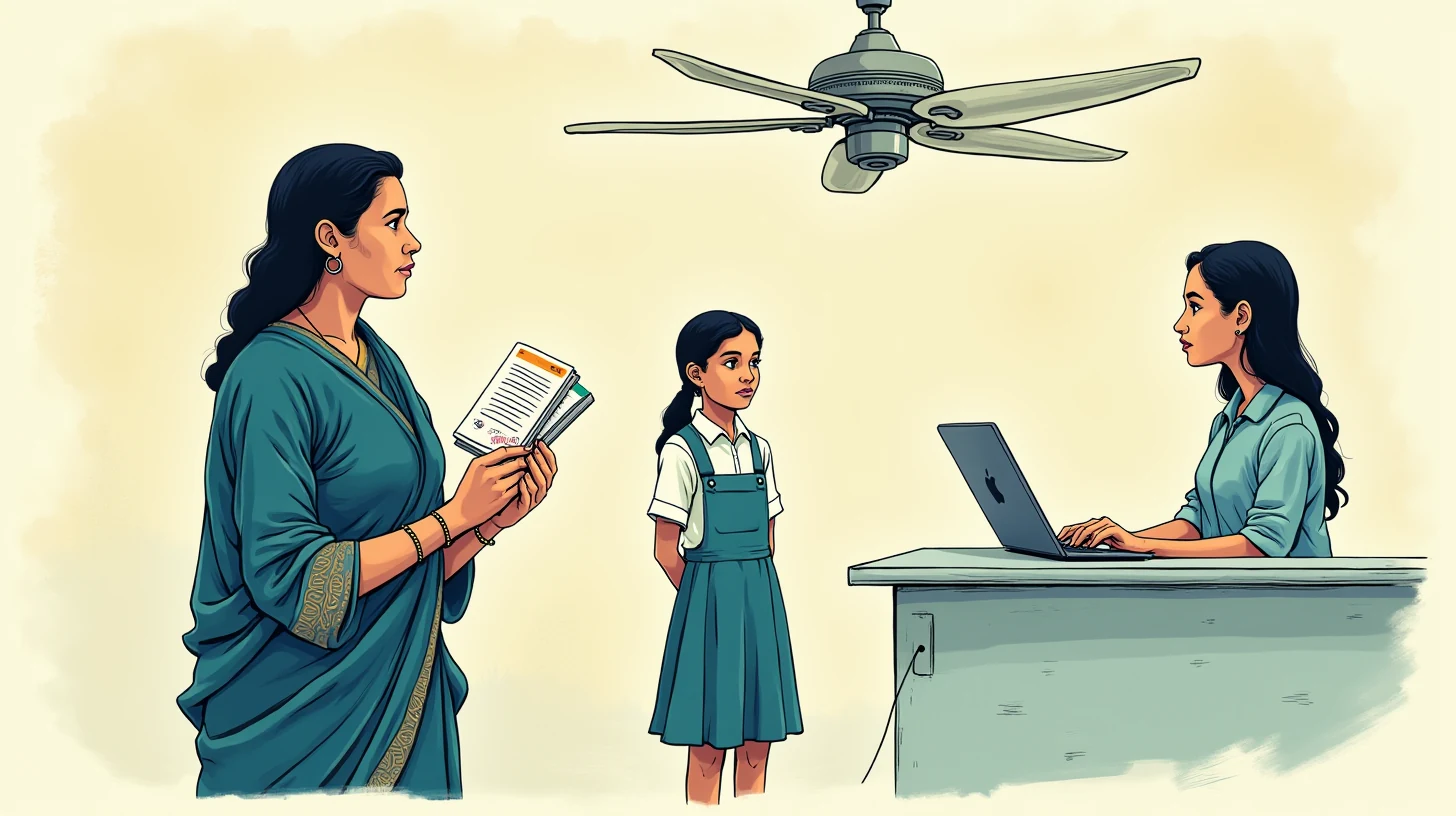
🗓️ The scholarship that almost didn't arrive
She had brought the printout with her—the one that made no sense. Bank verification failed. That's what it said, in the kind of government English that leaves you staring at the screen. Kavita was ST (Scheduled Tribe), Class 11, eligible for the Chhattisgarh Pre-matric Scholarship through NSP. The grades were good. The documents were submitted. Everything matched, or so it seemed. But the PFMS (Public Financial Management System) had looked at the name on the bank account and said no.
The problem wasn't malice or bureaucratic slowness. The problem was a name.
Sunita earned ₹54,000 a year in agricultural labour. Budha earned the same, maybe a little more in cotton-picking season. Together, they had barely crossed five digits a month. The scholarship—₹2,000 for the academic year—wasn't going to make them wealthy, but it would buy Kavita's textbooks without the family cutting meals. And the message on the portal, that one tiny gate closing, felt like it might cost her daughter's future.
That's when a voice behind her said, "Kavita applied for scholarship, haan?"
⚠️ How the teacher became a bridge
It was Sharma sir, Kavita's Class 11 Hindi teacher. He taught at Arang Government Higher Secondary, where most of the students came from families like Sunita's—families where every rupee mattered. He knew the scholarship process inside out because he had helped dozens of girls navigate it. And he had begun to notice something: the ones who succeeded weren't always the brightest or the most organized. They were the ones who had someone to ask when the system broke.
Three months earlier, Sharma sir had attended a state education department training workshop in Raipur on government correspondence and digital literacy. Another teacher from a district college had mentioned a tool—not a traditional helpline, not a government office—an agent that could be talked to in Hindi, that knew the specific rules of Chhattisgarh scholarships, PFMS systems, and the peculiar ways that banks and the NSP portal didn't always speak the same language. The teacher had used it to resolve a name mismatch issue of his own and had passed the information along.
Sharma sir pulled out his phone during the parent-teacher meeting. He showed Sunita the agent's interface. "Ask it about bank verification," he said. "Tell it your daughter's situation."
Sunita had never used a smartphone like this before. Budha had an old Android with a cracked screen, mostly for receiving work-site calls. But Sharma sir guided her. She asked, in Hindi, about the bank verification failure.
"PFMS नाम-मिलान बहुत सख्त है। आपकी बेटी का बैंक खाता 'कविता बुद्ध नेटम' के नाम से खुला था—पितृनामक प्रारूप, उसके पिता का नाम। लेकिन NSP और PFMS उसे आधार और स्कूल प्रमाण पत्र से 'कविता नेटम' के रूप में जानते हैं। वे मेल नहीं खाते, इसलिए सिस्टम कहता है नहीं। नोटरी एफिडेविट से बैंक में नाम सुधार करना पड़ेगा—पचास रुपये, पाँच दिन में खाता नया नाम दिखाएगा।"
(The PFMS name-matching system is very strict. Your daughter's bank account was opened as "Kavita Budha Netam"—the patronymic format with her father's name. But NSP and PFMS know her as "Kavita Netam" from her Aadhaar and school certificate. They don't match, so the system says no. You'll need a notary affidavit to correct the name at the bank—fifty rupees, five days for the account to show the new name.)
The agent's response came back in clear Hindi, with the tone of someone who had seen this exact problem a hundred times:
Sunita felt her chest tighten. This was a real problem, not a typo.
🌗 The patronymic name trap
To understand why this had happened, you have to go back to 2015, when Kavita was ten years old.
That year, Budha and Sunita had taken Kavita to the UCO Bank branch in Arang to open a savings account. At the time, it seemed like a good idea—a place for pocket money, a safe account if they ever needed to deposit emergency earnings. The bank officer had written down the name as it was spoken: "Kavita Budha Netam." In the Chhattisgarhi tribal tradition, especially in rural areas, a girl's name often included her father's name for official records. No one had thought to question it. The account worked fine. Money went in, money came out.
But the world of government digital systems does not run on tradition. The Aadhaar database, created when Kavita turned 12, listed her as "Kavita Netam." The school register, updated when she entered Class 9, listed her as "Kavita Netam." The NSP scholarship portal cross-checks names against Aadhaar with the precision of a clerk who has seen too many fraud cases to look the other way.
The PFMS system—which disburses all central and state scholarship money—uses an algorithm that matches bank account names character by character. "Kavita Budha Netam" will never equal "Kavita Netam" in such a system, no matter how much they refer to the same girl.
The agent, continuing its explanation in Hindi, broke it down: "This is common. It's not that your daughter won't get the scholarship. It's that the bank and PFMS don't recognize each other. The bank has one name. The government ID has another. You need to make them the same."
The path to correction
The solution, the agent explained, required a specific sequence of steps. First, Sunita would need a notarised affidavit from a notary public—someone with legal standing to certify that "Kavita Budha Netam" and "Kavita Netam" are the same person. This affidavit would state, in legal language, that both names refer to the same girl, with the same birth date and father's name, and that the bank account should reflect the Aadhaar name for all government disbursement purposes.
Second, she would take this affidavit to the UCO Bank branch in Arang—the same branch where the account was opened—along with Kavita's Aadhaar card and the school certificate. The bank would submit a "Name Correction Request" into their internal system, updating the account to reflect the correct name.
Third, once the bank's records were updated, the PFMS system would be able to verify the account. The scholarship would follow.
The agent also provided a number: the Chhattisgarh State Scholarship helpline. 1800-233-5568. "If there's any delay at the bank, or if they give you trouble, call this number. Tell them your daughter's name and the scholarship ID. They can check the status and sometimes push things along."
Sunita wrote the number down carefully on the back of the printout that had caused her so much worry.
The fifty-rupee solution
The notary at Arang tehsil—a small office tucked between a tailor shop and a ration distribution centre—charged ₹50 for the affidavit. Fifty rupees. For a family earning ₹54,000 a year, ₹50 was two hours of Budha's labour in the cotton fields. But Sunita paid it without hesitation.
The notary had seen this before. He asked for Kavita's Aadhaar, her birth certificate (which Sunita had kept safe for sixteen years), and Budha's identification. He typed up a single page in Hindi and English, stating that the undersigned guardian Sunita Netam was certifying that "Kavita Budha Netam," born [date], daughter of Budha Netam, and "Kavita Netam," holder of Aadhaar number [XXXX-XXXX-XXXX], are one and the same person. He stamped it with his seal, signed it with a red ink pen, and handed it to Sunita.
"This will work," he said. "Just take it to the bank with the Aadhaar and anything from the school."
The next morning, before the fields got too hot, Sunita and Kavita walked to the UCO Bank branch in Arang. It was a small, government-owned bank, understaffed and perpetually behind on paperwork. But the manager, Mr. Rao, had seen name correction requests before. He knew the rules. He took the affidavit, the Aadhaar, and the school certificate. He wrote down the account details and the request number.
"Five to seven days," he said. "Sometimes faster. We'll update the system and send you an SMS when it's done."
Sunita's voice, from notes after the scholarship was disbursed:"जब नाम की समस्या आई, तो मुझे लगा कि सब खतम हो गया। लेकिन शर्मा सर ने एक उपाय दिखाया जो हमारे पास था। सिर्फ पचास रुपये, एक कागज़, और पाँच दिन। अब कविता की स्कॉलरशिप आ गई। हर महीने बीस पचास रुपये उसके स्कूल के लिए जो हम बचाते हैं, अब वह ज्यादा है।"
When the name problem came, I thought everything was lost. But Sharma sir showed me a solution that was within our reach. Just fifty rupees, one paper, and five days. Now Kavita's scholarship has arrived. Every month, the twenty, fifty rupees we save for her school—now there is more.
Six working days later, the SMS arrived. The account name had been updated. Sunita checked the NSP portal on Sharma sir's phone. The status had changed. Bank verification: Passed.
Within two weeks, the scholarship money—₹2,000—appeared in Kavita's account.
When systems don't talk to each other
The story of Sunita and Kavita is a story about how government systems, designed with good intentions, sometimes create barriers that only become visible when you run headlong into them.
The NSP (National Scholarship Portal) is a centralized system. It collects applications from all over India, for scholarships from all states and the central government. It needs standardized data: names, Aadhaar numbers, bank account details. The PFMS (Public Financial Management System) is equally standardized. It's a disbursement machine. It takes a name and searches for a matching bank account. If it finds one, money flows. If it doesn't, the process stalls.
Neither system has the flexibility to say, "Well, these two names are probably the same person, so let's let it slide." Flexibility is the enemy of audit trails. Flexibility is how money goes missing. So both systems are intentionally rigid.
The gap falls between them. It's a gap that banks know about—because they've been issuing accounts for decades, under various naming conventions—and that schools know about, because they've been registering students longer than Aadhaar has existed. But the gap is small enough that most people never see it. Your name is probably consistent across all your documents. Your parents probably used the same format everywhere.
But if you're born into a tradition where your father's name is part of your official name, and you grow up in a place where government IDs are issued without that tradition, the gap becomes a chasm.
The agent's explanation to Sunita wasn't revolutionary. It was simple: identify where the gap is, find the tool to close it (in this case, a notarised affidavit and a bank name correction), and use it. But that simplicity only arrived because someone had asked the question before, had found the answer, and had recorded it in a way that could be retrieved and explained in clear Hindi.
🧭 What Kavita's scholarship means
In the final week of October 2025, Kavita sat in Sharma sir's office to review the status. The scholarship had been disbursed. The notification on NSP was clear: "Approved and Payment Processed."
For Kavita, the ₹2,000 was enough to buy the Class 11 textbooks without her parents postponing the purchase. It was enough to keep her focused on her studies rather than on the weight of her family's finances. But the scholarship meant something larger, too: it meant that the system, however clumsy, had worked. The state government's pledge to support tribal students had actually reached her.
Sunita's relief was physical. She had been terrified for two months that the scholarship would simply disappear—that some glitch in the system would mean months of waiting, or worse, that Kavita would be denied because of a technicality beyond their control. Instead, there had been a solution. A teacher who had taken the time to learn a little more than his job required. An agent that could translate the language of government systems into the language of a rural Chhattisgarhi mother. A notary with fifty rupees' worth of authority.
The scholarship was small in rupees, but it represented something that many families at Arang Government Higher Secondary school understood without being told: the difference between an education that happened and an education that was interrupted. The difference between completing Class 12 and dropping out at Class 11 to work in the fields. The difference between a daughter who became a teacher or a nurse, and a daughter who became a worker without choices.
Budha, when Sunita told him the money had come through, said simply: "Good. Now she can study without worry."
Sunita was already planning. The scholarship would come again in the final year, if Kavita maintained her marks. That was another ₹2,000. And if Kavita made it to college, there was a post-matric scholarship. The state had set up a system. You just had to know how to navigate the places where the system had gaps.
🌱 The agent's guidance: How the system actually works
When Sunita asked the agent about the next steps, once the bank name correction had been submitted, the agent provided this guidance in clear Hindi:
"PFMS nام-matching ki prabandh bahut sakht hai. Bank mein account ka naam 'Kavita Budha Netam' tha, lekin Aadhaar aur NSP mein 'Kavita Netam' hai. Ye dono alag hain, isliye PFMS verification fail hua. Bank mein naam sudharne ke liye notary affidavit chahiye—isses dono naam ek aadmi ke liye hain yeh likha ho. Affidavit + Aadhaar + school certificate lekar bank mein jaao. Woh apna internal system update karega. Paanch se saat din mein account name badal jayega. Phir PFMS dobara check karega aur match ho jayega. Scholarship aayega."
The PFMS name-matching system is very strict. Your daughter's account at the bank was opened as "Kavita Budha Netam," but her Aadhaar and NSP show "Kavita Netam." These are different, so PFMS verification failed. To correct the name at the bank, you need a notary affidavit—stating that both names refer to the same person. Take the affidavit, Aadhaar, and school certificate to the bank. They will update their internal system. In five to seven days, the account name will be changed. Then PFMS will check again and the match will succeed. The scholarship will arrive.
This was advice that applied precisely because the agent understood not just the rules, but the ways that rules broke down in practice. It wasn't written in the NSP handbook. It wasn't on the Chhattisgarh scholarship webpage. It was the kind of knowledge that lived in the experience of teachers, notaries, and bank managers—people who had seen the same problem before and had learned the solution.
By October 2025, as Kavita's scholarship status changed from "Failed" to "Approved," the solution had saved Sunita from weeks of futile phone calls to government offices, and had saved Kavita from the real possibility of incomplete schooling.
In Arang block, and across Chhattisgarh, there were many other families with the same gap between bank names and Aadhaar names. Some had found the solution. Some were still staring at the "Bank Verification Failed" message, not knowing that the answer was a fifty-rupee notary affidavit and a walk to the local bank branch.
The agent, and teachers like Sharma sir, made sure that at least one family—and the next family, and the next—would find the bridge across that gap.