
The Vadodara taxi driver and the RTE 25% lottery
Pinkesh Solanki sits in the driver's seat of his white Maruti Dzire most days from 6:30 AM to 10 PM, completing rides on the Ola app across Vadodara's Gotri and Tarsali neighbourhoods. The car is three years into a five-year EMI—₹8,200 every month, direct debit, no excuses. His wife Hetal works from home in their one-bedroom flat in Tarsali, stitching kurtis for a small exporter who sends her orders by WhatsApp and collects finished pieces twice a week. Their son Pratham turned four in December. He asks questions about numbers and colours and why the sky has clouds.
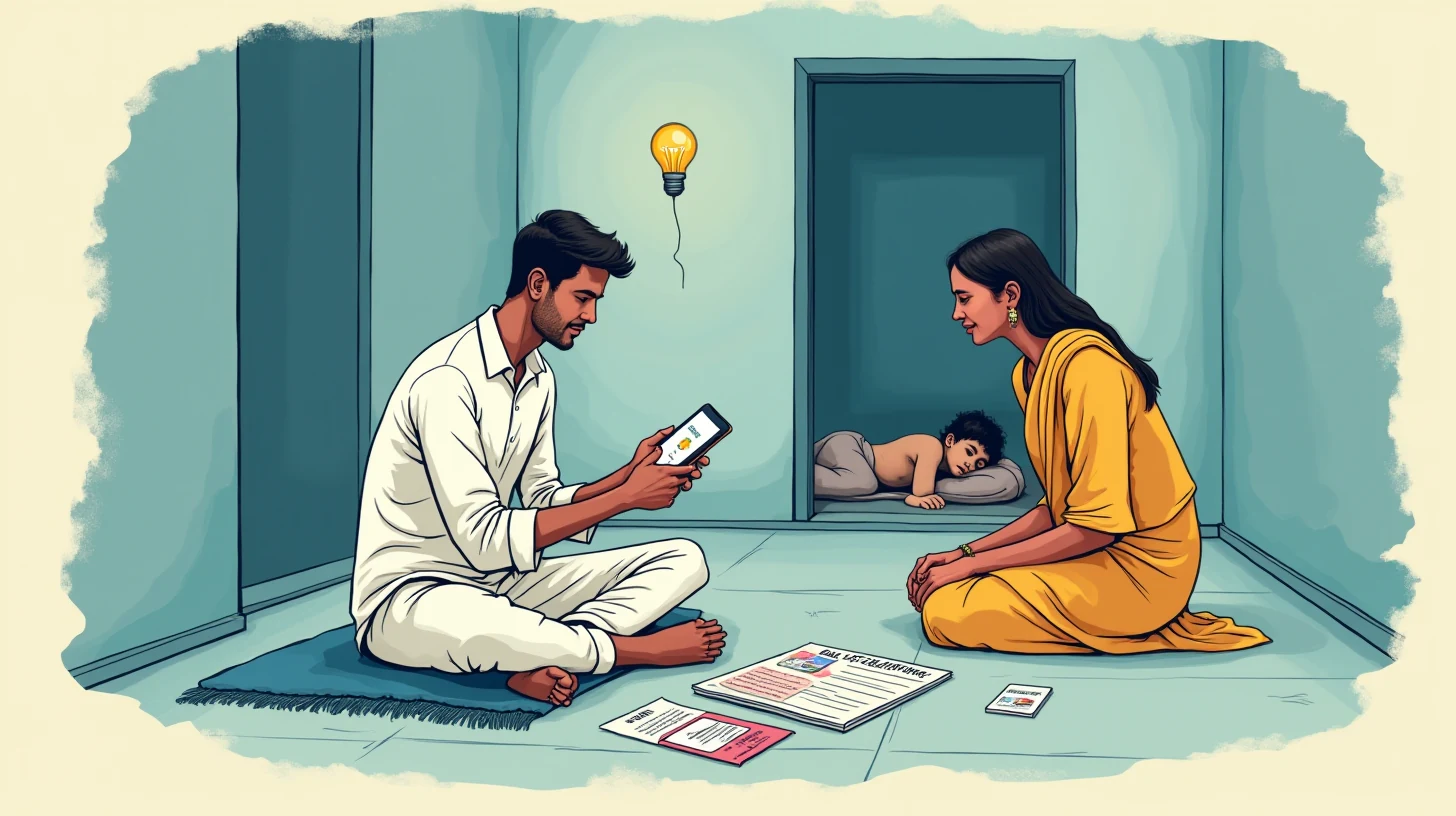
The family's annual income, according to the Mamlatdar's issued certificate, is ₹1.65 lakh. That figure—the combined earnings from the taxi and the stitching—qualifies them for something the Right to Free and Compulsory Education Act calls Section 12(1)(c): a 25% reserved seat in a private English-medium school, no fees, for children from economically weaker sections and scheduled castes. In Gujarat, the system is run online at rte.orpgujarat.com, and it works by lottery. Thousands of families apply. The state computer assigns seats randomly. No dalal. No fixing. Just names drawn.
Pinkesh and Hetal had always believed English-medium school was for families like the ones they picked up at the airport—the ones with credit card payments and foreign jobs. They had assumed they would send Pratham to the Gujarati-medium school where the fees were manageable. But a taxi friend mentioned it one morning. "Your income is low. You are SC. The state will give him a private school seat. English medium. Lottery." Pinkesh asked his dispatcher. The dispatcher said his daughter had applied last year. "Twenty-one days. Fourteen documents. Then computer decides."
That same week, Hetal saw a WhatsApp circular forwarded in the building society group chat: "RTE 25% Admissions 2026-27. Portal opens March 27. Deadline April 16. Apply at rte.orpgujarat.com." She wrote the dates on a scrap of paper and stuck it to the kitchen window. Fourteen documents seemed like a lot for a family that had never assembled anything more complex than a PAN card form. But English-medium school. For Pratham. The circular had a checklist.
🗓️ The twenty-one days
The Right to Free and Compulsory Education Act reserves 25% of seats in private schools for children from economically weaker sections, scheduled castes, scheduled tribes, and children with disability. Section 12(1)(c) is the legal anchor. In Gujarat, the state conducts an annual lottery every April. Families apply between late March and mid-April. The portal is rte.orpgujarat.com. The deadline in 2026 was April 16, 2026. The documents required were fourteen:
- Aadhaar card (father)
- Aadhaar card (mother)
- Aadhaar card (child)
- Birth certificate of the child
- Address proof (electricity bill or lease agreement)
- BPL ration card (for EWS applicants) or income certificate (for SC applicants)
- Income certificate issued in the current financial year
- Caste certificate (if applicable; Pinkesh's was dated 2019)
- Vaccination card (pink, the one given at the government hospital)
- Bank passbook first page
- Passport photograph
- Self-declaration form
- Any school transfer certificate (if applicable)
- Medical fitness certificate (if applicable)
Of these, only eleven were live requirements for the Solanki family. The school transfer certificate did not apply. The medical fitness certificate did not apply. But the income certificate—dated in the current financial year, issued by the Mamlatdar—was mandatory. It was the one piece of paper that would tell the RTE portal: "Yes, this family's income really is ₹1.65 lakh. They qualify for the 25% quota."
Pinkesh had obtained an income certificate two years prior for a bank loan. That certificate would not be accepted. The system demanded the current year's certificate. This meant a visit to the Mamlatdar's office in Tarsali to apply for a new one.
⚠️ The visits that went nowhere
On Monday, March 28—the first day of the twenty-one—Pinkesh took the morning off after the 6 AM shift ended. He parked the Dzire near the Tarsali Mamlatdar's office and climbed the concrete stairs to the first floor. The office smelled of stale chai and paper dust. He took a token number from the counter clerk—token 47. The wall clock showed 10:12 AM. Two dozen people sat on wooden benches or stood against the walls, all holding tokens with higher numbers.
By 11:52 AM, he was token 47. He walked to the counter where a young officer in a blue shirt was processing land records. "Income certificate?" The officer glanced at him without looking up. "The officer who handles income certificates is not here today. Come tomorrow." Pinkesh asked when the officer would be back. The reply was a flat "tomorrow" and a gesture toward the door.
Monday consumed. Four days remained in the initial window before the weekend.
On Tuesday, March 30, Pinkesh had booked a wedding party transportation job—a family of six going to a farm in Savli for a relative's engagement. The bride was travelling with flowers and bangles in his Dzire. He could not cancel. He drove 140 kilometres that day.
On Wednesday, March 31, at 9:47 AM, Pinkesh returned to the Mamlatdar's office. Token 23. The office was busier. He waited forty minutes. When his turn came, he approached the counter and saw that yes, the income certificate officer was now in—the same young man who had turned him away on Monday. But the officer pointed at his computer screen with a grimace. "System is down. Network problem. Come next week, maybe Tuesday or Wednesday." It was 10:27 AM on Wednesday, March 31. Four days of the twenty-one had been consumed. Pinkesh walked back to the Dzire with a weight in his chest.
That evening, Hetal found him sitting on the kitchen floor, looking at the fourteen-item checklist. "We only need the income certificate," she said. Pinkesh replied, "The Mamlatdar office is a lottery too. When I arrive, they send me away. How am I supposed to apply to the RTE lottery when I can't get the one piece of paper that lets me?"
- 📋
March 27 — Portal opens
Gujarat RTE 2026-27 admissions cycle begins. Pinkesh sees the WhatsApp circular in his taxi group. Deadline is April 16 — 21 days. The document list has 14 items, of which 11 are live requirements.
- 🛑
Day 1 (Monday, March 28) — First Mamlatdar visit
Pinkesh arrives at 10 AM, waits one hour forty minutes. Officer handling income certificates is not in. Told to come tomorrow.
- 🛑
Day 3 (Wednesday, March 31) — Second Mamlatdar visit
Tuesday was a booked wedding party shift — couldn't cancel. Wednesday: officer is in but system is down. Told to come next week. Four of 21 days gone.
- 📱
Day 4 (Thursday evening, April 1) — Neighbour's daughter
Hetal knocks on Ridhhi's door on the third floor. In twenty minutes the agent is installed on Pinkesh's three-year-old phone with the sticky charging port. The conversation begins in Gujarati.
- 📨
Day 8 (Wednesday, April 8) — Income certificate arrives
The iORA Gujarat e-citizen portal issued the digital income certificate in 4 working days. The RTE portal accepted it. Eleven days still remain.
🌗 What Ridhhi's floor has to do with it
On Thursday evening, April 1, Hetal stood in the third-floor corridor of the building society and knocked on the door of flat 3C. A young woman answered—Ridhhi, 22, a final-year B.Com student at Maharaja Sayajirao University. Ridhhi had moved in six months ago. She and Hetal had spoken once or twice at the building society's monthly meetings, but they were not close. Three months prior, Ridhhi had mentioned to Hetal that she was helping her younger cousin with a school application using an AI agent on her phone. Hetal had not thought much about it at the time. But on Thursday evening, remembering that conversation, she had climbed one flight of stairs and knocked.
Hetal explained the situation. The RTE portal. The income certificate. The Mamlatdar's office sending them away twice. The deadline was April 16. Ridhhi listened, then said: "Come. Let's sit at your kitchen table. I'll help."
They went downstairs. Ridhhi sat at the small kitchen table in the Solanki flat. Pinkesh's phone was a three-year-old model with a charging port that had begun to stick, so Ridhhi used her own phone initially to download the agent and show them how it worked. She created an account for Pinkesh using his Gmail, which he had signed up for when he joined Ola. She installed the application. It took eleven minutes.
Then Ridhhi asked: "Tell me what documents you have already."
They laid out what they had gathered: Pinkesh's Aadhaar, Hetal's Aadhaar, Pratham's birth certificate, the BPL ration card (laminated plastic, edges worn from being held in wallets for years), Hetal's address proof (an old electricity bill), Pratham's vaccination card (the pink government hospital card, now crumpled at the corners), Pinkesh's bank passbook first page (showing the EMI debit), and a passport photo of Pratham taken at the stationery shop near the taxi stand three weeks prior.
Ridhhi turned to Pinkesh and asked in Gujarati: "Tame iORA portal jaanyo cho?"
Pinkesh did not.
"iORA Gujarat ek online portal che. Tame Mamlatdar's office na jaaye iORA par aavdan kari shakho. Government digitally income certificate issue kare. Paanch se saat working days lage. RTE portal a digital certificates accept kare. Aane iORA fee sirf ₹50. Tame aaj raat ne aavdan kar shakho. Certificate email maa aave aur RTE portal a accept karega."
(iORA Gujarat is an online portal. You can apply there without going to the Mamlatdar's office. The government issues the certificate digitally. It takes five to seven working days. The RTE portal accepts these digital certificates. And the iORA fee is just ₹50. You can apply tonight. The certificate will arrive by email and the RTE portal will accept it.)
Ridhhi held up her phone and showed him the iORA Gujarat website. "This is an online portal where you can apply for an income certificate without going to the Mamlatdar's office. The government issues the certificate digitally. It usually takes five to seven working days. The RTE portal accepts these digital certificates. You can apply tonight."
Pinkesh said: "Sachi vaat che? Online thai jay?" Really? It can be done online?
Ridhhi nodded. She pulled up the iORA application form on her phone and began reading it aloud. The form asked for:
- Name and Aadhaar of the applicant
- Address
- Type of certificate required (income, caste, residence, etc.)
- Annual family income
- Reason for certificate
- Bank account for refund (if applicable)
- Photographs of documents
"You fill all of this," Ridhhi said, "and upload the documents—your Aadhaar, address proof, bank passbook, and a copy of your last six months of income records or your taxi app statement. Then there's a small fee. The portal sends your application to the Mamlatdar's office digitally. The system reviews it, and the certificate is issued to you via email within a week. No waiting on a bench. No being sent away."
They submitted the iORA application that night at 11:36 PM. Ridhhi helped photograph and upload the documents using her phone, email them to Pinkesh so he could access them on his own device, and submit the form. Pinkesh paid a fee of ₹50 through the portal.
Before they closed the laptop, Ridhhi showed him one more thing: the iORA portal also allowed him to download a digital copy of his caste certificate from his 2019 application on file. "You don't need to get the old paper certificate renewed. This copy will work." She helped him download and save it.
The income certificate arrived by email on Wednesday, April 8. Four working days. The PDF came with a digital signature from the Mamlatdar's office and a unique certificate number. When Pinkesh uploaded it to the RTE portal to verify, the system accepted it immediately.
Ridhhi then helped Pinkesh and Hetal with the document organisation. She showed them how to create a Google Drive folder named "RTE_Pratham_2026" and shared it with Pinkesh's account. Over two evenings, they photographed or scanned the remaining documents—the pink vaccination card placed flat on the kitchen table to avoid glare, the laminated BPL ration card, the passport photo, Pratham's birth certificate, both parents' Aadhaar cards printed and arranged neatly. Hetal had the self-declaration form printed at the stationery shop near the taxi stand and filled it in her careful handwriting. Ridhhi took a photograph of the completed form and uploaded it to the folder.
By Friday, April 9, the folder contained all fourteen documents. Twelve were active requirements. Two did not apply.
On the evening of April 10, Ridhhi helped Pinkesh research schools in the Tarsali postal code 390009 on the RTE portal's school directory. The portal allowed applicants to search schools by pin code and create a preference list in order. Eight schools came up in Tarsali:
- Maharaja Sayajirao Public School—4 RTE seats, 1.8 km away, English medium, established 1987
- Navrachana Vidyani Vidyalaya—2 RTE seats, 6 km away, English medium, established 2001
- Ahmedabad Public School (Tarsali branch)—1 RTE seat, 5.2 km away
- Udgam School for Children—2 RTE seats, 7.1 km away 5-8. Four other schools, each with 1-2 seats, between 4-9 km away
Pinkesh and Hetal ranked them. First choice: Maharaja Sayajirao Public School. It was closest. Second choice: Navrachana Vidyani Vidyalaya. It was further but had a better reputation in the building society. Ridhhi typed the preferences into the portal's dropdown menus.
Before they finalised the submission, Ridhhi shared something else the agent had told her: "The RTE lottery is run by a state computer. It's a random draw. No agent, no dalal can fix the outcome. You cannot pay anyone to change it. The lottery assigns seats. That's all it does."
The next morning, Pinkesh asked Ridhhi again: "Are you sure no dalal can change the computer result?"
Ridhhi said: "The agent told me: 'Lottery computer che, bhai. Koi fix nahi kari shake. Agent ne paise na apavta.'" The lottery is run by a computer. Nobody can fix it. Don't pay any agent.
Pinkesh believed her.
🧭 What Section 12(1)(c) presumes
The Right to Free and Compulsory Education Act, passed in 2009, enshrined the principle that 25% of seats in private schools must be reserved for children from economically weaker sections, scheduled castes, scheduled tribes, and children with disability. No child in India should be barred from a private school because of income. The law is clear. It is binding on every state. Every school. Every year.
But the law presumes something that is not always true: that families know how to navigate the portal. That they know the Mamlatdar's office is not the only route to an income certificate. That they understand which documents are mandatory and which are optional. That they know the lottery cannot be fixed and that paying a dalal is a loss. That they can photograph a vaccination card without causing glare. That they can create a Google Drive folder.
For Pinkesh and Hetal, all of these presumptions would have been false without Ridhhi knocking on the door. The RTE Act says 25% of seats shall be reserved for them. It does not say a neighbour's daughter will explain the iORA portal. It does not say the agent will be installed on a phone with a sticky charging port. It does not say the documents will be organised and uploaded correctly. But the law presumes the process is navigable. For most families, it is not—without knowing someone who has done it before, or an agent who knows the route.
What it does
- 🔍Identifies the online income certificate route via iORA Gujarat — the path the Mamlatdar's office didn't mention
- 🗂️Organises 14 documents into a named folder and tracks which have been uploaded correctly
- 📞Explains that the RTE lottery is computer-run and that no dalal can influence it
What it does not do
- 🔒Never logs into rte.orpgujarat.com — the family's portal account and submissions remain theirs
- 💳Never pays the iORA fee or any portal charge on the family's behalf
- ✅Never predicts lottery outcomes — the state computer assigns seats randomly from the eligible pool
On April 14, Pinkesh submitted the RTE application at 11:43 PM. The portal sent an SMS confirmation to his phone. He took a screenshot and saved it to the Google Drive folder. He had submitted on day 19 of 21. Two days remained before the deadline.
"School ni lottery jeetvi aani AIni den nathi. Sahee rite apply karyu hatu ane ame prove kari shakya — aa aani den che."— Winning the lottery wasn't the AI's gift. That we had applied correctly and could prove it — that was the gift. Hetal Solanki, one week after the lottery result.
🌱 What the folder actually gave them
The Gujarat RTE lottery was held on April 22. The state computer ran the draw that afternoon. Results were announced online at 6:47 PM. Pinkesh was on a shift, driving across Vadodara with a passenger heading to the railway station. Hetal checked the portal on her phone while sitting on the kitchen floor. She saw the result: Pratham Solanki had been allotted Navrachana Vidyani Vidyalaya, seat 2, KG-1 (kindergarten one), the second choice school, 6 kilometres away.
She called Pinkesh: "School mili." School is allotted.
Pinkesh heard her voice and pulled the car to the side of the Gotri flyover. "Sahi me? Navrachana?" Really? Navrachana?
"Haan." Yes.
He sat in the car for a moment, the engine running, the 6 PM traffic moving past him. A family's daughter had knocked on his door without him asking. An agent had been installed. A route had been found. A computer had drawn his son's name.
The logistics were immediately complex. Navrachana Vidyani Vidyalaya was 6 kilometres away—three times further than Maharaja Sayajirao Public School had been. The school hours were 8:30 AM to 3:30 PM. Pinkesh's shift with Ola began at 6:30 AM most days and ended by 10 PM. Hetal's stitching orders came irregularly. They could not manage a commute of 6 kilometres in the 8:15 AM window before Pinkesh had to pick up his first passenger.
That Sunday, Hetal spoke to a family on the second floor of their building society—a couple with a daughter who had also applied for RTE and had been allotted to a school outside Tarsali. They had planned to carpool. On Pinkesh's shift days, they would drop Pratham at Navrachana at 8:20 AM. On Hetal's days at home, she would manage the drop and pick-up. It would be tight—Pinkesh on shift by 8:15 AM, the car pulling into school gates by 8:20 AM. But it would be workable.
One week after the lottery result, Hetal sat on the kitchen floor again, this time with a notebook in which she had written down the school name, the allotted seat number, the admission dates, the list of books to buy, the uniform sizes, and the fee structure for the RTE slot (zero rupees for tuition; small fees for transport, uniform, and books).
Pinkesh asked her: "Was it the lottery that won for Pratham, or was it something else?"
Hetal thought for a moment. "School ni lottery jeetvi aani AIni den nathi. Sahee rite apply karyu hatu ane ame prove kari shakya—aa aani den che." Winning the lottery wasn't the AI's gift. That we had applied correctly and could prove it—that was the gift.
She pointed at the SMS screenshot in the Google Drive folder: "Look. Submission confirmation. 11:43 PM on April 14. We applied on time. The folder shows all fourteen documents. The iORA certificate has the Mamlatdar's digital signature. We didn't pay a dalal. We didn't bribe anyone. We did this ourselves, and I can show Pratham when he grows up—we applied for your school with our own hands. We proved we could do a big thing."
For a family that had never navigated anything more complex than a PAN card form without a broker, being able to show a confirmation SMS and a folder of correctly uploaded documents was not a logistical convenience. It was a form of dignity. It was the proof that they had not been trapped by the Mamlatdar's office or by the need for a dalal or by ignorance of the iORA portal. They had applied correctly. The computer had drawn the name. That sequence—correct application, transparent lottery, named result—is not trivial for families whose experience with government systems had often been the reverse: opaque, gatekept, requital-based.
The law says 25% reserved. It does not say families need a dalal to reach the portal. It does not say they need to wait outside a Mamlatdar's office with a token number. It does not say they will be sent away twice before finding the iORA route. That gap—between legal entitlement and actual accessibility—is what this agent was designed to bridge. Not to apply for them. Not to fix the lottery. Not to replace the system. But to read the system with them. To walk them through the iORA portal. To show them that the digital income certificate was a route the government had built but the Mamlatdar's office had not mentioned. To be in the room when they needed someone who had navigated it before.
Pinkesh and Hetal will drive Pratham to Navrachana Vidyani Vidyalaya for the first time on June 2, 2026. The carpool family will be in the car. The school will assign him a seat in the classroom. His uniform will arrive the week before. There will be a teacher. There will be forty other children. There will be an English-medium curriculum. The lottery gave him the seat. But the folder—the RTE_Pratham_2026 folder in Google Drive, containing fourteen documents, an SMS confirmation, a digital income certificate with the Mamlatdar's signature, and the memory of an application that Pinkesh and Hetal had filled themselves—that folder is theirs. That folder is the proof.
Portal vaanchu chhu tara sathe. Reading the portal with you.