
The Vijayawada mother and the Amma Vodi bank link
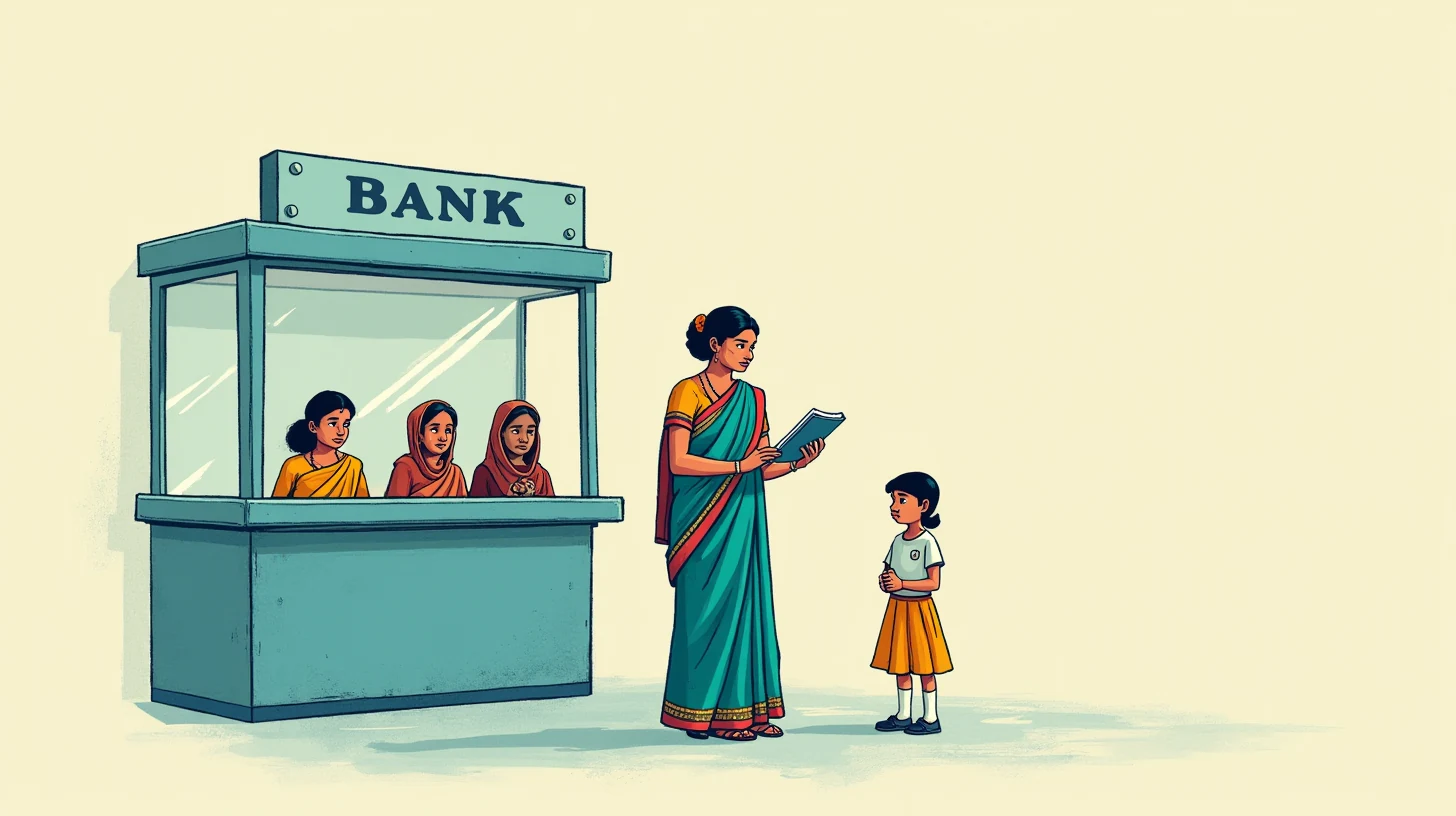
Padma Reddy stood in the UCO Bank branch in Vijayawada in mid-January 2025, her passbook in one hand and her Aadhaar card in the other. She had come to ask a simple question: where was the Amma Vodi money?
🗓️ When the money stopped, the questions began
The previous year, in 2024, she had received ₹15,000 from the Jagananna Amma Vodi scheme — the Andhra Pradesh government's direct transfer to mothers of school-going children. The money had arrived in her bank account without fuss. She had used it to pay for her daughter Sunita's school materials, uniforms, and tuition. Sunita, now 15 and in Class 9 at Zilla Parishad High School, was thriving.
But this year, the money hadn't come. And when Padma logged into the Navasakam AP portal — the government's database where beneficiary lists live — she saw something troubling: her name was still there, but her status had changed. It no longer said "approved" or "disbursed". Instead, it said "bank verification pending".
She had done nothing wrong. Her daughter still attended school. She still lived in Ajit Singh Nagar colony in Vijayawada. She still qualified. So why was she blocked?
The bank staff didn't have an answer. They told her to come back with a letter from the enrollment center. She had begun the journey that many mothers in India know too well: the slow walk through bureaucracy, one counter at a time, asking the same question over and over.
⚠️ Two visits to the enrollment center, no clarity
By late January, Padma had visited the local Aadhaar enrollment center twice. Both times, queues stretched out of the room. Both times, the staff had waved her away or given her vague instructions. One told her that her mobile number linked to her Aadhaar was outdated and needed to be updated first. Another suggested she needed a new Aadhaar print. A third — barely looking up — said to check back in a few weeks.
She asked other mothers at the school gate. Some said the government was slow with payments this year. Others shrugged. One suggested she needed a bank letter. Another said her Aadhaar was corrupted.
Sunita asked if she needed to leave school.
Padma said no. But at night, she began to worry. Ranga Rao, her husband, worked as a construction labourer. Some months the work was steady; other months, it disappeared. The ₹15,000 was supposed to cushion those months — to cover Sunita's books, her exam fees, her school events. Without it, the numbers didn't work.
By late January, Padma had resolved to spend an entire day at the enrollment center, if that's what it took. But the night before, Vijaya — her neighbour and colleague, also an ASHA worker — stopped by.
🌗 The neighbour and the agent
Vijaya had been an ASHA worker in Ajit Singh Nagar colony for four years, the same as Padma. They knew each other's families, borrowed dal from each other's kitchens, and compared notes on the government schemes they helped villagers apply for.
In February, Vijaya showed Padma something new on her phone: an agent that explained government schemes in Telugu. She had used it to understand a form she had been asked to fill for a health programme. "Let me ask it about the Amma Vodi," Vijaya said.
Padma watched as Vijaya typed a question in Telugu on her phone. The agent — speaking in Telugu — responded within seconds. It explained the scheme in plain language: who qualifies, what the money was for, what documents were needed.
Then Vijaya asked the key question: "My friend's name is pending on the Navasakam portal. It says 'bank verification pending'. What does this mean?"
"'బ్యాంక్ వెరిఫికేషన్ పెండింగ్' అంటే ఆధార్ నమోదు కేంద్రం కాదు. ఇది NPCI బ్యాంక్-ఆధార్ మ్యాపర్ లింక్ కాలం ముగిసిందని అర్థం. Navasakam పోర్టల్ ఆ తల్లి యొక్క బ్యాంక్ ఖాతా ఆధార్ నంబర్కు నిజంగా అనుసంధానం చేయబడినది కాదా అని నిర్ధారించాలి. ఆ లింక్ వెలువడితే, డబ్బు లేవని నిలిచిపోతుంది. కానీ ఆధార్ కేంద్రంలో ఆ లింక్ను మళ్ళీ స్థాపించకుండా, ఏదైనా CSC కియోస్క్లో ఇది చేయించుకోవచ్చు. కేవలం ₹30, ఇరవై నిమిషాలు. Navasakam ఐదు కార్య దినాలలో నవీకరణ అవుతుంది."
("Bank verification pending" doesn't mean the Aadhaar enrollment center. It means the NPCI bank-Aadhaar mapper link has expired. The Navasakam portal needs to confirm that mother's bank account is genuinely linked to her Aadhaar number. Without that link verified, the money cannot be disbursed. But this link doesn't need to be re-established at the Aadhaar enrollment center. You can do it at any CSC kiosk for just ₹30 in twenty minutes. The Navasakam portal will update within five working days.)
What the agent revealed
The agent explained in Telugu that "bank verification pending" didn't mean the Aadhaar enrollment center. It meant something else entirely: the NPCI bank-Aadhaar mapper. This was a separate system from Aadhaar updates. The Navasakam portal uses it to confirm that a mother's bank account — where the money was supposed to land — is genuinely linked to her Aadhaar number. Without this link verified, the money cannot be disbursed.
Padma's link had expired. It happened to many people, the agent said. But here was the part that changed everything: the link didn't need to be re-established at the Aadhaar enrollment center. It could be re-established at any Common Service Centre (CSC) — the small digital kiosks found in almost every town and village in India. And it would cost only ₹30.
The agent also mentioned that Padma could check her NPCI mapper status herself, right now, at npci.org.in/upi/profile. She didn't need to wait for anyone. She could verify the status was indeed expired before spending money.
Vijaya's phone was in Padma's hands. She opened the link. The portal showed her account details, and there it was: "Mapper Status: Inactive (Expired)". A red flag next to her name.
For the first time in six weeks, Padma felt the weight lift slightly. The problem had a name. It had a location. It had a price.
The CSC, twenty minutes, thirty rupees
On a Wednesday morning in early February, Padma walked to the CSC at the Ajit Singh Nagar Municipal Ward office. It was ten minutes from her home, past the school, down the colony's main road. She carried her Aadhaar card and her mobile phone.
The CSC operator — a young man in a small room lined with computers and printer paper — had done this many times before. "NPCI re-linking?" he asked. She nodded. He opened a portal on his computer, asked her to unlock her Aadhaar on her phone (using her OTP), and entered the details. Twenty minutes later, he handed her a receipt.
"Status will update in five working days," he said. "Check Navasakam after that."
She paid ₹30.
Padma walked home thinking about how many days she had lost — the two enrollment center visits, the sleepless nights, the worry in Sunita's eyes — to a path she hadn't been told about. The CSC was in her colony. The cost was small. The time was brief. But no one at the bank had mentioned it. The enrollment center staff had never offered it. The portal itself gave no hint.
Only the agent, responding in Telugu, had named it clearly.
"The ₹15,000 is not just money. It's the difference between Sunita staying in school and having to help at home. When it arrived this year, after all those weeks of not knowing, I cried. I could buy her the books she needed. I could pay for her exam coaching. Her father's work is uncertain — some months there is nothing. This money is the certainty. It's why she can study."— Padma Reddy, in Telugu, February 2025
"The ₹15,000 is not just money. It's the difference between Sunita staying in school and having to help at home. When it arrived this year, after all those weeks of not knowing, I cried. I could buy her the books she needed. I could pay for her exam coaching. Her father's work is uncertain — some months there is nothing. This money is the certainty. It's why she can study."
Five working days, one portal update, one victory
By February 20, the Navasakam portal had updated. Padma's status no longer said "bank verification pending". It said "verified". Within two weeks, the ₹15,000 appeared in her UCO Bank account.
She showed the bank statement to Sunita. "Look," she said. "The government remembered us."
Sunita hugged her. She had been studying with a small knot of anxiety in her chest, unsure if the year's school fees would be covered. Now she could focus. She moved through her Class 9 studies with the weight lifted.
Padma also told other mothers in the colony about the CSC. "Don't go to the enrollment center if your status says 'bank verification pending'," she began to repeat. "Go to the CSC. Thirty rupees. Twenty minutes. That's all it took."
By March, two other mothers in Ajit Singh Nagar had solved the same problem the same way. One brought Padma a small gift — a packet of jaggery — as thanks.
🧭 What the agent does and doesn't do
It's worth pausing here to say what the agent does and doesn't do, because Padma's story is about the boundary between the two.
The agent is not a shortcut that bypasses the work. It's clarity. It separates the "this must be done at the enrollment center" from the "this can be done at the CSC" — a distinction that neither the bank nor the enrollment center staff had made for Padma. It speaks in Telugu. It answers the question once and doesn't make you wait in a queue to get the same answer again.
For Padma, that clarity was everything. It moved her from the enrollment center's slow logic — "come back in a few weeks, maybe we'll know more" — to the CSC's quick logic: "Give me your Aadhaar OTP. Twenty minutes. Done."
🌱 The mother and the ₹15,000 today
By May 2026, Sunita is finishing Class 9. The final exam results will come in June. Her teachers have begun to talk about which school she might attend for Class 10 — there is ambition in these conversations. She scored well in all subjects. Padma and Ranga Rao are discussing whether she might apply to a private school, or a government school with a strong reputation in another part of the city.
The Amma Vodi money arrived again this year without incident. The second time, Padma knew the portal would update. She knew her name would shift from "pending" to "verified". She also knew, from watching other mothers, that this was not how it worked for everyone. Some still got stuck at the enrollment center. Some still didn't know about the CSC.
She has begun to tell the story differently to mothers who ask her about the scheme. She no longer just tells them "apply to Navasakam". She tells them, "Apply, and if it says 'bank verification pending', go straight to the CSC. Don't go to the enrollment center. It's thirty rupees and twenty minutes. I did it, and it worked."
Vijaya still has the agent on her phone. She and Padma have used it a few more times since then — once to understand a nutrition programme, once to check the rules for ASHA worker health insurance. Each time, the clarity comes in Telugu, quick and specific.
Padma hasn't thought of herself as someone who uses technology. She has a phone, but it's mostly for calls. But now, sometimes in the evening, she asks Vijaya to show her the agent again. She types a question in Telugu. The response comes back in seconds. And for the first time, she feels like the system is speaking to her in her language, at her pace, without the hierarchy of the queue.
The ₹15,000 is still in her bank account. Sunita will carry it forward into Class 10. And somewhere in Vijayawada, other mothers are still standing in Aadhaar enrollment center queues, waiting for an answer that takes thirty rupees and twenty minutes at the CSC to solve.
Padma knows because she was one of them. And now, when she sees that look — the worried, searching look of a mother trying to understand why the money hasn't come — she stops and tells the story. Not as a success, but as a map.