
The Agartala forest guard and the bank branch that closed without telling him
Bimal Tripura turned 65 in the monsoon of 2022. For thirty years, he had walked the forests around Agartala—patrolling reserve boundaries, documenting wildlife, enforcing timber regulations. The work was hard and thankless, but it had given him a pension. Every month, without fail, that pension arrived in his UCO Bank account at the Agartala City Branch. It was the certainty that made the rest of life manageable.
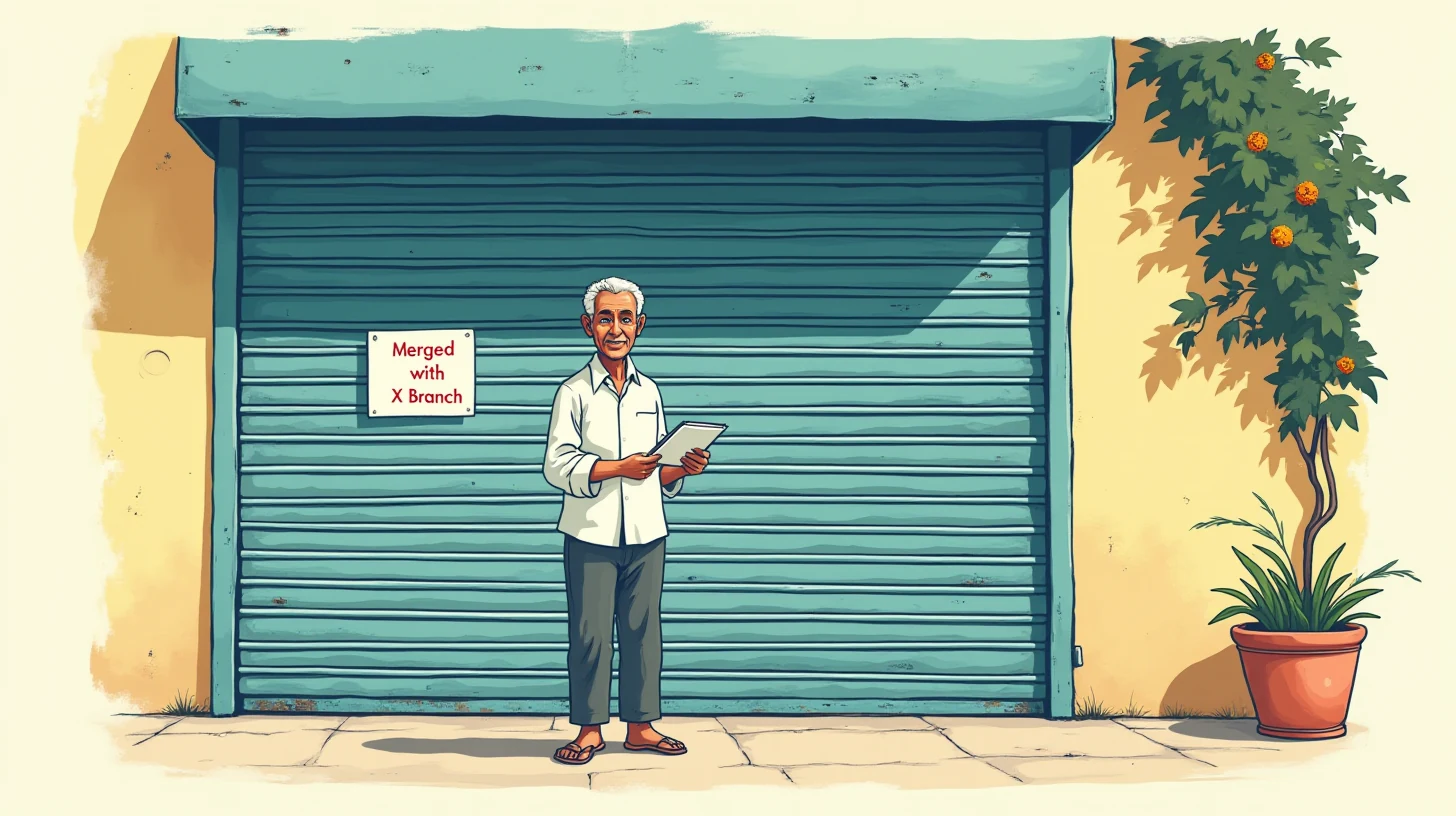
Then the certainty disappeared.
🗓️ Bank branch rationalisation and pensioners
The closure was not dramatic. No riot, no scandal. In 2022, as part of UCO Bank's nationwide branch rationalisation—a cost-cutting exercise that consolidated underperforming branches into larger hubs—the Agartala City Branch was folded. Its operations moved to the Agartala Main Branch, two kilometres away. The bank completed the paperwork. Accounts were automatically migrated. From the bank's perspective, the matter was resolved.
What the bank did not do was notify every account holder. That notification, simple as it might seem, was the first break in the chain.
Bimal did not discover the closure until his pension did not arrive in March 2023. He called the bank. The voice on the phone was young, impatient. "Sir, your branch is closed. It merged with Main Branch in 2022. Your account is there now. Check your balance online."
Bimal did not check balance online. He was sixty-five years old, a forest guard from a tribal district. Online banking was not his comfort. His wife, Malti, was the one who began to worry. Sixty rupees for a kilo of rice now. Medicine for his knees. Their son worked in Silchar and sent money when he could, but not every month. The pension was the anchor.
"Is it a government problem?" Malti asked. "Did the government forget you?"
Bimal thought it might be. The government had forgotten many things before.
- 🏦
UCO Bank Agartala City Branch closes (2022)
Branch rationalisation. No notification sent to pensioners. Account automatically migrated to UCO Agartala Main Branch.
- ❌
Pension credit stops
Tripura Finance Department PPO still points to old (closed) branch code. Treasury cannot process credit. Three months of missing pension.
- 📋
PPO mandate update at Finance Department
Bimal submits PPO mandate update request with new UCO branch passbook and Aadhaar. Tripura Finance Pension Cell processes in 5 working days.
- ✅
Pension resumes — three months arrears credited
New branch code mapped to PPO. Three months of arrears credited in first payment.
⚠️ Three months of missing pension
For three months, the pension did not arrive. Bimal visited the Agartala Main Branch twice. The first time, a clerk glanced at his passbook and said, "Sir, your account is here. Money is coming." It was not. The second visit, a different clerk took his number and said someone would call. No one did.
Malti began rationing. Rice was watered. Oil came out of the bottle in drops. Their daughter-in-law, who lived in Agartala, brought groceries sometimes. Bimal sat in the small house near the old forest office and waited. Pride kept him from asking the neighbours. Shame kept him from mentioning it to the few colleagues he still saw.
"শাখা বন্ধ হয়ে গেছে, আমার পেনশন বন্ধ হয়ে গেছে। কেউ জানায়নি।"— The branch closed, my pension stopped. No one informed me.
His son, Ravi, came back from Silchar for a weekend. He saw his mother's tightness, his father's silence, and he was angry in the way young men are—at the system, at the bank, at his father for not fighting harder.
"Aba, forget UCO," Ravi said. "Open SBI account. Transfer the pension. These government banks are dying. UCO is garbage."
It was not wrong, exactly. But Bimal had banked with UCO for thirty years. The account was old. The staff knew his name. Switching felt like admitting defeat. It also felt complicated—forms, verification, another month of waiting maybe.
"Let me see," Bimal had said, which meant nothing, which meant everything.
🌗 Agent traces the branch closure and explains the fix
It was Malti who contacted the agent. She used her son's phone, nervous about every word. "My husband's pension is stopped. The bank branch closed. We don't know what to do."
The agent listened. The agent asked for the pension payment order number, the UCO account number, the date the pension last arrived. Within an hour, the agent had the answer.
"UCO Bank Agartala City Branch বন্ধ হয়েছে ২০২২ সালে, কিন্তু আপনার অ্যাকাউন্ট স্বয়ংক্রিয়ভাবে Agartala Main Branch-এ স্থানান্তরিত হয়েছে। আপনার টাকা নিরাপদ। কিন্তু আপনার PPO—পেনশন পেমেন্ট অর্ডার—এখনও পুরানো শাখা কোডের দিকে তাকিয়ে আছে। আপনাকে Tripura Finance Department-এর Pension Cell-এ PPO ব্যাংক ম্যান্ডেট আপডেট করতে হবে।"
"UCO Bank Agartala City Branch closed in 2022, but your account was automatically migrated to Agartala Main Branch. Your money is safe. But your PPO—Pension Payment Order—still points to the old branch code. You need to update the PPO bank mandate at the Tripura Finance Department's Pension Cell."
The agent explained the process in Bengali, then in clear simple English. The PPO—the government order that authorised Bimal's pension—was linked to a specific bank branch. When that branch closed, the pension system lost the routing information. The account existed. The money was there. But the conduit was broken.
The agent also explained the options.
Option One: Update the PPO bank mandate. Visit the Tripura Finance Department Pension Cell in Agartala. Bring the PPO copy, the new UCO passbook from Agartala Main Branch, and Aadhaar. Fill a simple form. They would update the mandate within 5 working days. Pension would resume. The three months of arrears would be credited in one lump.
Option Two: Transfer the pension to SBI or another bank. Bimal could request a new bank mandate entirely. SBI had more branches. It was more modern. Some people preferred it. But it meant another form, another verification, and it did not solve the immediate problem faster. The current arrears would still take time to release.
"Your choice," the agent said, in Bengali, in the voice of someone who understood that choice itself was a luxury. "But the fastest way home is to update the UCO mandate. The Finance Department will do it in five working days. Then your three months comes."
Bimal brought the papers to the Finance Department on a Monday in May. The Pension Cell was in a white building near the Secretariat, staffed by two women in government saris who had processed thousands of these updates. They knew the problem by heart—the branch rationalisations, the accounts that seemed to vanish, the old men who lost sleep over it.
One of them, a woman named Gitanjali, walked Bimal through the form. "We will do this in two days," she said. "Your PPO will be updated. The bank will know where to send your money."
It took five days, not two. But on the fifth day, the confirmation came. Bimal received a letter. The mandate was updated. The next pension would arrive.
On the fifteenth of May, when the money came, it came all at once. March. April. May. Seventeen thousand rupees. Malti cried. She went to the market and bought fish. She bought oil that did not come out in drops.
🧭 Systemic: Branch closures that pensioners weren't informed about
The UCO Bank branch rationalisation was not unique. Across India, as banks consolidated to cut costs, thousands of branches closed. Many of them were the last physical bank presence in small towns and tribal districts. When they closed, the bank sent no letter, no SMS, no email to retail customers. They assumed people would notice.
Many did not notice until they could not.
The problem was structural. The Pension Payment Order system in most Indian states was not integrated with the bank rationalisation system. When a bank closed a branch, the bank updated its own records. But the state pension system—which had issued the original mandate to a specific branch code—was not automatically notified. The pension orders remained frozen in time, pointing to buildings that no longer existed.
For government pensioners like Bimal, the gap was acute. They were old. They had limited flexibility. A missed pension was not an inconvenience. It was a crisis.
The solution existed, but it required the pensioner to know about it. They had to figure out why the pension had stopped. They had to contact the bank, discover the closure, understand the mandate issue, and then contact the Finance Department to update the PPO. It was a four-step process that required information most retirees did not have.
The agent, in those conversations with Bimal and Malti, filled that gap.
What it does
- 🔍Traces the pension stoppage to the specific branch closure event and confirms the account migration to the new UCO branch
- 📋Explains the PPO mandate update process at the Tripura Finance Department Pension Cell, including required documents
- 🏦Explains the SBI transfer option as an alternative if Bimal prefers to move his pension account entirely
What it does not do
- 🔒Never contacts the bank or the Finance Department on Bimal's behalf
- ✅Never confirms the arrears amount — that is determined after the PPO mandate is updated and Treasury processes the backpayment
🌱 Quiet close
A month later, Bimal was in the small tea stall near the old forest office, the kind of place where retired forest guards gather on Tuesday mornings. His pension was coming again. Malti had even bought him a new shirt—not white, but a pale blue that brought out the grey in his hair.
He told the story to Bhima, who had retired two years before him, and Ravi, who had worked in the reserve for forty years and still walked its boundaries sometimes. They listened the way men listen to warnings. The bank closures, the mandate forms, the Finance Department Pension Cell. One of them, Bhima, nodded.
"My branch closed too," Bhima said. "In 2022. But my pension kept coming. I never knew why. I thought I was lucky."
"You were," Bimal said. "Some branches told people before they closed. Some banks sent letters. UCO sent nothing."
Ravi, the younger one, said what they were all thinking. "What happens to the others? The ones who don't know? The ones in remote places?"
No one had an answer. The system worked, if you knew it existed. The pension was safe, if someone could tell you where to look. But knowledge was not automatic. Notification was not guaranteed. The simplest thing—a letter, an SMS, a phone call—was still missing.
The tea grew cold. They did not talk about it much longer. There was nothing to be done about the ones who did not know. You could only be grateful when you found out, and move forward.
What you can do if your pension branch closes
If your pension stops suddenly:
- Call your bank and ask: has my branch closed?
- Ask where your account was migrated.
- Confirm your account and balance are intact at the new branch.
- Contact your state Finance Department Pension Cell and ask: does my PPO mandate need updating?
- If yes, bring: PPO copy + latest passbook from the new branch + Aadhaar.
- File a mandate update form. Standard processing time is 5 working days.
- The pension will resume in the next cycle. Arrears are credited together.
If you want to change banks entirely (e.g., UCO to SBI):
- Open the new bank account first. Get it verified and active.
- Then ask the Finance Department for a "bank mandate change" form (different from a simple update).
- The process takes longer (10-15 days) but gives you complete control.
- Arrears are still credited once the new mandate is active.
For government pensioners in Tripura: The Tripura Finance Department Pension Cell is open Monday to Friday. Walk in with your documents or email your pensioner ID and branch details to finance.tripura.gov.in.
For other states: Search "[Your State] Finance Department Pension Cell" or "[Your State] Directorate of Pensions."
The branch may be closed. But your pension is not lost. It just needs to be found.