
The Aizawl teacher and the fingerprint scanner that couldn't read arthritic hands
Lalhmingthanga Ralte spent thirty-five years in front of a classroom in Aizawl. He taught history and English at Zemabawk High School, the same school his own children had attended. His hands—which had once written lesson notes on the blackboard, corrected stacks of exercise books, guided teenage fingers through grammar exercises—were known by generations of students. They were hands that built. Hands that shaped minds.
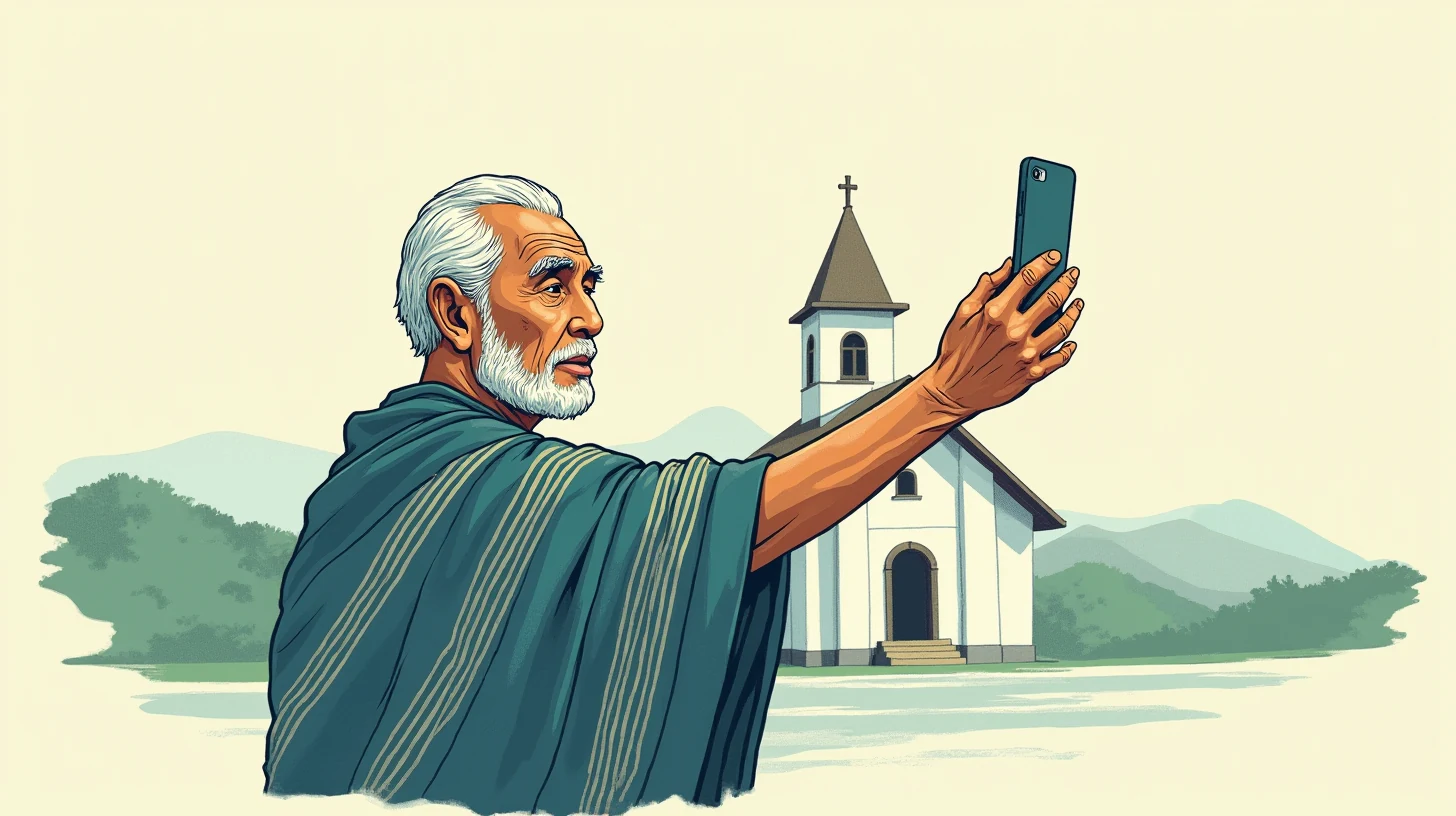
A teacher's hands, now unreadable
At seventy-two, those hands had become his greatest problem.
Lalhmingthanga has severe arthritis in both hands, the kind that thickens his knuckles and curls his fingers inward even at rest. The pain is constant but manageable with the right painkiller. What isn't manageable is this: his fingerprints are now so faded and distorted that every biometric scanner in Aizawl's banks rejects him. Not because the machine is broken. Because his hands no longer match the government's fingerprint records from when he first retired in 1998.
Every November, without fail, this became a crisis.
Lalhmingthanga lives in a small house near the Zion Church in Aizawl's downtown. His pension—₹18,000 a month from the Mizoram Education Department—arrives via his State Bank of India account. But every year, in November, the bank's biometric system asks him to prove he is still alive. This is the Jeevan Pramaan process: an annual life certificate submission required by all pensioners in India. The government's rule is straightforward: touch your finger to the scanner, the bank records the biometric, your pension continues. Miss the deadline, your pension suspends. Miss it for three months, the bank begins recovery procedures.
For three years, Lalhmingthanga had missed it.
🗓️ What Jeevan Pramaan requires and what arthritis prevents
The Jeevan Pramaan scheme exists to prevent pension fraud. Imposters have claimed pensions of dead pensioners; the system was built to catch that. Every year, between October and November, all pensioners must undergo Aadhaar biometric authentication—fingerprints, iris scan, or face authentication—and the bank records this on the government's database. The message is simple: you are alive, your pension continues. In most cases, it takes five minutes.
For pensioners with severe arthritis, scleroderma, leprosy-related hand damage, or other conditions that have scarred or flattened the fingerprints, it is impossible.
Arthritis alone affects roughly 30% of Indians over sixty-five. Of those, perhaps 5–8% have damage severe enough that fingerprint scanners cannot read them. The biometric infrastructure of India was designed assuming all fingers are intact. It was not designed for the hands that age and disease produce.
Lalhmingthanga discovered this in November 2021. He went to his SBI branch in Aizawl with his Aadhaar card and pension passbook. The teller smiled and asked him to place his finger on the scanner. Nothing. He tried again. The machine beeped—"Fingerprint not readable." The teller tried the other hand, all five fingers. Each time: "Fingerprint not readable."
The teller made a note in his file. "Come back next week," she said. "Sometimes the scanner needs adjustment."
He came back. The result was the same.
By late November, the bank informed him by post: his pension had been suspended pending successful Jeevan Pramaan submission. The suspension letter arrived the first week of December. He had no income.
- 📅
November 1 — Jeevan Pramaan window opens
All pensioners must submit life certificate. Lalhmingthanga visits the CSC. Biometric scanner cannot read arthritic fingerprints.
- ❌
Submission fails — bank notified
CSC marks submission as failed. SBI Aizawl branch receives notification. Pension credit suspended pending valid certificate.
- 📵
December–January — two months without pension
Lalhmingthanga borrows from daughter Zualteii. Reinstatement application submitted. Pension resumes January.
- 📱
Face RD solution — submit from home
AadhaarFaceRD + Jeevan Pramaan app combination. Front camera face authentication. Certificate generated immediately. No CSC visit needed.
⚠️ The cycle that repeats
For the first time, Lalhmingthanga called his daughter.
Zualteii works in Aizawl at a nonprofit that focuses on rural healthcare. She makes a decent salary, but not enough that lending her father ₹18,000 for three months was painless. Yet she did it, without hesitation, without resentment visible on her face. November to January: three months of her salary diverted to her father's pocket, to cover his rent, his medicines, his church donations.
When his pension finally restarted in mid-January 2022—after he submitted the suspension-reversal application in December and the bank's back-office processed it—Zualteii didn't ask for repayment. But Lalhmingthanga knew the rhythm: save through February, March, April. Spend carefully. By October, he had saved enough to cover November's rent and medicines if the scanner failed again. But not enough to not need Zualteii.
In November 2022, the same thing happened. The scanner rejected him again. Zualteii lent him money again. No complaint, but he noticed her sitting quieter at dinner.
In November 2023, the same thing happened for the third time.
By 2024, Zualteii had begun putting aside money in September, knowing what was coming. She didn't say it out loud, but Lalhmingthanga saw it: she was budgeting for his poverty as if it were a utility bill. A certainty. An annual tax on her salary because her father had arthritis.
He felt this more acutely than the pain in his hands.
"Ka ke kan thlakna hi ka ke an lak ta lo. Ka pension chu a rawn lo. A lo ni tawh a."— My fingerprints, they cannot take them anymore. My pension doesn't come. It has become like this.
🌗 "My fingerprints, they cannot read them anymore"
"Ka ke kan thlakna hi ka ke an lak ta lo. Ka pension chu a rawn lo. A lo ni tawh a."
(My fingerprints, they cannot take them anymore. My pension doesn't come. It has become like this.)
— Lalhmingthanga Ralte, speaking to a bank teller in Aizawl, November 2024
He had not complained publicly. He was a retired schoolteacher; he had dignity. But sitting in the bank's customer service area, watching the teller's eyes flick away from his hands, the resignation in his voice was audible. It has become like this. Not it could be, but it is. Final. Unchangeable. Something he had accepted about aging in India.
What he did not know was that the solution had existed since 2022.
🧭 The arthritis the biometric system never accounted for
The answer is structural, not malicious. The Jeevan Pramaan system was designed around fingerprints. Face authentication was added later, in 2022, as an alternative for specific cases: pensioners who could not provide fingerprints. Yet the disbursing banks—SBI, PNB, BOI—were not obligated to proactively inform pensioners of the alternative. The awareness stayed within the UIDAI's technical documentation and on government ministry websites. It did not reach the SBI tellers in Aizawl.
This is not uncommon in India's social security system. Schemes exist. Alternatives exist. But knowledge of them does not reach the pensioners who need them most. Those without smartphones, without family tech-savvy enough to Google, without someone to tell them, simply don't know.
The gap reveals a deeper issue: the biometric infrastructure was built for a standardized pensioner—one with intact, readable fingerprints, young enough to travel to a bank branch, literate enough to navigate forms, and fortunate enough to have no medical condition that erases a fingerprint. Arthritis, leprosy, scleroderma, and age itself were afterthoughts, if thoughts at all. And when solutions do exist—face authentication, doorstep banking, CSC assistance—they remain optional knowledge, mentioned in fine print, known by the tech team but not the teller behind the counter.
For the free model: awareness and guidance happen through NGOs, church health workers, and family members who stumble onto the solution. For premium support: banks would proactively notify all affected pensioners by SMS of face authentication options during the Jeevan Pramaan window.
What it does
- 📱Explains Face RD app installation steps and walks through face-authentication process on the specific phone model
- 📋Identifies whether the pensioner qualifies for SBI doorstep banking as a fallback if face authentication doesn't work
- 📅Sends a Jeevan Pramaan deadline reminder in October so the November window is never missed
What it does not do
- 🔒Never accesses the UIDAI or Jeevan Pramaan system on the pensioner's behalf
- ✅Never submits the life certificate without the pensioner completing the face scan themselves
🌱 A November without borrowing
In October 2024, Zualteii helped her father download the AadhaarFaceRD app. They tested it together on a Saturday morning, sitting in the courtyard of their house overlooking Aizawl's hills. Lalhmingthanga held the phone at arm's length, as the volunteer had described, and looked into the camera. The app captured his face in three seconds.
"It worked," he said, surprised and not surprised.
The Jeevan Pramaan app, when opened, now gave him a choice: fingerprint or face. He selected face. Within minutes, his submission went through. The bank received the notification. His life certificate was recorded.
In November 2024, for the first time in three years, Lalhmingthanga's pension did not suspend. It arrived on the eleventh of the month, as scheduled. Zualteii did not set aside savings in September. No conversation about borrowing happened over dinner.
The relief in that simple continuity—a pension that came because a finger no longer had to touch a scanner—was not dramatic. It was quiet. A monthly deposit in a bank account. A small thing. But for a seventy-two-year-old man with arthritic hands, it was everything.
"I taught history," Lalhmingthanga said, months later, when the volunteer visited again. "I taught my students that every system changes. That what seems permanent today becomes obsolete tomorrow. But sometimes I forgot to believe it about my own life."
He smiled, his hands resting on the arms of his chair. "The system did change. I just needed someone to tell me."
If you are a pensioner with arthritis or hand scarring that affects fingerprint scans:
- Download the free AadhaarFaceRD app from your phone's app store and use it with the Jeevan Pramaan app for face-based authentication.
- Contact your pension-disbursing bank's customer service to confirm they support face authentication for Jeevan Pramaan submission.
- If you don't have a smartphone or are uncomfortable using one, ask your bank about PSB Doorstep Banking (available for SBI pensioners aged 70+) or visit your nearest CSC (Common Service Center) to have an operator assist you.
- Submit your Jeevan Pramaan before the November deadline—don't wait until your pension suspends.
- Tell other pensioners about this option. Many don't know it exists.