
The Bhopal constable and the SSSM ID that stopped his pension
Rajendra Prasad Shukla had been a constable in the Madhya Pradesh Police for exactly thirty years. He walked the lanes of Bhopal for three decades—the cotton mills, the old city, the neighbourhoods that grew up around the Van Vihar. He knew the names of shopkeepers and the timing of monsoons. When he retired at sixty-four, the department had given him a certificate and a handshake. The pension, they said, would come to his bank account every month, like clockwork.
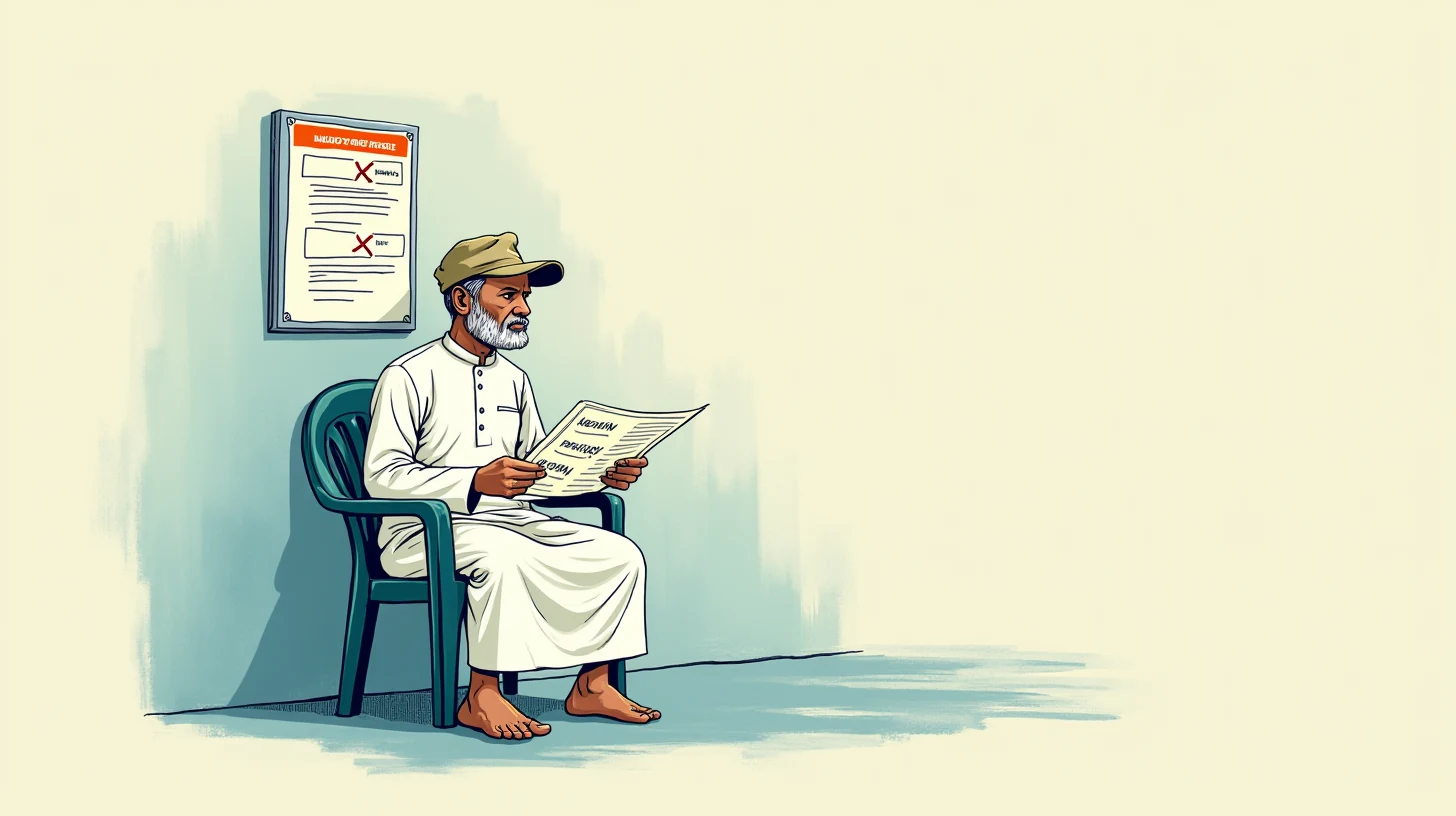
It came for four months. Then it stopped.
Rajendra sat in his small house in Arera Colony with his wife Sunita, watching the bank balance remain unchanged. The police pension office was silent. His pension letter said nothing had changed. The bank said there were no holds. He waited for the fifth month. Nothing. By the sixth month, Sunita was making calls to relatives who had contacts in the government office. Rajendra himself, now sixty-four and without the structure of duty rosters and morning roll calls, felt an unfamiliar strain creeping in.
"I thought it was a computer mistake," he told an agent later. "I thought if I waited one more month, the system would catch up."
It didn't. The mistake, as it turned out, wasn't a computer error. It was an absence—the absence of three letters. SSSM.
🗓️ What SSSM is and why MP requires it
Madhya Pradesh, like several Indian states, built its own family welfare system outside the national databases. The SSSM—Samagra Samajik Suraksha Mission—is a unique, state-level family ID that acts as the primary key for almost every welfare transaction in the state. It was introduced to consolidate the chaos of multiple overlapping welfare schemes and to prevent fraud and duplicate claims.
The SSSM database contains family information: the head of household, spouse, children, dependents, even details of land holdings and income. When you apply for a pension in Madhya Pradesh, you need three things:
- Your Aadhaar (national biometric ID)
- Your SSSM family ID (state welfare ID)
- Your pension account number linked through the state's IFMIS portal (Integrated Financial Management System)
All three must be connected. All three must exist. If one is missing, the pension system treats the entire application as incomplete.
Rajendra had his Aadhaar. His pension account was registered. But in 2021, when the state tightened the linkage rules, he had never obtained an SSSM family ID. Nobody had told him he needed one. In thirty years of service, the department's pension office had never mentioned it. When he retired, the paperwork flowed through the old channels. The new SSSM requirement seemed to catch only those who asked about it or who saw the notification on a government website.
For Rajendra, the stopping of his pension was the first time he heard the word SSSM.
- 🛑
Pension stops — 'KYC incomplete'
MP IFMIS portal requires three-way linkage: Aadhaar + SSSM ID + pension account. Rajendra has Aadhaar linked but SSSM missing.
- 🏢
Ward Office — SSSM ID issued same day
Rajendra visits the nearest municipal Ward Office with Aadhaar and family details. SSSM family ID issued within 4 hours, free of charge.
- 💻
MP IFMIS portal — SSSM entered
Log in to mpifmis.mp.gov.in. Go to KYC section. Enter SSSM ID. Pension linkage updated immediately.
- ✅
Pension resumes in 5–7 working days
Treasury processes the linked mandate. Arrears from the pension-stop date credited with first resumed payment.
📋 The timeline: pension stop to pension resume
The notification came in the last week of the fourth month. The MP IFMIS portal, where his pension details were held, showed his KYC (Know Your Customer) status as Incomplete. No reason given. No next steps listed. Just: Incomplete.
He visited the Police Pension Disbursement Office in Bhopal. An officer there, kind but hurried, told him to check his Aadhaar linkage. "Link your Aadhaar to your pension account," she said. Rajendra had never done this explicitly—his Aadhaar had been on file for years. But he asked a younger relative, and together they managed to upload his Aadhaar photograph to the portal. They submitted the form. They waited.
The pension did not resume.
Two weeks later, on his second visit, a different officer mentioned, almost in passing, that the state required something called SSSM. "Do you have your SSSM number?" the officer asked. Rajendra pulled out his Aadhaar card. The officer shook his head. "Not Aadhaar. SSSM. It's a different number."
Rajendra didn't have it.
"Then go to your Ward Office," the officer said. "They issue it."
The Ward Office, when he arrived the next morning, confirmed it. His name was not in the SSSM database. To obtain an SSSM family ID, he would need to visit with Sunita and bring proof of residence, a copy of their marriage certificate, and his Aadhaar. The Ward Officer, a woman named Meera Sharma, was efficient. Within four hours, the SSSM family ID was issued—a long number printed on a certificate.
Rajendra then returned to the MP IFMIS portal and, following a printed instruction sheet that came with the SSSM certificate, entered his new SSSM ID into the KYC section of his pension profile. He clicked Submit.
The status changed to Pending.
Seven working days later, the pension appeared in his bank account. The amount was correct. It included a small make-up payment for the four months he had not received it. When Sunita saw the deposit notification, she wrote the SSSM number by hand in a small notebook where she kept important family details. "So we don't lose it again," she said.
⚠️ The trinity nobody explained
The deeper frustration for Rajendra wasn't the delay—it was the invisibility of the rule itself. The pension system's error message said "KYC incomplete." It did not say "SSSM ID missing." The police department's pension office had no posters, no circulars, nothing that told a retiring constable: "You will need an SSSM family ID."
The SSSM portal's own website listed it as a resource for scholarships, ration cards, and disability pensions. It did not prominently advertise that it was now mandatory for regular state pensions. A retiree reading about SSSM for the first time would assume it was for low-income welfare. They would not assume it was for them.
The three-way linkage requirement—Aadhaar + SSSM + pension account—was a state-level policy decision made in 2021, when SSSM data governance was strengthened. The policy made sense: it reduced fraud and consolidated databases. But the communication about the requirement never reached the population it affected most: men and women who had already retired, already had pensions in the old system, and were not expecting new compliance demands.
Rajendra's brother, a retired school teacher in Indore, faced the same issue the same month. So did a retired nurse in Jabalpur. They were all caught by the same invisible trinity.
"आधार तो लिंक था। पेंशन फिर भी नहीं आई। तब पता चला कि तीसरा ID भी चाहिए था।"— Aadhaar was linked. Pension still didn't come. Then I found out a third ID was also needed.
🌗 The three-way bridge
An agent working with retirees in Madhya Pradesh would explain it like this:
"राजेंद्र भैया, मध्य प्रदेश में पेंशन के लिए अब तीन चीज़ें ज़रूरी हैं — आधार, SSSM फैमिली ID, और IFMIS पर पेंशन अकाउंट। तीनों जुड़े होने चाहिए। आपका SSSM नहीं बना है — वार्ड ऑफिस जाइए, एक दिन में बन जाएगा।"
(Rajendra uncle, in Madhya Pradesh pensions now need three things — Aadhaar, SSSM family ID, and the pension account on IFMIS. All three must be linked. Your SSSM is not made yet — go to the Ward Office, it will be done in one day.)
In Hindi:
"राजेंद्र भैया, मध्य प्रदेश में पेंशन के लिए तीन चीजें अब जरूरी हैं। पहली: आपका आधार। दूसरी: आपका SSSM फैमिली आईडी—यह राज्य के लिए एक खास पहचान संख्या है। तीसरी: आपका पेंशन अकाउंट, जो कि IFMIS पोर्टल पर रजिस्टर्ड है। तीनों को जुड़ा हुआ होना चाहिए।
आपका आधार तो लिंक है, लेकिन SSSM नहीं। यह बिल्कुल मुश्किल नहीं है। आप अपना आधार और घर का पता साबित करने वाला कोई पेपर लेकर अपने वार्ड ऑफिस जाएँ। वहाँ एक घंटे में SSSM फैमिली आईडी बन जाएगी। फिर आप उस नंबर को MP IFMIS पोर्टल पर KYC सेक्शन में भरेंगे। पाँच से सात दिन में पेंशन वापिस आने लगेगी।"
English translation:
"Rajendra uncle, in Madhya Pradesh, pensions now require three things. First: your Aadhaar. Second: your SSSM family ID—this is a unique state identification number. Third: your pension account, which is registered on the IFMIS portal. All three must be linked together.
Your Aadhaar is linked, but SSSM is not. This is not difficult at all. Take your Aadhaar and any document proving your home address and go to your Ward Office. Within an hour, your SSSM family ID will be issued. Then you enter that number into the KYC section on the MP IFMIS portal. Within five to seven days, your pension will resume."
🧭 A state-level ID that national systems don't acknowledge
The deeper architectural issue is that SSSM is a state-level database. Aadhaar is national. They were never designed to talk to each other. When Madhya Pradesh made SSSM mandatory for pensions in 2021, it created a compliance burden that affected thousands of retirees who had never heard of SSSM because their careers ended before the system existed in its current form.
A man who retired in 2015 would have had no interaction with SSSM. A man who worked in another state and later moved back to Madhya Pradesh would have no SSSM record at all. A woman who had married and changed her name might find her SSSM family record difficult to trace because it was registered under her maiden name.
The SSSM is also not portable. If you move out of Madhya Pradesh, it has no value. If you move to another state, that state's welfare system won't recognize it. It is, in essence, a locked state resource.
For national pension systems, this creates friction. A civil servant who worked in Karnataka and retired to Bhopal has to suddenly satisfy a new, unfamiliar compliance requirement. The national pension infrastructure (Aadhaar, bank account, pension number) flows smoothly across state lines. The SSSM requirement acts as a local checkpoint that nobody warned them about.
What it does
- 🔍Identifies SSSM as the missing third element in the MP pension trinity and explains why Aadhaar alone is insufficient in Madhya Pradesh
- 🏢Locates the nearest Ward Office (for urban Bhopal residents) or Gram Panchayat (for rural residents) for same-day SSSM issuance
- 💻Guides the MP IFMIS KYC section navigation to enter the SSSM ID after it is obtained
What it does not do
- 🔒Never accesses the MP IFMIS portal or the SSSM portal on Rajendra's behalf
- ✅Never confirms the arrears amount — Treasury calculates this independently
For free: Understanding this boundary helps retirees navigate other state-specific welfare schemes. If you move to Madhya Pradesh, SSSM is now part of your ecosystem.
For premium: A professional advisor working with retirees in MP would proactively register all clients for SSSM family IDs during the onboarding process, not wait for a pension stop to surface the need.
🌱 The third ID that took four hours
The quiet resolution came on a Thursday morning in Bhopal. Rajendra and Sunita went to the Ward Office in their local municipal area. Meera Sharma, the Ward Officer, greeted them with the weariness of someone who had explained SSSM to dozens of newly retired people in recent months.
"This happens," she said, not unkindly. "The police department doesn't tell retirees. The pension office doesn't tell them. Nobody mentions it until the money stops."
She collected their documents. A copy of their marriage certificate. Their Aadhaar cards. Proof of residence (a recent electricity bill). She typed their names into the SSSM portal, entered their family details, and within ninety minutes, the certificate was printed and signed.
The SSSM family ID was: MP000412856789 (example format; actual numbers are longer).
Rajendra kept the certificate with his pension documents. Sunita, more methodically, wrote the number in her notebook. "Just in case," she said. "In case there's trouble again."
When the pension resumed, it was the small details that stayed with them: the number written in Sunita's careful hand. The SSSM certificate filed in a cardboard folder. The knowledge that a third ID existed, that it was required, and that future claims—maybe a disability allowance, maybe a widow's pension when the time came—would all require it.
For Rajendra, the whole episode had taken about four weeks from the first visit to the Ward Office until the pension resumed. For other retirees who didn't have contacts or whose Ward Offices moved slowly, it could stretch to two months.
But once obtained, the SSSM family ID is permanent. Unlike Aadhaar, which updates, or pension numbers, which sometimes change with transfers, the SSSM ID remains the same. It is the bedrock of state welfare services in Madhya Pradesh.
Rajendra is sixty-four now. He has perhaps twenty years of pension ahead of him. In that time, his SSSM family ID will be required for any new welfare claim, any update to his pension status, and eventually, for his wife's survivor pension when the time comes.
An invisible system made visible only when it breaks. That is how Rajendra Prasad Shukla learned about the SSSM.