
The Daman clerk and the merger that moved his pension file to Silvassa
In January 2020, India's administrative map shifted. The Dadra and Nagar Haveli Union Territory and the Daman and Diu Union Territory—two separate union territories that had existed since India's reorganization in 1962—were merged into a single entity: Dadra and Nagar Haveli and Daman and Diu (DNHDD). The merger was announced in the Union Budget with the promise of operational efficiency and cost savings.
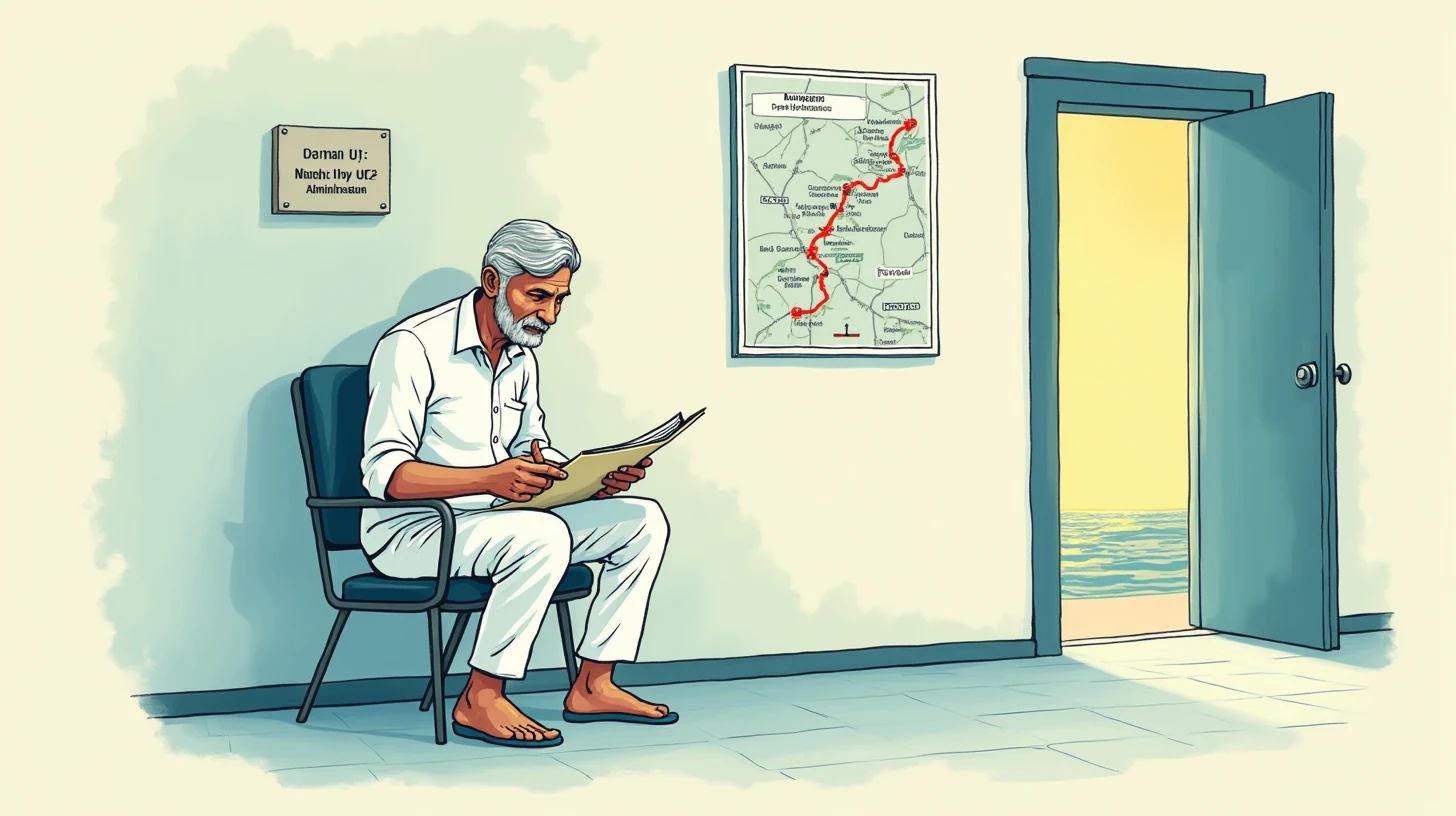
🗓️ The 2020 UT Merger and Its Administrative Aftermath
For the residents and retirees of Daman, the announcement meant something more abstract: reorganization, consolidation, a new administrative center in Silvassa (the capital of the former Dadra and Nagar Haveli UT). The files would remain where they were. The systems would follow the government to Silvassa. And somewhere in that transition, some pensioners found themselves waiting—not because of bureaucratic spite, but because no one had explicitly told them what to do.
Ramesh Patel was one of them.
Ramesh, 64, had spent twenty-nine years as a clerk in the Daman & Diu UT Administration. He had filed his retirement papers in early 2020, just as the merger was being finalized. His service book sat in the Daman Secretariat. His pension file was assembled there. Everything was in order. And then the silence began.
Six months passed. His wife Savita grew anxious. The bank kept asking where his pension was. The neighbors—some of whom had retired years earlier—had long since received their first disbursements. Ramesh checked the Daman Secretariat twice. A clerk, sympathetic but also helpless, told him: "Sahab, hamara records complete hain, lekin system ab Silvassa mein chal raha hai." Our records are complete, but the system is now in Silvassa.
No one had explained what came next.
:::infographic type: timeline
- Jan 2020: Dadra and Nagar Haveli UT and Daman and Diu UT merge into DNHDD
- Feb 2020: Ramesh Patel submits retirement papers; file created in Daman Secretariat
- Mar–Aug 2020: File remains in Daman; pension processing system migrates to Silvassa
- Aug 2020: Ramesh inquires at Daman Secretariat; no forward movement
- Sep 2020: Ramesh learns about pension file transfer request; submits to Silvassa Pension Cell
- Sep–Oct 2020: Silvassa Pension Cell coordinates with Daman to retrieve file (21 working days)
- Oct 2020: Pension approved; first disbursement processed :::
⚠️ File in Daman, System in Silvassa, Pension Stuck
The administrative geography of a UT merger creates pockets of ambiguity—especially for retirees whose paperwork predates the restructuring.
When two union territories merge, their bureaucratic organs don't simply combine like water and oil. Instead, one becomes subordinate to the new unified structure. In the case of DNHDD, Silvassa (the capital of the former larger UT) became the administrative seat. The Pension Cell—the office that processes, verifies, and approves pension files—relocated there. All new pensioners' files were directed to Silvassa. But what about files that were already in motion?
Ramesh's file was in transit when the transition happened. Not lost—not misfiled. Simply waiting in a place where the system no longer lived.
The Daman Secretariat's pension section still existed, but it no longer had authority over pension processing decisions. The staff there maintained the archives, but they couldn't move a file forward. Moving a file to Silvassa required an explicit request from the pensioner—a request that, frustratingly, no one had communicated.
Savita's worry deepened into something closer to quiet anger. Why, she asked Ramesh, hadn't the government told him? Why wasn't there a notice in the Daman Secretariat? Why did they have to guess?
These were reasonable questions. In theory, the UT Administration should have issued a circular explaining the new pension process to all retirees and incoming pensioners. In theory, the Daman Secretariat should have proactively transferred all pending files to Silvassa. But theory and practice diverged. And the people caught in that gap—the retirees and their families—waited.
:::infographic type: boundary Daman Secretariat Pension Section (Pre-2020) | DNHDD Unified Pension Cell in Silvassa (Post-2020)
- Authority: Process and approve pensions for Daman & Diu UT | Authority: Process and approve pensions for all merged UT
- System access: Standalone filing system | System access: Unified DNHDD administrative portal
- Archive: Complete records for pre-2020 retirees | Archive: Receives files from Daman on request
- Role post-merger: Records maintenance only | Role: All pension processing and approval :::
:::pullquote Gujarati "ઓફિસ ભળી ગઈ, પણ ફાઇલ ક્યાં ગઈ? ડામણમાં બેઠો છું, અને ઓફિસ સિલ્વાસ્સા ગઈ."
(The office merged, but where did my file go? I'm in Daman, and the office went to Silvassa.) :::
🌗 An Agent Explains the File Transfer Request
It was Ramesh's nephew, who worked in an NGO in Dadra, who finally found the answer. He had called the DNHDD UT Administration's general helpline—a number few retirees knew to use—and explained the situation. A clerk at the other end walked him through it.
The pension processing hadn't stalled because of a rule or a restriction. It had stalled because the system didn't know to ask for the file. And the file wouldn't move without someone asking.
What Ramesh needed was simple: a written request to the Silvassa Pension Cell. Not a formal application. Not a detailed petition. Just a letter stating that his pension file, currently held in the Daman Secretariat, should be transferred to Silvassa for processing.
When Ramesh heard this, he felt something release—not quite relief, but the relief that comes with finally having a name for the problem.
The agent, speaking in Gujarati—Daman's primary language—explained it this way:
"જો તમારી ફાઇલ ડામણમાં છે અને પેન્શન સિસ્ટમ સિલ્વાસ્સામાં છે, તો તમારે સિલ્વાસ્સા પેન્શન સેલને એક સરળ પત્ર મોકલવું પડશે કે 'મારી ફાઇલ ડામણમાંથી મોકલ કરો અને પ્રક્રિયા કરો.' તેઓ આંતરિક રીતે ડામણ સચિવાલય સાથે તાલમેલ કરશે. તમે તમારી સર્વિસ બુક, નિવૃત્તિ આદેશ, આધાર અને બેંક પાસબુક લઈને જાઓ. સિલ્વાસ્સાથી ફાઇલ મળ્યાથી 21 કામના દિવસમાં તમારી પેન્શન મંજૂર થશે."
(If your file is in Daman and the pension system is in Silvassa, you need to send one simple letter to the Silvassa Pension Cell saying, "Please request my file from Daman and process it." They will coordinate with the Daman Secretariat internally. Go with your service book, retirement order, Aadhaar, and bank passbook. Once Silvassa receives the file, your pension will be approved in 21 working days.)
The agent also explained that Ramesh, as a UT Administration employee, would receive two pension streams: the UT pension (administered by DNHDD) and the EPFO EPS-95 monthly pension (from his employee provident fund contributions). Both would be processed in parallel once the file moved to Silvassa.
This clarity transformed everything. Ramesh typed a letter that evening—simple, direct—and delivered it to the DNHDD UT Administration office in Daman (which still existed as a local liaison point, even if processing had moved). Within two weeks, the Silvassa Pension Cell acknowledged receipt. They confirmed they had coordinated with Daman. The file was being retrieved.
On the twenty-first working day, Savita saw the deposit notification. The first pension payment appeared in their bank account. Six months of silence ended in a single institutional handshake—a file request from Silvassa to Daman, a file transfer that shouldn't have required a citizen's request in the first place.
🧭 Systemic: UT Mergers and Their Pension Administration Gaps
Ramesh's experience reveals a pattern that repeats across administrative reorganizations. When two bureaucratic entities merge, the physical assets (buildings, files, furniture) don't automatically relocate. The systems (software, approval chains, authority centers) do. And the gap between where the file is and where the system is becomes a waiting room for confused retirees.
The Daman & Diu UT administration had existed since 1962. Employees had paid into its pension system for decades. The Daman Secretariat held their files as a matter of institutional routine. When the merger happened, no one explicitly said: Every pending pension file will now need a transfer request. It was assumed, or forgotten, or deemed the retiree's responsibility.
Similar gaps exist in other UT mergers across India. Jammu & Kashmir was reorganized in 2019. Ladakh was separated. Puducherry's relationship with the center shifted. In each case, retirees found themselves navigating bureaucratic transitions they hadn't caused and couldn't predict.
The lesson isn't that mergers are bad—administrative consolidation can improve efficiency and reduce duplicative overhead. The lesson is that mergers create temporary friction zones. And those zones, left unmanaged, become waiting rooms where people's livelihoods pause.
A well-designed merger would include:
- Proactive notification: Every retiree with a pending file should receive a written notice explaining the new process and what step they need to take.
- Automatic file transfer protocols: Instead of waiting for pensioners to request transfers, the old secretariat should automatically forward files to the new center on a scheduled basis.
- A single contact point: A helpline or liaison officer explicitly empowered to answer questions about pension file transitions.
None of these existed for Ramesh. He had to discover the solution through his nephew's initiative. Others might not have been as lucky.
🌱 A Quiet Close
Ramesh and Savita sat on the small balcony of their flat in Daman on the day the pension arrived. The sea was visible in the distance—the same sea that had been there through his twenty-nine years of service, through the announcement of the merger, through the six months of waiting.
He told Savita that he was grateful it had worked out. She nodded, but there was something else in her expression: a quiet recognition that it shouldn't have taken so long, and that their outcome—finding the answer—was a matter of luck and a nephew's persistence, not the system working as intended.
The Daman Secretariat clerk who had sympathized with him—"our records are complete, but the system is in Silvassa now"—had been right. The records were complete. The system had moved. And in the space between those two truths, a pensioner had to find his own way forward.
For anyone in a similar situation—a retiree from the old Daman & Diu UT, or from any merged UT, waiting for a pension that should have arrived—the path forward is the same one Ramesh finally took: a written request to the Silvassa Pension Cell (or to the new unified center in your region), a clear statement of what you need, and the documents that prove your service and identity. The institution will coordinate internally. The file will move. The approval will come.
But it shouldn't require a six-month wait and a nephew's detective work to know that.
The first pension payment had been enough. After that, the system worked smoothly. Ramesh received his monthly disbursement, his EPFO pension came through in parallel, and life resumed. But every time he thought about those six months, he wondered how many other retirees were still waiting—still not knowing that all they had to do was ask.
For Daman and Dadra and Nagar Haveli and Daman and Diu retirees:
- To request a pension file transfer: Contact the Silvassa Pension Cell via the DNHDD UT Administration office in Daman or directly (contact available on https://dnh.nic.in)
- Documents to bring: Service book, retirement order, Aadhaar, bank passbook
- Processing timeline: 21 working days from file receipt at Silvassa Pension Cell
- Dual pensions: UT pension and EPFO EPS-95 pension are processed in parallel
- If your pension is delayed: Request a file status update from either the Daman Secretariat (which holds the original file) or the Silvassa Pension Cell (which processes it)