
The Delhi widowed uncle and the CGHS card renewal
Ramesh Khanna is sixty-eight years old. He lives in a two-bedroom DDA flat in Mayur Vihar Phase I, East Delhi — the kind of colony where every second building has a small Hanuman temple and the Residents' Welfare Association has been arguing about the same overhead tank, the same broken lift, and the same contested parking since 1997. He moved into this flat in 2001, when his children were still in school and the jacaranda tree outside the bedroom window was barely taller than the compound wall. The tree now reaches the second floor. The children are long gone.
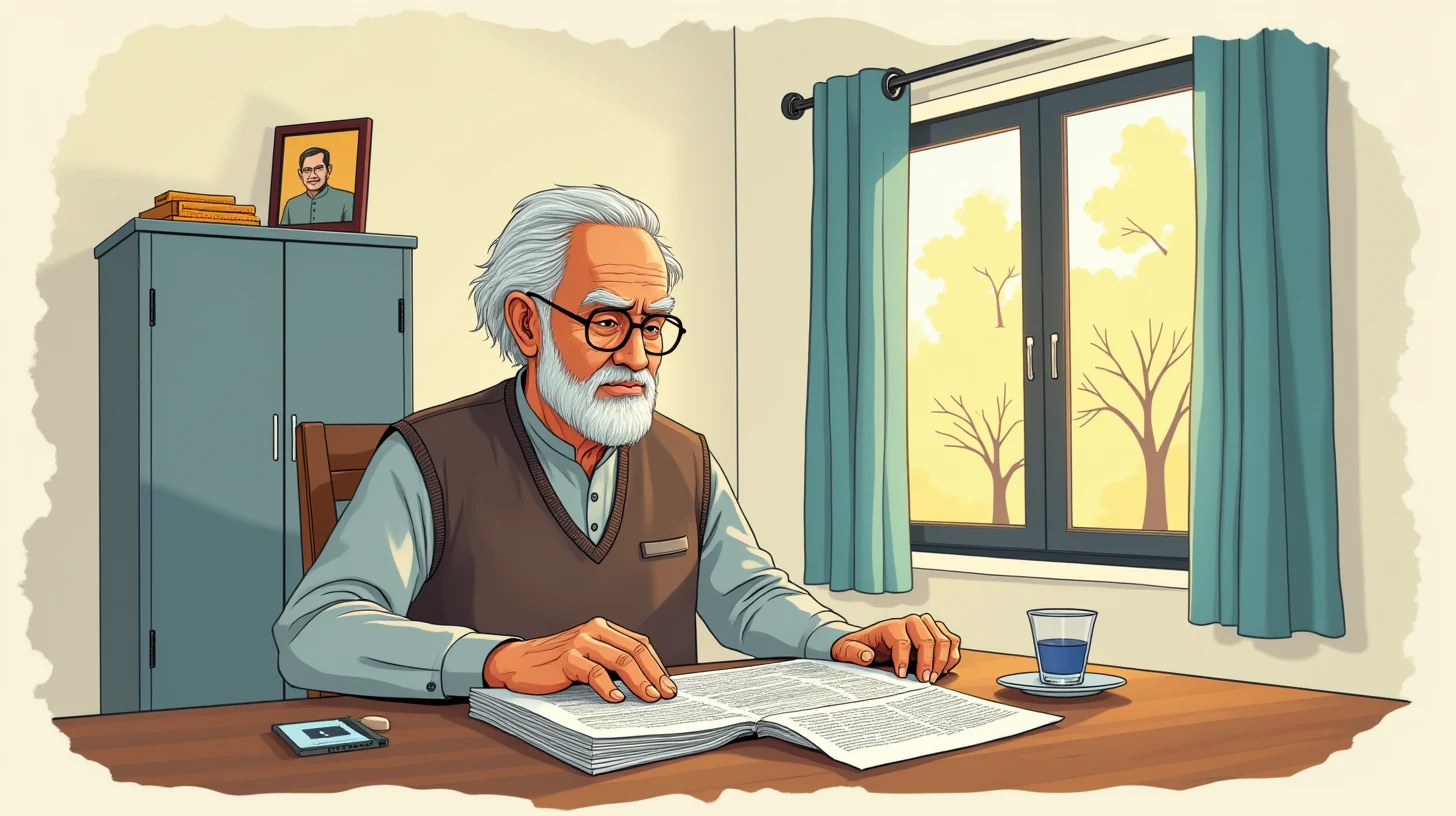
He retired in 2022 after thirty-two years in the Ministry of Housing and Urban Affairs, where he rose, methodically and without great drama, from Section Officer to Deputy Secretary. He is, by temperament and training, a man who reads before he signs. His noting files were precise; his minutes were never returned.
His wife Sarla died in October 2023 of kidney failure. She had been, for thirty-eight years, his primary informational node for the domestic world: the CGHS forms, the LPG KYC, the bank nominations, the insurance renewals, the small diary she kept with dates that mattered — bill deadlines, card expiry dates, the quarterly check on the FD. She had never been in government service herself. She had simply been very organised, in the way that women of her generation often were — because nobody else was going to be.
His son Vikram lives in Noida with a young child and a wife who works. His daughter Priya is in Lucknow, married to a man named Ashish who works in IT services and who knows, in the practical way of IT-services people, how to install things on tablets. Ramesh speaks to Vikram every few days and to Priya every week. He manages the cooking himself — dal, sabzi, the occasional rajma on Sundays. He walks forty minutes in the morning along the Yamuna Pushta road, then reads Dainik Jagran over a glass of nimbu pani. His pension is ₹52,000 a month, transferred on the first working day of every month to his SBI account at the Mayur Vihar Phase I branch, without fail, as it has been since 2022.
What is unusual is what happened last March when a letter arrived from the CGHS and stayed on the dining table for five weeks without being opened properly.
🗓️ The annual ritual
The Central Government Health Scheme is one of the more useful things the Government of India has built for its employees. A retired Central Government officer on ₹52,000 a month — Ramesh's bracket — is entitled to cashless outpatient consultations, diagnostics, and hospital treatment at CGHS-empanelled facilities, subject to CGHS-approved rates. For a sixty-eight-year-old with a history of mild cardiac arrhythmia who sees a cardiologist every quarter at a private hospital in Laxmi Nagar, this is not an abstract benefit. It is, potentially, a ₹40,000 to ₹60,000 difference per admission.
The card is not automatic. It is issued once at retirement and it expires. The renewal requires a small but specific packet of documents: a copy of the Pension Payment Order, a recent passport photograph, and the expired card itself, submitted in person at the CGHS Wellness Centre that serves the pensioner's address — or, alternatively, via the CGHS portal online. The Wellness Centre for Mayur Vihar Phase I falls under the Patparganj Zone, and the assigned dispensary is CGH Dispensary No. 14. Ramesh did not know any of this. Sarla had noted the card's first renewal date in her small diary. The diary had been in her beside-table drawer. He had not opened the drawer since November 2023.
- 📅
January 2025 — card expired
The CGHS card issued at retirement in 2022 expired quietly, with no SMS and no knock on the door. The expiry date had been in Sarla's diary. Ramesh did not know.
- 📬
March 2025 — physical letter
A CGHS letter arrived by post — because Ramesh's mobile number and email were not registered in the CGHS database — notifying him of the expiry and asking him to renew before availing any benefits.
- 🍽️
March–April — the dining table
The letter sat on the table for five weeks. Not laziness: paralysis. Ramesh did not know which dispensary covered Mayur Vihar, what a PPO copy looked like, or whether to go in person or online.
- 🏥
June 2025 — cardiology review due
His quarterly cardiology review at Laxmi Nagar was three months away. Without a valid CGHS card, it would be an out-of-pocket ₹40,000 bill.
The system, as designed, had done everything correctly. A card had been issued. An expiry date existed. A letter had been sent when the card lapsed. There was a portal. There was a dispensary. The problem was that the entire apparatus assumed the pensioner would know what a Pension Payment Order looked like, which dispensary covered their pin code, and whether the process was in-person or online. Sarla had known all of these things. She had noted the answers in her diary. The diary was in the beside-table drawer. Ramesh had not opened it.
⚠️ What very nearly happened
The letter arrived on a weekday in March, after Ramesh's morning walk. He opened the envelope — the CGHS letterhead was recognisable — read the first two paragraphs, registered that something had expired, and put the letter on the dining table with the intention of dealing with it after lunch.
He did not deal with it after lunch. That evening he read it more carefully and established that his CGHS card had expired in January 2025 and that he must submit a renewal application to his Wellness Centre with a PPO copy, a passport photograph, and the old card. He read the phrase "Pension Payment Order" and felt a particular uncertainty: he had never needed his PPO. Sarla had filed it. He did not know where it was. He did not know which Wellness Centre served Mayur Vihar Phase I. He put the letter back on the dining table.
The following week, his son Vikram called from Noida. Ramesh mentioned the letter. Vikram said:
"पापा, ये सब CGHS के चक्कर में मत पड़िए — हम अपना इंश्योरेंस ले लेते हैं आपके लिए।" — Papa, don't get tangled up in all this CGHS business. We'll just get you a private insurance policy instead.
Ramesh said he would think about it. He did think about it, across two cups of tea: private health insurance for a sixty-eight-year-old with a documented cardiac history would cost ₹35,000 to ₹45,000 a year, with sub-limits on cardiac procedures that would apply at exactly the wrong moment. The CGHS card, renewed, would cost nothing. This was not a close call in financial terms. It was only a close call because the renewal required knowing four things that Ramesh did not know.
He told Vikram he would manage. He put the letter back on the dining table.
This was in late March. He managed to not-manage for five weeks — a period that he would later describe to Priya, with civil-service understatement, as "kuch delays ho gaye." The letter moved twice: once to the kitchen counter and back, when he wiped the table for his Sunday rajma. Without a valid card, any CGHS-empanelled consultation would be out-of-pocket and then claimed — a reimbursement process that is, by everyone's testimony, considerably more difficult than simply having a valid card. The quarterly cardiology review in June was not a crisis yet. But it was coming.
🌗 What changed
Priya visited from Lucknow in the last week of April. She had come partly to see her father and partly — daughters often have a second purpose on such visits — to assess the quiet accumulation of things that her father was not saying in their weekly calls. She found the CGHS letter on the dining table in the third minute of her arrival, under a copy of Dainik Jagran placed over it at the angle a piece of paper adopts when someone has decided that covering it constitutes dealing with it.
She read it. She called Ashish in Lucknow and asked him to walk her through what to install on her father's tablet. He guided her in twenty minutes over a video call — language set to Hindi, font bumped two stops, a quick demo with a utility-bill screenshot. He called it "ek chhota sa assistant." Priya handed the tablet to her father and said, simply, that if a letter confused him, he could show this to it and ask.
That evening, after Priya had gone to bed, Ramesh photographed the CGHS letter with the tablet and typed, in Hindi, "Yeh kya hai aur mujhe kya karna chahiye?" — What is this and what should I do?
The agent replied in clear, large-text Hindi:
"नमस्ते रमेश जी। यह CGHS का नवीनीकरण पत्र है। आपका CGHS कार्ड जनवरी 2025 में समाप्त हो गया था। नवीनीकरण के लिए आपको तीन दस्तावेज़ चाहिए: पेंशन पेमेंट ऑर्डर की फ़ोटोकॉपी, एक पासपोर्ट फ़ोटो, और पुराना CGHS कार्ड। आपका नामित वेलनेस सेंटर CGHS डिस्पेंसरी नंबर 14, पटपड़गंज ज़ोन है, जो मयूर विहार फेज़ I के पास ही है। वहाँ सोमवार से शुक्रवार सुबह 9 से दोपहर 1 बजे तक जमा किया जा सकता है, बिना किसी अपॉइंटमेंट के। क्या आपके पास अलमारी में PPO फ़ाइल होगी?"
(Greetings Ramesh ji. This is a CGHS renewal letter. Your CGHS card expired in January 2025. For renewal you need three documents: a photocopy of the Pension Payment Order, one passport photograph, and the old CGHS card. Your designated Wellness Centre is CGHS Dispensary No. 14, Patparganj Zone, which is near Mayur Vihar Phase I. Submissions are accepted Monday to Friday, 9 AM to 1 PM, walk-in. Do you think the PPO file might be in your almirah?)
It had read the letter. It had named the dispensary. It had confirmed walk-in. And then — gently, without making him feel that he should have known — it had asked about the almirah.
He opened the almirah. The PPO was in a manila envelope behind the LIC policy folder. Sarla had labelled it, in her neat hand, "Pension PPO — important." He stood in front of the almirah for a moment with the envelope in his hands, and then he sat back down and typed: "PPO mil gaya." Found it.
The agent walked him through the rest: photocopy the relevant pages at the shop on the ground floor of the next building, take a fresh passport photo at the studio on the main road, put the three items in the envelope, go Tuesday morning when the dispensary would be less busy. It also told him something he had not asked: since Sarla had died, her name could be removed from the renewed card with nothing more than a death certificate. He had been unclear, in a dim, anxious way, whether a spouse's death created some additional complication in the renewal. It did not. He took the death certificate with him.
CGHS card renewal
resolved in 6 daysThe agent named the dispensary, confirmed walk-in hours, found the PPO in the almirah, and noted Sarla's removal required only the death certificate. New card arrived by post six working days after his Tuesday visit.
PAHAL subsidy lapse
₹900 × 6 months backA February SMS from the LPG distributor about Aadhaar-bank seeding lapse had been misread as 'subsidy cancelled.' The agent clarified: a 20-minute fix at SBI Mayur Vihar Phase I, with six months of arrears credited back.
Income tax regime error
₹18,000 — noted for 2026The agent flagged that FY2024-25 was filed under New Regime when Old Regime + Section 80TTB would have saved ~₹18,000. The revision window had closed; a July 2026 reminder was set for the comparison.
He went on a Tuesday morning, as suggested, at 9:45. He submitted the form. He was out in forty minutes. The new CGHS card arrived by post six working days later. He put it in the almirah, in the slot that Sarla would have used, in a small envelope that he labelled — in his own hand, in the neat, slightly formal script of a career government officer — "CGHS Card — valid, renewed April 2025."
🧭 Why we built it
There are, by conservative government estimate, roughly five million retired Central Government employees in India. A non-trivial fraction of them are widowers or widows — people who have, for the first time in their adult lives, been left alone with the administrative housekeeping of a household that two people once ran together. The split, in those households, was almost never 50-50. One person knew where the PPO was. One person noted the renewal dates. One person had the CGHS dispensary phone number memorised from 2010. When that person dies, the accumulated informal knowledge — the diary, the labelled envelopes, the mental map of which branch handled what — goes with them.
Ramesh Khanna spent thirty-two years at the Ministry of Housing drafting noting files about urban policy. He could not, on his own, find his CGHS dispensary. Not because he was incapable. Because the knowledge had been divided — reasonably, efficiently, without anyone planning it — between two people, and then one of those people was gone. The CGHS letter was sent. The portal exists. The dispensary is real. The failure is the assumption, baked into every government renewal system, that there is always one person in the household who knows where the documents are and what the acronyms mean.
The bureaucratic surface of a retired Central Government household is not small. CGHS renewals. Jeevan Pramaan certificates. LPG KYC. Income tax regime selection. Pension nominee updates. Each individually manageable. Collectively a perpetual low-grade load that, if one person handled, the other never had to. And now the other has to.
We built a small, quiet, Hindi-first assistant that lives on the tablet the son installed and the daughter configured. It reads letters. It reads SMS. It does not, ever, complete the transaction for him — Ramesh would not permit this, and we have built it not to. What it does is exactly what Ashish, the IT-services man in Lucknow, would do if he were sitting in the next room with a laptop: read the letter, name the dispensary, check the hours, ask about the almirah.
What it does
- 🔍Reads physical letters and SMS, identifies the issuing agency, and names the specific action required — renewal, re-seeding, document assembly — in plain Hindi.
- 📋Surfaces the documents he needs from his own almirah and tells him which CGHS dispensary, which SBI branch, which walk-in hours apply to his address.
- 📅Sets forward reminders — July 2026 for the income-tax regime comparison — so the next deadline does not sit on the dining table for five weeks.
What it does not do
- 🔒Never enters his Aadhaar OTP, net-banking password, or CGHS portal credentials.
- 💳Never submits a form, transfers money, or completes any government transaction on his behalf.
- 📁Never opens the steel almirah without being asked — it tells him what to look for; he finds it himself.
We built it free. We will keep it free for this user — the retired widower in a DDA flat in East Delhi, whose wife handled the forms for thirty-eight years — forever. The model that makes it free is the same model that makes WhatsApp free: this is not a market segment with discretionary consumer budget. It is a market segment with daughters in Lucknow and sons in Noida who will, in time, pay for the small things on top — the cross-state tax-filing comparison, the reminder that the LIC policy anniversary is next month, the quiet weekly summary that the agent prepares for Priya so she knows what her father is and isn't mentioning in their calls. But the core thing — reading the letter with him, in Hindi, in large font, on a Tuesday evening after the nimbu pani — is, and will remain, free.
🌱 What we hope happens
Priya Khanna wrote to us in early May. She said that she had understood, when she found the CGHS letter under the Dainik Jagran, something she had not quite understood before: that her father was not unwell, not depressed, not deteriorating in any of the ways she had feared. He was simply in a category of difficulty that had no prior template for him. He was a man who had spent thirty-two years managing the government of India's housing policy. He could not find his Wellness Centre on a map. These two facts are not contradictory. They are simply the shape of what happens when informal household knowledge — the knowledge that lived in Sarla's diary and Sarla's head — is suddenly, permanently, gone.
She said that the first week after installing the agent, her father called her not about the CGHS but about a Dainik Jagran article on pension commutation rules. He had an opinion. The call lasted forty minutes. She had not had a forty-minute call with him about something interesting, rather than something anxious, since before her mother's illness. She did not attribute this to the agent; that would be too much. But she noted that when the background administrative anxiety had been attended to, he had more room to be the person he actually was.
Which is, all considered, what we hoped this product would do.
If you have a parent or an uncle in a similar situation — anywhere in India, managing an CGHS card or a Jeevan Pramaan or an LPG KYC or a pension nomination update without the person who used to handle all of it — the product is free at gabforge.in. We support native Hindi, Marathi, Bengali, Tamil, Telugu, Kannada, Malayalam, Gujarati, Punjabi, Odia, and Assamese. The installation takes twenty minutes. We will not advertise to your father. We will not touch his documents. We will read the letter with him, and then we will be quiet.