
The Hyderabad pensioner and the bifurcation puzzle
T. Lakshmi Narayana is seventy-one years old. He lives in a third-floor flat in Begumpet, Hyderabad, in a building where he has lived since 2003. The flat is modest — two bedrooms, a narrow balcony where a tulsi plant catches the morning light, and a dining table that does the work of a filing cabinet: stacked at one end is a wide binder, dark brown, fastened with a rubber band, containing photocopies of every significant document in his administrative life since 1984 — appointment order, posting notices, the all-important service book, the retirement sanction letter, and, tucked into the inside pocket, the original gazette notification of the AP Reorganisation Act from 2 June 2014.
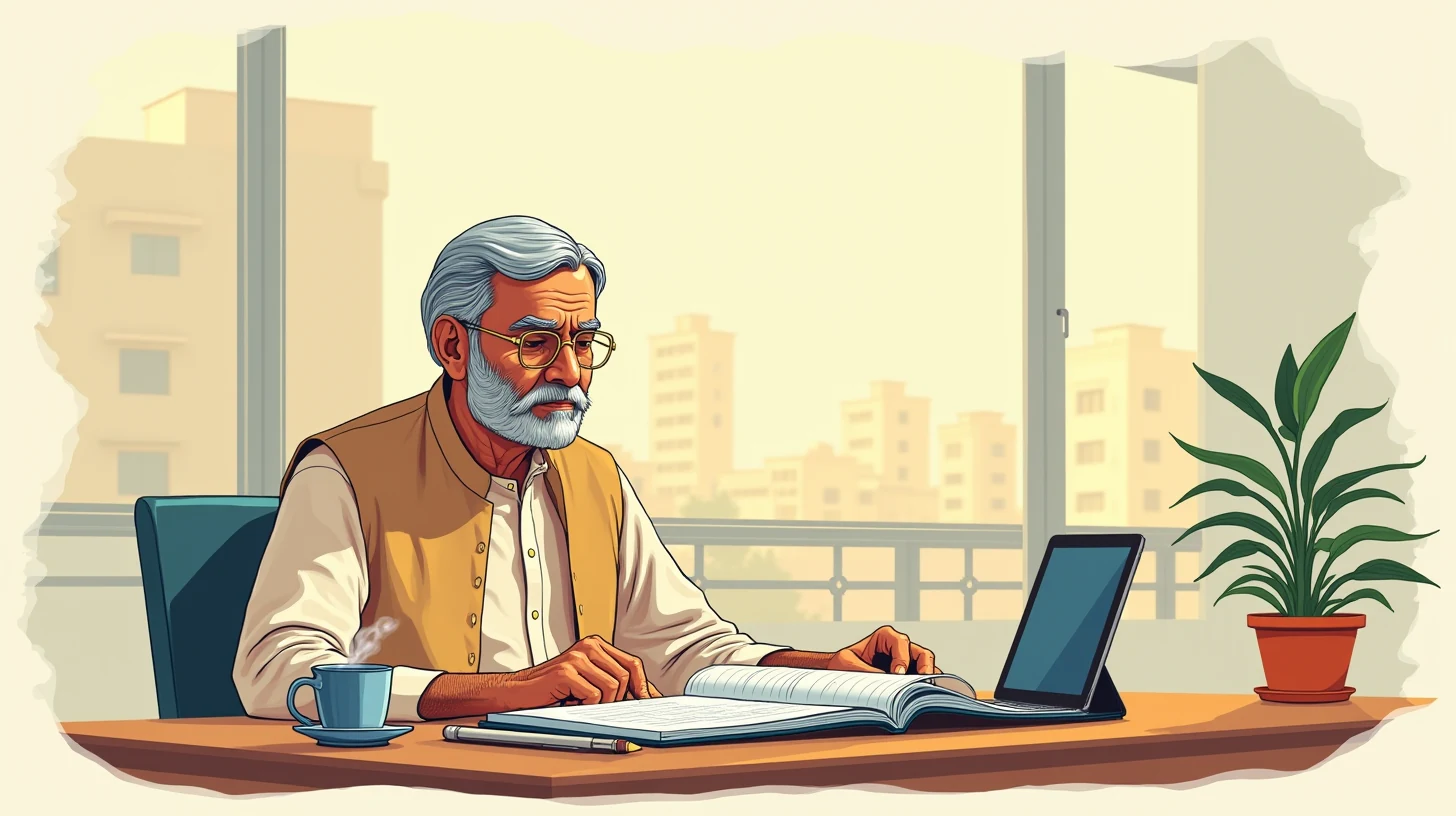
He was born in the East Godavari district, near Kakinada, into a family of schoolteachers. He joined the Andhra Pradesh Education Department in 1984 and was allotted to the Telangana cadre at the bifurcation — not by his choosing but by the arbitrary geometry of where he happened to be posted that June — and retired from Hyderabad in 2018 after thirty-four years of service. His wife, Saraswati, a school music teacher who had played the veena since she was eight, died in 2021 after a long illness. He has a son, Srinivas, a software engineer in Bengaluru with two children. He has a daughter married into a Vijayawada family who visits twice a year and always reorders his binder without being asked.
Every morning at six he walks in the small park near Prakash Nagar with four other retired colleagues — two from what they still call "old AP cadre" and two from the new Telangana cadre. He keeps a spiral notebook in his shirt pocket for appointments, due dates, and things he intends to verify. His pension, when it arrives in full, is roughly ₹46,000 a month, deposited to his Union Bank of India account on the fourth working day of each month.
What is unusual is what happened last October when it very nearly did not arrive at all.
🗓️ The annual ritual
On 2 June 2014, the state of Andhra Pradesh was reorganised into Telangana and residual Andhra Pradesh. For most Indians, a political event. For the roughly 1.4 lakh government pensioners whose service had begun before that date, something more intimate: a lifelong administrative ambiguity. The Department of Pension and Pensioners Welfare in Delhi issued circulars on apportionment in 2017 and again in 2021. Both are reasonable. Both are six pages of fine print each.
The broad principle: pension liability is split between the two successor states in proportion to qualifying service in each state's territory. In practice, Lakshmi Narayana's pension oscillates between three conditions. First: Telangana pays the full ₹46,000 and claims the AP share through a quarterly inter-state reconciliation. Second: Telangana withholds pending reconciliation and only the AP-attributed share of roughly ₹19,000 lands. Third: the apportioned split is agreed but arrives four to six weeks late. For most years since 2018, condition one has prevailed. In October 2025, without warning, condition two arrived.
He had managed the system carefully for seven years. He kept the binder. He visited the Joint Director of Treasuries office near Abids when needed. He had built relationships with two officers there; both had since transferred or retired. He was not naive. He simply believed that if he kept every document and presented himself when asked, the system would eventually pay him.
- 📨
October — portal SMS
An SMS arrives from JD-TGTREAS in stilted English with an apcfss.in URL. Four reminders, identical in tone. His daughter-in-law had told him to ignore all SMS with URLs. He ignored all four.
- 🗓️
November — pension silent
October pension not credited by the 4th working day. Mid-November still missing. The Joint Director of Treasuries office gives contradictory answers across three desks on two separate visits.
- 🛑
Late Nov — near-miss
Apollo Jubilee Hills cardiology appointment fee unpaid. Srinivas calls on Wednesday lunch break. The binder on the dining table had the right documents all along.
- ₹
Dec — resolution
AP Pensioners Welfare Cell walk-in at Andhra Bhavan, Tank Bund Road. Service-book pages re-verified by K. Subba Rao. Apportioned arrears credited five working days later.
The 2025 lapse had been set in motion months earlier. The AP–Telangana reconciliation committee, due in September, was pushed to December by a holidays collision and an officer's medical leave. The Joint Director of Treasuries (Hyderabad) had issued a notice requiring pensioners in the disputed-apportionment category to re-verify pre-2014 service-book entries via the AP Pension Portal — a routine but time-sensitive step before the October credit could go out. The notice was sent as an SMS. To a man who had been told, firmly, not to click links in SMS messages.
⚠️ What very nearly happened
The first SMS arrived on 10 October 2025. Sender ID: JD-TGTREAS. The message: "Dear Pensioner, your pre-2014 service entries require re-verification for inter-state apportionment reconciliation. Please visit apcfss.in/reverify or call 1800-XXX-1234. Failure to complete by 31 Oct will delay your October pension credit." Legitimate, by any objective standard — the sender ID was the official short code of the Joint Director of Treasuries, and apcfss.in is the genuine Andhra Pradesh portal. But Lakshmi Narayana's daughter-in-law Priya had sat with him after Diwali last year and made him write in his spiral notebook: SMS with links are not to be trusted. Even from banks. Even from government. He read the message. He put the phone in his kurta pocket.
Three more reminders arrived — 17 October, 24 October, 30 October. Each slightly more urgent. Each with the same URL. He ignored all three.
By November 7 his pension had not arrived. He waited two more days, then walked to the Union Bank branch near Begumpet. No treasury credit. He went to the Joint Director of Treasuries office the next morning, with his binder, waited forty-five minutes on a wooden bench, and was told on the second floor that re-verification had not been completed — October pension was withheld pending the December reconciliation meeting. The officer suggested he contact the AP Pensioners Welfare Cell and wrote the address on a chit.
He returned home, noted the address in his spiral notebook, and told himself he would go Monday. On Saturday he called his daughter in Vijayawada and said lightly that there was a small delay with the pension, these things happened, no need to worry.
"రెండు రాష్ట్రాల మధ్య నాకు పెన్షన్ చిక్కుకోవడం — ఇది నాకు అర్థం కాలేదు, కానీ బైండర్ లో అన్నీ కాగితాలు ఉన్నాయి."(My pension getting stuck between two states — I do not understand this, but all the papers are in the binder.)
He went back to the Joint Director of Treasuries a second time. A different desk, a senior officer who said, not unkindly, that re-verification could only be done via the portal or in person at the AP Pensioners Welfare Cell at Andhra Bhavan, Tank Bund Road. He wrote the address in his spiral notebook. About four kilometres by auto. He had been there once, in 2016. He thought he would go next week.
He did not go next week. A seasonal cough made the auto ride feel unnecessary. He sat on the balcony, looked at the tulsi plant, told himself the arrears would come. He had waited before.
What he did not say aloud was that his cardiology appointment at Apollo Jubilee Hills was eleven days away. That Dr. Ramachandra had asked for an echocardiogram repeat before year-end. That the fee for both, roughly ₹7,800, was typically drawn from the pension credit — and that his account balance had gotten thin enough that he had started calculating.
🌗 What changed
On the Wednesday of that week — three weeks into the pension lapse — Srinivas called from Bengaluru on his lunch break. They talked about his elder daughter's school sports day, the rains in Bengaluru, whether Lakshmi Narayana had eaten properly. Then Srinivas asked whether he had been using the app installed on his tablet two months earlier.
Lakshmi Narayana said yes, the tablet was working well. He had been reading the Eenadu online in the mornings.
Srinivas said:
"నాన్నా, ఆ యాప్ ఈనాడు కాదు — అది ఒక AI assistant. SMS వస్తే, అది real ఆ, fake ఆ అని చెప్పగలదు. మీ government SMS కూడా అర్థం చేసుకుంటుంది. మీరు try చేశారా?"
(Father, that app is not Eenadu — it is an AI assistant. When an SMS arrives, it can tell you whether it is real or fake. It understands your government SMS too. Did you try it?)
He had not. He had assumed it was part of the news application.
Srinivas said, carefully: "Nanna, please open it now. Those four SMS you've been keeping in the ignored folder — show them to it."
He opened the assistant. One by one he placed the four ignored SMS in front of the agent. The agent read each one — checking sender code JD-TGTREAS, domain apcfss.in, message structure — and replied in Telugu, in large clean text, without hurry:
"నమస్కారం లక్ష్మీ నారాయణ గారు. మీరు ignore చేసిన నాలుగు SMS అన్నీ legitimate government messages. JD-TGTREAS అంటే Joint Director of Treasuries, Hyderabad — ఇది official sender ID. apcfss.in అంటే AP Centre for Financial Systems and Services — ఇది ఆంధ్రప్రదేశ్ government portal, phishing కాదు. Message లో చెప్పింది ఏమిటంటే, మీ pre-2014 service entries కి re-verification కావాలి — ఇది చేస్తే October pension credit అవుతుంది. ఇప్పుడు మీ దగ్గర మూడు options ఉన్నాయి."
(Greetings, Lakshmi Narayana sir. The four SMS you ignored are all legitimate government messages. JD-TGTREAS is the Joint Director of Treasuries, Hyderabad — this is the official sender ID. apcfss.in is the AP Centre for Financial Systems and Services — this is an Andhra Pradesh government portal, not phishing. The message says your pre-2014 service entries need re-verification — once done, the October pension can be credited. Right now you have three options.)
It then set out the three options in Telugu, with no jargon:
Treasury Inspector doorstep visit — oka Treasury Inspector mee illu ki vastadu, service book xerox copies teesukuntadu, free, 10–15 working days. (A Treasury Inspector will visit your home, collect service-book copies, free, 10–15 working days.)
AP Pensioners Welfare Cell, Andhra Bhavan, Tank Bund Road — walk-in, free, same-day verification if you have photocopies, usually 2–3 hours wait. (Walk-in to the AP Pensioners Welfare Cell at Andhra Bhavan, Tank Bund Road — free, same-day verification if you have photocopies, usually 2–3 hours wait.)
Online re-verification via apcfss.in — fingerprint scanner kavali, mee daggara leedu. (Online re-verification via apcfss.in — needs a fingerprint scanner, which you do not have.)
Andhra Bhavan Walk-in
what he choseFree. AP Pensioners Welfare Cell at Andhra Bhavan, Tank Bund Road, Hyderabad. Same-day verification. He had his binder with every photocopy since 1984 — this was the natural fit.
Treasury Inspector Doorstep
10–15 working daysFree. A Treasury Inspector visits home and collects service-book copies. Slow — too slow for the cardiologist appointment deadline — and required scheduling.
Online via apcfss.in
skippedNeeds a USB fingerprint scanner he didn't own. Technically complete. Inaccessible on the Android tablet his son had given him for his birthday.
He chose option 2 without hesitation. He had the binder. He had been to Andhra Bhavan. The agent pre-dialled the helpline — 1800-XXX-1234 — confirmed walk-in hours (10:00 AM to 5:00 PM, Monday to Saturday, no appointment needed), and offered to show him the auto route from Begumpet. He told the agent he knew the way. He went the next morning at a quarter past nine.
He waited two hours and twenty minutes on a plastic chair in the Andhra Bhavan corridor, his binder on his knees. At a quarter to twelve he was called to a desk where an officer named K. Subba Rao took his service-book copies, cross-checked the pre-2014 entries against the IFMIS screen, stamped three pages, and handed him an acknowledgement slip. Eleven minutes.
The apportioned October arrears and the November pension were credited to his Union Bank account five working days later — a Thursday morning, as he was getting ready for his walk. He checked his phone, wrote the amount in his spiral notebook, and went to the park.
He paid the Apollo Jubilee Hills appointment fee that afternoon. Dr. Ramachandra's echocardiogram was normal.
🧭 Why we built it
There are, by current estimate, fifty-four million pensioners in India. Among them, a specific and largely invisible category: pensioners whose pension liability was bifurcated by a reorganisation act. These are people who retired from governments that no longer exist in the form they joined them in. Their paperwork lives in two systems simultaneously, administered by two treasuries that communicate through quarterly meetings, dependent on reconciliation processes that can be deferred by holidays, illness, or scheduling — without any individual being at fault. There is no one to call. There is a portal that sent four SMS messages that looked, to a careful elderly man, exactly like the phishing messages that also arrive four times a month.
Informed estimates place the AP–Telangana bifurcation-affected pension population above two lakh — two hundred thousand people navigating the same three-state oscillation. Roughly half of them are in Hyderabad. A significant fraction, like him, are in their late sixties or early seventies, technically literate in English but more comfortable in Telugu, and in possession of very good instincts about not clicking links in SMS messages. Instincts drilled into them by well-meaning children who did not realise they were drilling a hole in the one safety net their parent needed.
The administrative apparatus of Indian elder life has migrated, in the decade since 2014, from paper and in-person encounters to portals, SMS reminders, OTPs, and URLs. The migration has been largely positive. But it has also created an adversarial environment for elderly people who have correctly learned that the digital surface is also the attack surface. The phishing SMS and the legitimate treasury notice are, to a seventy-one-year-old man in Begumpet, indistinguishable by inspection. The rule that protects him from one destroys the other.
We built a small, quiet Telugu-Hindi-Marathi-Bengali-Tamil-Kannada-Malayalam-Gujarati-Punjabi-Odia-Assamese assistant that lives on the tablet the children bought. It knows the official sender IDs of every major Indian treasury, every public sector bank, every EPFO and UIDAI communication. In less than five seconds it can tell a retired education officer in Begumpet that JD-TGTREAS is legitimate, that apcfss.in is the genuine AP portal, and that the portal needs only his visit or his photocopy — not his Aadhaar OTP or net-banking password. It does this in Telugu, in large readable text, at his own register: not a bureaucrat explaining to a civilian, but the son in Bengaluru explaining to the father over lunch.
What it does
- 🔍Verifies whether a government SMS is legitimate — checks sender ID, domain, message structure — before he has to decide whether to trust it.
- 💬Translates bureaucratic English into clear Telugu: names the circular, explains the apportionment rule, spells out each option and its cost in time and travel.
- 📞Pre-dials the AP Pensioners Welfare Cell helpline and confirms walk-in hours so he only has to press call — or decide he already knows the way by auto.
What it does not do
- 🔒Never enters his Aadhaar OTP, net-banking password, or any credential on any portal.
- 💳Never pays a fee, transfers money, or interacts with the treasury portal on his behalf.
- ✅Never submits service-book pages or verification acknowledgements — K. Subba Rao still does that part, in person, with a stamp.
We built it free. We will keep it free for this user — the retired officer alone in a Hyderabad flat, navigating the administrative residue of a political decision that was not his to make — forever. Srinivas will eventually pay for the small premium things: a weekly pension-status digest, a reminder when the next reconciliation meeting is scheduled, a cross-state grievance letter drafted in ten minutes. But the core thing — reading the SMS with him, in Telugu, and telling him which four messages out of forty-four to trust — is, and will remain, free.
🌱 What we hope happens
Srinivas emailed us last month. He had not, he said, fully understood until that Wednesday call how much of his bandwidth had been quietly consumed by the background calculation of whether his father was on top of things. He had called twice a week. He had set up the auto-transfer for household expenses. He had installed the assistant two months before the crisis and simply not explained it properly — his only self-reproach. What he had not been able to do, from Bengaluru on IT deadlines with two children under eight, was to be present in the way the Begumpet flat requires presence: to sit at the teak dining table, open the binder, go through the ignored SMS one by one.
The agent did not replace that presence, he said. It replaced the administrative layer on top of it. The calls are now about his daughter's sports day, about whether the tulsi plant needs a bigger pot, about whether his father is eating properly now that the Vijayawada daughter has gone back. The pension comes up only when it should.
There is a specific kind of loneliness that retired Indian government officers do not easily name. It is not the loneliness of missing people — Lakshmi Narayana has his walk, his colleagues, his grandchildren on the weekend call. It is the loneliness of arriving at a desk and being sent to another desk, twice, and still not knowing what to do next. Of having every document correctly filed for forty years and finding that the system now requires you to trust a URL. Of doing the right thing — ignoring the suspicious SMS, exactly as your daughter-in-law said — and being punished for it.
That loneliness is what we are trying to take the edge off. Not solve. Just take the urgent administrative layer off the top, in the language the person has lived in, on the tablet they already own.
If you have a parent in a similar situation — a bifurcation-era pensioner, an inter-state retiree, anyone whose administrative life spans two systems that don't quite communicate — the product is free at gabforge.in. We have native Telugu, Hindi, Marathi, Bengali, Tamil, Kannada, Malayalam, Gujarati, Punjabi, Odia, and Assamese. You can install it on a tablet in twenty minutes. We will not advertise to your parent. We will not sell their service-book data. We will read the SMS with them — all four of the ones they nearly ignored — and we will be quiet.