
The Itanagar officer and the Jeevan Pramaan that never arrived
Tamo Riba turned sixty-eight last March, sitting on the wide veranda of his village home thirty kilometres north of Itanagar, looking out at the Araku Valley. Thirty-two years of service in the Arunachal Pradesh Administrative Service—postings across Papum Pare, Lohit, and Changlang districts—had left him lean, methodical, and deeply suspicious of systems that worked on paper but failed in practice.
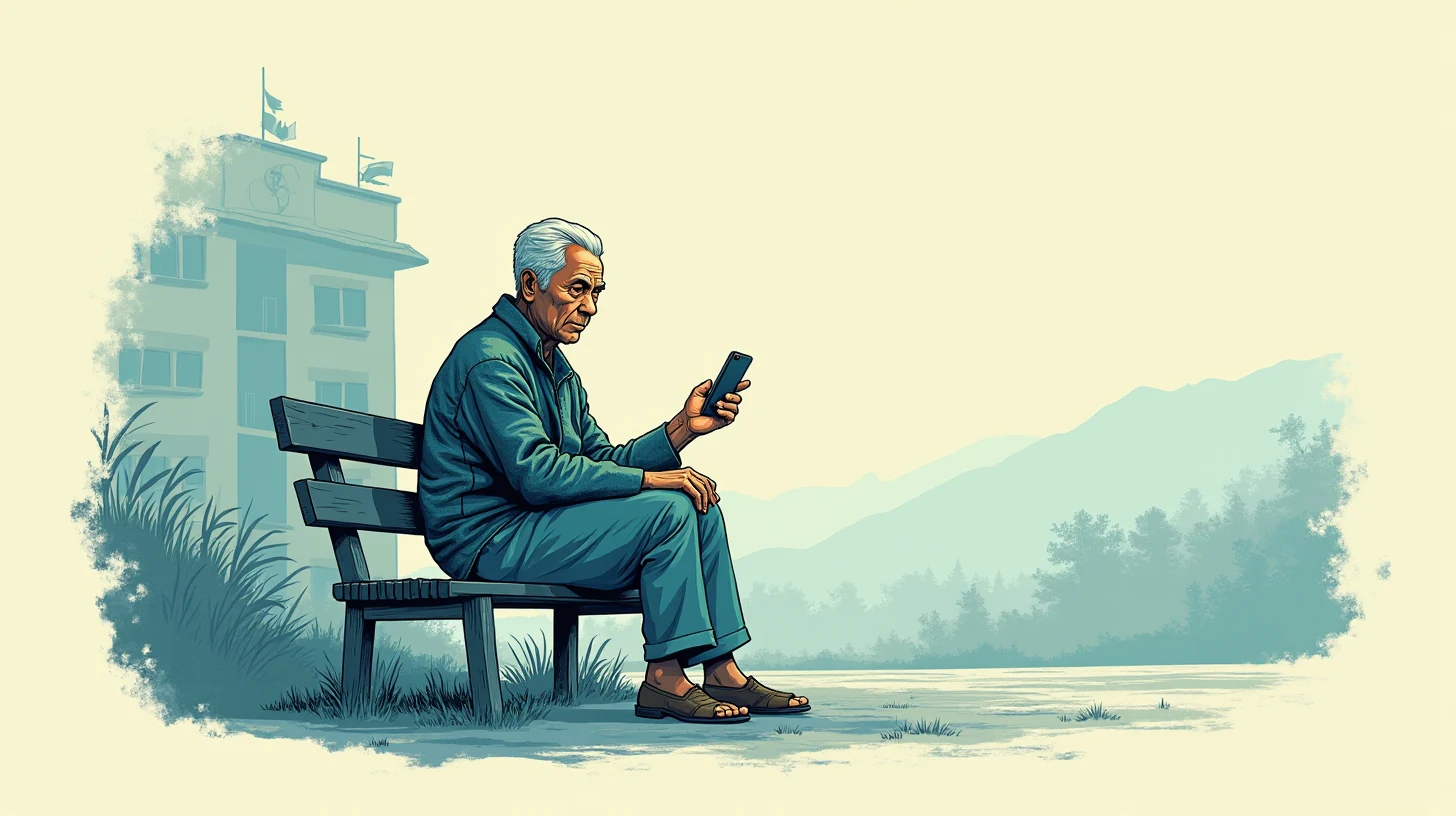
The officer in the hills
He had earned his pension with patience. The civil service was not glamorous work, especially in the hills. It meant monsoon roads that became impassable rivers, quarterly trips to the district office on foot when vehicles broke down, and the quiet satisfaction of a rural development project that actually reached the people it was meant for. By his last posting as Additional Deputy Commissioner in Itanagar, Tamo had become the kind of officer bureaucracies depend on: steady, incorruptible, and never surprised by how things actually worked versus how they were written in regulations.
Retirement had been planned. His wife Mina, a retired government school teacher, kept their household running with the precision of someone used to managing resources on modest means. They grew vegetables in the back plot. Their son Nabam was settled in Guwahati, working in IT. Their daughter had married and moved to Bangalore. It was, on the surface, the quiet retirement Tamo had earned.
But every November, without fail, one system had defeated him: the Jeevan Pramaan.
🗓️ The November ritual that fails every year
Jeevan Pramaan is a word that now fills Tamo with quiet dread. It means "proof of life"—the annual government certificate that pensioners must submit to confirm they are still alive. It sounds simple. For urban pensioners living within reach of a biometric kiosk or bank branch, it is. You walk in, place your fingerprints or iris on the scanner, the certificate is generated, sent to your bank electronically, and your pension continues.
For pensioners in Arunachal Pradesh, the system breaks down completely.
Tamo's village, Nyiro, sits forty kilometres from the nearest CSC (Common Service Centre) with a functioning biometric device. The CSC in the sub-divisional town, which locals call "kiosk," has a Securemetrics fingerprint scanner that breaks down three times every year—usually in August when the monsoon humidity swells the circuit boards. In 2023, it was broken for six consecutive weeks. The backup CSC, in the next district, is ninety kilometres away.
But the Jeevan Pramaan window is rigid: November 1-30. Miss it, and your pension suspension becomes automatic.
Last year, Tamo made the journey in the second week of November. The CSC was closed—the operator had gone to attend a family funeral in Bengaluru. He returned November 24th. The scanner worked. Tamo stood in line, thumb on the reader, waiting for the screen to confirm his biometric had been registered. It failed. The error said "Low quality fingerprint." He tried again. Failed again. The operator suggested—with the sympathetic shrug of someone who had seen this before—that his fingerprints might be "worn down from years of writing," which was not actually how fingerprints worked, but Tamo did not argue. He tried his other thumb. Failed. His index finger. Failed.
He left the CSC without a certificate.
By December 15, the suspension notice arrived from SBI. His pension, which had been credited faithfully on the 28th of every month for sixteen years, would not be credited in January. The reason given was "Jeevan Pramaan not submitted." The rule was two months of suspension pending reinstatement. To get reinstated, he would need to submit the life certificate, and then wait 4-6 weeks for processing.
Tamo had served the government for thirty-two years. The government was now telling him that it could not confirm he was alive.
His wife Mina had begun quietly setting aside money in October each year, anticipating the suspension. When Nabam called from Guwahati, he had offered—with the generous frustration of a son—to wire money every November. "Papa, why are you going through this? Let me just send you 40,000 every year." It was not about the money, really. It was about the principle: a pensioner who had served the state faithfully should not have his income suspended because the state's own infrastructure was broken.
- 📅
November 1 — window opens
All pensioners must submit a Jeevan Pramaan life certificate. Tamo travels 40km to the nearest CSC. Biometric device fails or reads incorrectly.
- ❌
Certificate not submitted — pension suspended
CSC cannot record successful biometric. SBI notified. Pension credit suspended for the month.
- 📵
December–January: two months without pension
Tamo's son Nabam in Guwahati wires money to cover the gap. Reinstatement request processed. Pension resumes in January.
- 📱
Face RD solution (available since 2022)
AadhaarFaceRD app + Jeevan Pramaan app. Front-camera facial recognition. No CSC visit. No biometric device. Certificate submitted from home in 5 minutes.
⚠️ What very nearly happened
The year Tamo turned sixty-six, his son's offer became almost an expectation. Nabam, earning well at his IT job, had stopped framing it as an offer and started framing it as practical reality. "Papa, the system doesn't work there. Don't waste your time fighting it. I'll handle it." This is what happens when systems fail consistently: the failure becomes normalized. The workaround becomes the actual system. A son wires money to cover the gaps in his father's pension because no one has told the father that another solution exists.
And there was something deeper that troubled Tamo, something a lifetime in administration had taught him to recognize: the systemic unfairness of it. Millions of pensioners in rural Northeast India faced the exact same problem. The biometric infrastructure was designed as if all of India lived within 15 kilometres of a working CSC. It was not malice. It was simply that no one in Delhi, when designing the system, had actually sat in a CSC in rural Arunachal Pradesh and watched the monsoon humidity destroy a six-month-old scanner.
Worse: there was a solution that existed, had existed for four years, and almost no one in Arunachal Pradesh knew about it.
🌗 What the agent found
When Tamo's story reached an agent—a trained counselor helping rural pensioners navigate government schemes—the conversation happened partly in Hindi, partly in English, the mixture that is the lingua franca of government offices across the Northeast.
"Tamo जी, आपको पता है कि Jeevan Pramaan का एक Face Authentication option है? बायोमेट्रिक फिंगरप्रिंट नहीं, सिर्फ चेहरे की तस्वीर। UIDAI ने यह 2022 में शुरू किया था, लेकिन किसी ने आपको बताया नहीं।"
(Tamo-ji, do you know there is a Face Authentication option for Jeevan Pramaan? Not biometric fingerprints—just face photograph. UIDAI launched this in 2022, but no one told you.)
Tamo's expression shifted. This was new.
The agent explained the process, which was extraordinarily simple, so simple that the fact it existed and was never communicated to rural pensioners felt almost like a design failure in itself.
The solution: Jeevan Pramaan Face RD App.
Here is how it works:
- Download the Jeevan Pramaan app (free, available on Android and iOS) from the official government portal.
- Download the AadhaarFaceRD app (the UIDAI face recognition component, also free).
- Open the Jeevan Pramaan app. Select "Face Authentication" instead of fingerprint.
- The app will ask you to scan your Aadhaar number. Then it activates your phone's front-facing camera.
- You look directly at the camera. The system captures your face, runs it through UIDAI's database, and verifies your identity in real-time.
- Your life certificate is generated immediately. Within 24 hours, your bank receives the certificate electronically.
- Your pension continues. You never visit a CSC.
The technology works on any Android phone with a functioning camera. It works in areas with no biometric infrastructure. It works for pensioners whose fingerprints are worn, whose hands shake, whose arthritis makes biometric scanning painful. It works for people who live forty kilometres from the nearest kiosk.
It had been available since 2022. No pension authority had announced it to Arunachal Pradesh.
"Tamo जी, यह बिल्कुल फ्री है। कोई CSC नहीं जाना, कोई मशीन नहीं, कोई परेशानी नहीं। सिर्फ आपके फोन का कैमरा, और आप का चेहरा। तीस सेकंड में पूरा काम हो जाता है।"
(Tamo-ji, this is completely free. No need to visit a CSC, no machine, no trouble. Just your phone's camera, and your face. The whole thing takes thirty seconds.)
"हर साल नवंबर में वही डर। मशीन काम नहीं करती, और मेरी पेंशन रुक जाती है।"Every year the same fear in November. The machine doesn't work, and my pension stops.
— Tamo Riba, retired officer
🧭 The connectivity gap the system didn't close
What it does
- 📱Explains Face RD app installation and walks through the face-authentication process step by step
- 📋Identifies whether the pensioner is eligible for SBI doorstep banking as a fallback option
- 📅Sends a Jeevan Pramaan deadline reminder in October each year so the submission is never last-minute
What it does not do
- 🔒Never accesses the UIDAI or Jeevan Pramaan system on the pensioner's behalf
- ✅Never submits the certificate — Tamo must complete the face scan himself on his own Aadhaar-linked phone
The technology itself is not the story. The story is the gap between what the government built and what the government actually told people was available.
Jeevan Pramaan Face RD has been live since October 2022. The technology works. The system is free. It solves the exact problem that causes pension suspensions across rural India. By conservative estimates, millions of pensioners in remote areas—Arunachal Pradesh, Nagaland, Manipur, parts of Chhattisgarh, Jharkhand, and the Northeast in general—face the biometric-failure problem every November.
Yet the announcement never reached Arunachal Pradesh. Not a single pension circular. Not a single CSC operator training session. Not a single notification to pensioner associations. The technology sat in the government's infrastructure, available, free, and unknown.
This is not a complaint about the government—the system itself is excellent design. This is a complaint about implementation: the last mile of connecting people to the solutions already built for them. A retired officer in the hills had to hear about it from an agent, not from his bank, not from the pension authority, not from the government.
The core service—face authentication submission—is entirely free. There is also a premium option through the Jeevan Pramaan portal, which adds family notifications and digital archiving, but Tamo needed nothing beyond the basic free service.
🌱 A November without suspension
That November, Tamo made the decision to try the Face RD route.
He did not have a smartphone himself—he owned a basic phone for calls—but Mina had an Android phone she used for family group chats. They downloaded the Jeevan Pramaan app and the AadhaarFaceRD app on her phone. The downloads took a few minutes on their 4G connection (Jio signal was steady enough on the hillside, at least in the afternoons).
Tamo opened the Jeevan Pramaan app. The interface was straightforward: it asked for his Aadhaar number, which was printed on a card he kept in a drawer. He entered it. The app transitioned to the camera screen.
He looked at the phone's camera, held at arm's length. The face scan took about three seconds. The screen flickered, and a message appeared: "Face authentication successful. Your life certificate has been generated." A PDF appeared on the screen, dated with today's date, stamped with the official Jeevan Pramaan seal.
He could see, on the screen itself, the status: "Submitted to bank." An SMS arrived on Mina's phone—the notification that SBI had received the certificate.
The entire process took less than two minutes.
This November, there was no suspension notice. The pension was credited on the 28th as it always had been. No two-month gap. No wire transfer from Guwahati. No son worried about his father, and no father forced into the humbling position of depending on his son's income to cover the gaps in his own pension.
Nabam called that evening, as he did every month after the pension was credited. Tamo mentioned, almost in passing, "I submitted the life certificate differently this time—no need to go to the kiosk." Nabam asked how. When Tamo explained, Nabam said something that made the difference clear: "Papa, why did no one tell you this four years ago?"
What still needs to happen
The Face RD app will not solve itself to the last person who needs it. Millions of pensioners in rural areas have still never heard of it. Many do not have smartphones, which means they depend on family members or CSC operators to help them use it. Some will not trust it because it is unfamiliar. Some will fail the face scan because the lighting in their home is too dim, or because the camera captures a reflection, or because UIDAI's database has a slightly different photo than what the camera captures today.
The real solution would be simple: announce it. Add a line to every bank's pension notification. Train CSC operators to demonstrate the app as a fallback option. Send SMS messages to pensioners before November 1st. Include it in the pension-authority website in every state. Reach the people for whom the system was already built.
Until then, Tamo remains an exception: a retired officer whose November no longer brings dread, not because the system was fixed, but because he found out it had already been fixed, four years ago, in Delhi, and simply never announced its own existence to the hills of Arunachal Pradesh.