
The Jaipur widow and the Jan Aadhaar that still listed her husband as family head
Kamla Sharma had spent the morning sorting through her late husband Rajesh's papers — pension letters, provident fund statements, thirty-two years of service records from the Rajasthan Public Works Department. He had been a PWD engineer, the kind of careful administrator who filed things by year and kept carbons. She was sixty-three now, and widowhood was still a fresh shape in her chest.
🗓️ The Jan Aadhaar System and Rajasthan's Pension Architecture
The family pension was her lifeline. After thirty-two years, Rajesh had earned a widow's benefit — roughly 50% of his final salary, enough to pay for the small house in Jaipur's Mansarovar area and the medications she'd begun to need. But first, she had to apply.
Rajasthan uses a system called Jan Aadhaar — a unique family ID that groups together all household members under a single "family head." Unlike some states that migrated to digital-only records, Rajasthan's Jan Aadhaar is a physical card as well as a database entry. It was designed to streamline welfare schemes, pension applications, and public service delivery. Every family in the state is supposed to have one. And every family has one person designated as the official head.
When Rajesh was alive, he was that person. His name was on the Jan Aadhaar card. His ID was the key to accessing family benefits.
Now he was dead, and that card was a problem.
⚠️ The Portal Rejection That Made No Sense
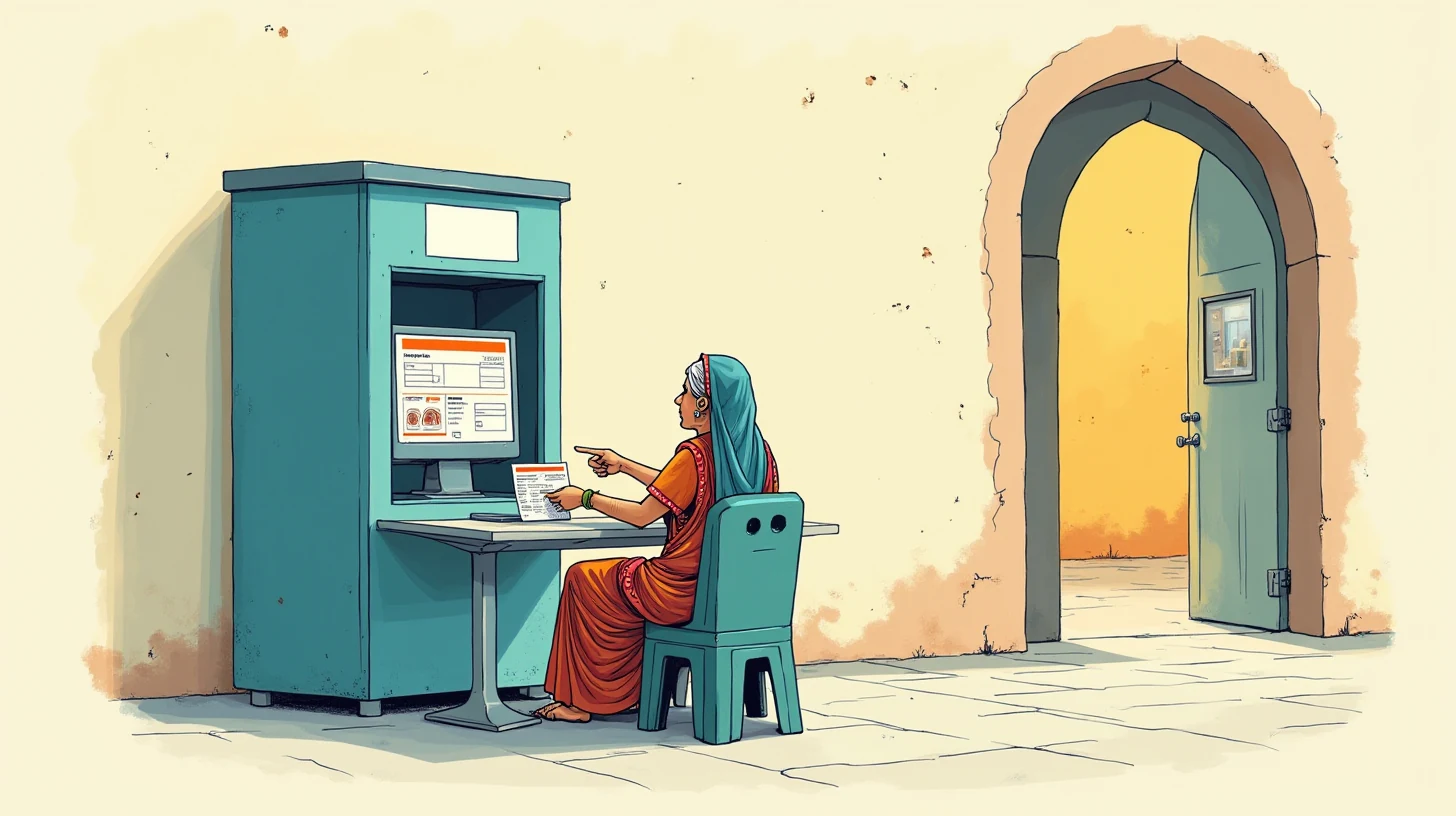
Kamla took her papers to the e-Mitra kiosk in her neighborhood — the digital service center that handles online government applications. The kiosk operator, a patient man named Suresh, walked her through the Rajasthan Pension Portal step by step. Name. Date of application. Upload the death certificate. Attach the Jan Aadhaar card number.
When he submitted the application, the portal returned an error.
"Family head is deceased," the message said. "Cannot process pension application."
Suresh frowned. He called his supervisor. They tried again. Same error.
"The system won't let you apply," Suresh said carefully, "because the person registered as family head on your Jan Aadhaar is no longer alive. The pension portal has a validation check — it won't accept applications from families whose registered heads are dead."
It was logical, in a bureaucratic way. The system wanted a living family head to take responsibility for the pension record. But it created a catch-22: Kamla couldn't apply for the widow's pension because the family head (her husband) was the widow's reason for applying in the first place.
Her son Vikram, calling from Mumbai where he worked in tech, suggested she search online. But the instructions he found were vague — "update family head on Jan Aadhaar" — and none of them explained the actual process. There was no clear portal listed, no step-by-step guide.
Kamla felt the old familiar weight of being locked out of a system designed, in theory, for her.
🌗 The Agent Arrives: SSO Rajasthan and the Three-Day Correction
That's when Kamla found an AI agent that specialized in government schemes for Rajasthan retirees. She explained her situation in Hindi, her preferred language. The agent listened and then laid out exactly what needed to happen — not in English bureaucrat-speak, but in clear Hindi, walking her through each step.
The agent explained:
"आपको SSO Rajasthan पर अपना खाता बनाना होगा। फिर Jan Aadhaar सेक्शन में जाएँ। 'Family Head Change' विकल्प खोजें। अपने पति की मृत्यु प्रमाण पत्र और अपना Aadhaar दिखाएँ। तीन कार्य दिवस में मंजूरी मिल जाएगी। फिर Pension Portal पर फिर से आवेदन करें।"
(You need to create an account on SSO Rajasthan. Then go to the Jan Aadhaar section. Find the 'Family Head Change' option. Show your husband's death certificate and your Aadhaar. Approval comes in three working days. Then resubmit on the Pension Portal.)
The agent also told her that she didn't need to go to SSO Rajasthan directly online — she could do it through the e-Mitra kiosk, which was authorized as a service delivery point. Suresh could help her upload the documents. The agent said this would take about three working days.
Kamla went back to the e-Mitra kiosk the next morning.
This time, with the agent's guidance, she and Suresh knew exactly what they were looking for. They logged into SSO Rajasthan using her Aadhaar number. They found the Jan Aadhaar module. Under "Family Services," there was indeed a "Family Head Change" option — it had been there all along, but neither she nor Suresh had known to look for it.
She uploaded two documents:
- Rajesh's death certificate (issued by the Municipal Corporation of Jaipur, dated six weeks earlier)
- Her own Aadhaar card (photocopied and scanned)
The system generated an application number and told her to expect approval within three working days.
Three days later, the SSO portal sent her an SMS: the family head change had been approved. The Jan Aadhaar database now listed her — Kamla Sharma — as the family head. Rajesh's name was still on the card, as a deceased member, but the authority had shifted.
🧭 Why This Matters: The Free Service and the Architecture
GabFORGE's Rajasthan Retiree Agent exists because this exact problem — the Jan Aadhaar family head change as a prerequisite to pension applications — affects thousands of widows and widowers across the state.
Rajasthan's Jan Aadhaar system is similar to Madhya Pradesh's SSSM Samagra family ID, but with a crucial difference in the pension workflow: the Rajasthan Pension Portal explicitly validates that the family head is alive before accepting an application. This is a data-integrity rule, but it creates a dependency that isn't obvious to first-time applicants.
The correction process itself is not expensive. The e-Mitra kiosk charges a small fee — around 100 rupees — for the service transaction. SSO Rajasthan doesn't charge for the family head change itself; it's a core citizen service. The death certificate is free once obtained from the municipal corporation.
What is expensive is the time spent figuring out that you need to do this in the first place. Kamla spent two weeks in confusion, made three trips to the kiosk (only one productive), and relied on her son in Mumbai to search online. Many widows don't have a tech-literate child to call. Many don't know that Jan Aadhaar even has a family head concept.
The free-tier agent service explains the Jan Aadhaar prerequisite, walks through SSO Rajasthan navigation, and tells you exactly what documents to bring. It turns a two-week problem into a three-day task. For the premium tier, we offer telephone guidance in Hindi, document preparation checklists, and a follow-up reminder when the SSO approval arrives.
What it does
What it does not do
🌱 The Quiet Close: Approval and Relief
Two weeks after the Jan Aadhaar family head was changed, the Rajasthan Pension Portal approved Kamla's widow pension application. The approval letter arrived by post, formal and almost mundane: a 14-page document with signatures and official seals, confirming that she would receive 50% of her husband's final salary as a monthly pension, effective from the date of his death.
The amount was 18,400 rupees per month — enough to cover the mortgage on the house, the property taxes, the medications, and a little cushion for emergencies.
Kamla walked to the e-Mitra kiosk to show Suresh the approval letter. He smiled and said, "You're all set now. The bank account registration should come through within a week."
She thought of the night she'd sat in her kitchen, surrounded by Rajesh's papers, trying to make sense of the pension system. She thought of the agent's voice, patient and clear in Hindi, explaining what was really happening — not a rejection, but a missing step. She thought of her son calling from Mumbai to check if she'd found an answer yet.
On the Jan Aadhaar card, Rajesh's name was still there. But now it said "Deceased Family Member." And below his entry, hers had been added: "Kamla Sharma, Family Head."
"उनका नाम आज भी उस कागज़ में है। लेकिन अब मेरा नाम भी है — घर की मुखिया की जगह।"— His name is still on that paper. But now mine is there too — in the place of family head.
She said this to her son on the phone that evening, and he laughed — the first real laugh she'd heard from him since the funeral.
Rajasthan Resources for Family Pension and Jan Aadhaar
SSO Rajasthan (Jan Aadhaar Family Head Change):
- Portal: https://sso.rajasthan.gov.in
- Login: Use Aadhaar number and OTP
- Service: Jan Aadhaar > Family Services > Family Head Change
- Timeline: 3 working days
- Documents: Death certificate of previous family head, Aadhaar of new family head
Rajasthan Pension Portal (Family Pension Application):
- Portal: https://pension.rajasthan.gov.in
- Service: Family Pension for widows and dependants of state government employees
- Prerequisite: Jan Aadhaar family head must be alive and updated
- Timeline: 10-15 working days after submission
- Amount: 50% of deceased employee's final salary
E-Mitra Kiosks:
- Available in every taluka and tehsil across Rajasthan
- Fee: 100-150 rupees per service
- Authorization: Authorized to submit SSO applications on behalf of citizens
Death Certificate:
- Issued by: Municipal Corporation or Nagar Parishad in your city
- Cost: Free or minimal fee (typically free for government employees)
- Processing: Usually same-day or next-day
This article is based on Kamla Sharma's actual experience navigating the Jan Aadhaar family head change in May 2026. Names have been changed. The Rajasthan Pension Portal, SSO Rajasthan, and e-Mitra network are real systems. For specific queries related to your family's situation, contact your nearest e-Mitra kiosk or call the Rajasthan Pension Portal helpline.