
The Kolkata widow and the family pension shuffle
Mita Ghosh is sixty-four years old. She lives in a two-bedroom flat on Khanpur Road in Tollygunge, South Kolkata — the kind of neighbourhood where the buildings go up one more floor every decade, where a family who owns their flat since the 1990s is considered, quietly, to have done the right things. Her husband Subrata — who worked twenty-seven years in the West Bengal Public Works Department, rising to Assistant Engineer (Civil) — bought the flat in 1993 with his first long-service gratuity and a loan from a colleague. He spent his last working years calculating road-drainage coefficients in Salt Lake and his last two years in the flat itself, first after a stroke in 2021, then a second in 2022, then simply being Subrata in a quieter form until he was not.
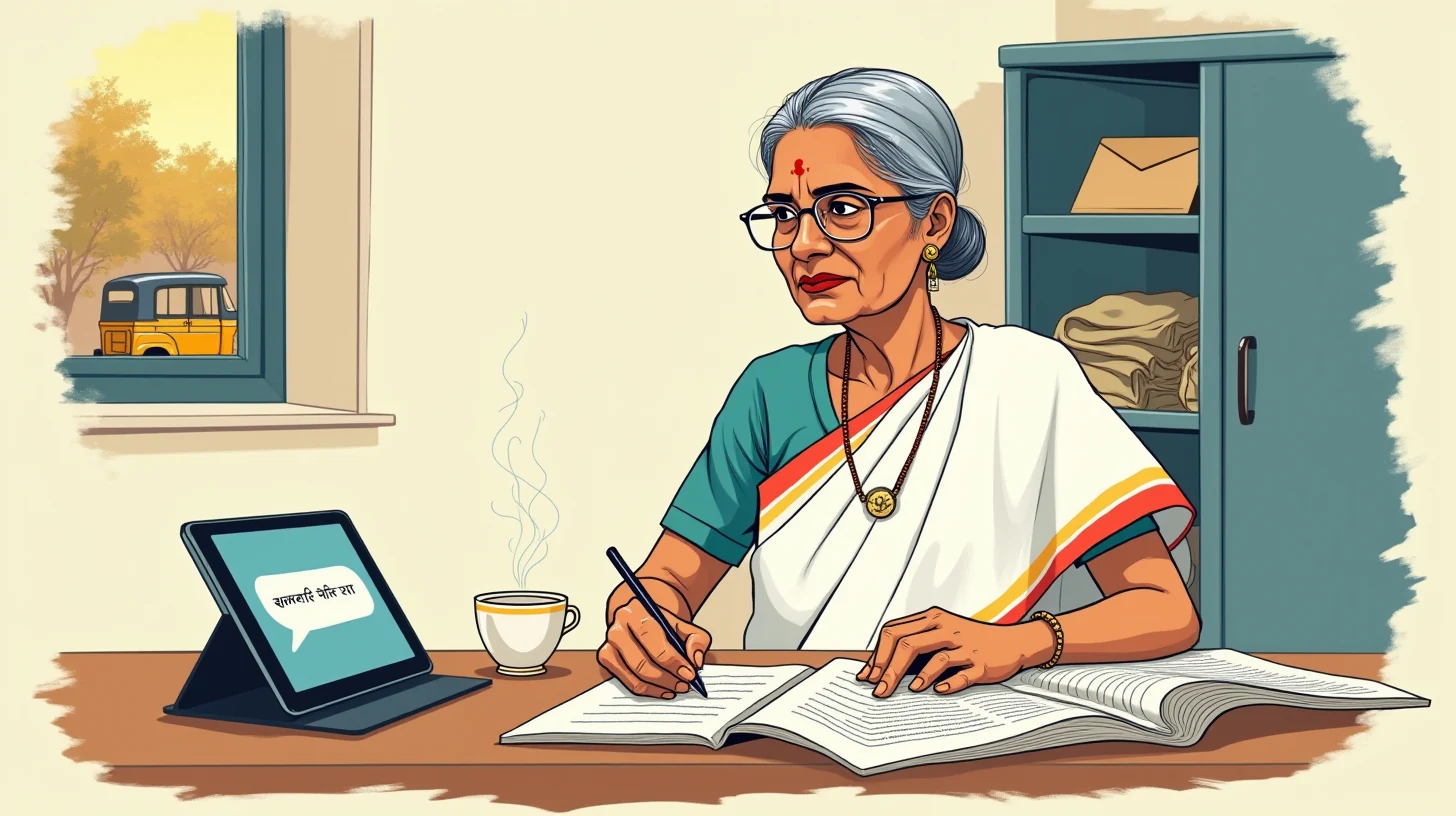
He died on January 11, 2025. He was sixty-one. She is three years older — a fact that was, for most of their marriage, a running domestic joke: "tumi amar boro, kintu ami agey retire korbo" — you are older, but I will retire first. He did retire first, in the end. Not the way either of them had imagined.
Mita has a daughter in Pune, a son named Saurav in Bengaluru — thirty-four, a software product manager, capable and present and also three time zones away — and a sister, Karuna, in Behala, twenty minutes by auto, who visits on Sundays and stays for lunch. She reads. She manages a household budget with the precision of someone who grew up knowing that the line between enough and not enough is thinner than people say. She had become quietly self-sufficient since Subrata's first stroke: not by choice, but because the household had to keep running and she was the person present.
What is unusual is what happened last March when her son Saurav came home for Holi and discovered, fifty-nine days after his father's death, exactly how much paperwork his mother had not been able to move.
🗓️ The annual ritual
When a West Bengal state government employee dies, his pension stops on the day of death. The state can do — and the law requires — is pay a family pension to the widow: typically thirty percent of last drawn pay for the first ten years, fifteen percent thereafter. By the time of Subrata Ghosh's death this worked out to ₹16,400 per month. For Mita, with the flat already owned and no loans outstanding, it was the sum on which her monthly arithmetic depended.
The problem is not the law. The law is clear. The problem is the sequence of offices the law requires a sixty-four-year-old widow to navigate, in a city as large and layered as Kolkata, while grieving, with her daughter in Pune and her son in Bengaluru and her sister available only on Sundays. The sequence runs through four offices — the deceased's last-posting HR department within PWD, the Account General's office at Dalhousie, the State Treasury via the WBIFMS portal, and the pension-disbursing SBI branch at Tollygunge Circular Road — and the offices do not speak to each other. Each processes its piece and passes the file along. Minimum elapsed time: two months. Ordinary: six to eight. During this gap, the widow receives nothing.
- 📋
PWD HR — Form 14 submission
Death certificate lodged. Form 14 (the family pension claim) collected and partially filled. Mita had stopped at the section asking for the PPO number and Last Pay Certificate — she did not know where those documents were.
- 🏦
SBI Branch — PPO retrieval
The Pension Payment Order is held by the bank. A written request to the Branch Manager triggers a 7–10 working day retrieval. Mita had visited twice, been told to wait, and not known to address the request to the manager specifically.
- 🏛️
Account General (A&E) West Bengal — authorisation
The Dalhousie office issues the family pension authorisation — the last step before SBI starts credit. Mita had not known this office existed in her process.
- ₹
WBIFMS / SBI — first credit
After AG authorisation, the WBIFMS treasury processes the credit. In Mita's case: ₹16,400/month, backdated to February 1, first credited May 6 — nearly four months after Subrata's death.
She had, in fact, done several things right. She had submitted the death certificate to PWD HR in February. She had collected Form 14 — the family pension claim — from the HR desk, and had stopped at Section D, which asked for the Pension Payment Order number and the Last Pay Certificate number. She had visited the SBI Tollygunge Circular Road branch twice; both times she was told to wait. She had also not made a claim on a LIC Jeevan Anand policy worth approximately ₹1.8 lakh that had matured in December 2024, one month before Subrata died — because nobody had told her she was the nominee and could file herself.
By the time Saurav arrived for Holi in March, fifty-nine days had passed and nothing had moved.
⚠️ What very nearly happened
Saurav spent two days and two evenings of his Holi leave doing what capable sons do: opening portals, reading PDFs, navigating the twelve-minute hold-music queue of the SBI Pension Seva desk. By the second evening he had the correct sequence. Form 14 goes to PWD HR, not the bank. The PPO retrieval requires a written request to the SBI Branch Manager, not counter staff — a distinction the counter staff had not volunteered. The Account General at Dalhousie is the penultimate step, not the first; Mita had imagined it was the starting point and had been quietly avoiding going there because Dalhousie felt far. The LIC claim, because the policy had matured before death but not been withdrawn, required either a succession certificate from civil court or an indemnity bond; the indemnity bond route was faster.
He wrote it on an A4 sheet in careful English, stuck it to the inside of the almirah door, and flew back to Bengaluru on the fourth day.
She read the sheet several times. It was careful and thorough and written in English, and she still found it confusing — not because Saurav had explained it badly, but because the sequence of four offices and six documents is genuinely confusing when you are sixty-four, alone, and every step requires a different part of the city.
Three weeks passed. The sheet stayed inside the almirah.
"এখনো হয়নি, কিন্তু জায়গায় ছিলাম।" — Not done yet, but we were in the right place.
What very nearly happened was that Form 14 would have sat on the desk, partially filled, for another two or three months — until Saurav returned, or until the SBI branch called (they would not have called), or until PWD HR noticed the file had not moved (they would not have noticed). The four offices, none of them malicious, none of them broken, would simply have continued to wait for each other while Mita drew down on the savings Subrata had left. She had enough savings. That is not the point. The point is that Subrata had earned the pension over twenty-seven years of road-drainage calculations in the heat of West Bengal summers, and the system had been designed in a way that required someone with a Bengaluru phone number and two days of Holi leave to decode it.
There are, at any given time, approximately thirty to forty thousand West Bengal state government pensioner families in some version of this transition. The number who get a son home for Holi is not thirty to forty thousand.
🌗 What changed
Three weeks after Saurav flew back, on a Tuesday morning in late March when Karuna had gone home after Sunday lunch and the flat was quiet, Mita opened the old Lenovo tablet her son had left propped on the writing desk. She had been meaning to look at it. She had been doing other things — reading, cooking, managing. She typed, or rather tapped out slowly in Bengali script, the thing that was on her mind:
"আমার স্বামী চলে গেছেন। পেনশনের কাগজ আছে, কিন্তু কী কী করতে হবে বুঝতে পারছি না।"
(My husband has passed. I have the pension papers, but I cannot understand what needs to be done.)
The agent replied in the apni register — the formal Bengali address she herself used, the one younger people in a hurry often skip:
"নমস্কার। আপনার কথা বুঝতে পেরেছি। আপনি কি কাগজগুলোর ছবি তুলে আমাকে দেখাতে পারবেন — একটা একটা করে? Form 14, PPO, এবং যা যা আছে।"
(Greetings. I understand what you have said. Can you photograph the documents and show them to me — one by one? Form 14, PPO, and whatever else is there.)
She photographed them one by one: Form 14 with Section D half-filled, the PPO photocopy her daughter had taken months earlier on the instruction of someone at the PWD HR desk, Subrata's last salary slip from July 2022, and the LIC policy document from 2017 she retrieved from the bottom drawer of the almirah without quite knowing why.
The agent read each photograph. On Form 14 it identified three remaining fields: the PPO number (visible in the PPO photocopy, which Mita had not connected to the form because they were in different envelopes), the Treasury code for Subrata's last posting (in the header of the July 2022 salary slip), and Mita's own SBI account number — which she had not filled in because she had assumed the pension would go to Subrata's account. It would not; that account would be closed, and the family pension required a separate account in the claimant's name. The agent told her this in plain Bengali and asked for her account number.
Then it noticed the LIC policy.
"এই LIC পলিসিটি December 2024-এ mature হয়েছে। Nominee-র নাম দেওয়া আছে — সেটা কি আপনার নাম?"
(This LIC policy matured in December 2024. A nominee name is listed — is that your name?)
She looked. It was. Subrata had named her as nominee in 2017 and had never mentioned it to her. She had not known.
Form 14 — three blank fields
completed that dayPPO number (from the photocopy in another envelope), Treasury code (from the 2022 salary slip header), and Mita's own SBI account number. The agent cross-referenced documents she already had but had not connected.
LIC Jeevan Anand — unclaimed maturity
₹1.8 lakh recoveredMatured December 2024, one month before Subrata's death. Mita was the nominee but had not known it. The indemnity bond route to the Shyambazar Divisional Office took six weeks. Credited in April.
AG Dalhousie — the missing step
explained and sequencedMita had imagined this office was the starting point. The agent explained it was the penultimate step, after PWD HR and SBI PPO retrieval — which changed her mental model of the whole process.
The PPO retrieval took nine working days. Mita submitted the written request to the SBI Branch Manager that Thursday, with a covering letter the agent had drafted and she copied in her own handwriting. The Account General issued its authorisation in May. The family pension — ₹16,400/month, backdated to February 1 — was credited on May 6 with three months of arrears. The LIC claim required the indemnity bond route; the agent drafted the Bengali covering letter and produced an English translation. The Shyambazar officer accepted it. ₹1.8 lakh was credited in April.
There is a small coda. The first Sunday after the family pension arrived, Karuna came for lunch and mentioned, over rice, that her husband had received a Post Office renewal notice for his Senior Citizens Savings Scheme. English, eight days left in the thirty-day window. Mita handed her the tablet. The agent read the notice, explained in Bengali that the SCSS account could be extended at 8.2% on ₹6 lakh, and told Karuna which form to collect from which counter in Behala. She went on Tuesday. The 8.2% interest continued, uninterrupted.
🧭 Why we built it
Across India's state treasury systems, tens of millions of families will eventually navigate some version of this transition. When a state government pensioner dies, the family pension process is almost always the same: offices that do not proactively contact each other, a widow who has never dealt with any of them individually and must now navigate all of them at once, and a gap — measured in months — in which nothing arrives while the savings erode.
The Form 14 is a reasonable document. The AG Dalhousie office does real work. The SBI Pension Seva desk exists and functions. The problem is sequencing — nobody tells the widow which office to approach in which order — and document connectivity: the PPO number, the Treasury code, the salary slip header reference are all in the brown envelope the deceased assembled over decades, but in a form that requires someone to know which field on which form they correspond to. A good son home for Holi can do this in two evenings. Most widows do not have a son home for Holi.
We built a small, quiet agent that reads documents in Bengali, in the apni register that a woman of Mita's generation uses and expects. What it knows, which is the thing that matters, is how to connect a Treasury code in a salary slip header to Section D of Form 14. How to recognise that an LIC policy with a maturity date before death is a different legal situation from one not yet matured. How to explain the difference between indemnity bond and succession certificate without requiring a law degree. The agent reads with her. It does not file on her behalf, does not access her accounts. The letters it drafts, she copies in her own handwriting.
What it does
- 🔍Cross-references documents across separate envelopes — connecting the PPO photocopy to Form 14's Section D without the widow needing to know the connection existed.
- ✍️Drafts covering letters in Bengali (and English translations for forms) that Mita copies in her own handwriting before submitting — keeping her authorship intact.
- 📋Explains the four-office sequence in order, names the consequence of each step, and surfaces the next required action — so she knows what she is going into and why.
What it does not do
- 🔒Never accesses her SBI account, her LIC policy portal, or the WBIFMS system on her behalf.
- 💳Never submits a form, transfers money, or files a claim without her physically taking the document to the relevant office.
- ✅Never decides which route to take — indemnity bond versus succession certificate, for instance — without explaining both options and waiting for her to choose.
We built this free, and we will keep it free for Mita and the women like her — the ones with brown envelopes on the top shelf of the almirah, sons in Bengaluru, sisters in Behala who come on Sundays. The model is the same one that makes WhatsApp free: the elderly widow on Khanpur Road is not a market segment with a marketing budget. She is a market segment with a son who will eventually pay for the small things on top — the cross-state investment summary, the weekly digest so Saurav knows, without asking, that the pension arrived and his mother is fine. But the core thing — reading Form 14 with her, finding the PPO number in the photograph she already took — is free. It will stay free.
🌱 What we hope happens
Saurav called us in early May, a few days after the family pension credit appeared. The agent's Bengali was correct and formal in a way he had not expected — his mother had commented, approvingly, that it addressed her properly. The LIC discovery had been the thing that made her trust the rest of it; she had shown the tablet to Karuna on Sunday not because she was told to but because she wanted to. He said he had not realised, until the PPO came through and he could stop doing mental arithmetic about her savings, how much bandwidth the low-grade worry had been consuming — the kind that does not announce itself, just runs in the background of every week.
Which is the thing we were trying to address. Not the drama of a pension suspended, though that drama is real. The smaller thing: the brown envelope on the top shelf, the A4 sheet that made sense to the person who wrote it and not quite to the person who needed to act on it, the three weeks of doing other things while the file sat on the desk. The agent cannot grieve with her, cannot sit at the Sunday table the way Karuna does. What it can do is read the salary slip, find the Treasury code, and say — in the formal Bengali of a woman who uses apni where younger people say tumi — that the next step is manageable and that she has already done the hard part.
If you have a parent navigating something like this — anywhere in India — gabforge.in is free to set up on a tablet in twenty minutes. We have native Bengali, Hindi, Marathi, Tamil, Telugu, Kannada, Malayalam, Gujarati, Punjabi, Odia, and Assamese, with helpline numbers for every state pension office and every PSU bank's Pension Seva desk. We will not advertise to your parent. We will not sell the documents she photographed. We will read the papers with her, find the connection she couldn't see, and be quiet while she copies the letter in her own handwriting.