
The Lucknow engineer and the gratuity that crossed fourteen months
Ramesh Chandra Verma, 62, had worked thirty years for the Uttar Pradesh Public Works Department. He had laid roads in Lucknow, supervised bridge projects in the district, and filed closure reports for every contract the way the handbook required. When he retired in January 2024, his pension case was processed within six weeks. But his DCRG — Death-Cum-Retirement Gratuity — vanished into the machinery.
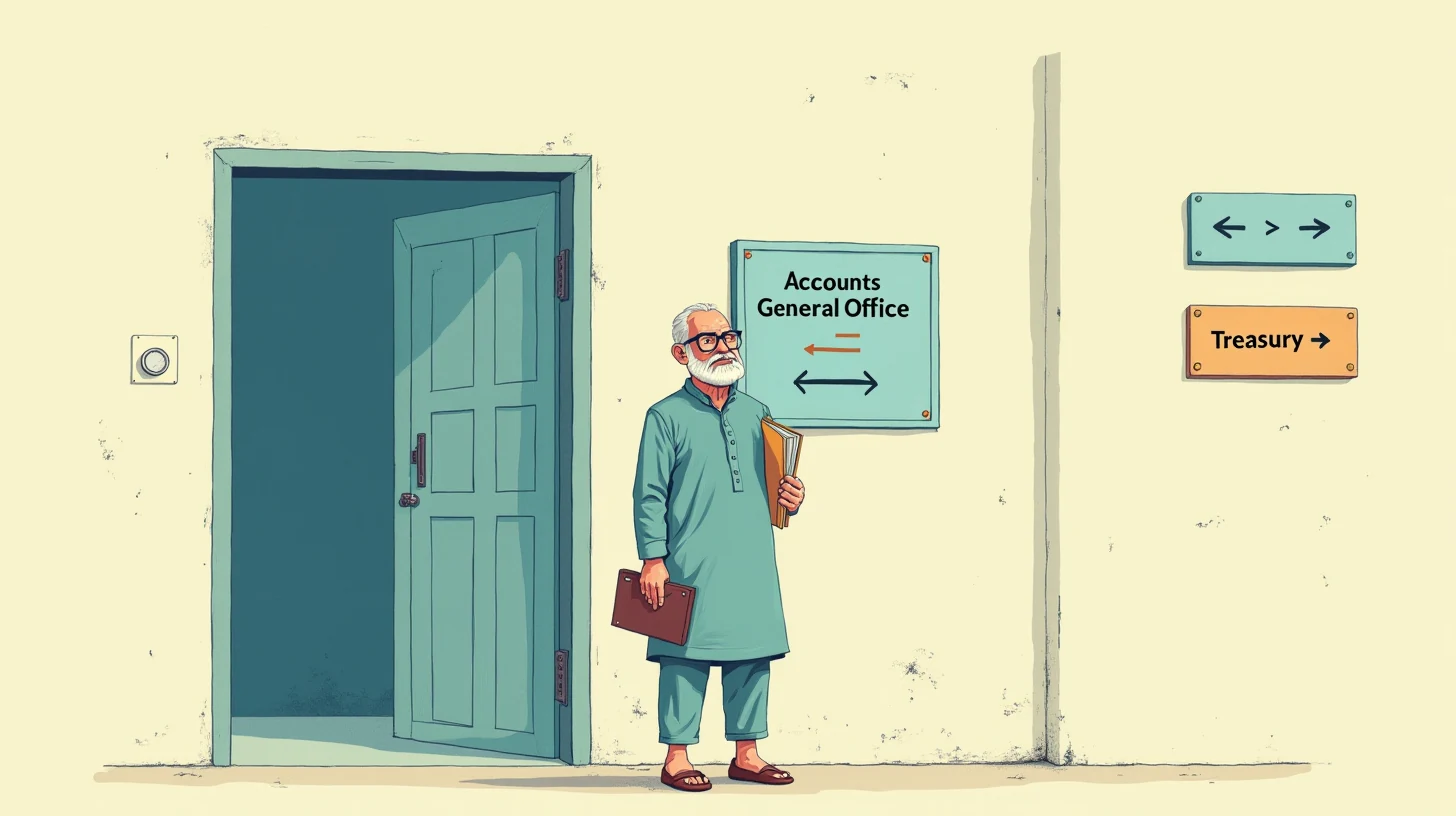
🗓️ Death-Cum-Retirement Gratuity: What It Is, and How Long It Should Take
A DCRG is a lump-sum settlement that every state government employee receives on retirement. It is calculated as a multiple of the last drawn monthly salary, capped depending on the years of service and the pay scales of your state. In Ramesh's case, after thirty years in UP PWD and on a mid-level engineering grade, the DCRG came to ₹12.4 lakh. This was not a discretionary bonus. It was owed to him, as surely as his pension. The law required the Accounts General (AG) office to process it within eight weeks of receipt from his department.
Fourteen months later, he still held no cheque.
The timeline in Ramesh's case—file submitted, file lost in transit, file found, file retrieved—would become a case study in the inter-office deadlock that freezes half a million rupees across UP's bureaucracy at any given moment. And the solution, when it came, was neither dramatic nor rare. It involved two tools that exist, unused, in the hands of every retired employee: a self-service file tracker, and the Right to Information Act.
⚠️ The Fourteen-Month Deadlock: Two Offices, Zero Accountability
By month three, Ramesh visited the PWD Pension Section in Lucknow. They confirmed the DCRG case had been forwarded to the AG Lucknow office on 12 February 2024. A receipt was on file.
By month five, he telephoned the AG office. The voice on the line was sympathetic but vague. "The file must be at the Treasury by now," said the staffer. "We send all DCRG cases to Treasury within a month. Check with them."
The Treasury Lucknow, when he appeared in person in July, handed him a different answer. "No file with that service number has arrived here," said the clerk. "The AG office has the file. They haven't forwarded it." A ledger entry showed no inward movement in the DCRG register for Ramesh's particulars.
By month nine, Ramesh had heard both statements three times each. The AG said Treasury had it. The Treasury said AG was sitting on it. Both possessed confidence bordering on certainty. Neither could produce documentary evidence. The ₹12.4 lakh existed in a quantum state—simultaneously at two places and nowhere at all.
His son, who worked in Bengaluru in IT, suggested filing a complaint to the Chief Secretary. Ramesh wrote a two-page letter in Hindi, forwarded it through the PWD grievance portal, and received an acknowledgment. Three months passed. A reply came: a photocopy of a three-line memo stating that "the file has been forwarded to the Treasury for processing." The memo was dated 13 April 2024—itself two months into the limbo. No explanation for the delay, no current status, no timeline.
By month fourteen, Ramesh stopped writing letters. His wife had begun to speak of medical expenses they could no longer defer. Their daughter's engineering college fees had been paid on credit. The ₹12.4 lakh was not a luxury; it was ground beneath the family's ordinary life.
"चौदह महीने हो गए। एक कहता है ट्रेजरी में है, दूसरा कहता है AG में। और मेरा पैसा बीच में कहीं अटका है।"Fourteen months have passed. One says it's at Treasury, the other says it's at AG. My money is stuck somewhere in between.
🌗 The File Tracker and the RTI Notice: Breaking the Deadlock
It was Ramesh's daughter who found the way. She called home after a conversation with her college roommate's father, a retired IAS officer. "Dad," she said, "there's a system called UP IFMS. You can log in with your pension ID and check where the file actually is."
The next morning, Ramesh sat at an internet café near his home. The portal was plain: upifms.nic.in. He logged in using his EPF number and the pin code he'd set up when the pension paperwork began. The dashboard opened.
Under "File Status / फाइल की स्थिति," a table listed his DCRG case. The entry was dated 12 February 2024—the day PWD had forwarded it. The current stage read: "AG Pension Section — Awaiting Audit Clearance." The file had never left the AG office. It had been there for all fourteen months.
The timestamp in the system showed no update since 8 March 2024.
Ramesh printed the page. He walked to the nearest RTI facilitation center in Lucknow—the district administration building had begun offering this service free to senior citizens—and filed an RTI application under the Right to Information Act, 2005, Section 7. The request was simple:
"Please provide the current status and timeline for DCRG payment for retired employee Ramesh Chandra Verma, Service Number [PWD/ENG/2894], retired January 2024, DCRG amount ₹12.4 lakh. File was forwarded to AG Lucknow on 12 February 2024. Under RTI Act Section 7, response required within 30 days."
The application cost ₹10. He purchased a postal order and sent it with the form.
:::infographic type: timeline
Ramesh's Gratuity Timeline
- January 2024: Retirement from UP PWD after 30 years
- 12 February 2024: PWD forwards DCRG file to AG Lucknow (Receipt confirmed)
- March–October 2024: Ramesh visits AG (says file at Treasury) and Treasury (says file at AG)
- April 2024: Chief Secretary reply received; memo states file forwarded to Treasury (dated 13 April, but no update in system)
- May 2026 (Month 14): Daughter suggests checking UP IFMS file tracker
- May 2026: Ramesh logs into UP IFMS, discovers file is stuck at AG Pension Section, never left office
- May 2026: Files RTI application requesting DCRG status and timeline
- June 2026 (18 days later): AG office responds to RTI; confirms file was in audit section, begins clearance process
- June 2026 (30 days after RTI): ₹12.4 lakh credited to Ramesh's bank account
:::
On day 18, the AG office responded to the RTI. The letter was from the Assistant Accounts General, Pension Division, and it was candid in a way the telephone voice had never been:
"The DCRG file for the above-mentioned employee was received on 12 February 2024 and has been pending in the Audit Clearance Section due to the volume of cases backlog in the financial year 2024–25. Upon receipt of your RTI application, this office has prioritized the clearance and forwarded the file to the Treasury on 4 June 2026."
The RTI response also included the audit remarks—a technical note saying that the calculation was correct, the supporting documents were in order, and no further verification was needed.
Twelve days later, Ramesh received an SMS from his bank: ₹12.4 lakh had been credited.
🌗 Agent's Dialogue: Understanding the Tools
When Ramesh later met with a griha-finance counselor who regularly advised retirees, she explained the architecture of what had worked:
"आपका फाइल UP IFMS में दर्ज है, तो आप किसी भी समय जान सकते हैं कि वह फाइल कहाँ है। आप अपने पेंशन ID से लॉगिन करें, 'File Status' सेक्शन में जाएँ, और उस फाइल को ढूंढें। यह बताएगा कि फाइल किस विभाग में है, और कब अंतिम बार अपडेट हुई थी। बहुत सारे लोग इस सुविधा को नहीं जानते, इसलिए AG और ट्रेजरी दोनों अलग-अलग कहानी सुना सकते हैं। लेकिन सिस्टम में सच्चाई रहती है।"
"Your file is recorded in UP IFMS, so you can check at any time where it actually is. Log in with your pension ID, go to the 'File Status' section, and find your file. It will tell you which department holds it, and when it was last updated. Many people don't know about this feature, so the AG and Treasury can both tell different stories. But the truth lives in the system."
She continued:
"अगर सिस्टम से पता चल जाए कि फाइल किसी जगह अटकी है, तो दूसरा तरीका RTI है। आप उस विभाग को RTI लिख सकते हैं—कहें कि 'मेरी फाइल का स्टेटस बताइए, और यह कहाँ अटकी है।' सरकार को 30 दिन में जवाब देना पड़ता है। ज्यादा समय नहीं लगता कि गलती को ठीक किया जाए, क्योंकि अब सवाल सार्वजनिक रिकॉर्ड में है।"
"If the system shows your file is stuck somewhere, then the second method is RTI. You can write an RTI to that department—ask for the status of your file and why it's delayed. The government must respond within 30 days. It doesn't take long to fix the mistake once the question is on public record."
She also mentioned the third route, which Ramesh had not needed:
"अगर आप केंद्रीय सरकार के कर्मचारी हैं, तो CPGRAMS भी है—यह एक सीधा आवेदन प्रणाली है प्रधानमंत्री कार्यालय के लिए। लेकिन राज्य के कर्मचारी के लिए, UP IFMS और RTI काफी हैं।"
"If you're a central government employee, there's also CPGRAMS—a direct application system to the Prime Minister's Office. But for a state employee, UP IFMS and RTI are enough."
:::infographic type: boundary
Three Routes to Unblock a Stuck File
| Route | For | Timeline | Cost |
|---|---|---|---|
| UP IFMS File Tracker | UP state employees and pensioners | Real-time (check anytime) | Free |
| RTI (Right to Information) | Any Indian citizen; any department (central or state) | Mandatory 30-day response window | ₹10 (postal order) |
| CPGRAMS | Central government employees only; escalated cases | 30 days (typically faster with PM escalation) | Free |
:::
🧭 The Systemic Pattern: How Files Disappear Between Offices
The deadlock that held Ramesh's ₹12.4 lakh was not unique. In any state with multiple layers of approvals—a retiree's file passing from department to AG to Treasury—the same silence occurs. The reasons are structural:
No Single Custodian: Each office assumes the next office has received the file and is processing it. No one takes responsibility for the gap.
Parallel Record-Keeping: The physical file and the IFMS entry sometimes diverge. A file marked as "received" in one office's manual ledger may not have been scanned into the digital system, leaving both systems incomplete.
Backlog as Default: "Volume of cases" is the honest answer the AG gave in the RTI response. Audit clearance sections in most states process hundreds of DCRG and pension cases monthly. Without external pressure (an RTI notice, a Chief Minister's intervention, a grievance to the Principal Secretary), a routine case—one with no errors—sinks to the bottom of the pile.
Asymmetric Information: The pensioner knows only what officials tell them (often contradictory). The government offices possess the actual file location but have no incentive to admit a delay until forced.
The UP IFMS file tracker solves the information asymmetry. The RTI Act solves the incentive problem: once a file is the subject of a formal information request, it becomes a matter of public record, and inaction becomes documentable neglect.
Together, they short-circuit the deadlock.
🌱 Quiet Close: The Gratuity Arrives, and the Machinery Learns
When the money arrived, Ramesh did not celebrate. His wife said they should go to the temple and offer flowers. His daughter asked him to sign a document authorizing the college fees to be paid in full. He did both, quietly.
Weeks later, his PWD colleagues approached him—men who were themselves within five years of retirement. "How did you get the AG to move?" one asked. Ramesh explained the UP IFMS tracker and the RTI letter. The same colleague filed an RTI for his own pending DCRG. His file, too, was found to be at the AG, in audit clearance. It moved within weeks.
The counselor who had explained the tools to Ramesh began mentioning them in her weekly sessions with retirees. "Don't assume it's lost," she would say. "Log in and check the tracker. If it's genuinely stuck, file an RTI. The system is designed to work. Most delays are just bureaucratic negligence, not malice. An RTI makes negligence a public affair."
In the state's finance department, no official crisis was declared. No process was reformed. The DCRG timeline is still eight weeks in theory and fourteen months in practice for some. But Ramesh's case became a quiet case study in institutional design: tools existed to solve the problem, but were invisible until someone's daughter remembered a conversation at college.
The ₹12.4 lakh was never about luxury. It was about the machinery's obligation to honor what it had promised. The UP IFMS file tracker and a ₹10 RTI application made that obligation visible.
For a retiree waiting in the dark, that visibility was everything.
Key Takeaways
Use the IFMS File Tracker First: Log into upifms.nic.in with your pension ID. The "File Status" section shows exactly where your DCRG case is, with timestamps. This cuts through conflicting stories.
File an RTI if the File Is Stuck: If the tracker shows your file has been in one office for more than 60 days, file an RTI under the Right to Information Act, Section 7. Cost is ₹10 via postal order. Response is mandatory within 30 days. The RTI often triggers action.
Know the Routes:
- UP state employees → UP IFMS + RTI to UP Finance/AG
- Central government employees → CPGRAMS (escalated route)
- Any citizen, any grievance → RTI (universal)
Document Everything: Keep receipts of file forwarding, acknowledgments from PWD, and the RTI application itself. These create a trail that protects you if the case goes to a higher authority.
Speak to Someone Who Knows: A griha-finance counselor, a retired IAS contact, or a legal-aid volunteer can guide you through the IFMS and RTI process. Many don't charge for retirees.
Ramesh Chandra Verma's ₹12.4 lakh moved not because a minister intervened or a journalist published an exposé. It moved because he and his family understood that the tools existed, and used them. The machinery worked—once it was forced to acknowledge that it had stopped.