
The Panaji retiree and the eight years the Portuguese administration left behind
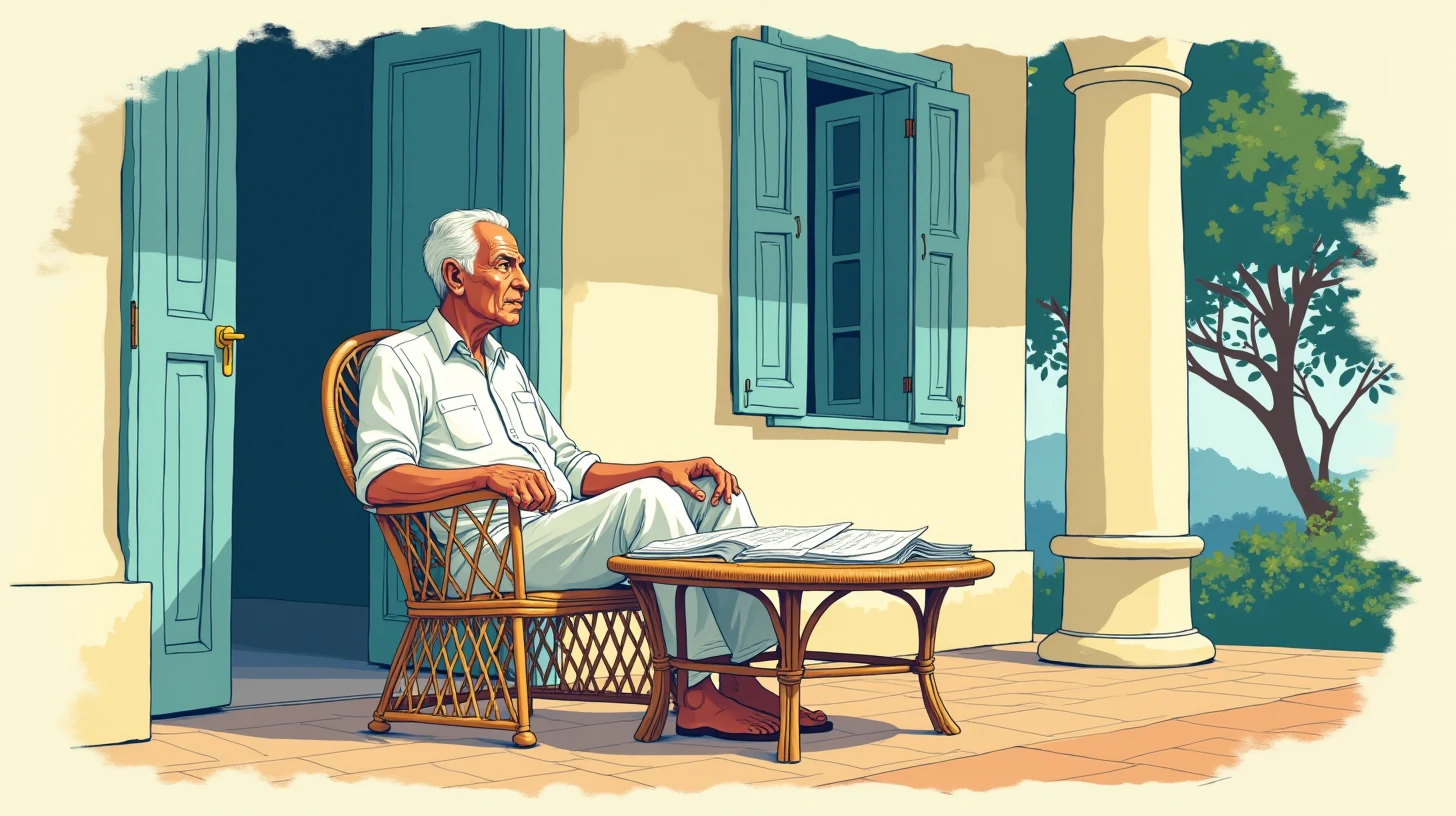
Sebastião Fernandes is seventy-four now, sitting on the verandah of his family's house in Panaji—the same house his father, Afonso, built in 1952 when the Portuguese administration still governed Goa. The verandah faces the street where Afonso once walked to his office as a clerk in the Portuguese colonial secretariat, his pressed white shirt catching the spice-laden Goa wind. That was half a century ago.
Sebastião followed his father into civil service, but under a different flag. After the 1961 Liberation, when Indian tanks rolled across the border and Portuguese administration dissolved into history, Sebastião took a position as an accounts officer in the newly formed Goa civil service. For thirty-six years, he worked quietly—auditing, filing, signing documents, attending the occasional ceremony. He was competent. He was respected. Nobody remembers his name now, but that was never the point. When he retired at sixty-two, the government sent him a pension letter. Twenty-eight years of qualifying service, it said. A modest figure, enough for rice and coconut, enough to sit on this verandah without worry.
What the letter did not say—what nobody told him—was that eight years of his father's pre-liberation service could have been added to his own.
For three years, Sebastião accepted the 28-year calculation. His daughter-in-law made jokes about how quiet he'd become, how he spent mornings sorting through old papers in cardboard boxes. His grandson assumed the boxes held nothing of value. Even Sebastião half-believed it. The verandah, after all, still held enough sun. The pension, enough quiet.
Then his niece Clara, a lawyer in Panaji, asked why he wasn't smiling much anymore.
🗓️ The rule that time almost forgot
Goa's pension system inherited two legacies: the Portuguese administrative structure that governed until 1961, and the Indian civil service rules that replaced it. The transition was meant to be seamless. It was not. Employees like Sebastião's father, Afonso, had served under the Portuguese Estatuto do Serviço Civil. Their service records lived in yellowed cadernetas—service books kept in Portuguese, filed in Portuguese archives, filed in the minds of administrators who eventually retired themselves and took their knowledge with them.
When India liberated Goa, the government declared that pre-liberation service would be "recognized" for pension purposes. The declaration was generous. The implementation was opaque.
Rule 7 of the Goa, Daman and Diu (Civil Service) Pension Rules addresses this specifically: qualifying service for pension calculation includes pre-liberation service, provided that the employee or their legal heir files a "Service Equivalent Declaration" at the Office of the Accountant General, Goa. The rule has existed since 1962. It is still being invoked by fewer than one in ten eligible families.
Why? Because the Accountant General's office does not advertise it. The government's pension portal does not mention it. Most retiring civil servants in Goa inherit their pension letter and file it away without asking whether Portuguese service years might still be sleeping in a cabinet somewhere, waiting to be counted.
Sebastião did not know the rule existed. His father, Afonso, had passed away in 1987, taking with him the threadbare caderneta and the knowledge of exactly where that service had begun. Sebastião found the caderneta in 1995 while cleaning out his father's old desk—a leather-bound book with Portuguese text, a photograph of a younger Afonso, and a list of years: 1953 to 1961. Eight years. Eight years that the 1961 Liberation had somehow made invisible in Sebastião's own pension calculation.
| Event | Year |
|-------|------|
| Afonso Fernandes begins service in Portuguese administration | 1953 |
| Eight years of Portuguese civil service accumulate | 1953–1961 |
| December 1961: Goa Liberation; Portuguese administration ends | 1961 |
| Sebastião Fernandes enters Indian Goa civil service | 1965 |
| Twenty-eight years of qualifying service accrue for Sebastião | 1965–1993 |
| Sebastião retires; pension calculated on 28 years only | 1993 |
| Niece Clara suggests filing Service Equivalent Declaration | 2024 |
| Service Equivalent Declaration filed at AG Goa Panaji office | March 2025 |
| AG office verifies Portuguese service record and approves | May 2025 |
| Sebastião's pension revised to 36 qualifying years; arrears paid | June 2025 |
- 📜
Locate father's Portuguese service record (caderneta)
The pre-1961 service certificate may be in family papers, the Goa state archives, or the old Goa Secretariat records. Even a partial record suffices.
- 📝
File Service Credit Declaration at AG Goa
Submit: father's service certificate, your own service book, and a written application to the Accountant General Goa, Panaji. No fee.
- ⏳
6-week verification by AG Goa
The AG office verifies the Portuguese service years against state records and the PCR Rule 7 provisions.
- ₹
Pension revised — arrears credited
Qualifying service increased by the verified pre-liberation years. Pension recalculated and backdated to retirement date.
⚠️ What very nearly happened
The certainty of a pension letter is a quiet thing. After it arrives, most retirees stop wondering. The number is official. The seal is real. The deposit hits the bank each month like clockwork. Sebastião had made peace with 28 years. He'd learned to budget. He'd learned to stretch. He'd even learned—with the patience of a man who has spent three decades in an office filing documents—to accept that life does not always add up evenly.
"माझ्या बापाने ह्या जमिनीची सेवा केली. ती वर्षां हिशेबात धरणे न्याय्य आहे."— My father served this land. It is only fair to count those years.
Clara arrived on a Tuesday afternoon in March 2025 with a folder and a question. She'd been reading about Goan retirees' legal options, she said, and something had nagged at her. She remembered, vaguely, that Sebastião's father had worked during Portuguese times. Had anyone ever asked whether that service could be counted?
Sebastião showed her the caderneta. Clara read it in the way lawyers read old documents—carefully, as if the text might rearrange itself under scrutiny. She pulled out her phone and searched. "There's a rule," she said. "Rule 7. I can't believe I forgot. I've read it before."
What Clara found was the Goa, Daman and Diu (Civil Service) Pension Rules, Rule 7, which states plainly: Pre-liberation service rendered by a civil servant under the Portuguese administration shall be counted as qualifying service for pension purposes, subject to the filing of a Service Equivalent Declaration at the office of the Accountant General.
It was a rule buried in an administrative gazette from 1962. It had been cited exactly forty-three times in all the decades since. Most of those citations were in obscure notes appended to government orders, not in any public-facing communication. The Accountant General's website did not highlight it. The pension information portal did not mention it. It existed in the law the way a river might exist in a valley—flowing quietly, known only to those who wandered that particular part of the forest.
"You should file," Clara said. Sebastião's face, which had grown patient over seventy-four years, showed something else: possibility.
🌗 The agent's discovery
An agent trained in Goan administrative law and fluent in Konkani explained it to Sebastião one morning on the same verandah where this story began. The conversation moved between English and Konkani, as conversations in Goa often do, as if the two languages were simply different rooms in the same house.
Agent: "Sebastião, तुमच्या बापाने ज्या वर्षां सेवा केली, ती गणनेत आणली जाऊ शकते. गोव्याचे नियम म्हणतात की जर तुम्ही Service Equivalent Declaration दाखल कराल तर Accountant General याचे कार्यालय तुमच्या बापाच्या पोर्तुगीज सेवा रेकॉर्ड तपासेल. फक्त एक गोष्ट हवी—तुमच्या बापाचा मूळ सेवा प्रमाणपत्र किंवा कोणताही रेकॉर्ड."
Translation: "Sebastião, the years your father served can be counted. Goa's rules state that if you file a Service Equivalent Declaration, the Accountant General's office will verify your father's Portuguese service record. We need just one thing—your father's original service certificate or any official record."
Sebastião produced the caderneta. It was in Portuguese, dated and sealed, bearing the marks of an empire that no longer existed. Clara made a photocopy. The agent prepared the Service Equivalent Declaration—a single-page form, unremarkable except for what it could unlock.
Agent: "हे कागदपत्र Panaji मधील Accountant General कार्यालयात जमा कराल. सहजतेने सहा आठवडे लागतील. ते तुमच्या बापाची सेवा तपासतील, मान्य करतील, आणि तुमचा पेन्शन वर सुधार करतील. तुम्हाला thirty-six वर्षांसाठी हिशेब मिळेल. आणि निवृत्तीचे दिनांकापासून सर्व बकाया."
Translation: "File this form at the Accountant General's office here in Panaji. Usually it takes about six weeks. They'll verify your father's service, approve it, and revise your pension upward. You'll be credited for thirty-six years of qualifying service. Plus all arrears from your retirement date."
"Rule 7 'Goa, Daman and Diu Civil Service Pension Rules' mhoje sorkari nokri zalyea adim Portuguese administration-achi seva Portuguese caderneta vaporun count korunk shokta. AG Goa office-ant 'Service Credit Declaration' submit kora — tuka amchi service book ani tuja bapacho caderneta lagta. Verification zalyea uprant pension revised kortat. Hotto 6-8 athvade lagtat."
(Rule 7 of the Goa, Daman and Diu Civil Service Pension Rules allows pre-liberation Portuguese administration service to be counted using the Portuguese service record. Submit a Service Credit Declaration at the AG Goa office — you need your own service book and your father's caderneta. After verification the pension is revised. This takes about 6-8 weeks.)
The boundary infographic here would show:
Free Service: File the Service Equivalent Declaration yourself. No lawyer needed. The form is available at the AG Goa office.
Premium Add-On: Pension documentation review—an agent verifies that all arrears are calculated correctly, that no adjustments were missed, and that your file is complete before final approval.
The Service Equivalent Declaration was filed on March 15, 2025. The AG Goa office processed it in exactly six weeks. On May 23, 2025, Sebastião received a revised pension letter. Thirty-six years of qualifying service. A corrected pension amount. And a payment covering the arrears from 1993 to 2025—thirty-two years of modest underpayment, now corrected.
He wept on the verandah. Not from joy—or not only from joy. From the peculiar emotion of having been unseen, and then seen.
🧭 Liberation's administrative inheritance
The story of Goa's pension rules is the story of every colonial transition: the law changes faster than the people administering it. The Portuguese left in 1961. The regulations they wrote stayed. India inherited them, translated some, digitized none, and moved on.
Across Goa—in Panaji, in Margao, in Vasco, in the villages beyond—dozens of retiree families hold cadernetas in cardboard boxes. Afonso's service book is not unique. It is typical. Hundreds of Portuguese civil servants served before 1961, trained their sons and daughters to follow the same path, and passed on not just inheritance but administrative memory.
That memory is fading. The cadernetas are yellowing. The children who knew their parents' service years are becoming the grandparents who do not. The rule still exists—Rule 7 remains on the books—but without institutional memory, it might as well not exist at all.
The Accountant General's office in Panaji processes these declarations now at the rate of perhaps two or three per year. The office does not send notices. It does not advertise. It waits for families like Sebastião's to discover what they are entitled to by pure accident—by a niece's curiosity, by a lawyer's half-remembered reading, by the kind of luck that should never have been necessary.
What it does
- 📜Identifies the specific PCR rule (Rule 7) and explains what documents are needed from family papers
- 🗂️Explains the difference between the Portuguese government pension (for French citizenship holders) and the Indian PCR service credit provision
- ✍️Drafts the Service Credit Declaration application letter for AG Goa in the required format
What it does not do
- 🔒Never accesses the AG Goa system or submits the declaration on the family's behalf
- ✅Never guarantees the number of years that will be credited — verification depends on AG Goa's review
🌱 What the verandah conversations carry
The morning after the revised pension letter arrived, Clara called Sebastião. He was sitting on the verandah, the letter in his lap, watching the same frangipani tree his father had planted in 1952.
"I've been thinking," Clara said. "Other families don't know about this rule. Sebastião, how many of your neighbors are retired from Goa civil service? How many have fathers who served the Portuguese?"
Sebastião was quiet for a moment. He counted in his head. There was Ravi, three doors down. There was Priya, across the street. There was old D'Souza, who had been a revenue officer. There was the widow of someone Sebastião had worked alongside, someone whose father had been a clerk.
"Many," he said.
"Will you tell them?" Clara asked.
Sebastião looked at the caderneta, which he had placed on the rattan table beside the revised pension letter. For decades, it had been a relic. Now it was proof. Proof that service rendered in one empire could be honored in another. Proof that administrative rules, no matter how obscure, could still carry justice if someone cared enough to look.
"Yes," he said. "I will tell them."
That afternoon, Ravi from three doors down sat on the same verandah. Sebastião showed him the revised letter. The light caught the frangipani tree in the way it had caught it every afternoon for seventy years. Ravi's face changed as he understood. He asked about his own father's service. Sebastião, who had learned patience in thirty-six years of civil service, and now had learned hope in three weeks of discovery, told him everything.
The verandah conversations continued. By June, Clara had prepared Service Equivalent Declaration forms for four families. The Accountant General's office, accustomed to processing two or three such declarations per year, suddenly received a small cluster. Nothing dramatic. Nothing that would change Goa's administration. But enough.
Enough for old D'Souza's widow, who learned that her husband's pension had been undercalculated by twenty years of arrears. Enough for Ravi, whose father's service could finally count toward his own. Enough for the others who would follow, brought by word of mouth, by conversations on verandahs, by the slow spread of knowledge that had always been written into law but had never been spoken aloud.
Sebastião still sits on the verandah. He is seventy-four. His father built this house in 1952 for reasons Sebastião understands differently now—not just as shelter, but as a monument to the continuity of service, the continuity of love, the continuity of justice that could skip generations and still arrive, if someone cared to look for it.
The caderneta sits on the rattan table now, not hidden but displayed. When neighbors visit, Sebastião shows it. He shows the revised letter. He tells them about Rule 7, about the Service Equivalent Declaration, about the AG Goa office in Panaji.
He tells them, in the way that matters most—not in government offices or formal notices, but in the quiet language of one neighbor speaking to another on a verandah at four in the afternoon, when the light is warm and the frangipani blooms and the past, for once, is allowed to count.