
The Patna lineman and the EPS-95 pension he was shortchanged on
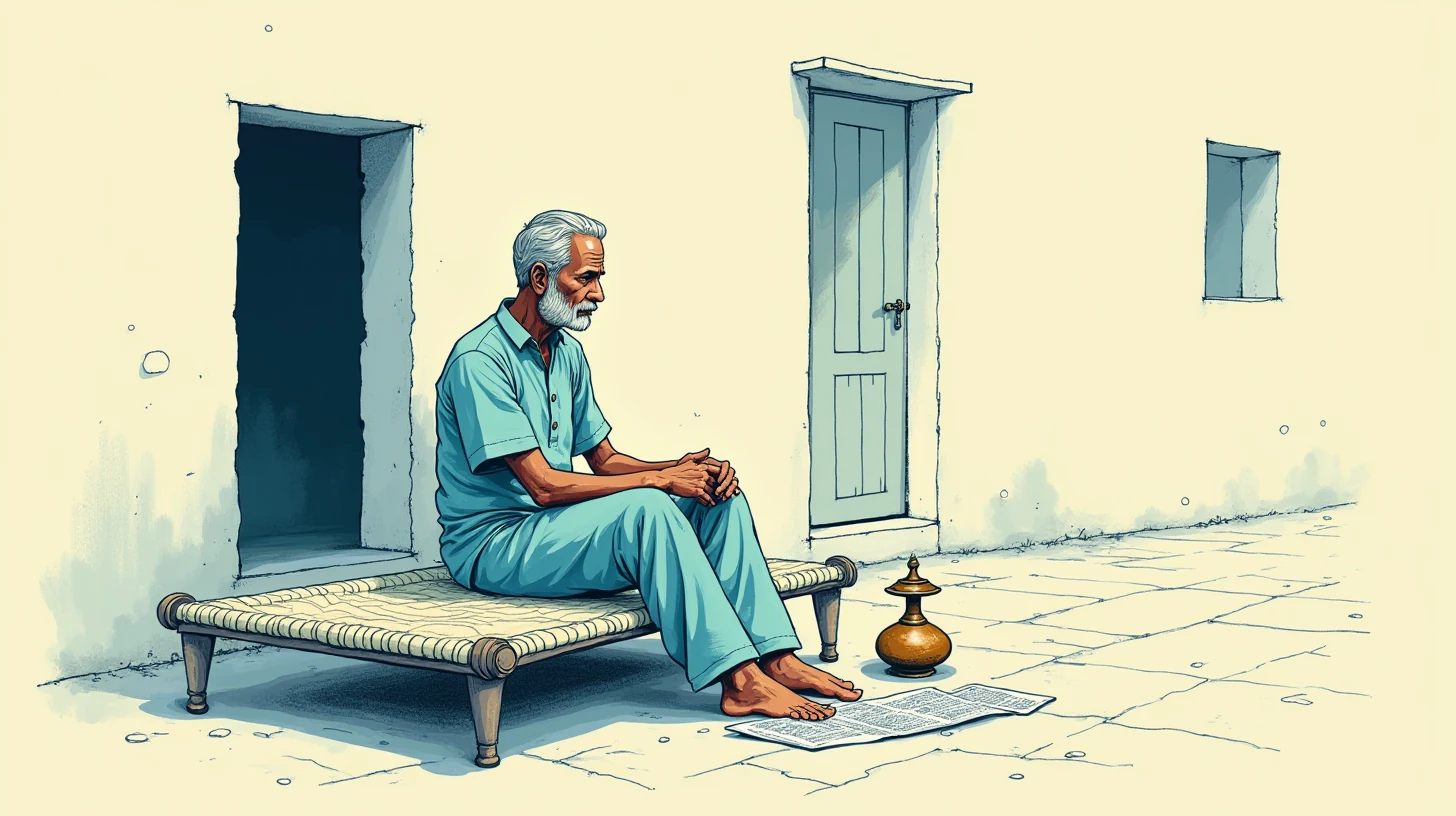
Ramchandra Prasad's hands tell the story before his mouth does. Scarred. Weathered. Calloused in the exact places that grips a high-voltage cable year after year, decade after decade. At sixty-six, he sits on his charpoy in a small courtyard in Patna's Kumhrar neighbourhood with a folded pension slip and a Supreme Court judgment printout beside him—documents that have become more precious to him than they have any right to be.
Thirty-one years. That's how long Ramchandra climbed Bihar State Electricity Board's electricity poles. Not on weekends. Not in the dry season. In the monsoons when the sky split open and the poles became lethal. In the May heat when the thermometer hit forty-four degrees and the cable itself was too hot to grip. Through blackouts and rolling cuts, through neighbourhoods that grew and changed and sometimes forgot to pay their bills. Thirty-one years of training younger linesmen, of carrying a toolbox and a responsibility that wasn't written in any job description: keep the lights on for Patna.
His pension slip says ₹1,150 per month.
That number has haunted him since the day it arrived. His son, who works in Delhi as an accountant, sends ₹5,000 every month—a gesture that wounds Ramchandra more than it helps. Medicine costs ₹2,500 on good months. Rent is ₹3,000. His wife passed away five years ago; he has no one to feed but himself and his aging mother. The ₹1,150 doesn't touch any of it.
For two years, he thought this was simply the hand the government had dealt him. An old man's portion. Until his younger neighbour, a retired Bank of India clerk, mentioned a Supreme Court judgment from 2022. Something about pensions. Something about a ceiling that wasn't really a ceiling at all.
🗓️ What EPS-95 was supposed to be
The Employees' Pension Scheme, 1995—EPS-95—was designed as a safety net. Workers at factories, banks, utilities, and government corporations would contribute a percentage of their salary to the EPFO (Employees' Provident Fund Organisation). At retirement, they'd receive a monthly pension proportional to their wages and years of service.
But there was a flaw written into the scheme from the start.
The EPFO imposed a ceiling on the wages used to calculate pension contributions. For decades, that ceiling was ₹15,000 per month. If you earned ₹28,000 (as Ramchandra did by his final years), you contributed on only the ₹15,000 portion. The remaining ₹13,000 went untaxed in the eyes of the pension scheme—invisible. Your pension, therefore, was calculated as if you'd never earned more than ₹15,000 in your entire career.
This wasn't unfair by accident. It was unfair by design. The government was protecting its fiscal liability by capping what workers could earn for pension purposes. Millions of postal workers, electricity board employees, bank staff, and railway personnel spent their entire careers funding a pension system that treated them as if they earned less than they actually did.
For thirty-one years, Ramchandra earned more than ₹15,000. In his final decade, his actual wages climbed to ₹28,000 per month. But the EPFO's ledger showed him as a ₹15,000-a-month worker. When his pension was calculated, the formula applied to that fictional number—and arrived at ₹1,150.
In March 2022, the Supreme Court of India intervened. The judgment stated that workers who had contributed on wages above the ₹15,000 ceiling had a right to a "Higher Pension Option" or "Joint Option." If your employer filed the right paperwork and certified your actual wages, the EPFO would recalculate your pension based on what you actually earned, not what the ceiling said you could earn.
The court gave employers a window: March 2023. One year. File the paperwork, certify the wages, let the pension calculations be revised.
Ramchandra's employer, Bihar State Electricity Board, never filed anything.
Current pension (ceiling wage)
₹1,150/monthCalculated on statutory ₹15,000 ceiling. BSEB never filed the Joint Option. Pension is 1.17% of ₹15,000 × 31 years of service.
Revised pension (actual wage)
₹3,200/monthUnder 2022 SC judgment: calculated on actual ₹28,000 wage. Employer non-compliance allows EPFiGMS grievance route even after March 2023 deadline.
⚠️ The employer who never filed
The HR department at BSEB operates in a rhythm that doesn't accelerate for Supreme Court judgments. Ramchandra made several visits to their office in person. Sat in waiting rooms. Spoke to clerks and junior officers who had never heard of the 2022 judgment. One official, a woman named Geeta, actually checked a file and told him: "The window closed in March 2023. It's too late now."
He believed her. For another year, he accepted that the ship had sailed, that his ₹1,150 was his final answer, that climbing electricity poles for thirty-one years had been worth a pension that didn't cover medicine.
But the Supreme Court judgment isn't a one-time opportunity that expires and evaporates. It's a principle. And that principle opens a door that the EPFO itself can unlock.
The door is the Employees' Provident Fund Grievance Management System—EPFiGMS. It's a portal where workers can file complaints against employers for non-compliance. For breach of duty. For failure to follow the law.
When the agent—Lata, who handles pension queries for retirees—explained this to Ramchandra, something shifted in his face. Not hope exactly. A kind of mathematical clarity. He had a right. BSEB had a duty. The EPFO had a process. It wasn't too late.
"तीस साल बिजली के खंभे चढ़ा, और पेंशन इतनी कम कि दवाई भी नहीं आती।"— Climbed electricity poles for thirty years, and the pension is so small I can't even buy medicine.
🌗 What the agent clarified
Lata: "Ramchandra-ji, the March 2023 window has officially closed, but the Supreme Court judgment doesn't disappear after a deadline. It becomes a principle that the EPFO can enforce. You didn't miss your chance because your employer missed theirs. That's the difference.
आपका दावा है कि आपका पालक नियोक्ता—बिहार विद्युत बोर्ड—ने आपको Joint Option filing में सहायता नहीं दी। और ऐसा इसलिए है क्योंकि उन्हें पता ही नहीं था। या उन्हें मतलब नहीं था। कोई फर्क नहीं पड़ता। EPFO के पास एक नियम है: अगर नियोक्ता अपना कर्तव्य पूरा नहीं करता, तो कर्मचारी EPFO grievance portal पर शिकायत दर्ज कर सकता है। आप शिकायत दर्ज करेंगे।
(Your claim is that your employer—Bihar State Electricity Board—never helped you file the Joint Option. And that's because they either didn't know, or didn't care. Doesn't matter. The EPFO has a rule: if the employer doesn't fulfill their duty, the employee can file a complaint on the EPFO grievance portal. We'll file that complaint.)"
English translation:
"Ramchandra-ji, the March 2023 window has officially closed, but the Supreme Court judgment doesn't disappear after a deadline. It becomes a principle that the EPFO can enforce. You didn't miss your chance because your employer missed theirs. That's the difference.
Your claim is that your employer—Bihar State Electricity Board—never helped you file the Joint Option. And that's because they either didn't know, or didn't care. Doesn't matter. The EPFO has a rule: if the employer doesn't fulfill their duty, the employee can file a complaint on the EPFO grievance portal. We'll file that complaint."
"2023 की मार्च डेडलाइन बंद हो गई है, लेकिन BSEB ने Joint Option कभी file नहीं किया था — यह नियोक्ता की गलती है। EPFiGMS पर शिकायत दर्ज करें: UAN नंबर, Form 11 की कॉपी, और ₹28,000 असली तनख्वाह दिखाने वाले वेतन पर्ची — यह सब लगाएं। EPFO Patna का ऑफिस 30 दिन में जवाब देगा।"
(The March 2023 deadline has closed, but BSEB never filed the Joint Option — that is the employer's fault. File a grievance on EPFiGMS: attach UAN number, Form 11 copy, and salary slips showing actual wages of ₹28,000. The EPFO Patna office will respond within 30 days.)
Lata walked him through what the EPFO Patna regional office would need:
- His UAN (Universal Account Number)—printed on every pension statement
- Form 11 (the Joint Option form), filled correctly with his actual wages from his final salary slips
- Salary slips or payroll documents showing his actual monthly wages across at least the last five years of service
- A formal letter to EPFO explaining that his employer never filed the original Joint Option, despite the March 2023 deadline
- A copy of the 2022 Supreme Court judgment—though EPFO already has this
The complaint would be filed under EPFiGMS. EPFO would then serve BSEB with a notice asking them to respond within thirty days. Either BSEB would cooperate and provide the certification of his actual wages—which they almost certainly would, under pressure—or EPFO would make the determination based on his salary records alone.
In Ramchandra's case, the salary records were clean. Three decades of employment at a single institution, with documented raises. BSEB's payroll department could verify every number.
🧭 The pension gap that serves nobody
What it does
- ⚖️Explains the 2022 Supreme Court judgment and the employer non-compliance exception that applies to Ramchandra's case
- 📋Guides the EPFiGMS grievance application: what fields to complete, which documents to attach, and which EPFO regional office to address
- 🔍Calculates the estimated pension difference to confirm whether filing is worth the effort
What it does not do
- 🔒Never files the EPFiGMS grievance on Ramchandra's behalf or accesses his UAN
- ✅Never guarantees the outcome — EPFO processes the claim independently
This isn't a small problem affecting three or four retirees. Millions of Indian workers have pensions calculated on the ₹15,000 ceiling. Postal workers. Electricity board staff. Bank employees. Railway workers. Sugar factory hands. Textile workers. Cement plant employees. Anyone who worked at a PSU or large corporation with an EPFO-registered pension scheme between the 1990s and the early 2020s.
The Supreme Court judgment is now more than three years old. The March 2023 filing window closed eighteen months ago. Most workers don't know it exists. Most employers have quietly filed nothing. Most retirees assume their pension is final, unchangeable, written in stone.
But the EPFO grievance system exists precisely for moments when employers fail in their duties and workers are left shortchanged. It's slow—typically thirty days to sixty days for a resolution. It requires documentation. It requires the worker to know that the system exists and that they have a right to use it.
For many workers, the knowledge gap is the last barrier. They've already accepted a small pension. They've already stretched their son's or daughter's remittance to cover medicine and rent. The idea that a retired lineman can challenge his pension calculation feels too ambitious, too legal, too far from the world they inhabit.
The agent service exists to bridge that gap. Not to secure the pension—that work belongs to EPFO and BSEB. But to explain that the gap exists, that the right exists, and that filing a complaint costs nothing but time and a handful of documents.
🌱 What ₹3,200 changes
Ramchandra's revised pension, assuming the EPFO processes his Joint Option grievance and BSEB certifies his actual wages of ₹28,000, will be ₹3,200 per month.
That's not a fortune. It's not enough to live comfortably on in a city. But it's enough to change the math. Medicine becomes affordable. He can reduce the amount his son sends from Delhi—a reduction that matters because his son has a daughter in school and a mortgage. The ₹3,200 isn't just money; it's the difference between accepting charity and having independence. Between being a burden and being a grandfather who can still buy his granddaughter a gift on her birthday.
Ramchandra filed his EPFiGMS complaint on a Tuesday. He brought his documents to a cyber café, paid ₹50 to have them scanned, and uploaded them through the portal with help from the café owner's son. The EPFO system auto-acknowledged the complaint and assigned it a ticket number.
Thirty-two days later, a letter arrived from the EPFO Patna regional office. BSEB had been served notice. They had responded—not enthusiastically, but responsibly—with payroll documentation covering his entire final decade. The EPFO's response was brief: "Recalculation approved. New monthly pension amount: ₹3,200. First revised payment will be made in the next pension cycle."
When the first ₹3,200 arrived in his account, Ramchandra transferred ₹1,500 to his son and went to the clinic. He sat on the doctor's bench and heard, for the first time in two years, that he could afford the blood pressure medication his cardiologist had prescribed. That he didn't have to choose between it and eating rice.
Thirty-one years of climbing poles had finally been counted the way it should have been counted from the beginning.
If you're a retiree with an EPS-95 pension calculated before March 2023, and you earned more than ₹15,000/month at any point in your career, you have a right to revisit your pension calculation. Your employer may have missed the filing deadline—but the EPFO grievance system allows you to challenge that failure. You need your UAN, salary slips, and the patience for a sixty-day process. The difference, like it was for Ramchandra, might be everything.
Free service: We'll help you gather the documents and file the EPFiGMS complaint. Premium adds annual pension tracking to catch any recalculation errors.