
The Pune pensioner and the Jeevan Pramaan saga
Mrs. Indumati Deshpande is seventy-two years old. She lives in a small two-bedroom flat in Sahakar Nagar, Pune, in a building that her husband — a retired senior clerk from the Maharashtra State Electricity Board — bought with his provident fund in 1996. He died of a stroke in March 2020, in the second week of the first lockdown, and she has lived alone in the flat for six years now. Her only son, a software engineer named Mahesh, lives in Dallas, Texas, with a wife and two children whom Mrs. Deshpande has met three times in person and approximately four hundred times over WhatsApp video. Her younger sister lives in Nashik, two and a half hours away by bus. She has a maid who comes twice a day. She has a doctor who comes once a month and a cardiologist whom she visits every quarter at Ruby Hall. She has a small Bharat Gas cylinder that she changes herself, against her son's strenuous transcontinental objections.
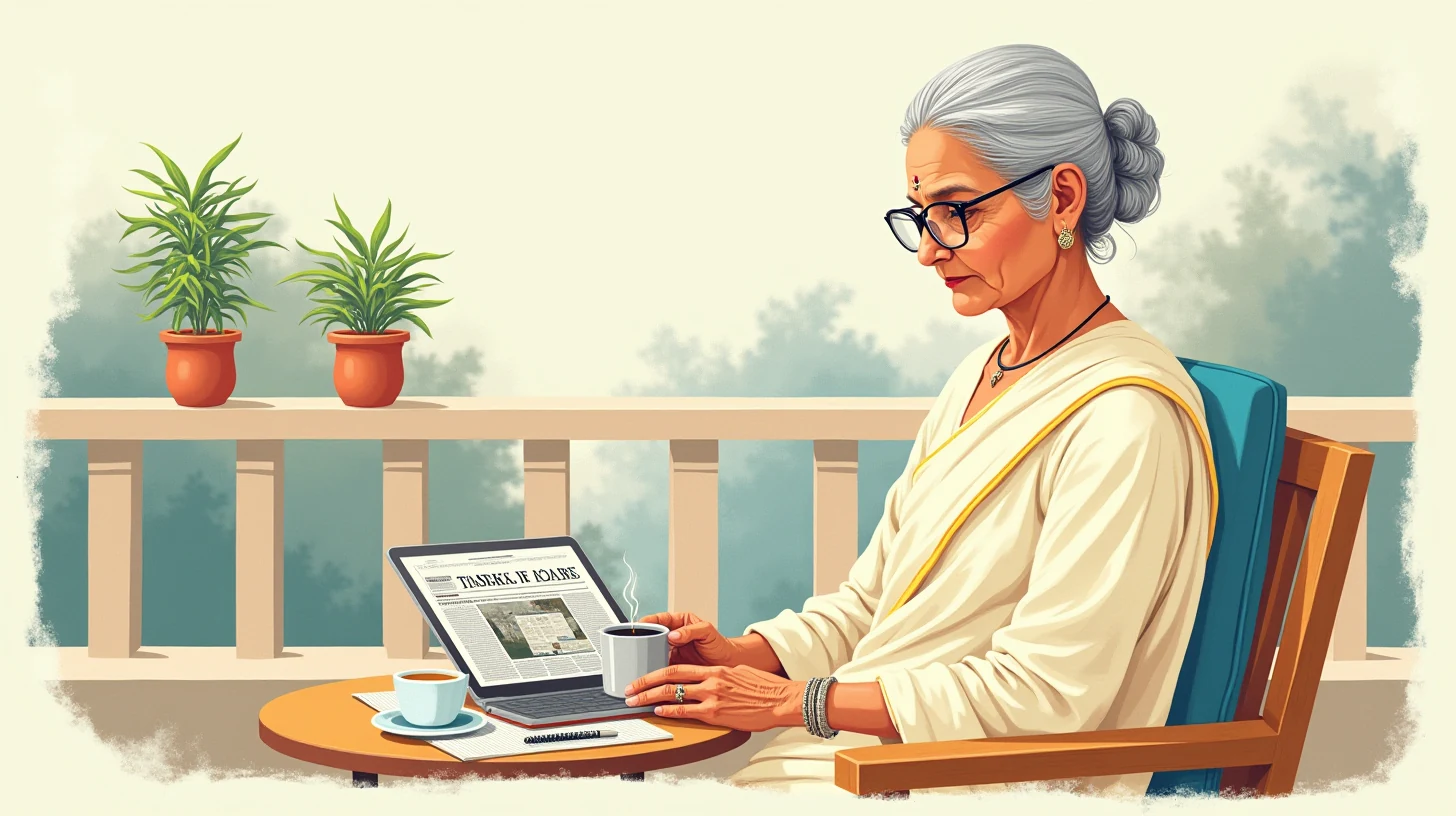
Her pension is ₹38,000 a month, of which she spends about ₹14,000 and saves the rest in a series of small fixed deposits that she opens every quarter at the State Bank branch on Tilak Road, with the same officer, Mr. Kulkarni, whom she has known since 2003 and who calls her kaki. This is a perfectly normal life for a retired widow in a perfectly normal Pune neighbourhood. There are forty thousand Mrs. Deshpandes in this city.
What is unusual is what happened last October when she very nearly lost her pension.
🗓️ The annual ritual
Every year, between November 1 and November 30, every pensioner in India who draws a Government or Government-equivalent pension must submit what is called a Life Certificate — a piece of paper, or, since 2014, a digital certificate called Jeevan Pramaan, that says: I, the pensioner in question, am still alive. Without this certificate, the bank is required, by rule, to stop pension payments until the pensioner shows up in person. The rule is not unreasonable. The Government of India pays pensions to roughly seventy million people, a non-trivial fraction of whom die quietly every year, and without an annual proof-of-life check the system would haemorrhage money to dead pensioners' bank accounts being raided by everyone from honest sons to dishonest cousins. The rule, in principle, is fine.
The rule, in practice, is administered through a sequence of small bureaucratic transactions that — if you are seventy-two, alone, and not particularly comfortable with a smartphone — can become, very quickly, a labyrinth from which the path back to your own pension is non-obvious. The bank does not chase you. The Government does not chase you. The system has been designed, in a quietly Kafkaesque way, around the assumption that the pensioner will themselves remember, between November 1 and November 30, to walk into their bank branch — or, since 2014, to log into the Jeevan Pramaan portal with their Aadhaar and a biometric capture — and assert, formally and in writing, that they are not dead.
Mrs. Deshpande had submitted her Life Certificate every year since 2002, when her husband retired. From 2002 to 2019 she submitted it in person at the Tilak Road branch, with Mr. Kulkarni, and that took twenty minutes and a cup of tea. From 2020 onwards, post-pandemic, the bank had quietly pushed her — as it had pushed all its older customers — to the digital Jeevan Pramaan portal, which works through Aadhaar biometric authentication and which, to her enduring confusion, did not work for her in 2020, 2021, or 2022 because her fingerprint biometric had been corrupted in the original Aadhaar enrolment by either age or a long history of cooking with mustard oil.
- 📨
October — bank SMS
Arrives in stilted English with a URL inside. Indistinguishable from the dozen weekly phishing SMS — so Mrs. Deshpande, following her daughter-in-law's rule, ignored all four.
- 🗓️
November — 29-day window
Nov 1 to Nov 30. Branch, CSC kiosk, or Jeevan Pramaan portal. Mr. Kulkarni had been transferred to Aurangabad.
- 🛑
Nov 5 — pension suspended
No certificate filed. The bank's system stopped the payment. The cable operator's bill began to stack on the side table.
- ₹
Late Nov — resumption
Only after a Doorstep visit. Arrears credited 5–7 working days later. She was eleven days into the lapse when Mahesh called from Dallas.
The bank had, each year, eventually accepted her in-person submission, because Mr. Kulkarni knew her, and because the rules permit a fallback to in-person verification. But in 2023, Mr. Kulkarni had been transferred to a branch in Aurangabad. The Tilak Road branch had a new manager — a young man named Sawant who was polite, competent, and entirely unaware of the seventeen-year-old social contract between his branch and Mrs. Deshpande.
In 2023 and 2024, she managed. In 2025, she did not.
⚠️ What very nearly happened
In October 2025, Mrs. Deshpande's pension was due to be paid on the 5th of November, as it had been on the 5th of every month for twenty-three years. November 5 came and went. November 10 came and went. By November 14 — two weeks late, with the bills from the building society and the cable operator stacking up on the side table and the maid asking, gently, if there was a problem with the money — she walked the four hundred metres from her flat to the State Bank branch at Sahakar Nagar (the Tilak Road branch had also, in 2024, been closed and merged) and asked the new young man at the counter what was going on.
What was going on was that her Life Certificate for FY2025-26 had not been submitted. The notice — an SMS, in stilted bureaucratic English, sent on October 8 to the phone number she had registered with the bank in 2007 — had said: "Dear Pensioner, your Jeevan Pramaan Life Certificate for FY2025-26 is due by 30 November 2025. Please submit via the JP portal (jeevanpramaan.gov.in) or visit your branch. Failure to submit will result in suspension of pension payments." She had received the SMS. She had read it; she had been a school-headmaster's daughter and a senior clerk's wife and she could read English perfectly well. What she could not do, with any confidence, was tell whether this particular SMS was a real bank notice or one of the dozen near-identical phishing messages that landed on her phone every week. Her daughter-in-law in Dallas had warned her, over many video calls, to click nothing, trust no SMS, even from your bank. The SMS in question contained a URL — jeevanpramaan.gov.in — and her safe behaviour, the one Sushma had drilled into her, was to ignore any message containing a URL. So she had. Three further reminders, identical in tone, had likewise been ignored. November 1 had come and gone with no submission. The system, on November 5, had automatically suspended her pension.
The bank — politely, professionally — could do nothing for her at the counter. She would need to submit the certificate, after which her pension would resume, with arrears, in five to seven working days. The submission could be done online (she did not know how), at a Jeevan Pramaan kiosk (she did not know where the nearest one was), or via a Doorstep Banking service (she did not know what this was). The young man at the counter was sympathetic but also had a queue of seven other customers behind her. She walked back to the flat.
She did not call her son. He was, she knew, in a difficult phase at work — there was something called a "performance review" — and she did not want to add to his transcontinental worry. She called her younger sister in Nashik, who said:
"ताई, मला कळत नाही या डिजिटल कार्याचा — तू महेशला फोन कर."(Sister, I don't understand these digital things. Just call Mahesh.)
She did not call Mahesh. She sat with a cup of tea on the balcony and decided that the world had become a place she could no longer fully participate in, and that she would deal with the pension in the morning.
She didn't, in the morning. She didn't on the Tuesday either.
The story of what very nearly happened is that, on the Thursday of that week, she would have been ten days into a pension lapse, with no submission filed, no kiosk visited, and no doorstep banker called, drifting quietly toward a December where the bills would not have been paid and her son would have noticed the absence of her usual transfer to him for his daughter's Diwali present and would have called, very alarmed, from Texas at 3 AM her time. This is the small, undramatic, very Indian way in which old women lose their pensions: not because anybody is cruel, not because the bank is broken, but because four real bank SMS were indistinguishable from the four hundred phishing SMS that arrive each year, and the safe rule — ignore everything with a link — had quietly cost her the one message that mattered.
🌗 What changed
What did, in fact, happen was that on the Wednesday morning — eleven days into the pension lapse — Mrs. Deshpande's son Mahesh called her on his lunch break (which was her dinner time) and, in the course of the usual conversation about the grandchildren and the weather and the new haldi-doodh recipe she had tried, casually mentioned that he had installed something on her tablet two months earlier and wanted to know if she had been using it.
She said yes, the tablet was working fine, the news app was working fine, she had been reading the Times of India in the mornings as usual.
He said: "Aai, the thing I installed wasn't a news app. It was an AI assistant. When an SMS arrives and you aren't sure whether it's real or phishing, you can show it to the assistant and ask. It understands Indian banks. Did you try?"
She said no, she had not. She had thought it was part of the news app.
He said, very gently — because he is a good son and because he had, several times, in the past three years, watched his mother quietly stop trusting things she had once trusted — "Aai, please open it. Show it the four SMS you've been ignoring."
She opened it. One by one, by way of the tablet's screenshot gallery, she showed it the SMS from the bank. The agent read each one — checking sender ID, the URL, the message structure — and replied to her, in a Marathi-English mix at her own register, in clean large readable text:
"नमस्कार इंदुमती-ताई. ही बँकेचा SMS आहे — तुमचं जीवन प्रमाण सर्टिफिकेट, जो दर वर्षी नोव्हेंबरमध्ये सबमिट करावा लागतो, तो या वर्षी सबमिट झाला नाही. त्यामुळे नोव्हेंबरपासून पेन्शन बंद आहे. ही एक सामान्य चेक आहे — बँकेने तुम्हाला मेला समजून घेऊन पेन्शन बंद केली आहे. त्या सबमिशनचे ३ पर्याय आहेत. कुठला पर्याय तुम्ही ट्राय करू शकता?"
(Greetings Indumati-aunty. This is a bank SMS — your Jeevan Pramaan certificate, which must be submitted every November, was not submitted this year. That is why your pension is suspended since November. This is a routine check — the bank has assumed you might have passed away and stopped the pension. There are 3 options for submission. Which one would you like to try?)
It then offered three options, in Marathi, in large text:
- Ghari kuni yeil — Doorstep Banking, free, 1 working day. The bank sends a person to your home with a fingerprint scanner.
- Jvaal-tula janare kendra — Common Service Centre at Sahakar Nagar, 600 metres from your flat, walk-in.
- Vidya-pramaan online — online portal, needs a fingerprint scanner on the tablet (you don't have one).
Doorstep Banking
what she choseFree. State Bank sends a person to the flat with a portable fingerprint scanner. One working day. Mrs. Deshpande picked this because she didn't want to walk to the CSC alone.
CSC Kiosk · Sahakar Nagar
600 m awayFree. Walk-in. Six hundred metres from her flat. Not chosen — she was 72 and recovering from a quiet October.
Jeevan Pramaan online
skippedNeeds a USB fingerprint scanner she didn't own. Worked on principle. Inaccessible on the tablet her grandchildren had bought her.
Mrs. Deshpande picked option 1 — the doorstep banker — because she had not been comfortable going to the CSC. The agent helped her dial the State Bank Doorstep Banking number on the tablet, which connected to a Marathi-speaking call centre, which scheduled a home visit for the next morning at 10 AM. The visit took twenty-three minutes. The doorstep banker — a soft-spoken young woman named Kavita — took her fingerprint, took a selfie of her with the Aadhaar card, submitted the Jeevan Pramaan certificate from her own tablet. The submission was confirmed by SMS within an hour. The pension, with arrears for November, was credited on the following Tuesday.
She did not, then or later, tell her son how close it had been.
🧭 Why we built it
There are, by careful estimate, fifty-four million pensioners in India. Roughly seven million of them are widows over the age of sixty-five, living alone or with elderly siblings. Roughly half of those are in cities or large towns, and the other half in smaller towns and villages. The Jeevan Pramaan annual life-certificate problem is one specific instance of a much broader pattern: the bureaucratic interstitial tissue of Indian elder life — the EPFO portal, the BMC water bill, the LPG subsidy KYC, the LIC policy maturity notification, the SBI Net Banking second-factor authentication, the Cowin booster reminder, the Income Tax Form-16 — generates a perpetual stream of small, English-language, digital-first, jargon-heavy transactions that an elderly Indian woman in a Pune housing colony cannot fully participate in.
The transactions are not, individually, complicated. None of them is rocket science. Every single one of them, taken in isolation, can be solved by a thirty-minute phone call to a son, a daughter, a nephew, or a younger cousin. Collectively, however, they constitute a constant low-grade administrative load that the elderly person cannot delegate (because the son is in Dallas), cannot safely act on (because real bank SMS and phishing SMS look identical), and cannot ignore (because the LPG cylinder gets cut, or the pension gets suspended).
We built a small, quiet, Marathi-Hindi-Bengali-Tamil-Telugu-Kannada-Malayalam-Gujarati-Punjabi assistant that lives on the tablet the grandchildren bought for her sixty-fifth birthday and which she uses mostly for video calls and the news. The agent reads her SMS, in any language. It surfaces the urgent ones in big-text Marathi. It walks her through the response, in real time, with the bank's helpline number on the screen at the right moment. It does not, ever, complete the transaction for her — she would not allow it to, and we have built it not to. What it does is the thing that the absent son in Texas would do if he were sitting in the next room: read the letter, explain it, hand the phone over with the right number already dialled.
What it does
- 🔍Tells her whether the SMS is a real bank notice or phishing — checks sender ID, URL, and message structure before she has to decide.
- 💬Unpacks the bureaucratic shorthand (FY26, JP, .gov.in) and names the deadline, the consequence, and the three real options.
- 📞Pre-dials the State Bank Doorstep Banking helpline on the tablet so she only has to press call.
What it does not do
- 🔒Never types her Aadhaar OTP or net-banking password.
- 💳Never swipes a card, transfers money, or pays a fee on her behalf.
- ✅Never files the Jeevan Pramaan submission without Kavita the doorstep banker physically there.
We built it free. We will keep it free for this user — the elderly woman alone in a tier-2 Indian city — forever. The model that makes it free is the same model that makes WhatsApp free: this is not a market segment with a marketing budget. It is a market segment with sons in Texas, and the sons in Texas will, eventually, pay for the small things on top — cross-border tax-filing help, family-WhatsApp daily summary, a polite weekly call summary the agent prepares for the son so that he knows what his mother is and isn't telling him. But the core thing — reading the SMS with her — is, and will remain, free.
🌱 What we hope happens
Mahesh Deshpande emailed us last month. He had not, he said, fully understood — until this October — how much of his bandwidth was being absorbed, every week, by the low-grade transcontinental worry about whether his mother was on top of her administrative life. He had not been ignoring her. He had, he said, been doing exactly what good sons do — calling on Sundays, asking, listening, sending money for festivals — and he had still, structurally, been failing to notice that the Jeevan Pramaan certificate had not been filed for eleven days. The agent, he said, had not replaced his weekly calls. It had simply taken the urgent administrative layer off the top so that the calls could go back to being about the grandchildren, the weather, and the haldi-doodh recipe.
Which is, all considered, what we hoped this product would do. Not save anyone's pension in a single dramatic intervention. Just take the urgent layer off the top, in the language of the person who has lived their life in that language, on the tablet they already own, and very, very quietly.
If you have a parent in a similar situation — anywhere in India — and you would like to try setting them up the way Mahesh did, the product is free at gabforge.in. We have native Marathi, Hindi, Bengali, Tamil, Telugu, Kannada, Malayalam, Gujarati, Punjabi, Odia, and Assamese, and the call-centre routing knows every state's helpline numbers. You can install it on a tablet in twenty minutes. We will not advertise to your parent. We will not sell their bank data. We will read the SMS with them, and we will be quiet.