
The Ranchi steelworker and the two pensions he thought were mutually exclusive
Dilip Kumar Mahto sits on the concrete step outside his single-room house in Ranchi's Piska Nagri neighbourhood, holding a faded pension slip. The slip says ₹1,200. For twenty-six years, he had walked into the Bokaro Steel Plant before dawn, before the furnaces roared to life. Now sixty-three, with two adult children settled in Bangalore, he lives alone in the house his wife left him five years ago—not divorced, she ran away with someone else, a fact he mentions only when the conversation demands precision.
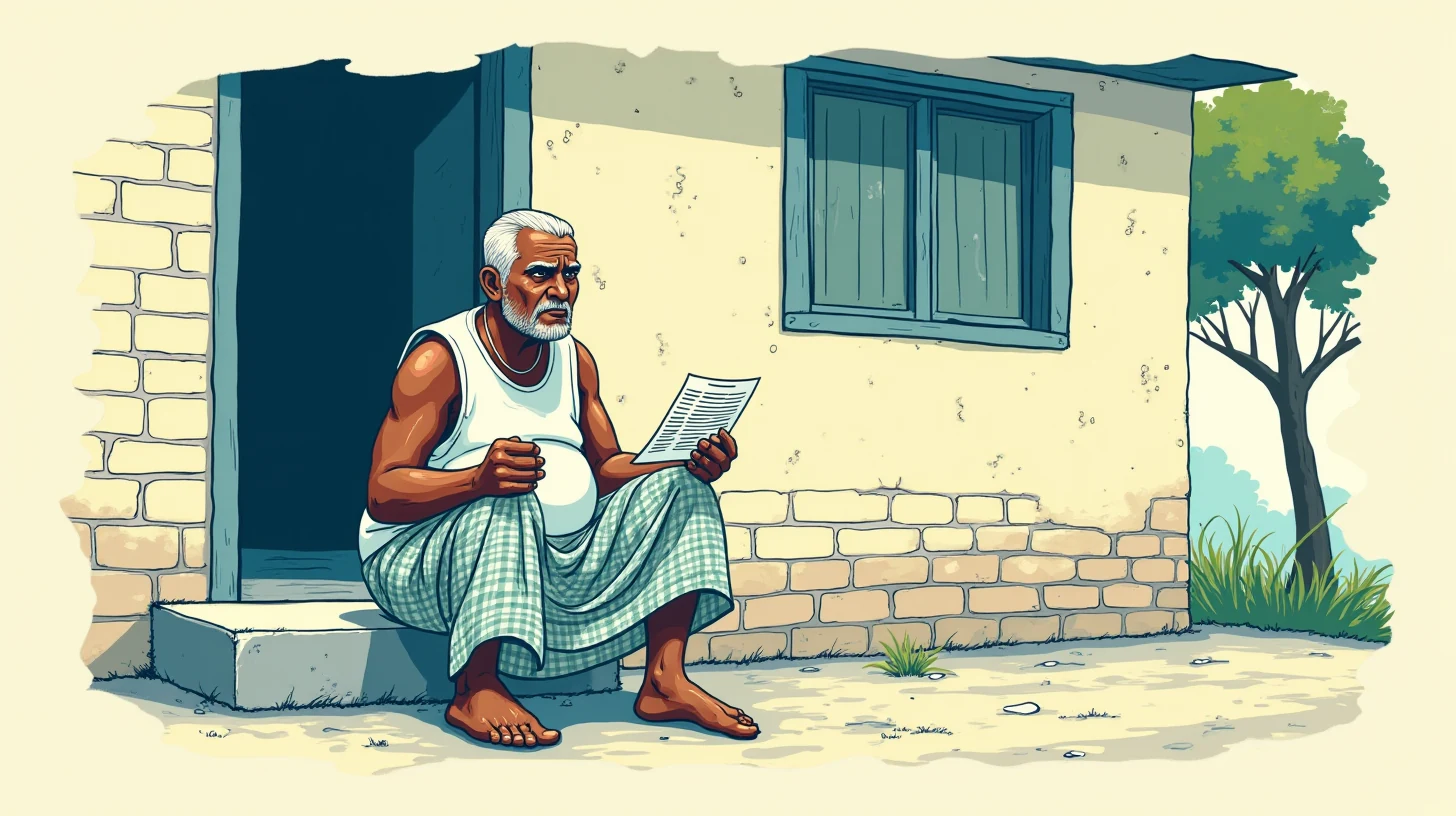
The ₹1,200 comes from EPFO's Employees' Pension Scheme 1995, or EPS-95. It was his entitlement. He had contributed every month for twenty-six years, a small percentage deducted from his wages at the steel plant. When he retired at fifty-nine, the EPFO office processed his pension application in two weeks. The first cheque arrived in his bank account that September. It was the only money he could rely on.
Medicines for his blood pressure and arthritis cost him ₹400 a month. Electricity bill, ₹200. Rice, dal, oil—what remained after these expenses barely stretched to twenty-six days. On the twenty-seventh, he borrowed from the grocer. He was not starving, not exactly. But he was counting. Always counting.
His neighbour, a retired schoolteacher named Sukanta Roy, had mentioned something one afternoon while they watered their plants. "The government is giving ₹1,000 a month to old people without pensions," Sukanta said. "You're fortunate you have your EPFO thing. Those of us who spent thirty years teaching for the state, we don't qualify." Sukanta had a government pension, substantial enough that he wore shoes without thinking about them, that he could buy tomatoes without checking the price.
Dilip heard this and believed it. If Sukanta, educated and informed, said the state pension was only for those without pensions, then it must be true. He had a pension—₹1,200 a month. Therefore, he was not eligible. The logic was simple. Dilip never applied.
🗓️ Two pension systems, one wrong assumption
Jharkhand, like most Indian states, operates two separate pension systems for the elderly. Understanding why one does not disqualify you from the other is the key to ₹1,000 that thousands of retired workers miss every month.
The EPS-95 pension, which Dilip receives, is funded through the Employees' Provident Fund Organisation—a central government body that manages retirement savings for private and Public Sector Undertaking (PSU) workers. When you work at a company like Bokaro Steel Plant, a percentage of your wages goes into an account. After ten years of contributions, you become eligible for a monthly pension at retirement. This pension is entirely funded from your own contributions and those of your employer. It is not a government handout; it is your earned entitlement.
The Mukhyamantri Vriddhjan Pension Yojana (MVPY), Jharkhand's state old age pension, is a separate welfare scheme. It gives ₹1,000 per month to residents aged sixty and above whose annual family income is below ₹1 lakh. The key word is family income. It includes pension income—but only from government or government-aided service pensions. Dilip's EPS-95 pension is neither government service nor government-aided. It is a contribution-based scheme for private and PSU sector workers.
The confusion arises because of the disqualification rule. If you receive a pension from Central Government service (like an IAS officer or railway worker), or from State Government service (like Sukanta the schoolteacher), you are disqualified from MVPY. The logic is that government employees already receive lifetime medical benefits, housing benefits, and other privileges that non-government workers don't. The state scheme is designed to fill gaps for ordinary workers and the poor. A retired IAS officer earning ₹50,000 a month shouldn't also get the ₹1,000 MVPY pension.
But Dilip is not a government employee. He is a PSU worker—a different category entirely. His EPS-95 pension comes from the central EPFO scheme, not from government service. The disqualification clause does not apply to him.
This distinction—so clear in law, so murky in popular understanding—has cost thousands of Jharkhand EPFO pensioners and their families real money.
EPFO EPS-95 Pension
₹1,200/monthFrom Bokaro Steel Plant contributions. Private/PSU sector pension. Does NOT disqualify from state old age pension in Jharkhand.
Mukhyamantri Vriddhjan Pension (MVPY)
₹1,000/monthState old age pension. Requires: age 60+, family income below ₹1 lakh. EPFO EPS-95 pensioners ARE eligible — only government service pensioners are disqualified.
Comparison: Government Service Pension vs. EPFO EPS-95 Pension
| Government Service Pension | EPFO EPS-95 Pension |
|---|---|
| Source: Central or State Government | Source: EPFO (private/PSU sector) |
| Disqualifies you from MVPY state old age pension | Does NOT disqualify you from MVPY |
| Examples: IAS, IPS, Railway, Teacher, Police, Civil Service | Examples: Factory worker, Bank employee (pre-1995), PSU worker |
| Funded by government treasury | Funded by employee and employer contributions |
| Typically higher (₹15,000–₹50,000+/month) | Typically lower (₹1,000–₹3,000/month) |
| You are disqualified from state welfare schemes | You remain eligible for state welfare schemes |
⚠️ The neighbour's confident misinformation
Sukanta Roy was not lying. He was speaking from his own experience. As a retired government schoolteacher, he did receive a government service pension, and he was disqualified from the state old age pension. When the state old age pension scheme launched, Sukanta enquired, filled out the application, and was rejected. The letter said his government teacher's pension made him ineligible.
But Sukanta made a logical error that became Dilip's loss. He generalised. If government pensioners were disqualified, then all pensioners must be disqualified. Why would the scheme include some people with pensions and not others? It didn't make sense to him. So when he mentioned it to Dilip—offhand, without having researched the specific rule—he stated it as fact: "You have a pension, so you don't qualify."
Dilip believed him. Why wouldn't he? Sukanta was educated, retired, trustworthy. Dilip had not read the MVPY scheme guidelines. He didn't know that there were different kinds of pensions. EPFO versus government service—these were not distinctions he thought to make.
Four years passed. Dilip lived on ₹1,200 a month. He watered his plant, borrowed from the grocer, counted his medicine bottles. Sukanta watered his plant beside him, no counting necessary.
"पड़ोसी ने कहा नहीं मिलेगा। मैंने मान लिया। चार साल गए।"— The neighbour said I wouldn't get it. I believed him. Four years went by.
In early 2026, a younger neighbour, Priya, who worked at a Common Service Centre (CSC), asked Dilip offhandedly if he'd applied for the state old age pension. Dilip said no—he had a pension already. Priya looked it up on her phone. "Bhaiya," she said, "your EPS-95 pension doesn't disqualify you. You're eligible. Your family income is below ₹1 lakh, isn't it?"
Dilip felt something cold move through his chest. Four years. ₹1,000 a month times forty-eight months equals ₹48,000. He had not known.
🌗 The distinction that matters
The agent's conversation with Dilip happened in Hindi, over tea at Priya's CSC office.
"Mukhyamantri Vriddhjan Pension में अयोग्यता सिर्फ सरकारी सेवा पेंशनरों के लिए है — EPFO EPS-95 पेंशन के लिए नहीं। EPFO पेंशन आपके Bokaro Steel के contribution से आती है, सरकारी नौकरी से नहीं। आपकी family income ₹1 लाख से कम है। आप eligible हैं। JharSewa portal पर या नज़दीकी CSC पर apply करें। Documents: Aadhaar, income certificate, age proof, bank passbook।"
(The MVPY disqualification is only for central/state government service pensioners — not for EPFO EPS-95 pension holders. EPFO pension comes from your Bokaro Steel contributions, not government service. Your family income is below ₹1 lakh. You are eligible. Apply on the JharSewa portal or at the nearest Common Service Centre. Documents: Aadhaar, income certificate, age proof, bank passbook.)
The boundary between the two systems is sharp:
- Disqualifying: Central Government service pension (IAS, IPS, Railways, postal service, etc.), State Government service pension (teachers, police, civil service)
- Not disqualifying: EPFO EPS-95 pension, EPFO EPS-98 pension, non-service provident fund withdrawals, private sector savings
Dilip's pension falls squarely in the second category.
🧭 The misunderstanding that costs ₹1,000 a month
Dilip's situation is not isolated. In Jharkhand alone, preliminary surveys suggest between 40,000 and 60,000 EPFO pensioners—many from SAIL plants in and around Ranchi, Bokaro, and Jamshedpur—remain unenrolled in MVPY because of the same misconception. They believe, as Dilip believed, that having any pension disqualifies them from the state scheme.
The mistake is understandable. Most people don't read government scheme guidelines. They trust word-of-mouth. And word-of-mouth is often from government employees like Sukanta, who are disqualified, and who naturally generalise from their own experience. The result is a gap between eligibility and enrollment.
At ₹1,000 per month per person, 50,000 unenrolled eligible pensioners represent ₹50 crore per month in unclaimed entitlements—₹600 crore per year. This is not a rounding error. This is real food, medicine, and dignity that stays in government coffers because people don't know the rule.
The GabFORGE platform's free tier catches this for anyone who uploads their pension documents. The premium tier goes further, checking eligibility against all state schemes—not just the old age pension, but schemes for people with disabilities, widows, and other categories. But even the free clarification alone solves the problem for thousands.
What it does
- ⚖️Clarifies the legal distinction: MVPY disqualifies government service pensioners, not EPFO/PSU pensioners — Dilip qualifies
- 📋Explains the JharSewa online application process and the documents needed for MVPY enrollment
- 🔍Checks whether Dilip's family income and age meet the MVPY eligibility criteria
What it does not do
- 🔒Never accesses the JharSewa portal or submits the MVPY application on Dilip's behalf
- ✅Never makes the eligibility determination officially — the BDO/district welfare office does that
🌱 ₹1,000 more
Dilip's application was approved in forty-five days. The first ₹1,000 deposit arrived on a Tuesday in April. He stood at the bank counter and read the amount twice.
He went home and cooked dal with extra ghee. He bought new shoes for the monsoon—he had needed them for two years. He paid back two months of borrowed credit from the grocer. He spent ₹300 on blood pressure medicine for an entire quarter instead of rationing doses.
And he told three other Bokaro retirees in his mohalla: Rajesh, whose son sent money but irregularly; Mohan, who was seventy-one and had given up calculating what he couldn't afford; and Chandrika, a widow who worked as a part-time cleaner despite her age.
All three were eligible. All three had believed they weren't.
By June, all three had applications in. Dilip checked on their progress. Rajesh's approval came first, in thirty-eight days. The others followed. Four households in Piska Nagri now had ₹1,000 more per month—money that moved slowly through the grocer, the electric bill, the medicine shop, the bread seller.
It wasn't wealth. But it was the difference between managing and not managing. Between choosing rice because you'd run out of dal, and choosing both. Between borrowed dignity and your own.
The rule had been there all along, written in the scheme guidelines on the government website. Dilip had simply needed someone—Priya, or an agent, or this article—to say it clearly: Your EPS-95 pension does not disqualify you. You are eligible. Apply.
For thousands more like him, the message hasn't reached yet. But it will.