
The Shillong teacher and the health scheme that said she wasn't a government employee
Margaret Lyngdoh's hands still remembered the chalk dust — and the weight of 28 years of it. She had taught English and science at Woodland Senior Secondary School in Shillong, preparing batches of Khasi and Bengali children for board exams while managing a household, raising a daughter alone after her husband's early death, and saving what little a private teacher's salary allowed. At 65, with her pension of ₹1,800 a month from the EPFO (Employees' Provident Fund Organisation), she had thought the hard part was behind her.
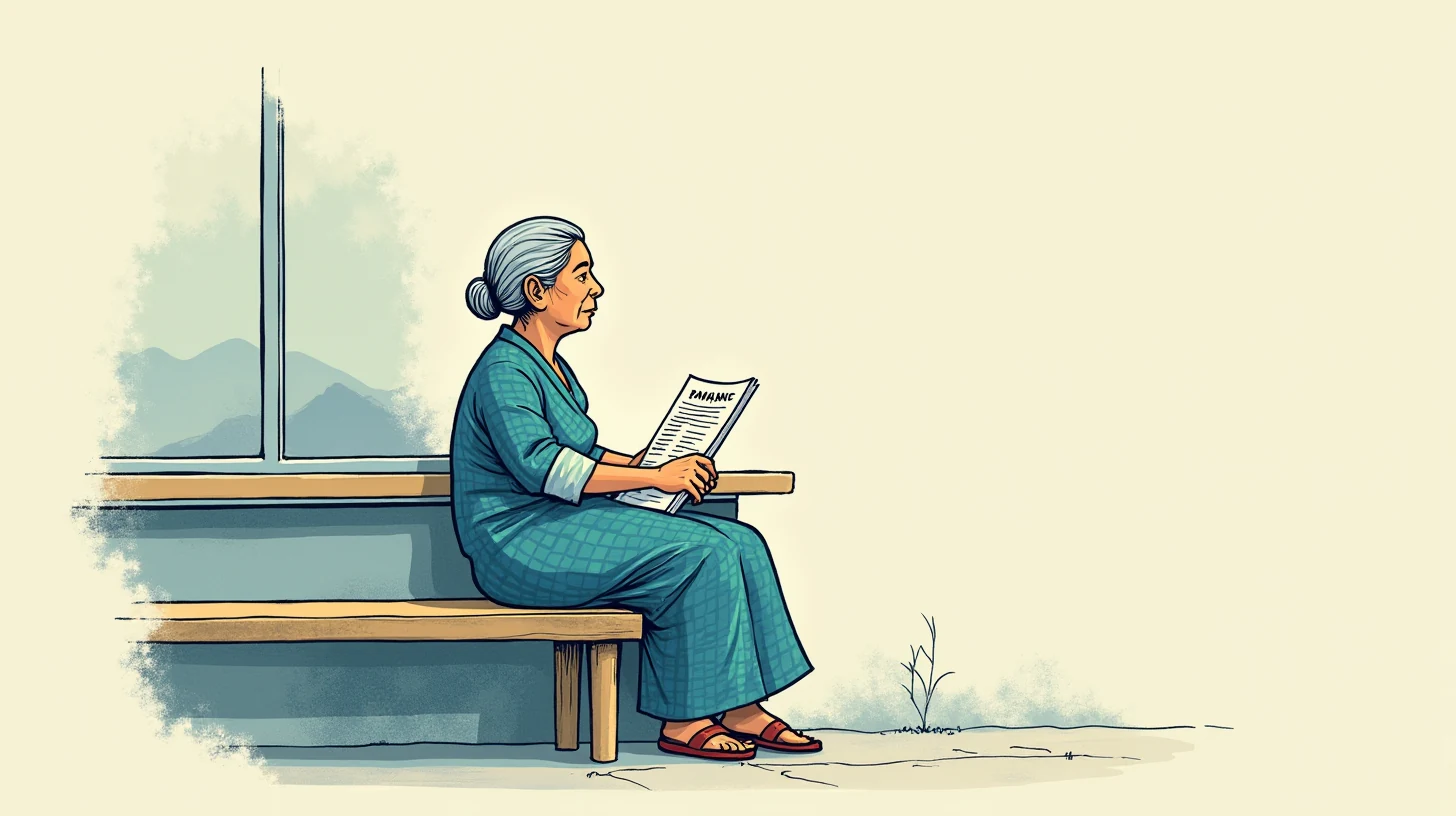
The cardiac arrhythmia diagnosis came on an ordinary Tuesday morning in early 2026. The cardiologist at Shillong Civil Hospital was clear: ablation surgery was needed. Safe, routine, but essential. The estimate landed at ₹1.4 lakh — more than seven months of her pension, money she didn't have. Her daughter Priya, working in Bangalore, had offered to help, but the guilt was immediate and familiar. Margaret had spent three decades telling students that education was their escape. She wasn't going to be the parent who became her child's financial burden.
She decided to exhaust every scheme first.
🗓️ The two health schemes most Shillong residents mix up
Shillong has two major health safety nets. Most people who know about one assume it covers them — and it usually does — until the moment you apply and it doesn't.
MEGHAS (Meghalaya Government Health Assurance Scheme) is the state's flagship scheme for its employees. If you worked for the Meghalaya government — as a teacher, nurse, police officer, administrative staff, or even informal sector workers employed by government-supported programmes — you and your family get cashless hospital care up to defined limits. It's generous within that boundary. The problem is that boundary: private sector workers don't cross it. Teachers at private schools, IT professionals, nurses at private hospitals, self-employed people — all excluded.
PMJAY (Pradhan Mantri Jan Arogya Yojana), also called Ayushman Bharat, is the central government's income-based health scheme. If your family income is below ₹5 lakh per year, you qualify for ₹5 lakh in cashless hospitalisation cover per year at any PMJAY-empanelled hospital — regardless of whether you ever had a government job. Private school teacher? Farmer? Small shopkeeper? Retired factory worker? If your household income is below the ceiling, you're in.
The confusion is understandable. Private school retirees in Meghalaya often assume the state has a universal scheme that covers them. It doesn't. So they apply to MEGHAS first, get rejected, and then — if they're lucky — someone tells them about PMJAY. If they're not lucky, they assume they have no scheme and start selling land.
Margaret did exactly this.
MEGHAS
Margaret ineligibleMeghalaya Government Health Assurance Scheme. For state government employees and pensioners only. Private school teachers do not qualify regardless of income.
PMJAY (Ayushman Bharat)
Margaret eligibleNational scheme, income-based. Families with annual income below ₹5 lakh qualify for ₹5 lakh cashless cover/year. Meghalaya has enrolled 94% of its rural/semi-urban population. Enrollment at any CSC in Shillong.
MEGHAS vs PMJAY: The core difference
| Criterion | MEGHAS | PMJAY |
|---|---|---|
| Who qualifies | Meghalaya state government employees, pensioners, and their families | Any family with annual income below ₹5 lakh (any sector) |
| Employer requirement | Must have worked for Meghalaya government | No requirement; private sector, self-employed, informal all eligible |
| Coverage | Cashless hospitalisation at empanelled hospitals; defined benefit limits | ₹5 lakh per family per year; cashless at PMJAY-empanelled hospitals |
| Enrollment | Through Meghalaya government administrative channels | Through CSCs (Common Service Centres) nationwide; online via pmjay.gov.in |
| Meghalaya coverage | State government workforce only (~2-3% of state population) | 94% of Meghalaya's rural and semi-urban population already enrolled |
| Relevant for private sector retirees | No — will be rejected | Yes — if income below ₹5 lakh |
⚠️ The rejection that felt personal
The rejection letter from the MEGHAS office on Laitumkhrah Road was polite and final: "Your application has been processed. As you are not a government employee or pensioner of the Meghalaya government, you do not meet the eligibility criteria for MEGHAS enrollment."
The officer who handed her the letter — a young woman in a government uniform — didn't volunteer any alternatives. Margaret stood at the window for two minutes, re-reading the same paragraph, waiting for the woman to say something like "but you might qualify for..." or "have you tried..." or even "I'm sorry." She didn't. The officer was already moving her file into a tray for the next applicant.
Margaret walked back to her flat in Laitumkhrah feeling physically smaller. Twenty-eight years of lesson plans, parent-teacher meetings, students who had become engineers and doctors and civil servants — and in the eyes of the Meghalaya health department, none of that made her a qualified human being asking for a cardiac surgery. The ₹1.4 lakh suddenly felt like a question mark placed directly over her survival.
She didn't tell Priya for three days.
"I taught for twenty-eight years. They said I didn't qualify because I taught at a private school. As if where you teach makes you less of a person who needs care."— Margaret Lyngdoh, Shillong
🌗 The right scheme, one CSC away
Three days later, Priya called from Bangalore and asked a question Margaret hadn't thought to ask: "Mummy, have you checked if you qualify for Ayushman Bharat?"
That phone call led Margaret to GabFORGE's agent portal. Within minutes, she had a response:
"MEGHAS is only for Meghalaya state government employees and pensioners — private school teachers don't qualify. But you likely qualify for PMJAY (Ayushman Bharat). If your family income is below ₹5 lakh per year, you are eligible for ₹5 lakh cashless cover per year at any PMJAY-empanelled hospital. Meghalaya has enrolled most of its population in PMJAY already, which means the system is mature here and hospitals know the process well.
Visit the nearest Common Service Centre in Shillong with your Aadhaar card, income certificate (from your last employer, or a self-declaration if you have no recent income), and your spouse's Aadhaar if applicable. The CSC operator will check your SECC database status — Meghalaya is 94% digitised — and if you fall below the ₹5 lakh threshold, you'll be enrolled on the spot. Your PMJAY card will arrive in 3-5 days. With that, any PMJAY-empanelled hospital, including NEIGRIHMS (the major institute in Shillong), will provide your cardiac treatment with zero cost to you, up to ₹5 lakh.
The MEGHAS rejection is not a reflection of your eligibility for health care — it's a reflection of MEGHAS's narrow scope. You fall into PMJAY's scope, and PMJAY's scope is much wider."
Margaret read the response twice, the second time aloud to herself.
The boundary: How private sector retirees get trapped in the wrong scheme
This happens because health schemes are often explained in silos. States like Meghalaya, Punjab, Tamil Nadu, and Karnataka have built flagship government-employee schemes — often named after the state, always generous for the intended population — and these become the "visible" scheme. Everyone knows about MEGHAS. The PMJAY enrollment at CSCs is quieter, less advertised, handled by low-bandwidth infrastructure. The result: educated, literate people like Margaret apply to the scheme they've heard about, get rejected because of an employment category technicality, and never hear about the alternative that would have covered them all along.
The boundary is administrative, not medical. The health problem doesn't change. The need is the same. But which scheme covers you depends entirely on which side of "government employee" you land on.
For private school teachers, nurses, IT professionals, small-shop owners, and informal sector workers in states with government-only health schemes, PMJAY is the pathway. It's means-tested rather than employment-tested, and that makes all the difference.
🧭 Private sector retirees and the scheme confusion
The broader pattern: Private sector retirees in states with government-exclusive health schemes systematically apply to the wrong scheme first. They know the state scheme exists, they assume it covers everyone, they apply, they get rejected on the "not a government employee" criterion, and then they either (a) give up, (b) ask someone who tells them about PMJAY, or (c) struggle.
This is a design gap, not a policy gap. The policy already exists — PMJAY covers them. The communication gap is the problem. Private schools are respected in most Indian cities, but the health system treats them as "outside the circle," and that assumption filters down to retirees who have spent their careers there.
The GabFORGE agent's response had contained a small but crucial phrase: "MEGHAS's narrow scope... PMJAY's scope is much wider." That reframing — from "you don't qualify" to "you qualify for the wider one" — was what Margaret needed. Not sympathy. Not a lecture on how the system should work. Just the fact that her eligibility existed and the pathway was clear.
What it does
- 🔍Distinguishes MEGHAS (government employees only) from PMJAY (income-based, all sectors) and identifies which scheme Margaret qualifies for
- 🏥Locates the nearest CSC in Shillong for PMJAY enrollment and explains what documents to bring
- 📋Confirms that Margaret's cardiac treatment at NEIGRIHMS (an empanelled hospital) is covered under PMJAY
What it does not do
- 🔒Never submits the PMJAY enrollment on Margaret's behalf or accesses her Aadhaar data
- ✅Never confirms coverage in advance — the hospital verifies PMJAY eligibility at the time of admission
🌱 The CSC on Police Bazar Road
On a Thursday morning, Margaret took a printed version of the agent's response and her Aadhaar to the CSC (Common Service Centre) on Police Bazar Road, a small office squeezed between a stationery shop and a mobile recharge counter. The operator there, a young man named Robert Khynthai, had processed PMJAY enrollments for the past two years. He did a quick check — Meghalaya's SECC database pulled her record within seconds, her annual income from the EPFO pension and her savings were well below ₹5 lakh — and he started the enrollment form.
"This will take five minutes," he said. "Your card comes in 3 to 5 days. After that, any hospital in the PMJAY list — I'll give you the list — will treat you without asking for money. Just show your card."
Margaret's cardiac ablation was performed at North Eastern Indira Gandhi Regional Institute of Health & Medical Sciences (NEIGRIHMS) in Shillong four weeks later. The entire ₹1.4 lakh was covered by PMJAY. She paid nothing. She recovered in a private room (covered under the scheme) and was discharged after five days with follow-up prescriptions and a post-operative clearance letter.
Priya flew back to Shillong for her mother's discharge. As they were leaving the hospital, Margaret folded her PMJAY card — now worn from being shown at the billing counter three times — and placed it in her purse next to the MEGHAS rejection letter. She didn't throw the rejection away. Instead, she wrote on the back of it: "Check PMJAY first. CSC on Police Bazar Road. Robert can help."
It was the kind of note a teacher writes. Useful. Calm. Passed on.
Within six months, three other private school retirees in Shillong had gone through the same CSC, asked for Robert, and said Margaret had sent them. Robert started keeping a printed list of PMJAY-empanelled hospitals in Shillong in a folder next to his desk, and he started explaining to private sector retirees exactly what Margaret had learned: MEGHAS will reject you because that's not your scheme, but PMJAY will cover you if your income is below ₹5 lakh, and 94% of Meghalaya is already in it.
The system didn't change. The boundary between government and private sector work didn't shift. But once the information moved from an agent's database to a CSC operator's folder to a community of teachers, the rejection felt less like a judgment and more like what it actually was: a misdirection that could be corrected in five minutes at a counter on Police Bazar Road.
Margaret still gets ₹1,800 a month from the EPFO. The scheme hasn't made her rich. But it's kept her from having to call Priya in Bangalore and ask her to sell something. And that, at 65, with 28 years of teaching behind her, was enough.