
The Surat textile retiree and the higher-pension window
Vinod Patel is sixty-eight years old. He lives on the second floor of a 1990s housing society in Varachha, Surat — the kind of building where the lift creaks but works and the watchman has known every family by name for twenty years. Varachha is not the face of Surat that the tourism brochures use. It is the working back of the city: diamond-polishing units running three shifts, textile wholesale lanes too narrow for two tempo-lorries to pass each other, and a particular understanding that a family which owns a flat rather than rents one has arrived at a certain dignity. The Patels arrived there in 1998, when Vinod put down his second-year bonus from Mafatlal Industries toward a down payment.
He retired in 2018 after thirty-two years as a dyeing-and-processing-unit foreman — seventeen years at Mafatlal Industries Surat, which closed in 2003, and fifteen more at Pratham Textiles in Pandesara. His wife Hansaben, sixty-five, is the family's institutional memory: she keeps a steel-bound register of every wage slip Vinod ever received, every PF statement, every property document, in neat Gujarati handwriting. Their son Harshad runs a diamond-polishing unit in Mumbai; Nilesh runs a textile-trading shop near the Ring Road in Surat; daughter Trisha lives in Vadodara with two children and calls every Sunday evening.
His monthly inflows, when everything works, come to roughly ₹17,000: the EPS-95 pension of ₹4,200 credited to his State Bank account at Varachha branch around the seventh; a PMVVY annuity of ₹3,000 from LIC; and ₹8,500 from a ground-floor shutter he rents to a mobile-accessories shop. Hansaben has an SCSS account at the post office. It is enough. They go to the Swaminarayan temple on Ekadashi, and every Uttarayan Vinod buys good-quality kite string because there are some economies that are not economies at all.
What is unusual is what happened last December when four EPFO SMS arrived on his phone, and Vinod, following a rule his son had drilled into him, ignored every one of them.
🗓️ The annual ritual
In November 2022, the Supreme Court of India ruled that EPF members who had contributed to the EPS-95 scheme on their actual salary — not the statutory ceiling of ₹15,000 — were entitled to pension proportionally higher, and that the denial must be corrected. The Government of India opened a joint declaration window through the EPFO Member Portal. By 2023, a procedure had been established: a member and their current employer submit a joint declaration online, attaching wage evidence, and the EPFO processes the revised pension.
This is, on paper, a straightforward mechanism. For a pensioner who retired in 2018, whose wages between 1986 and 2003 were paid by a company that no longer exists, whose second employer's office has changed hands twice, and whose UAN password has never been changed — it is rather less straightforward.
Vinod had heard about the higher-pension option from three men at his morning chai-stall near Varachha Diamond Market. One had succeeded, after much difficulty. Two had given up. The consensus was that the higher-pension option was not worth the trouble.
- ⚖️
Nov 2022 — Supreme Court ruling
The SC ruled that EPF members who had contributed on actual wages above the statutory ceiling were entitled to a proportionally higher EPS-95 pension. EPFO extended the joint declaration window through 2023.
- 📨
Dec 2025 — EPFO SMS
Four reminders from sender EPFOHO, with a unifiedportal-mem.epfindia.gov.in URL. Harshad had told Vinod to ignore all SMS with URLs. He did.
- 🛑
Jan 2026 — PMVVY stops
The LIC annuity did not credit on the 12th. Stale 2018 mobile number on the Aadhaar-bank linkage. A separate problem — but, as the agent later found, the same root cause.
- ₹
May 2026 — revised pension
₹13,180/month, plus ₹71,000 in arrears from the application date. Eleven weeks after online submission. The difference from ₹4,200: ₹8,980/month for the rest of his life.
He had drawn ₹4,200 a month for seven years. He had organised his arithmetic around it with the patience of a man who had spent three decades routing dye through industrial drums: methodically, with the expectation that the machine will do what it is supposed to do and no more. He did not know, with any precision, what the higher-pension option was worth in rupees. The men at the stall had spoken of the difficulty, not the upside. He had nodded and gone home.
⚠️ What very nearly happened
The first SMS from EPFOHO arrived on a Thursday evening in December 2025 while Vinod was reading Gujarat Samachar on the balcony. It said, in English, that his UAN had been identified as eligible for the Pension on Higher Wages option. There was a URL. He deleted it. Harshad had been very clear, over many calls from Mumbai: do not click, do not visit, do not respond to any SMS with a link. Vinod had absorbed the rule as a reflex rather than a decision. Three more reminders came in January. He deleted all three.
January brought a separate problem. On the twelfth — the day the PMVVY annuity was supposed to arrive — nothing credited. He waited two days, then walked with Hansaben to the LIC branch near Varachha Chowk. The young officer said the issue was an Aadhaar-bank linkage on a mobile number inactive since 2018. Re-verification with the current number was required — a thirty-minute process on a shorter day. The queue was not shorter. They came home without the fix.
That evening Trisha called from Vadodara and mentioned, lightly, that the children had not received their Republic Day gift. She assumed it was delayed in transit. Vinod said nothing. He had set aside ₹3,000 from the PMVVY credit for the gift, and the credit had not arrived.
"ચોપડામાં બધું છે — પણ બધી જગ્યાએ બેસવા જઈ શકું એમ નથી."— Everything is in the register — but I cannot sit at every counter myself.
He did not tell Hansaben about the arithmetic. She would have suggested calling Nilesh, twenty minutes away by auto. He did not want to call Nilesh, because calling Nilesh would have required assembling four uncomfortable facts in front of his son: ignored EPFO SMS on Harshad's instruction, the stopped PMVVY, the missing Republic Day money, a household slightly smaller than the one he managed in his head. None of it was anyone's fault. All of it was uncomfortable. He put the matter off.
What very nearly happened was another month of this. The PMVVY unresolved. The higher-pension window inching toward its administrative end-date. Vinod drawing ₹4,200 while the revised figure — ₹13,180, a number no one had yet told him — existed in an EPFO calculation that was waiting only for him to log in and apply.
🌗 What changed
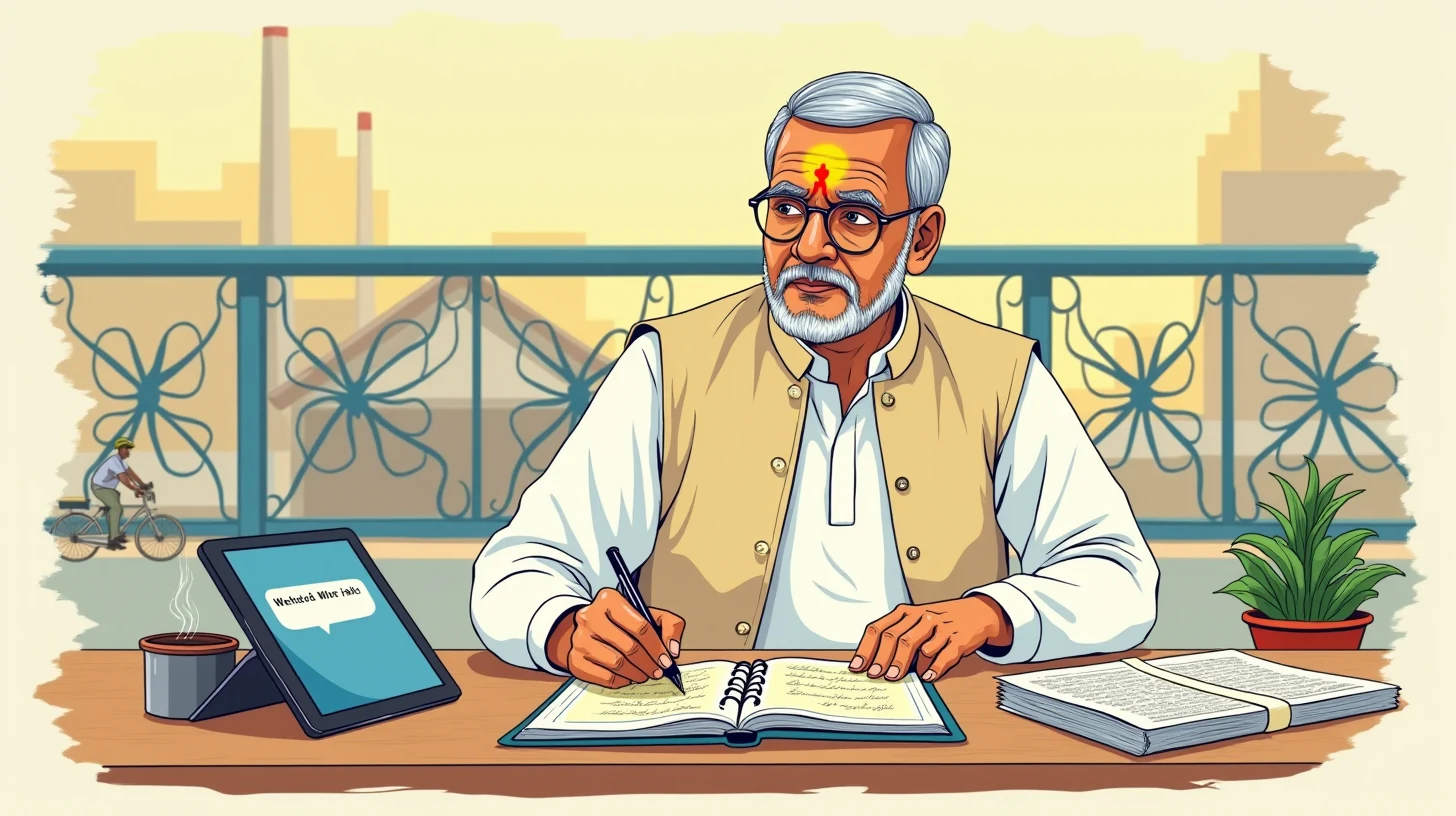
In the first week of February 2026, Hansaben's nephew Jignesh arrived from Ahmedabad for a four-day weekend. He is twenty-four, doing his chartered-accountancy articleship in Prahlad Nagar, with the fluency of young people who move easily between Tally ledgers and WhatsApp forwards. On the first evening, over dal-bhaat on the balcony, he picked up Vinod's old Samsung tablet and saw, in the deleted-message folder, four EPFO SMS from EPFOHO. He said nothing immediately. He installed the AI agent on the tablet, set the language to Gujarati, and on the second evening pulled his chair next to Vinod's at the writing table and handed the tablet across.
"કાકા, આ ચાર SMS EPFOHO ના છે — genuine government SMS છે. ઈ લોકો ક્યારેક ગુજરાતીમાં SMS ન કરે, પણ તમારા નંબર પર આવેલ છે. આ agent ને પૂછો — તમારી lifetime ની pension નો વધારો exactly કેટલો થઈ શકે?"
(Uncle, these four SMS are from EPFOHO — genuine government SMS. They sometimes do not send in Gujarati, but they came to your number. Ask this agent — it can tell you exactly how much your lifetime pension could increase.)
Vinod held the tablet. He typed, in Gujarati, slowly: "આ SMS સાચો છે કે નકલી?" — Is this SMS real or fake?
The agent checked the sender ID EPFOHO against TRAI's registered short codes, cross-checked unifiedportal-mem.epfindia.gov.in, and replied in Gujarati:
"વિનોદ ભાઈ, આ SMS EPFO તરફથી આવેલો સાચો SMS છે — નકલી નહીં. EPFOHO એ official sender ID છે. SMS ની માહિતી પ્રમાણે, તમારા UAN ઉપર Pension on Higher Wages option available છે. તમારો actual last salary ₹38,000 હતો — actual salary પર pension મળી શકે. તમારો revised pension approximately ₹12,000–₹14,000/month, ફરક ₹8,000–₹10,000/month. એક વાર apply કરશો, બાકી જીવનભર આ ફરક મળતો રહેશે."
(Vinod bhai, this SMS is a genuine EPFO message — not fake. EPFOHO is the official sender ID. According to the SMS, the Pension on Higher Wages option is available on your UAN. Your actual last salary was ₹38,000 — you can receive pension on the actual salary instead of the ₹15,000 cap. Your revised pension could be approximately ₹12,000–₹14,000/month — a difference of ₹8,000–₹10,000/month. Once you apply, this difference remains for the rest of your life.)
Vinod read it twice. He read the number — ₹8,000 to ₹10,000 more per month, for the rest of his life — with the slowness of a man whose arithmetic has been fixed at one figure for seven years and has just been told the figure was wrong. He looked at Jignesh. Jignesh nodded once.
The agent walked them through the login. The UAN was on an old Mafatlal wage slip from 2001 — Hansaben found it in four minutes. The password reset required the registered mobile, which hit the same wall: the 2018 Aadhaar-linked number that was also blocking the PMVVY. The agent caught it immediately:
"Password reset માટે registered mobile કામ કરતું નથી — આ same issue છે જે PMVVY રોકી રહ્યો છે. પહેલા UIDAI Aadhaar Seva Kendra જાઓ, mobile update કરાવો — ₹50, 30 minute. પછી both problems solve થઈ જશે."
(The registered mobile is not working for the password reset — this is the same issue blocking the PMVVY. First go to the UIDAI Aadhaar Seva Kendra, update the mobile number — ₹50, 30 minutes. Then both problems are solved.)
Two problems, one fix. Vinod went on a Tuesday morning to the UIDAI Aadhaar Seva Kendra in Athwa Lines. The update took twenty-six minutes and ₹50. He walked out with a receipt the size of a bus ticket that had connected two apparently separate problems into one resolved thread.
UIDAI mobile update
₹50 at Athwa LinesThe 2018 Aadhaar-linked mobile number was blocking both the EPFO password reset and the PMVVY bank-linkage re-verification. One visit, one counter, both unblocked. Root-cause resolution.
PMVVY annuity resumed
₹3,000/month restoredWithin a week of the UIDAI mobile update, LIC's system re-verified the bank linkage. January's missed ₹3,000 was credited as arrears. The Republic Day gift was sent.
EPS-95 higher-pension application
₹13,180/month — eleven weeksApplication submitted online via the 2023 Online Joint Declaration procedure for closed-employer cases, with Mafatlal-period PF statements from Hansaben's register and Pratham Textiles service certificate. EPFO acknowledged within 48 hours. Revised pension credited in May 2026 with eight months of arrears.
The higher-pension application took two more evenings. The complication of Mafatlal Industries — closed since 2003 — turned out to be a known case: the 2023 procedure for closed-employer situations allows the member to self-attest with supporting PF statements, without an employer co-signature. The agent produced a Gujarati checklist: Mafatlal PF statements from Hansaben's register (1986–2003 in neat sequence); Pratham Textiles service certificate from a manila envelope in the almirah; Aadhaar; current bank passbook. All present. The agent walked Vinod through the EPFO portal step by step, each field explained in Gujarati before it was typed.
The application was submitted on a Wednesday evening. EPFO acknowledged within forty-eight hours. Eleven weeks later — within the stated eight-to-twelve-week window — the revised pension arrived: ₹13,180 per month, with ₹71,000 in arrears.
Hansaben made note of it in the register, in the same handwriting she had used for his 1986 wage slips. Vinod folded his Gujarat Samachar, drank his chai, and went downstairs to tell the watchman that the second-floor lift was making a new kind of creak.
🧭 Why we built it
There are, by EPFO's own data, approximately seventy-eight lakh active EPS-95 pensioners in India. Among them, a large and imprecisely counted category who retired on actual wages significantly above the statutory ₹15,000 cap — people for whom the 2022 ruling opened a genuine window worth thousands of rupees per month for the rest of their lives. The fraction who have successfully applied is small, by EPFO's own filings. The majority are not opposed to applying; they are simply still waiting because the application requires a UAN that is accessible, a password that can be reset, an employer that can co-sign or a procedure that covers the case where it cannot, and someone in the household who knows which document in which envelope speaks to which field on which form.
Private-sector retirees — unlike Central Government pensioners — have no pension-welfare officer, no Pension Seva desk tailored to their situation. They have a member portal designed for working-age members, which retains that complexity when the user is sixty-eight. They have EPFiGMS — useful once you know it exists. What they do not have is someone who sits at the writing table on a February evening and says: that sender ID is legitimate, that domain is the real EPFO portal, and your pension could be ₹8,980 more per month for the rest of your life.
The complication Vinod's story illustrates is that the safe behaviour is indistinguishable from the dangerous one. Harshad told his father, correctly, not to click SMS links. This is good advice. It is also why Vinod ignored four legitimate EPFO reminders. The instinct that protects him from phishing is the same one that deleted the notice worth ₹10,000 a month. It succeeds at both, uniformly. That is why it costs so much.
What it does
- 🔍Verifies whether a government SMS is legitimate — checks sender ID, domain, message structure — and explains, in Gujarati, what the message is actually asking and what it is worth financially.
- 🗂️Matches the documents in Hansaben's register to the fields on the EPFO portal — connects a 1992 Mafatlal PF statement to the supporting-document requirement without the pensioner needing to know the connection existed.
- 📞Identifies when two separate problems — a stale PMVVY mobile number and a stale EPFO login mobile — have the same root cause and proposes the single fix that resolves both.
What it does not do
- 🔒Never enters his UAN password, Aadhaar OTP, or net-banking credentials — each field on the portal was typed by Vinod himself, one by one, on the tablet.
- 💳Never submits a form, makes a payment, or files a joint declaration without his explicit confirmation at each screen.
- ✅Never decides which documents to include — it tells him which are required; Hansaben opens the register and finds them.
We built it free. We will keep it free for this user — the retired foreman in a Varachha housing society, with a wife who has kept every wage slip since 1986 and a pension that was ₹4,200 for seven years because four SMS looked identical to a phishing attempt — forever. Private-sector retirees are not a market segment with a corporate training budget. They are a market segment with sons in Mumbai, daughters in Vadodara, and a steel-bound register that has every document but no one to sit with them and read it in the right direction. Harshad will eventually pay for the small things on top — a weekly household digest, a reminder when the PMVVY anniversary approaches, a pension-passbook summary so he knows, without calling, that the numbers arrived. But the core thing — reading the EPFO SMS with him, in Gujarati, on the evening his nephew visits — is, and will remain, free.
🌱 What we hope happens
Jignesh sent us a message in early May, a few days after the ₹13,180 pension arrived. He said his uncle had not changed his manner; that was not the point. The point was that on the last morning of the visit, as Jignesh was zipping his bag, Vinod had called from the balcony — not loudly, in the register of someone reporting rather than announcing — that the EPFO website had shown him where to file a grievance if the revised pension was wrong, and that he had bookmarked it. He had been a foreman for thirty-two years, Jignesh said; he had always checked the output before signing the shift sheet.
Which is what we hoped this would be. Not a rescue. Not a son home for the weekend to decode the government. Just a tablet on the writing table, set to Gujarati, that reads the SMS before Vinod deletes it and says: the sender ID is legitimate, the domain is the real portal, the number waiting for you is ₹13,180.
There is a specific kind of missed money in Indian elder life that does not announce itself. Nobody took anything. The Supreme Court ruled in Vinod's favour in 2022. The EPFO sent four reminders. The portal worked. The register had every document. The gap was two months of careful, well-intentioned deletion. For the ones whose sons told them not to click links — which is most of the good sons — the window is open and invisible at the same time.
If you have a parent in a similar situation — an EPS-95 pensioner, a private-sector retiree, anyone whose pension was capped below their actual salary and who has not yet applied — the product is free at gabforge.in. We have native Gujarati, Hindi, Marathi, Bengali, Tamil, Telugu, Kannada, Malayalam, Punjabi, Odia, and Assamese, and the routing knows the EPFO's UAN procedures, the PMVVY helpline, and the UIDAI Seva Kendra locations across India. You can set it up on a tablet in twenty minutes. We will not advertise to your father. We will not sell his UAN. We will read the SMS with him — all four of the ones he deleted — and we will be quiet.