
The Shimla trek vlogger and the forest drone permit
Devraj Thakur is twenty-six years old and lives in a first-floor room in Sanjauli, a dense hillside neighbourhood in South Shimla where the houses stack three and four storeys up the slope and the streets are narrow enough that neighbours pass morning tea through adjacent windows. He moved to Sanjauli from Rampur Bushahr, two hours away, four years ago — first to study, then to stay, because Shimla is the nearest city with a reliable 4G upload speed and enough tourism to justify what he does for a living. What he does for a living is trek, film, and edit. His YouTube channel, Pahaadi Frames, has 2.9 lakh subscribers. The format is simple: he hikes a Himachal trail alone, shoots four to six hours of footage including drone aerials, and edits it down to twenty-five minutes with Hindi-Pahari commentary and a tracking shot of the dawn from the ridge. Triund, Hampta Pass, Kheerganga, Chandratal — these are the backdrops of his most-watched videos. Some are famous. One Hampta Pass video has thirty-two lakh views.
His income in the financial year ending March 2026 came to approximately ₹7.2 lakh: AdSense revenue of ₹2.8 lakh, brand collaborations with two trekking-gear labels totalling ₹2.6 lakh, and a channel membership cohort of eight hundred subscribers at ₹99 per month. He works alone on most shoots, with occasional help from one or two fellow trek-leader friends in Dharamshala who join longer expeditions. He owns a DJI Mini 4 Pro drone, a Sony ZV-E10 camera, a Shimano hiking kit, and a four-year-old Redmi laptop that is still fast enough to run DaVinci Resolve if he closes everything else. He has no studio, no manager, and no insurance — which mattered very much on an August afternoon on the Triund ridge.
The ridge at Triund sits at 2,828 metres above sea level, on the edge of the Great Himalayan National Park buffer zone, inside the Kangra Forest Division of Himachal Pradesh. It is one of the most photographed stretches of trail in North India: a three-and-a-half hour climb from Mcleod Ganj, a wide grassy saddle, and then the Dhauladhar wall rising behind it in a near-vertical sweep that turns gold at dusk and grey at dawn. Devraj had been there six times before. He knew the trail as well as he knew the inside of his own editing timeline.
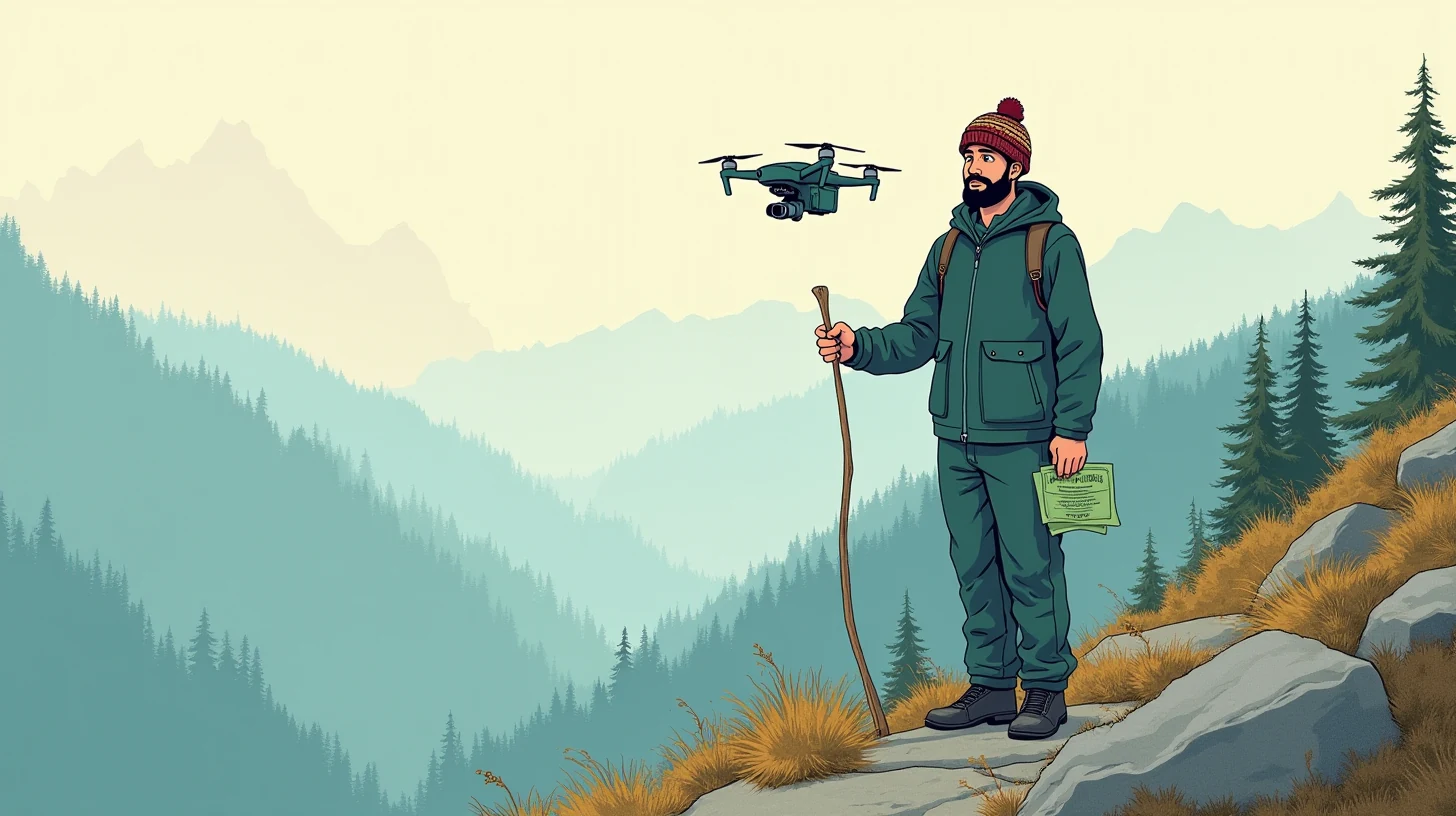
What he did not know, with any precision that August morning, was that the buffer zone of the Great Himalayan National Park is a protected forest under both the Indian Forest Act 1927 and the Wildlife Protection Act 1972 — and that flying a drone there without a permit was simultaneously a forest offence, a wildlife protection offence, and an unlicensed airspace operation under DGCA's drone rules. He launched the drone at 7:12 a.m., on the Triund meadow's western edge, in clear sky with no other trekkers near him. Sixty-two seconds into the flight, a wind shear from the Dhauladhar face hit the aircraft from the northwest. The controller showed a signal break of four seconds. The drone did not recover. It came down on the limestone slabs eleven metres below the launch point, the port arm snapped at the joint, the camera gimbal cracked. A forest guard from the Kangra Forest Division was on patrol two hundred metres down the ridge.
🗓️ The legal framework Devraj did not know existed
The Indian Forest Act of 1927 — one of the oldest pieces of environmental legislation still in force in India — classifies forests into reserved forests and protected forests, establishes what activities require permission inside them, and sets out the mechanism for compounding offences under Section 68. The Wildlife Protection Act of 1972 goes further: it establishes national parks and wildlife sanctuaries (Schedule I through VI), prohibits entry into core zones without permits (Section 27), and creates a prosecution mechanism for violations that includes imprisonment and fines (Section 51). The Great Himalayan National Park is a UNESCO World Heritage Site and a Schedule I protected area under the WPA. Its buffer zone — which includes the upper Triund meadow — is managed under a separate but linked framework: the HP State Forest Manual, which requires that any commercial filming, including drone footage intended for monetised content, be approved by the Deputy Conservator of Forests before the shoot.
The DGCA layer added a third dimension. Under the Drone Rules 2021 and the associated airspace map on the Digital Sky platform, Triund falls within a Yellow zone: flights are permitted, but only with prior Digital Sky permission obtained through the NPNT (No Permission No Takeoff) system. Devraj's DJI Mini 4 Pro was not registered on the Digital Sky platform. He had not applied for a Yellow zone flight plan. He had no Unmanned Aircraft Operator Permit and no UAS operator ID. The drone was, from the DGCA's perspective, an unregistered aircraft operating in a controlled zone without authorisation.
- ⚖️
Indian Forest Act 1927 — Section 26 + Section 68
Section 26 prohibits unauthorised entry and commercial activity in reserved and protected forests. Section 68 allows the Forest Officer to compound (settle) the offence by accepting a fee in lieu of prosecution — the ₹15,000 compounding offer Devraj received was under this provision. Compounding is discretionary; the officer can also refer upward.
- ⚖️
Wildlife Protection Act 1972 — Section 27 + Section 51
Section 27 prohibits entry into a national park (including buffer zones) for any purpose without written permission from the Chief Wildlife Warden. Section 51 sets the penalty: imprisonment up to three years and/or a fine up to ₹25,000 for a first offence, doubled for repeat offences. The Range Officer's refer-up threat invoked this section.
- 📋
HP State Forest Manual — Filming Permission
Commercial filming in HP forest divisions (including drone footage for monetised YouTube channels) requires a prior application to the Divisional Forest Officer, a shoot schedule, a security deposit, and in some cases a forest escort. The process takes seven to fourteen working days. Walk-in shoots are not permitted.
- 📱
DGCA Drone Rules 2021 — Digital Sky / NPNT
Triund ridge is a Yellow zone on the Digital Sky airspace map. All UAS flights require prior Digital Sky permission and NPNT compliance. Unregistered drones cannot legally fly in Yellow zones; the operator's UAS ID and flight plan must be approved before takeoff.
None of this was signposted on the trail. There is no sign at the Triund campsite that says: buffer zone, WPA applies, drone permit required. The trailhead at Gallu Devi has a Kangra Forest Division notice board, but it lists entry hours and fire rules, not filming regulations. Every year, dozens of creators climb Triund, launch drones on the meadow, and climb back down. Most encounter nothing. Devraj encountered a forest guard on his sixth visit who happened to be on patrol at 7:12 a.m.
⚠️ What very nearly happened
The forest guard, Ramesh, was unhurried. He waited while Devraj retrieved the broken drone from the limestone and then asked, in Pahari, whether he had the filming permit. Devraj said, in Hindi, that he did not know he needed one. Ramesh asked whether the channel was commercial. Devraj said yes — there were sponsors. Ramesh wrote in his patrol notebook and said that unauthorised commercial filming in a protected zone was an offence under the Indian Forest Act and the Wildlife Protection Act. He said he could offer a compounding of ₹15,000 on the spot, which would settle the IFA matter, but that the WPA component — flying without written permission from the Chief Wildlife Warden inside the GHNP buffer zone — was above his authority to compound. He said he would have to report it to the Forest Range Officer, who could either close the matter or forward it for formal prosecution.
Devraj paid ₹15,000 on the spot — cash from his trail bag, as always, for emergency contingencies — and walked down the hill with the broken drone in his daypack and a handwritten compounding receipt. The WPA referral did not happen: the Range Officer, on review, treated the IFA compounding as sufficient given the first offence and the absence of wildlife disturbance. But Devraj did not know this for eleven days, during which he received no response to his follow-up messages, had no legal counsel, and no clear sense of whether a notice was coming.
The DJI Mini 4 Pro had cost ₹79,999 at Croma in Shimla. The gimbal replacement alone — on a drone the repair centre said was not economical to fix — was ₹38,000. He bought a replacement unit for ₹85,000. The total cash drain from the August morning: ₹1,00,000. Against a monthly income of roughly ₹60,000.
"परमिट दी जानकारी नीं थी — तेनूँ पता होता तां कदे नीं उड़ाता। पर तेनूँ पता कित्थे होंदा?"— I didn't know about the permit — if I'd known, I would never have flown. But where was I supposed to find out?
The insurance gap was total. Devraj had no drone hull insurance — he had checked once, found the products confusing and expensive, and made a mental note to look again later. He had no third-party liability cover, which would have been relevant if the falling drone had struck another trekker or caused property damage. He had no professional indemnity policy, which some creator contracts now require for on-location shoots. He had no equipment cover under a general business policy because his business had no registered structure — he operated as an individual, filing ITR-3, with no LLP or proprietorship that would allow a commercial equipment policy. The ₹85,000 came out of savings that had taken eleven months to accumulate.
What very nearly happened — beyond the financial hit — was formal prosecution under Section 51 of the Wildlife Protection Act, with imprisonment and a penalty that would have closed the channel while the case worked through the Kangra Sessions Court. It did not happen because Ramesh was on his first patrol of the week and had latitude to offer compounding, and because the Range Officer was busy enough and inclined enough to leave it at that. These were accidents of geography and administration, not legal protections.
🌗 What changed
Three weeks after the Triund incident, Devraj was in Dharamshala for a weekend shoot with Karan Mehta — a trek leader who runs altitude treks out of Mcleod Ganj and occasionally appears in Devraj's longer videos. Karan is thirty-one, methodical, and had been through a similar but smaller incident at Bir Billing the previous year — an unnamed official had stopped him mid-shoot and demanded he show a filming permit. He had no permit either, but the terrain was outside a protected zone, so the matter ended with a stern warning. It had been enough to make him careful. He had since looked up the HP Forest Department portal, gotten a filming permit for two separate shoots, and registered his drone on Digital Sky.
On the drive back from Indru Pass, Karan mentioned that he had used a GabFORGE agent to navigate the permit process — his Dharamshala trek community's WhatsApp group had shared it a month earlier. Devraj installed it that evening in the Mcleod Ganj dhaba where they stopped for chai.
He typed, in Hindi: "Triund mein drone uraya bina permit ke — forest guard ne ₹15,000 maanga, WPA ke under notice ka darr tha. Ab permit kaise milega aur drone ka insurance kaise karu?"
"देवराज, तुम्हारा मामला दो अलग-अलग क़ानूनी ढाँचों में एक साथ आता है — Indian Forest Act 1927 की Section 26 और Wildlife Protection Act 1972 की Section 27। Triund का ऊपरी हिस्सा Great Himalayan National Park का buffer zone है, इसलिए दोनों लागू होते हैं। Forest Range Officer ने WPA refer नहीं किया — यह तुम्हारे लिए अच्छा रहा। आगे के shoots के लिए तुम्हें तीन चीज़ें चाहिए: पहला — hpforest.gov.in पर Divisional Forest Officer को filming permit application, जिसमें shoot schedule, drone model, और commercial intent declare करना होगा; दूसरा — DGCA का digitalsky.dgca.gov.in पर UAS registration और Triund क्षेत्र के लिए Yellow zone flight plan permission; तीसरा — drone hull insurance जो IRDAI-registered products के ज़रिए मिलती है — कुछ aviation underwriters ₹12,000–₹18,000 सालाना में ₹1 लाख hull cover देते हैं, third-party liability के साथ।"
(Devraj, your situation falls simultaneously under two separate legal frameworks — Section 26 of the Indian Forest Act 1927 and Section 27 of the Wildlife Protection Act 1972. The upper Triund area is the buffer zone of the Great Himalayan National Park, so both apply. The Forest Range Officer chose not to refer it under the WPA — that was fortunate for you. For future shoots you need three things: first — a filming permit application to the Divisional Forest Officer on hpforest.gov.in, declaring your shoot schedule, drone model, and commercial intent; second — UAS registration and a Yellow zone flight plan permission on DGCA's digitalsky.dgca.gov.in for the Triund area; third — drone hull insurance through IRDAI-registered products — some aviation underwriters offer ₹1 lakh hull cover at ₹12,000–₹18,000 per year, with third-party liability included.)
Devraj read it twice, then asked the agent to walk him through the HP Forest filming permit application. The agent pulled up the hpforest.gov.in portal structure — the application was to be addressed to the Deputy Conservator of Forests (Wildlife), Kangra Division, in Dharamshala — and explained what to include: channel name, subscriber count, commercial nature of the shoot, proposed drone model and registration number, proposed dates, and the specific forest compartments. Processing time: seven to fourteen working days, with a security deposit of ₹2,000 to ₹5,000 depending on the shoot scope.
The Digital Sky registration took twenty-five minutes. The DJI Mini 4 Pro, at 249 grams, qualifies as a Green category UAS under the Drone Rules 2021 — which means it does not need a UAS Type Certificate, only operator registration and a flight plan for Yellow zones. The agent walked Devraj through the registration form, the UAS ID application, and the Yellow zone flight plan for his next Triund shoot.
The insurance took longer. The agent identified three IRDAI-registered products available to individual drone operators: a hull-and-third-party policy from an aviation underwriter that covered craft up to ₹2 lakh at ₹16,500 annually; a marine-cargo extension available through one general insurer that covered transit damage but not in-flight crash; and a newer product specifically designed for commercial UAS operators that included public liability of ₹25 lakh alongside ₹1 lakh hull cover at ₹14,200 per year. Devraj chose the third.
HP Forest filming permit
₹2,000–₹5,000 deposit + 7–14 daysApplication to the Divisional Forest Officer (Wildlife), Kangra Division via hpforest.gov.in. Covers commercial filming including drone aerials in protected forest areas. Required separately for each shoot in GHNP and other HP wildlife divisions. The permit specifies approved compartments and dates.
DGCA Digital Sky UAS registration
₹100 fee + 25 minutesRegister the drone as a Green (under 250g) or Yellow category UAS on digitalsky.dgca.gov.in. Obtain a UAS operator ID. For Yellow zone flights (like Triund ridge), file a flight plan per shoot and receive NPNT approval before takeoff. One-time registration, per-flight plans.
Drone hull + public liability insurance
₹14,200–₹16,500/yearIRDAI-registered aviation underwriters offer individual UAS policies covering hull damage (₹1–2 lakh) and third-party public liability (₹25 lakh). Required for any commercial shoot; increasingly demanded by brand partners and essential if the drone falls on another person or damages property.
🧭 Why we built it
There are, by conservative estimates, four to five thousand Indian trek and adventure creators who fly drones in the Himalayas, Western Ghats, and Northeast. The subset who have a DGCA UAS registration, an HP Forest filming permit, and a drone insurance policy is small — probably in the hundreds. The majority are in the position Devraj was in: they know the airspace rules exist, vaguely, and they know permits are probably required, and they fly anyway because the chance of encountering an enforcement moment on any given day is low.
The chance is low until it is not. The Indian Forest Act's compounding mechanism under Section 68 gives field officers discretion to settle for cash — which means the forest guard who is in a good mood on a Tuesday lets the creator walk, and the forest guard who is meticulous on a Thursday writes it up. The Wildlife Protection Act's Section 51 prosecution pathway, if triggered, does not care about subscriber counts or good intentions: it provides for imprisonment up to three years. The Range Officer who decides whether to compound or prosecute is exercising professional judgment, not applying a scale of severity. Devraj was fortunate. He was also, until the morning of the incident, unaware that fortune was the mechanism in operation.
The insurance gap compounds everything. A DJI Mini 4 Pro that costs ₹79,999 and crashes once every three years costs the uninsured creator ₹26,666 per year in expected replacement cost — more than the annual premium on a hull policy. But the purchase behaviour follows the wrong mental model: the drone feels bought-and-owned, and insurance feels like a recurring cost on something that is not broken. It is not broken until the wind shear hits on the Dhauladhar face.
Trek creators are not a large market in absolute numbers. They are a small, specific, geographically concentrated group who face a compliance problem that does not appear in any creator-economy explainer, any YouTube creator monetisation guide, or any chartered accountant's checklist. The intersection of forest law, wildlife protection law, drone airspace regulation, and IRDAI insurance products does not map neatly onto any single adviser's domain. It is the kind of problem that requires someone to sit with the whole picture at once — and explain it in the dhaba in Mcleod Ganj on a Tuesday evening, before the next shoot.
🌱 What we hope happens
Karan messaged us a month after Devraj's permit came through. He said Devraj had shot his next Triund video — the first time he had been back to the ridge since August — with the permit in his daypack, the DJI registered on Digital Sky, and the flight plan approved before launch. He said the video did better than the original Triund video from two years ago. The thumbnail was the same as always: the Dhauladhar wall, first light, a drone shot of the meadow from seventy metres above. The only difference was the permit slip photographed in the corner of the closing frame.
We built this because the compliance knowledge that every trek creator needs exists — it is on hpforest.gov.in, it is on indiacode.nic.in, it is on digitalsky.dgca.gov.in. But it is distributed across three separate government portals in three separate bureaucratic vocabularies, none of which speaks to creators directly. The HP Forest Manual does not have a chapter titled "What YouTube creators need to know." The DGCA Drone Rules 2021 are thorough and clearly written, but only if you know they apply. The IRDAI insurance product registry lists UAS products, but finding them requires knowing to search for "aviation underwriter" rather than "drone insurance."
What the agent does is connect the three. It does not do the trekking. It does not do the filming. It does not decide whether the Triund shot is worth the permit wait. Devraj does all of that. The agent reads the regulations with him — the parts that are dry and procedural and critical — so that the next wind shear costs a battery replacement, not a trip to the Range Officer's office and eleven days of silence.
If you are a trek creator in Himachal Pradesh — or in Uttarakhand, Sikkim, Arunachal Pradesh, any high-altitude state with protected forest zones — the agent is free at gabforge.in. We support Hindi, Pahari, Punjabi, and the other major languages of the hills. We know the HP Forest filming permit process, the Digital Sky registration flow, and the IRDAI drone insurance landscape. We will not advertise to your subscribers. We will not keep your permit documents. We will read the forest rules with you — the ones no trail signpost mentions — and we will be quiet.
More from devraj
The Vijayawada Telugu storytime channel and the ITR-3 vs 44ADA bind
Sahithi Vemuri is thirty years old. She lives with her parents in a two-story house in Patamata, a middle-class neighbourhood in western Vijayawada, close enough to the Krishna river that on foggy December mornings the mist reaches the rooftop and turns the upstairs balcony into something from a folk tale she might use. That particular atmospheric quality is, in a sense, an occupational resource: Sahithi runs a YouTube channel called Ammayya Kathalu — roughly, "Mother's Stories" — that publishes Telugu-language folk tales for children between three and ten years old, in a voice-acting style that uses no animators, no puppets, and no English. Just Telugu, in Sahithi's own voice, playing all the characters: the cunning jackal, the slow-moving tortoise, Birbal's measured wit, the village grandmother who knows the way through every dilemma.
A ₹2.1 lakh tax demand. The agent read the notice in Telugu.
🎙️ Sahithi Vemuri, 30, voices Panchatantra tales, Akbar-Birbal stories, and Andhra regional folk tales in Telugu from her home in Patamata, Vijayawada. Her channel Ammayya Kathalu has 4.8 lakh YouTube subscribers and three lakh Instagram followers — parents across Andhra Pradesh play her episodes to put their children to sleep. For FY 2024-25, she earned ₹17.7 lakh: ₹9.4 lakh from YouTube AdSense, ₹7.2 lakh from six brand collaborations, and ₹1.1 lakh in Instagram creator-fund payouts. Her CA filed ITR-4 under Section 44ADA with profession code 16019, claiming 50% presumptive income. In March 2026, a Section 143(1)(a) intimation arrived at 11:22 p.m. — the department had reclassified her income as business receipts, disallowed the 44ADA deduction, and issued a demand for ₹2.1 lakh in additional tax plus interest.
The Srinagar Pashmina creator and the GI tag and KCC scheme
Roohi Wani is thirty-five years old. She lives in Rajbagh, the quiet residential quarter on the western shore of Dal Lake where the houses have proper lawns and the lanes are wide enough for two cars — a neighbourhood that Srinagar people describe with a mix of aspiration and matter-of-factness, the way cities describe the part where professionals settle when they stop renting. Her workroom is on the ground floor, a north-facing room with good diffused light that she chose specifically for the loom: a big traditional wooden frame, nearly two metres across, strung with fine pashmina warp threads so pale they read as white until the afternoon sun catches them and shows the thread as gold. The room smells of raw fibre and the lanolin that clings to undyed pashmina yarn even after three weeks of sorting.
Quick read: Srinagar Pashmina creator and the GI tag and KCC scheme
Two envelopes arrived the same week in February 2026. One was from the Kashmir Chamber of Commerce, forwarding a GI infringement notice under Section 22 of the Geographical Indications of Goods (Registration and Protection) Act, 1999 — citing her Shopify listings and three Instagram Reels that used "Kashmiri Pashmina" without a CDI authorized-user mark. The other was from J&K Bank Rajbagh, about a Kisan Credit Card application for her cooperative that had been sitting half-complete for three months. Both envelopes sat on the table beside her loom for four days before she opened them.
The Shimla trek vlogger and the forest drone permit — quick read
The Triund meadow does not tell you it is inside a protected zone. The signboard at the trailhead lists fire rules, not filming regulations. Devraj found out the hard way.
The Shillong indie-music creator and the DPDPA Telegram fan group
Badaplin Mawphlang is twenty-seven years old. She lives in a second-floor rented room on a steep lane off Laitumkhrah Main Road in Shillong, the kind of lane where the houses lean into each other across a gap barely wide enough for a loaded delivery motorbike. Her window faces a red-tin-roofed building with a water tank and a television satellite dish — not scenic, but she chose the room for the light in the afternoon, which comes from the west during monsoon and turns the plaster walls the colour of weak tea. She has lived there for two years, since she left her parents' house in Nongthymmai to be closer to the rehearsal studio she uses twice a week near Police Bazar.