
Quick read: Srinagar Pashmina creator and the GI tag and KCC scheme
Two envelopes arrived the same week in February 2026. One was from the Kashmir Chamber of Commerce, forwarding a GI infringement notice under Section 22 of the Geographical Indications of Goods (Registration and Protection) Act, 1999 — citing her Shopify listings and three Instagram Reels that used "Kashmiri Pashmina" without a CDI authorized-user mark. The other was from J&K Bank Rajbagh, about a Kisan Credit Card application for her cooperative that had been sitting half-complete for three months. Both envelopes sat on the table beside her loom for four days before she opened them.
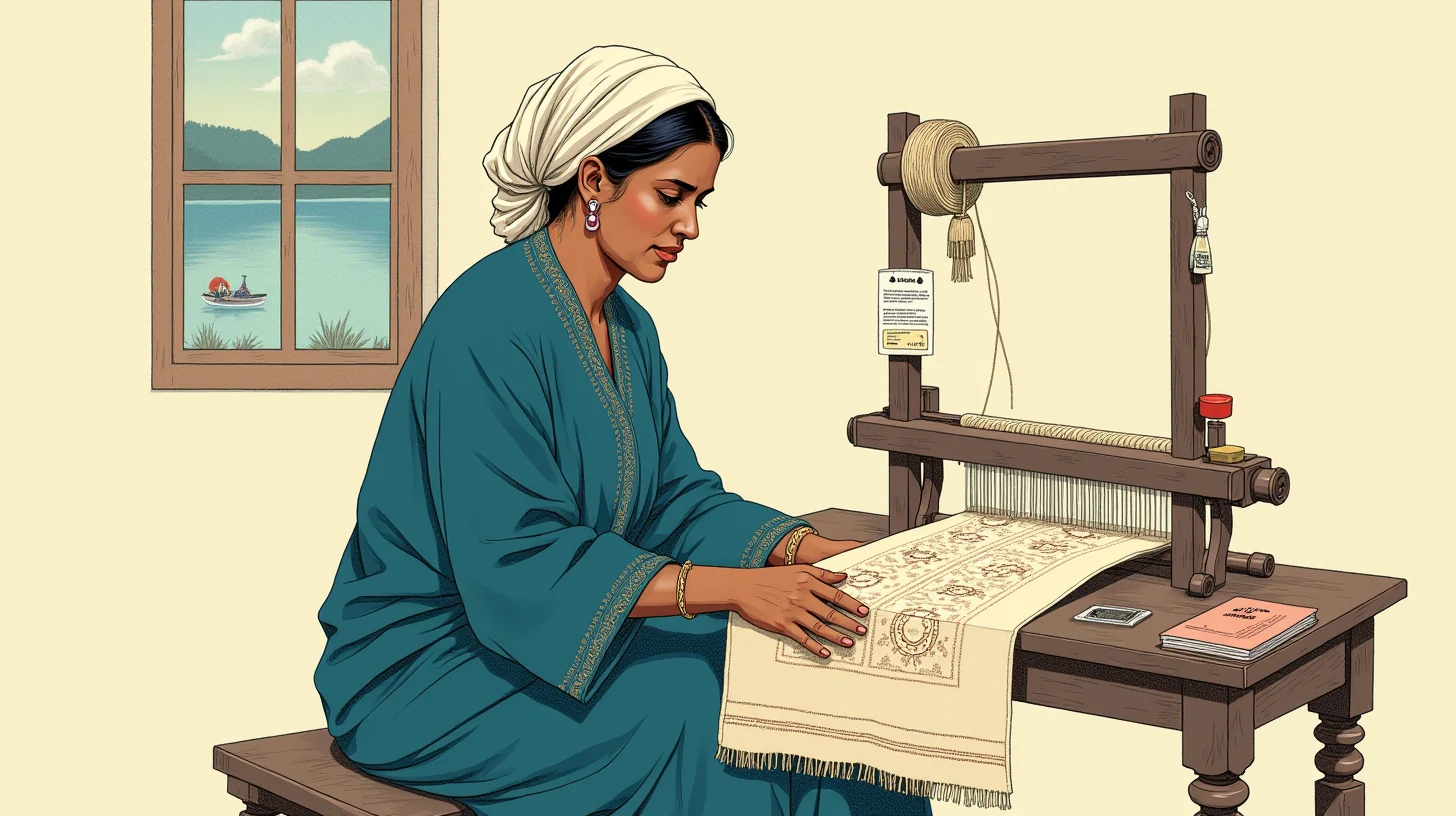
🧣 Roohi Wani, 35, Pashmina creator in Rajbagh, Srinagar — 120k Instagram, 55k YouTube. Fourteen-woman weaving cooperative near Dal Lake. Sells genuine Pashmina shawls from ₹6,800 to ₹1,24,000 on Shopify and Instagram. Four years of reels on natural dyeing, sozni embroidery, and the Changthang-to-Srinagar supply chain. Every piece real. Every listing, technically, an infringement.
🚨 The problem
Kashmiri Pashmina holds GI Registration No. 46, granted in 2008 — one of India's earliest GI grants under the 1999 Act. The Crafts Development Institute (CDI), Srinagar, is the designated inspection body. Any producer who commercially describes their product as "Kashmiri Pashmina" without CDI authorized-user status is liable under Section 22 of the GI Act — injunction, damages, and seizure of goods. Roohi had never known the authorized-user system was a formal legal registration, not a passive quality label.
Separately, the KCC handicraft extension (2018-19, under NABARD refinancing) offered her cooperative's fourteen members up to ₹3 lakh each — a total ₹42 lakh working-capital facility at an effective 4% interest after subvention. She had picked up the form in November. The missing piece: artisan identification cards for three weavers, a gap no one at the bank branch had flagged.
🚀 How GabFORGE helped
Her cooperative's anchor weaver had a nephew, Imtiyaz, who had just joined CDI Srinagar. He brought the agent on his phone to Nowgam on a Sunday afternoon.
- Identified the CDI pathway in full — Form GI-AUTH-02 at CDI Srinagar, parallel Section 17 application to the GI Registry Chennai, and an interim undertaking to the Kashmir Chamber that stays the infringement proceedings while the inspection runs
- Matched existing documents to the form — her J&K Handicrafts Department cooperative registration certificate and Changthang fibre sourcing declaration covered most of the CDI requirements already on hand
- Named the KCC gap — three weavers lacked artisan identification cards; the agent walked through the J&K Handicrafts Department online registration at kashmir.gov.in and the cards were applied for the same week
- Both applications filed in parallel — CDI inspection logged and KCC application submitted to J&K Bank Rajbagh within one week of the Nowgam Sunday visit
✅ What happened
CDI inspection completed in six weeks — all three shawls passed. GI Registry authorized-user certificate issued. Kashmir Chamber closed the infringement proceeding. Shopify listings restored with CDI Pashmina Mark batch numbers in each product description.
KCC appraisal by J&K Bank confirmed NABARD refinancing eligibility. Disbursement pending in the week Imtiyaz sent his April message — but the application was complete, the weaver payments would no longer be delayed, and the raw-fibre purchase for the summer run would not come from current revenue.
🇮🇳 Why this matters
Every Kashmiri craft creator selling online is in the same unlit junction. The GI authorized-user system for Pashmina has been active since 2008, enforced by an inspection body with a formal form number and a designated portal — and almost none of the 14,000-odd weavers and cooperatives in the Valley have filed it. The KCC handicraft extension has been available since 2018-19, with NABARD refinancing and a 4% effective rate, and the document gap that blocks most applications is one artisan card. The infringement came for the creator who was most genuinely selling the real thing.
More from roohi
The Vijayawada Telugu storytime channel and the ITR-3 vs 44ADA bind
Sahithi Vemuri is thirty years old. She lives with her parents in a two-story house in Patamata, a middle-class neighbourhood in western Vijayawada, close enough to the Krishna river that on foggy December mornings the mist reaches the rooftop and turns the upstairs balcony into something from a folk tale she might use. That particular atmospheric quality is, in a sense, an occupational resource: Sahithi runs a YouTube channel called Ammayya Kathalu — roughly, "Mother's Stories" — that publishes Telugu-language folk tales for children between three and ten years old, in a voice-acting style that uses no animators, no puppets, and no English. Just Telugu, in Sahithi's own voice, playing all the characters: the cunning jackal, the slow-moving tortoise, Birbal's measured wit, the village grandmother who knows the way through every dilemma.
A ₹2.1 lakh tax demand. The agent read the notice in Telugu.
🎙️ Sahithi Vemuri, 30, voices Panchatantra tales, Akbar-Birbal stories, and Andhra regional folk tales in Telugu from her home in Patamata, Vijayawada. Her channel Ammayya Kathalu has 4.8 lakh YouTube subscribers and three lakh Instagram followers — parents across Andhra Pradesh play her episodes to put their children to sleep. For FY 2024-25, she earned ₹17.7 lakh: ₹9.4 lakh from YouTube AdSense, ₹7.2 lakh from six brand collaborations, and ₹1.1 lakh in Instagram creator-fund payouts. Her CA filed ITR-4 under Section 44ADA with profession code 16019, claiming 50% presumptive income. In March 2026, a Section 143(1)(a) intimation arrived at 11:22 p.m. — the department had reclassified her income as business receipts, disallowed the 44ADA deduction, and issued a demand for ₹2.1 lakh in additional tax plus interest.
The Srinagar Pashmina creator and the GI tag and KCC scheme
Roohi Wani is thirty-five years old. She lives in Rajbagh, the quiet residential quarter on the western shore of Dal Lake where the houses have proper lawns and the lanes are wide enough for two cars — a neighbourhood that Srinagar people describe with a mix of aspiration and matter-of-factness, the way cities describe the part where professionals settle when they stop renting. Her workroom is on the ground floor, a north-facing room with good diffused light that she chose specifically for the loom: a big traditional wooden frame, nearly two metres across, strung with fine pashmina warp threads so pale they read as white until the afternoon sun catches them and shows the thread as gold. The room smells of raw fibre and the lanolin that clings to undyed pashmina yarn even after three weeks of sorting.
The Shimla trek vlogger and the forest drone permit
Devraj Thakur is twenty-six years old and lives in a first-floor room in Sanjauli, a dense hillside neighbourhood in South Shimla where the houses stack three and four storeys up the slope and the streets are narrow enough that neighbours pass morning tea through adjacent windows. He moved to Sanjauli from Rampur Bushahr, two hours away, four years ago — first to study, then to stay, because Shimla is the nearest city with a reliable 4G upload speed and enough tourism to justify what he does for a living. What he does for a living is trek, film, and edit. His YouTube channel, Pahaadi Frames, has 2.9 lakh subscribers. The format is simple: he hikes a Himachal trail alone, shoots four to six hours of footage including drone aerials, and edits it down to twenty-five minutes with Hindi-Pahari commentary and a tracking shot of the dawn from the ridge. Triund, Hampta Pass, Kheerganga, Chandratal — these are the backdrops of his most-watched videos. Some are famous. One Hampta Pass video has thirty-two lakh views.
The Shimla trek vlogger and the forest drone permit — quick read
The Triund meadow does not tell you it is inside a protected zone. The signboard at the trailhead lists fire rules, not filming regulations. Devraj found out the hard way.
The Shillong indie-music creator and the DPDPA Telegram fan group
Badaplin Mawphlang is twenty-seven years old. She lives in a second-floor rented room on a steep lane off Laitumkhrah Main Road in Shillong, the kind of lane where the houses lean into each other across a gap barely wide enough for a loaded delivery motorbike. Her window faces a red-tin-roofed building with a water tank and a television satellite dish — not scenic, but she chose the room for the light in the afternoon, which comes from the west during monsoon and turns the plaster walls the colour of weak tea. She has lived there for two years, since she left her parents' house in Nongthymmai to be closer to the rehearsal studio she uses twice a week near Police Bazar.