
The Bengaluru only son and the BBMP property mutation that wouldn't move
Suresh Narayanaswamy is forty-one years old. He works as a product manager at a mid-sized software company in Whitefield, Bengaluru — the kind of company that employs twelve hundred people in a glass building off the ITPL road and whose principal product is enterprise resource planning software for logistics firms in Southeast Asia. He earns well, by any reasonable metric. He lives in a two-bedroom flat in Marathahalli with his wife Deepa and their nine-year-old daughter Kavya, forty minutes from the Basavanagudi house where he grew up and where his mother Smt. Kamala Narayanaswamy, sixty-seven years old, has lived alone since February, when his father died.
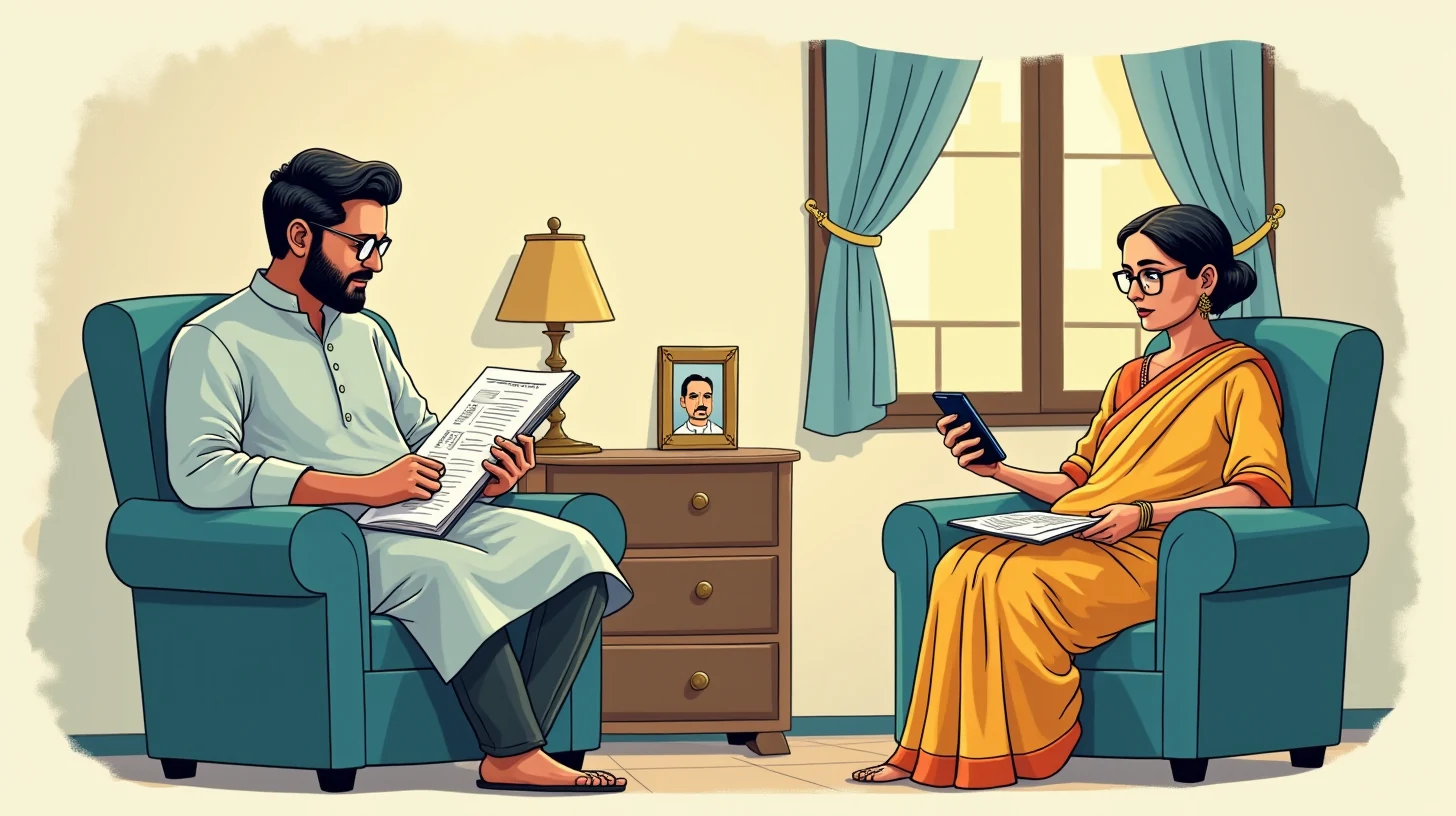
His father, Mr. V.K. Narayanaswamy — retired accounts officer, State Government, twenty-seven years of service — died on the fourteenth of February, which Suresh marks, privately, as one of the crueller ironies of the calendar. He died at home, in the Basavanagudi house, of a myocardial infarction, quickly, in the morning. He was seventy-one. He had been, in all the ways that matter, a careful man: his pension documents were in order, his life insurance had been maintained without lapse, and his fixed deposits — four of them, spread across SBI and Canara Bank — had nominations attached. He had, however, not gotten around to updating the property documents on the Basavanagudi house, which was registered in his name alone, from a purchase in 1988, and which now needed to be transferred to his wife's name through a process called mutation — a word that Suresh had encountered exactly once before his father's death, in a neighbour's conversation about something entirely unrelated, and retained nothing.
This is a story about what mutation actually means in BBMP's administrative universe, what Suresh's next seven months looked like while trying to navigate it for a mother who could not navigate it alone, and what changed when his cousin's wife — a senior consultant at a Koramangala firm who had been using a Kannada-speaking AI for her own tax compliance for about a year — suggested he try the same thing on his mother's phone.
- ⚖️
February — death and the missing transfer
Mr. V.K. Narayanaswamy dies. Pension and FDs were in order; the Basavanagudi house, registered in his sole name from a 1988 purchase, was not.
- 📋
March — Form D-9 at the South Bengaluru Tahsildar
Legal heir certificate application opens. The notarised affidavit, the witness list, the wrong form number, the transferred official, the printer down.
- 🛑
June — certificate arrives, BBMP demands more
Heir certificate in hand. The post-2022 BBMP ward office wants the cooperative NOC and a 30-year encumbrance certificate the website never listed.
- ₹
September — mutation acknowledged
Complete file submitted in August. Mutation is live in the BBMP system; future property-tax demand notices will go to Smt. Kamala Narayanaswamy.
🗓️ What mutation is, and why it is harder than it sounds
The word mutation, in Indian property law, refers to the updating of municipal revenue records to reflect a change of ownership. It is not, technically, a legal transfer of title — that happens at the sub-registrar's office, with a registered sale deed or, in the case of inheritance, a gift deed or a succession-based transfer deed. Mutation is the administrative follow-up: informing the local body — in this case the Bruhat Bengaluru Mahanagara Palike, which administers property tax for roughly 2.1 million properties across Bengaluru — that ownership has changed, so that future property-tax demand notices are issued in the new owner's name.
Without mutation, the property-tax notices for the Basavanagudi house would continue to arrive in the name of Mr. V.K. Narayanaswamy, deceased. If they were paid in that name, the payment would be valid, but the liability would technically remain in the old record. If, five or ten years from now, Suresh's mother wanted to sell the house, the buyer's lawyer would discover that the mutation had never been done, and the entire transaction would stall while the seller scrambled to catch up on thirty years of missing paperwork — or so the Basavanagudi neighbour, an experienced retired judge who had seen this exact scenario four times, told Suresh at the thirteenth-day ceremony.
The mutation process itself, for a property inherited through death of a registered owner, requires the following, more or less, according to the BBMP website: a death certificate of the previous owner; proof of relationship (birth certificates, marriage certificate); a self-attested copy of the will, if any, or a succession certificate or legal heir certificate from the relevant civil court; the previous owner's PAN; the latest property-tax paid receipt; the khata extract (the existing revenue record) from BBMP; and a mutation application filed either at the BBMP ward office or through the BBMP online portal, accompanied by all the above as PDF attachments.
It sounds like a list. It is, in practice, a scavenger hunt across three departments and two banks, conducted in a city where the ward office for Basavanagudi falls under a BBMP zone whose boundaries were redrawn in the 2022 reorganisation and which has, since the reorganisation, been operating out of a temporary building on a side road that does not appear on Google Maps. Suresh discovered this on the first Saturday he went to file the application, two weeks after the thirteenth-day ceremony, when the address he had found on the BBMP website led him to a locked building with a sign saying the office had shifted. A man at a tea shop across the road knew where the new office was. He told Suresh. Suresh went. The office was open, staffed, and the clerk — a woman named Lakshmidevi, competent and not unkind — told him that his application was incomplete because it was missing the legal heir certificate.
⚠️ The legal heir certificate, and the three months it took
A legal heir certificate — ಕಾನೂನು ವಾರಸುದಾರ ಪ್ರಮಾಣಪತ್ರ — is a document issued by the Revenue Department, specifically by the Tahsildar of the relevant taluk, certifying that the named individuals are the legal heirs of the deceased. It is required for a large number of post-death administrative transactions: pension transfer, bank account succession, insurance claim, and, as Suresh now discovered, BBMP mutation. The certificate is applied for at the Tahsildar's office of the taluk in which the deceased was resident — in this case, the South Bengaluru Tahsildar's office — with a prescribed form, an affidavit signed by two witnesses on stamp paper, the death certificate, and the identity documents of all heirs.
The process is supposed to take three to four weeks. Suresh applied in early March. He received the certificate in June. The three months in between involved, in rough chronological order: one visit to discover the correct form number (Form D-9, not the old Form-9 that several websites still listed); one visit to discover that the stamp-paper affidavit needed to be notarised by a specific category of notary and not merely signed; one visit to submit the complete application; two phone calls to the office that were not answered; one visit to follow up and discover that the file had been assigned to a different official after a transfer; one more visit to the new official, who said the verification had been completed and the certificate was ready but the printing system was down; and a final visit in June, on a Tuesday, during which Suresh sat in the waiting area for two hours and forty minutes and finally left with the certificate, in Kannada, in a format he could not fully read.
He photographed it and sent it to his cousin in Koramangala, who could read Kannada, who confirmed it was correct.
What his mother was doing during this time
Kamala Narayanaswamy is not a helpless woman. She ran a household for forty years, raised one son to adulthood, managed the domestic accounts with precision, and maintained, through her husband's illness in his last two years, a schedule of doctor visits, medication refills, and dietary adjustments that would have impressed a trained nurse. What she could not do, and had never needed to do, was navigate the BBMP website, read an SMS from the Ayushman Bharat ABHA portal asking her to update her health ID because her husband's family account had been flagged for deceased-member review, or understand a letter from the sub-registrar's office asking whether the property had any pending encumbrances that needed clearance before the succession deed could be registered.
The ABHA letter arrived in April. It was in English. She called Suresh. Suresh, in the middle of a product-roadmap review with his Singapore counterpart, told her he would look at it in the evening. In the evening, Kavya had a school event. He looked at it on Saturday, discovered it was asking for a routine update to remove his father's name from the family health account and reassign the policy head to his mother, and navigated the ABHA portal for forty minutes before successfully updating the record. He explained to his mother what it had been. She understood. She thanked him. She asked him why these things couldn't be in Kannada.
This is the exact question that has no good answer. The ABHA portal is, in principle, available in regional languages. In practice, the Kannada interface is incomplete — roughly sixty percent of the interface elements render in Kannada, and the remaining forty percent default to English, which means the completion of any multi-step transaction requires a bilingual user. Kamala was not a bilingual user. Suresh was, but Suresh had a full-time job, a nine-year-old, and a mutation process that was consuming two Saturdays a month.
"ಇದು ಯಾಕೆ ಕನ್ನಡದಲ್ಲಿ ಇಲ್ಲ?"— Why isn't this in Kannada? Kamala asked, of a portal that, on its surface, claimed to be.
The Karnataka Krishi Aarogya health scheme letters, when they arrived in May asking her to re-enrol because the state had migrated to a new beneficiary management system, went into the kitchen drawer with the BBMP receipts and the succession-deed drafts and did not come out for three weeks, because she had understood, reasonably, that these were documents that required Suresh to look at them and she did not want to bother Suresh.
🌗 What his cousin's wife suggested
Suresh's cousin Anitha lives in Koramangala with her husband, who also works in tech, and their two children. She is a senior consultant specialising in labour compliance for mid-market manufacturing firms. She had been using a Kannada-Hindi AI agent for her own professional work — reading draft government notifications, summarising new EPF circulars, translating compliance notices from Kannada to English for her Mumbai clients — for about a year when she heard, at a family lunch in May, the full account of what Suresh had been managing since February.
She said, in the direct way she had: "Suresh, neenu Amma ge phone mele install maadu. Avalu khanDita use maaDoLe." (Suresh, install it on Amma's phone. She will definitely use it.)
She came over to Basavanagudi the following Sunday and installed the agent on Kamala's Android phone — a Realme device her daughter-in-law had bought her two years ago for video calls. She showed Kamala, in Kannada, the three things the agent could do:
- Read any SMS or letter by taking a photograph and tell her, in spoken Kannada, what it was asking for.
- Help her understand what step of the mutation and succession process was currently pending.
- Call up any government helpline number she needed without having to find it herself.
Kamala was sceptical in the way of a woman who has seen many things promised and fewer delivered. She took a photograph of the Karnataka Krishi Aarogya re-enrolment letter that had been in the kitchen drawer for three weeks. The agent read it and replied, in Kannada, in a voice she described to Suresh later as "like a calm Kannada newsreader":
"Amma, ee patravannu odide. Idhu Karnataka Krishi Aarogya Yojana arogya vasati yojane baddagi. Nimma subbiyaage nimma hesaralli naav-enurolment maadabeku antha heLuttide. Idu oka form tumbisalu heLuttide — nimma Aadhaar, hosabaraha policy number, mattu nimma bank passbook xerox bekaaguttade. Neevu Suresh-anige ivaaga phOne maadi haeLi, navide aa documents ready ivantallu maaDoNa."
(Amma, I read this letter. It is about the Karnataka Krishi Aarogya health welfare scheme. It says we need to re-enrol in your name now. It says to fill one form — it needs your Aadhaar, the new policy number, and a photocopy of your bank passbook. You call Suresh now and tell him — together we will get those documents ready.)
The re-enrolment took forty minutes on the following Saturday. It required a document Suresh had not known to keep — the old policy card with the scheme beneficiary number — and which his mother, having had the matter explained to her in Kannada over the previous week, had located in the correct drawer and kept ready.
What changed
Over the following three months, four things happened that, individually, seem small and, together, constitute a different life for both Suresh and his mother.
First, the BBMP mutation file moved. Not because the process became simpler — it did not. The BBMP ward office demanded two additional documents that the website had not listed: a NOC from the housing cooperative (the Basavanagudi house sits within a layout that had a registered cooperative in 1992 and which has, technically, never dissolved), and an encumbrance certificate from the sub-registrar covering the last thirty years. Both were available. Neither was obvious. The agent, reading the BBMP demand notice from a photograph Kamala took at the ward office, identified both requirements in fifteen minutes and gave Suresh a list: encumbrance certificate from sub-registrar office at K.R. Road, NOC application to the cooperative secretary (phone number found in the 1992 registration document Kamala still had in a steel almira), current processing fee of ₹3,000 by DD or online at the BBMP portal. Suresh obtained both documents in three weeks, filed the complete application in August, and received the mutation acknowledgement in September. The mutation is now live in the BBMP system. Future property-tax notices will go to Smt. Kamala Narayanaswamy.
Second, the ABHA health-ID update was completed properly. The agent flagged, in June, that the health account still showed Suresh's father as the primary ID holder and that two pending outpatient claims had been stuck in processing because of the mismatch. Suresh had not known about the pending claims — they were from a hospital visit in January, just before his father's death, for a diabetes review, and the cashless claim had been filed by the hospital but not settled. The agent read the ABHA SMS trail, identified the two stuck claims, helped Suresh dial the Ayushman Bharat helpline, and the claims — totalling ₹14,200 — were settled within the month.
Third, Kamala stopped putting official letters in the kitchen drawer. This is not, on its face, a bureaucratic outcome. It is, functionally, the most important one. The pattern before the agent — receive an official letter in English or partly-readable Kannada, feel unable to parse it, feel reluctant to disturb Suresh, put it in the drawer, forget it — was the pattern by which the ABHA renewal had been missed for three weeks and by which, if it had continued, the Karnataka Krishi Aarogya re-enrolment might have lapsed. The pattern after the agent was: receive a letter, photograph it, hear it explained in Kannada, know what it needs, tell Suresh the specific thing it needs. The drawer is, since September, empty.
Fourth — and Suresh will tell this to anyone who asks — he stopped having two kinds of Sunday. Before, every other Sunday was a BBMP Saturday: a day that began with a list of documents and ended with either progress or frustration, and in both cases with a residue of guilt about the time he had not spent with Kavya. After, the Sundays were Sundays again, because the work had not disappeared but had been distributed — the gathering, the photographing, the initial parsing, the prioritisation — across the week, in small increments, between his mother, who could now report accurately, and the agent, who could now translate.
What it does
- 🔍Reads the BBMP demand notice, the ABHA SMS trail, and the Krishi Aarogya re-enrolment letter — in Kannada, by photograph.
- 🗂️Surfaces the exact documents the ward office wants: encumbrance certificate, cooperative NOC, the right fee head.
- 📞Finds the Tahsildar number, the BBMP zonal helpline, the cooperative secretary's old land-line.
What it does not do
- 🔒Never enters Suresh's DigiLocker or Aadhaar OTP — it surfaces, he submits.
- 💳Does not pay the BBMP fee or settle the ABHA stuck claim — Suresh signs the cheque, Suresh dials Ayushman Bharat.
- ✅Does not decide whether to invoke the registered-cooperative clause — that judgement, with the retired-judge neighbour's advice, stays with Suresh.
🧭 Why we built it
There are, in Bengaluru alone, somewhere between forty and sixty thousand families navigating a post-death property transition at any given time. The specific combination — BBMP mutation, legal heir certificate, sub-registrar succession deed, ABHA health ID update, pension transfer — is not an unusual problem set. It is, in fact, the exact problem set that the death of a property-owning senior in Karnataka generates every time. The documents are knowable. The offices are open. The processes, when you read them carefully, are not deliberately hostile. What they are is conducted in a language — a combination of bureaucratic English, formal Kannada, and form-field jargon — that an elderly woman alone in a Basavanagudi house cannot navigate, and which a working son in Whitefield can navigate only by sacrificing his Saturdays.
We built a Kannada-speaking agent that lives on the Android phone she uses for video calls, reads official letters by photograph, explains them in her language, and keeps a running log of what is pending and what is done. The agent does not file forms — Suresh still signs things, Suresh still goes to the sub-registrar. What it does is what a knowledgeable younger sibling would do if she lived next door: read the letter, explain it, tell the son what he actually needs to bring. Patravannu odide, nimge heLuttene. I read the letter, let me tell you.
🌱 What we hope happens
Post-death property transitions in India generate, conservatively, several hundred thousand pending mutation and succession applications at any given time. A significant fraction of these stall not because the family lacks intent but because the process information gap between what the government website says and what the ward office actually requires is large enough to defeat anyone making the attempt alone. The families that succeed are disproportionately those with a technically literate relative who can serve as translator and tracker. Families without that relative — and there are many — quietly give up, and the property records stay inconsistent for a generation.
We do not solve the mutation process. We are not the BBMP. What we do is provide the knowledgeable younger sibling, in Kannada, on the phone, reading the letters as they arrive. Suresh's mother does not have a younger sibling in Bengaluru. She has an agent. It has been, since September, enough.
If you are managing a similar process for a parent — anywhere in Karnataka, anywhere in India — the product is free at gabforge.in. We have native Kannada, and we know every ward office, every sub-registrar, and every BBMP helpline number. We will read the letters with your mother. And we will be quiet.