
The Bhopal daughter and the Ayushman Niramayam claim her father's pacemaker triggered
Meera's father, Rajesh Kumar, was sixty-seven when the cardiologist at Choithram Hospital first said the word: "pacemaker." Meera, forty-four, worked as a part-time accountant at a local textile warehouse in South Tukoganj, the old market district of Bhopal where she had lived all her life. The neighbourhood was dense—narrow lanes where cycle rickshaws and motorcycles threaded between cloth shops and spice vendors, where the air smelled of turmeric and diesel. Her father lived three lanes away in a three-room house they had shared since her mother died twelve years earlier. He had a government pension from thirty-five years as a junior railway clerk, and Meera's salary covered the rest. They were not poor, but they had no cushion.
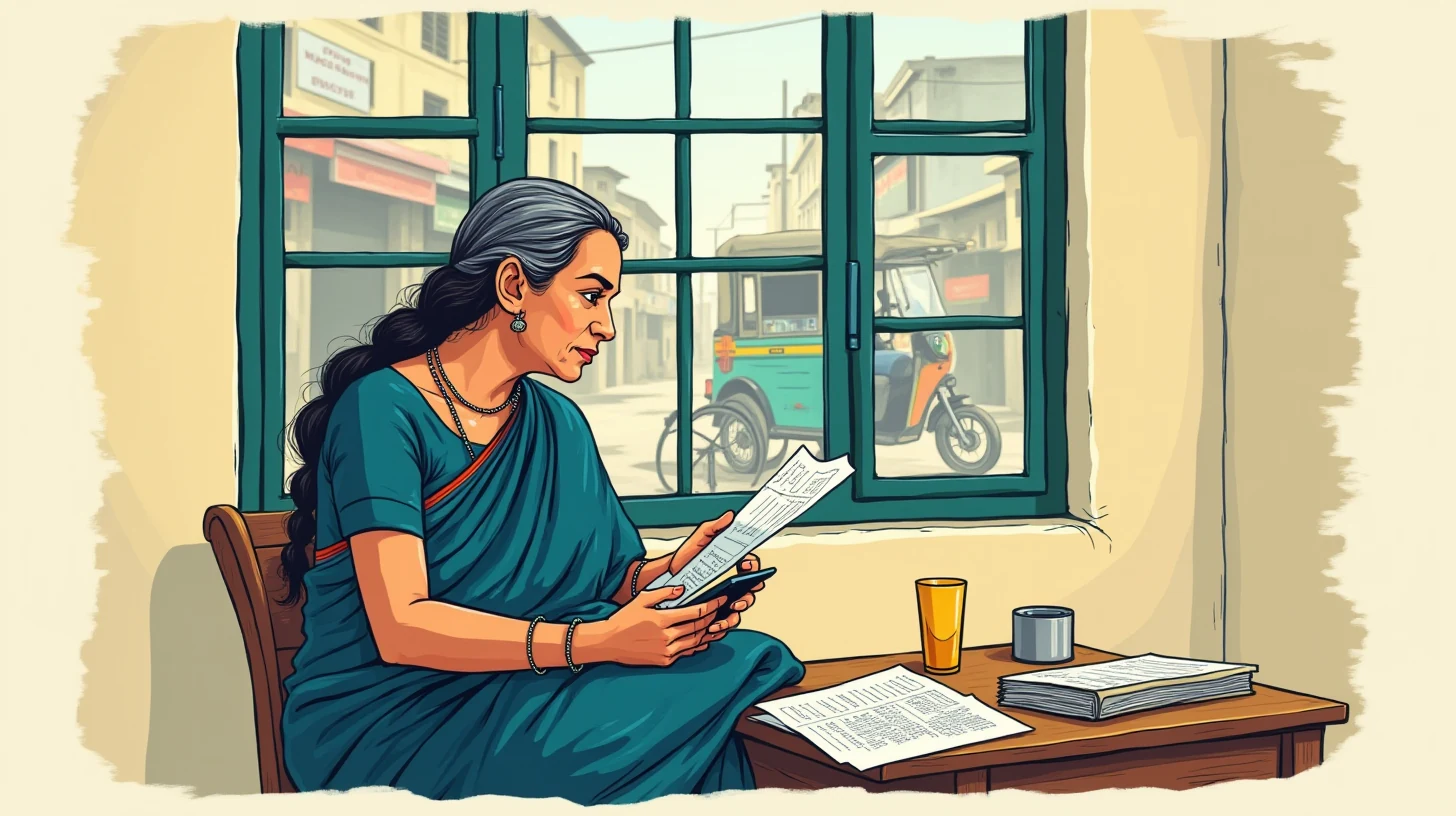
The cardiologist's diagnosis came in February. Rajesh Kumar had suffered two minor episodes—a flutter in the chest, a shortness of breath that lasted an hour. The ECG showed a conduction block; his heart was skipping beats. "If we don't intervene," the doctor said, "he is at high risk of sudden cardiac death within eighteen months." The solution was a dual-chamber pacemaker, a device that costs between ₹4.5 lakh and ₹5.5 lakh depending on the make. Meera had saved ₹60,000 toward a house renovation. She had no way to find the rest.
That evening, Meera sat in her father's room while he slept, his breathing slightly laboured even at rest. She opened her phone and searched "pacemaker government scheme Bhopal" and found, buried in a government website, the Ayushman Bharat Niramayam card. They were eligible—her father's pension qualified them as an unorganised sector worker's family. The scheme promised to cover up to ₹5 lakh for tertiary cardiac procedures, including pacemaker implantation. Meera felt something loosen in her chest. She lay awake that night, but not from fear. For the first time in three weeks, it was not entirely fear.
The next morning, she went to the Niramayam enrolment office near the Lakhanpur bus stand.
🗓️ The annual rhythm of a scheme that works—until it doesn't
The Ayushman Bharat Niramayam scheme had launched in Madhya Pradesh in 2019, almost seven years before Rajesh Kumar's diagnosis. It was born from the Pradhan Mantri Jan Arogya Yojana (PMJAY), a national scheme that promised free hospitalisation up to ₹5 lakh per household annually. But PMJAY had a gap: it was built on household income thresholds that shifted year to year, and in states like Madhya Pradesh, where the informal sector dominated, vast numbers of families fell between the cracks. They earned too much to qualify, but not enough to pay for major surgery out of pocket.
So Madhya Pradesh created its own tier—the Niramayam card—specifically for unorganised workers: vegetable vendors, laundry workers, construction labourers, small traders, and retirees like Rajesh Kumar whose pensions were modest. Every year, eligible families had to renew their card. It was a small ritual. You went to the primary health centre or the government office with your Aadhaar and pension documents, they took a fingerprint, and you received a card valid for twelve months. Meera's father had held his card for two years without ever using it. Like many schemes in India, it was something you carried but hoped never to need.
The promise was elegant: once you had the card, any procedure at an empanelled hospital was cashless. You walked in, the hospital verified your eligibility with the Trust-Based Intermediary (TPA) partner—in MP, this was Arogyasri, a state-contracted intermediary—and they sent the cost of your treatment directly to the hospital. You paid nothing at the point of care. The scheme covered everything: the device, the surgery, the anaesthesia, three days of post-operative care. Everything.
What the annual renewal process did not make clear—what, in fact, very few people understood—was that the ₹5 lakh cap was not a single number. It was attached to specific procedure codes. A pacemaker had different codes depending on whether it was single-chamber or dual-chamber, whether it was a simple battery replacement or a first implantation. Each code had a pre-approved cost. If the hospital's invoice listed a procedure code that didn't match Niramayam's schedule, or if the hospital asked for a cost higher than the schedule, the claim would flag. It would go to the TPA for escalation. It would wait.
Meera did not know this. No one told her. The scheme's website, the government office where she enrolled, the hospital admission staff—none of them mentioned the hidden taxonomy beneath the promise.
⚠️ The waiting begins: code mismatch and the TPA wall
Meera enrolled her father in early March. The process took ninety minutes. She submitted his pension documents, a photocopy of his Aadhaar, proof of residence (a utility bill), and a filled form in Hindi on rice paper. Two weeks later, the card arrived in the post. It was green, laminated, with both their names and his date of birth. It said "Valid until March 2025" in English and Hindi. Meera felt the weight of it in her hands and thought: we are going to be all right.
Dr. Vikram Sharma at Choithram Hospital, where Rajesh Kumar's cardiologist was based, agreed to proceed with the surgery in early April. The surgical team came to see her father and explained the procedure in detail. A small incision below the collarbone. Two leads threaded into the heart chambers. A battery pack the size of a small matchbox inserted under the skin. The operation would take two hours. He would be in hospital for four days.
"You have Niramayam?" the hospital admission counsellor asked, typing on her computer. Meera nodded and slid the card across the desk.
The counsellor scanned it into the system and then picked up the phone. "Let me verify with Arogyasri," she said. "Sometimes there are delays." She was silent for a few minutes, listening, then put the phone down. "They are checking the procedure code. The cardiologist has submitted it as code 9370—dual-chamber pacemaker, first implantation. Let me get back to you by end of day."
That was a Monday.
By Friday, Meera had not heard back. She called the hospital. The admission counsellor said that Arogyasri had flagged the claim. The procedure code 9370 was not in the current version of the Niramayam schedule. The hospital's billing rate for the full procedure—device, surgery, anaesthesia, materials—came to ₹4.8 lakh, which was within the scheme's cap. But the code didn't match. Arogyasri was asking the hospital to re-submit with a different code, or to escalate the case to the State Health Authority in Indore for a manual review.
"How long will that take?" Meera asked.
"Three to four weeks," the counsellor said. "Sometimes longer. The State Health Authority is busy."
Her father's surgical slot had been blocked. The next available date was in mid-June—two months away. But more immediately, Meera knew that her father's condition would not wait two months. His cardiologist had said he needed the operation urgently. The risk of sudden cardiac death was real. Waiting for a bureaucratic code mismatch to resolve felt like playing roulette with his life.
Meera told the hospital that she would try to pay privately. She had ₹60,000. She could take a loan from her workplace, maybe another ₹80,000. Her brother in Delhi said he could send ₹1 lakh. It would still leave them short, and she would be paying interest on a loan for years. She went home and sat in silence for an hour, staring at her phone.
That night, she did something she had never done before: she opened a note on her phone and typed her question to the agent.
🌗 The agent arrives: a moment in the South Tukoganj market
Meera's neighbour, Priya, worked as a community health volunteer for a non-profit that served domestic workers in Bhopal. One afternoon, Priya had been visiting homes in their lane, explaining the PMJAY scheme to people who might qualify. She had a tablet with her—a sturdy grey device with a cracked screen—and when Meera mentioned her father's pacemaker and the Niramayam delay, Priya asked if she wanted to "run it by the tablet."
"It's an agent," Priya said. "It helps with government forms and schemes. You ask it a question and it looks up the rules."
Meera was sceptical. But she was also desperate. She wrote out her father's case in a note on her phone: the diagnosis, the hospital, the procedure code, the TPA escalation, the ₹4.8 lakh cost, the sixteen-day deadline her cardiologist had given her (the next available surgical window before his risk profile changed). She handed Priya the note, and Priya typed it into the tablet in Hindi.
The tablet took a moment to process. Then it returned a long response, in Hindi, with specific references to the Niramayam notification and the State Health Authority's escalation protocol.
Meera read it aloud, slowly: "आप अपने पिता के लिए State Health Authority को Direct Escalation दे सकते हैं, अगर प्रक्रिया कोड Hospital के बिल के साथ Match नहीं करता। Cardiologist को एक Fresh Assessment Letter लिखना चाहिए जो यह कहे कि dual-chamber device Medical Emergency है। फिर आप State Health Authority के Escalation Portal को एक Formal Letter भेज सकते हैं, जिसमें Cardiologist का Letter, Hospital's Quote, और Niramayam Card की Copy हो। यह 5-7 दिन में Process हो सकता है।"
(The agent was saying that Meera could bypass the TPA's standard timeline by filing a direct escalation with the State Health Authority—if her father's cardiologist provided a written assessment confirming medical urgency. The letter should go to the escalation portal at the State Health Authority office in Indore, along with the surgical quote and her card copy. This route, the agent said, could resolve in five to seven days instead of three to four weeks.)
Meera looked at Priya. "Is that real?" she asked.
Priya shrugged. "Let me check the website while we're here."
They opened the tablet's browser and went to the State Health Authority portal—dmhp.mp.gov.in. There it was, embedded in the FAQ section: a procedure for "Medical Emergency Escalations" that could be filed by the patient, the hospital, or the cardiologist, with a dedicated email address and a promise of review within five to seven working days.
Meera had never heard of this pathway. The hospital admission counsellor had not mentioned it. The Arogyasri agent on the phone had not offered it. The agent on the tablet had.
She called Dr. Sharma the next morning and asked if he would write a medical urgency letter. He agreed, and she had it by 3 p.m. that same day. She then sat down at the same desk where her father had his pension documents spread out, and she wrote an email to the State Health Authority's escalation office, attaching the urgency letter, the surgical quote from Choithram, and a scanned image of her Niramayam card.
She sent it on a Tuesday evening. Fourteen days later, she received an approval letter. The procedure code had been grandfathered into the approved schedule for the specific hospital—Choithram had a history of cardiac implants—and the cost was approved in full. The surgery was booked for the following week. Her father came home ten days after that, tired but recovering, with a small ridge of stitches below his collarbone where the pacemaker sat.
- ⚖️
Early March — Niramayam enrollment
Meera submits pension documents and proof of residence. Card arrives valid until March 2025. Hospital admission begins.
- 🛑
Early April — Procedure code flagged
Hospital submits dual-chamber pacemaker claim under code 9370. Arogyasri TPA escalates to State Health Authority due to code mismatch, estimates 3-4 weeks.
- 📨
Mid-April — Agent reveals pathway
Priya's tablet agent surfaces the Medical Emergency Escalation route: direct filing with State Health Authority with cardiologist's urgency letter, 5-7 day timeline.
- ₹
Late April — Approval and surgery
State Health Authority approves ₹4.8 lakh claim within six working days. Surgery scheduled. Rajesh Kumar discharged ten days post-op, recovering at home.
🧭 Why the standard system failed, and why others are failing right now
The Niramayam scheme is one of India's more elegant bureaucratic inventions. Its architecture assumes that most claims will be straightforward: a person with a card walks into an empanelled hospital, the hospital verifies eligibility in real time, and the TPA processes the claim within the pre-approved schedule. It works smoothly for minor surgeries, for deliveries, for treatments that fit neatly into the scheme's code structure.
But the structure itself is the problem. The Niramayam scheme lists specific procedure codes tied to specific costs. These codes come from the Standard Treatment Guidelines (STG), which are published by the State Health Authority and updated every few years. But hospitals, especially older ones like Choithram, sometimes use slightly different codes depending on the complexity of the case, the surgeon's custom templates, or simply because the hospital's billing software is newer than the published guideline. When a code doesn't match—not because it's wrong, but because it's granular—the TPA is instructed to escalate and wait.
This system protects the scheme from fraud and cost overruns. But it also assumes that patients have time to wait. Meera's father did not. Thousands of other patients across Madhya Pradesh do not.
The medical emergency escalation pathway exists specifically to address this. It is described in the State Health Authority's notification, available on their website. But it is not publicised. It is not explained in the scheme's helpline materials. It is not mentioned in the orientation sessions that hospitals give to patients. Most patients never learn that it exists. They wait. Their conditions worsen. Some recover anyway. Some don't.
What the agent did, in Meera's case, was not to solve the problem. It was to surface a rule that already existed—a rule that the system had made invisible.
What it does
- 🔍Verified the Medical Emergency Escalation procedure against the State Health Authority website.
- 🗂️Listed the documents needed: cardiologist's urgency letter, hospital quote, and scheme card copy.
- 📞Identified the correct email address and timeline for escalation (5-7 working days).
What it does not do
- 🔒Never entered Meera's password or accessed her bank account or hospital records.
- 💳Never submitted the escalation on her behalf or committed her to any course of action.
- ✅Never assured Meera that approval was guaranteed; only that this pathway existed and had worked before.
🌱 The small weight of knowing what already belongs to you
Six months later, Rajesh Kumar sat on the small cement platform outside his house, watching the South Tukoganj market pass by. His chest felt light. The pacemaker had settled; he no longer felt its presence beneath his skin. He had returned to his routine: a walk around the block each morning, his cup of chai from the vendor three shops down, a nap in the afternoon. Meera still worked at the textile warehouse, and she still came home to check on him, but now she did not carry the weight of the code mismatch, the TPA delay, the impossible choice between debt and her father's life.
What struck Meera most, in the months after the surgery, was not relief. It was anger. Not at anyone in particular, but at the structure itself. The rule had existed. The pathway had been written down. She had qualified for it. But the system had not told her she qualified. She had only learned it existed when someone outside the system—Priya, with her tablet—had asked the question out loud.
How many other people, she wondered, were waiting right now in other hospitals across Bhopal, across Madhya Pradesh? How many were paying private rates for procedures that the scheme would cover, simply because the escalation pathway was invisible? How many of their families were taking loans, selling jewellery, postponing surgeries, because a bureaucratic taxonomy had hidden a rule that could have freed them?
The agent had not decided anything. It had not gone to the State Health Authority and lobbied on her behalf. It had not convinced the TPA to move faster. It had only said: "This pathway exists. This is how to use it. This is who to write to." And that small, true thing—the naming of something that was already there—had changed the trajectory of her father's life.
"सरकार का नियम तो है, लेकिन सरकार बताती नहीं कि नियम क्या है। जब तक कोई बाहर से नहीं आता और कहता है, 'यह देखो, तुम्हारे पास यह अधिकार है,' तब तक हम जानते ही नहीं।"— The government has rules, but the government doesn't tell you what the rules are. Until someone from outside comes and says, 'Look, you have this right,' you never find out.
"Niramayam के Medical Emergency Escalation का फायदा उठाने के लिए, Cardiologist को एक letter लिखना पड़ता है जो urgent बताए। फिर Direct State Health Authority को File करें। TPA की Wait न लगे।"
(To use the Medical Emergency Escalation in Niramayam, you need the cardiologist to write an urgency letter. Then file directly with the State Health Authority. You don't have to wait in the TPA queue.)