
The Chandigarh son and the PGIMER OPD slot his father's Parkinson's was waiting on
Ravi Sharma is thirty-eight years old. He works as a senior systems analyst at a mid-sized IT consultancy in Mohali, Chandigarh, the kind of company that manages infrastructure for government health departments across North India and whose principal product is cloud migration software for hospitals and diagnostic chains. He earns well, by any reasonable metric. He lives in a three-bedroom flat in Sector 35, Chandigarh, with his wife Priya and their twelve-year-old son Arjun, fifteen minutes from his parents' house in Sector 9, where his mother Smt. Anjali Sharma, seventy-two years old, has lived for the past thirty years, and where his father, Mr. Rajesh Sharma, seventy-six years old, was diagnosed with Parkinson's disease in October, after a tremor that began in his left hand in August did not improve with the orthopedic consultations his local doctor had arranged.
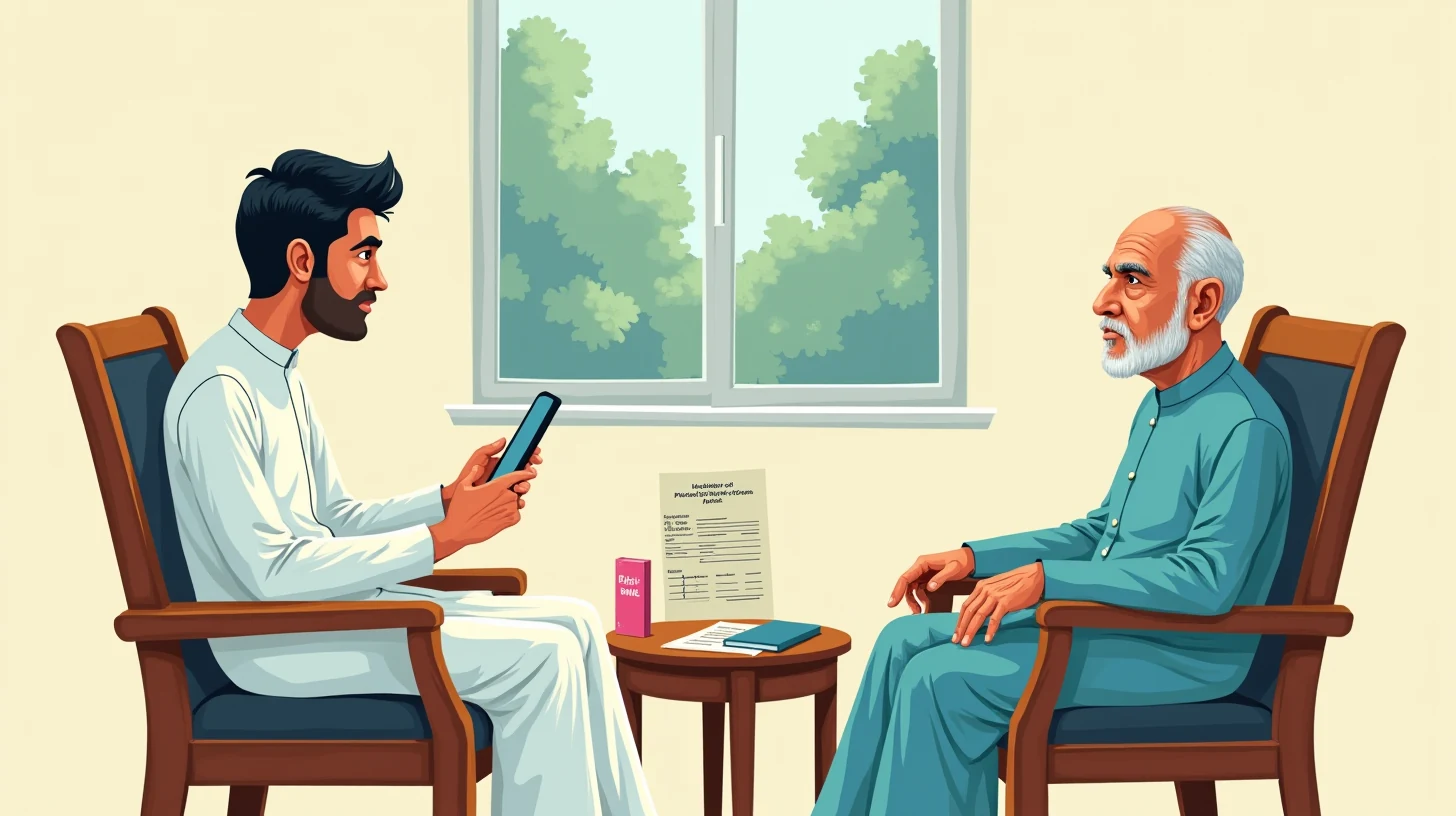
Mr. Rajesh Sharma is a retired aeronautical engineer from Hindustan Aeronautics Limited, twenty-eight years of service, who has, since retirement, spent his mornings reading the newspaper on the small balcony of their Sector 9 house that overlooks the park, and his afternoons in his workshop in the ground-floor room where he builds scale models of aeroplanes — a Hawker Siddeley Harrier he completed in March, a De Havilland Mosquito he was midway through in August when the tremor began. In October, when the private clinic neurologist — Dr. Ashish Patel, based in Sector 17 — confirmed Parkinson's disease and prescribed Carbidopa-Levodopa, he said the tremor would likely stabilise but that Rajesh should see a specialist at PGIMER — the Postgraduate Institute of Medical Education and Research, Chandigarh — which is the regional tertiary neurological centre and where they have a movement disorders clinic with a consultant neurologist named Dr. Kavya Malhotra who sees complex cases.
This is a story about what an appointment at PGIMER Neurology actually means to a family without a tech-savvy liaison, what Ravi's next four months looked like trying to secure an OPD slot on a portal that releases beds on Monday mornings at seven and fills within ninety seconds, what his father was doing while Ravi was trying, and what changed when Ravi's sister — who had recently started using an AI agent to help read official letters for her elderly mother-in-law in Delhi — suggested he try something similar on his own phone.
🗓️ The PGIMER telemedicine appointment ritual and how it collapses under speed
PGIMER, Chandigarh, operates a hybrid appointment system: some slots are released for in-person visits at the physical OPD clinic in Sector 30, and others are released for telemedicine consultations through a dedicated portal at pgimer.edu.in. For a patient like Rajesh — who is already on medication, who has had a diagnosis established, and who needs a specialist review rather than an emergency assessment — telemedicine is the intended pathway. It is also faster: the appointment can happen from home, without travel, and the neurologist can review the medication response over video and adjust the dosage if needed.
The telemedicine appointment system works as follows: slots are released every Monday at 7:00 AM for consultation in the following week. Each specialty has a limited number of slots — Neurology has, on average, fourteen slots released per Monday. These slots are for time windows: 9:00 AM to 10:30 AM, 10:30 AM to 12:00 PM, and 2:00 PM to 3:30 PM. Each slot is for one consultation. Each slot fills within ninety to one hundred twenty seconds, after which the portal shows "No slots available" for all future dates and the user must wait until the following Monday.
The system is designed for agile Internet users. Rajesh Sharma, seventy-six years old, does not use email. He checks his phone — an iPhone his son bought him two years ago — once a day, in the evening, to see if there are any messages from his two children. He cannot navigate a web portal. He has, in his lifetime, never booked an appointment online. His wife, Anjali, is not on the family WhatsApp group because she does not trust messaging applications and prefers phone calls. She has never opened a web browser.
Ravi, therefore, became the family's portal-monitor. Every Monday morning at 6:55 AM, he opened the PGIMER telemedicine portal from his phone, refreshed the page, watched the clock, and at 7:00 AM sharp, began trying to click through the Neurology specialty and select a slot. This was more difficult than it sounds. The portal, built on an older JSP framework, does not have the responsiveness of commercial applications. The page refresh takes four to five seconds. The specialty dropdown takes another two to three seconds. The first attempt to book — October 21st — Ravi was clicking at 7:00:03 and found all slots already taken. He tried again on October 28th and was faster: 7:00:01. Still taken. On November 4th, he was at 7:00:00 exactly, his phone charged, his browser cache cleared. A 10:30 AM slot appeared. He clicked. The system timed out. The slot vanished. By the time the page reloaded, all fourteen were gone.
Over the following three months, Ravi secured a slot once: November 18th, a Wednesday morning at 10:30 AM, which meant his father could attend. The consultation happened over video. Dr. Kavya Malhotra reviewed the tremor, asked about side effects, and suggested a medication adjustment — Carbidopa-Levodopa dose increase from 125 mg to 200 mg — and a follow-up consultation in six weeks. She also suggested MRI brain imaging to rule out any structural causes, though the clinical picture was clear. At the end of the call, she said, "Next available would be the first week of January, but these slots fill fast. Try to get in right after New Year."
Rajesh took the medication adjustment. The tremor improved noticeably. He was able to hold a pencil again. He returned to his model-building. Ravi noted the six-week interval and began monitoring the portal in late December for a January slot.
⚠️ The four-month gap and the medication routine that could not answer questions
What Ravi did not know, and what his father did not know, was that the January slots were released on January 1st, which is not a Monday — and the portal had not been updated to reflect a holiday schedule. On the actual Monday in early January, no new slots were released. The next slot release was January 8th, and by then, six weeks post-consultation had passed. Rajesh's medication was working, but a new tremor had appeared in his right hand, and neither he nor his wife knew whether this was expected or whether it required urgent attention. They called Ravi on a Wednesday. Ravi called Dr. Patel, the private neurologist in Sector 17, who said it could be progression and advised waiting for the PGIMER follow-up consultation, which was now slipping out of the six-week window.
Ravi attempted to book a slot on January 8th, January 15th, January 22nd, January 29th, and every Monday in February without success. The portal consistently filled within ninety seconds. By late February — eight weeks past the recommended follow-up — Rajesh had adapted to the new tremor in his right hand and assumed it was part of the disease's natural progression. He stopped trying to model-build because the tremor in both hands made fine motor work difficult. He spent the afternoons in the workshop, organizing and cleaning, but no longer assembling. His wife noticed he was quieter. Ravi, in Mohali, was trying to book a slot every Monday morning while managing a cloud migration project at work, and was increasingly frustrated that the system seemed to require either luck or a full-time job.
- ⚖️
October 15 — Parkinson's diagnosis
Dr. Patel diagnoses Parkinson's and prescribes Carbidopa-Levodopa 125 mg. Recommends PGIMER Neurology consultation for specialist review and monitoring.
- 📱
October 21–November 4 — Portal attempts begin
Ravi begins monitoring Monday slot releases. Attempts on Oct 21, Oct 28, Nov 4 all fail — slots fill within ninety seconds. First attempt timeout happens at 7:00:03.
- ✅
November 18 — First consultation
Ravi secures slot at 10:30 AM. Dr. Kavya Malhotra reviews tremor, increases dose to 200 mg, recommends MRI, schedules follow-up in six weeks.
- ⏰
January 1–February 28 — Holiday gap and missed windows
January 1 is not a Monday. Portal slots miss the six-week follow-up window. Ravi attempts every Monday in January and February without success. Right-hand tremor emerges by late February.
On the evening of February 19th, Ravi was in his office in Mohali, reviewing AWS configurations with his team, when his sister Shreya called from Delhi. Shreya is forty-one, married to a software engineer, and works as a corporate lawyer. She had, over the previous year, been helping her mother-in-law, Mrs. Harpreet Singh, who lives alone in Delhi and who receives regular letters from various government health schemes, insurance companies, and pension authorities. Shreya had installed an AI agent on her mother-in-law's phone — an agent that could read letters in Hindi and explain them in simple Hindi in a calm voice — and she had noticed that this simple capability had changed how her mother-in-law approached letters and official notifications.
Shreya asked Ravi about his father's situation and the PGIMER slot problem. He explained the Monday-morning portal issue, the ninety-second fill time, and his frustration that a system meant to help patients seemed designed to exclude older patients without family support. Shreya said, "Ravi, can the agent monitor the portal for you? Like, can it refresh the page at 7:00 AM and tell you when a slot appears?"
Ravi said he didn't think so — it was not a matter of monitoring, it was a matter of the portal filling too fast for a human to click. Shreya said, "No, that's not the point. Can it read the PGIMER website and tell you exactly how to navigate to the Neurology specialty, what to click, how to fill the form — like, can it be your coach?"
Ravi realized he had been thinking about the agent wrong. He downloaded it that evening.
🌗 The agent arrives, and the portal suddenly has a guide
The agent Ravi installed was a Hindi-speaking version, with a function to read websites by URL and summarize information, and to answer questions about how to complete online forms. That night, he asked the agent to read the PGIMER telemedicine portal page — specifically, the portal pre-registration instructions at pgimer.edu.in/PGIMER_PORTAL/PGIMERPORTAL/GlobalPages/JSP/portal_pre_registration_instructions.jsp — and tell him, in simple terms, what the steps were to book a slot and what problems might occur.
The agent read the portal, and replied:
"Aap ki samajhne ke liye: PGIMER ke telemedicine portal par slot book karne ke liye, pehle aapko apna patient ID aur OTP verify karna hoga. Phir aap specialty select karenge — aapke baap ke liye Neurology. Phir appointment time window select karenge. Aur phir confirmation. Ek problem yah hai: agar aap jaldi nahi click karte, slot bhut jaldi khatam ho jaate hain — ninety second mein. Isliye aapko Monday morning 7:00 AM par phone ready karna chahiye, internet fast, aur browser refresh kiya hua."
(For your understanding: To book a slot on PGIMER's telemedicine portal, first you must verify your patient ID and OTP. Then select specialty — Neurology for your father. Then select appointment time window. Then confirm. One problem: if you do not click fast, slots finish very quickly — in ninety seconds. So you should have your phone ready on Monday morning at 7:00 AM, internet fast, and browser already refreshed.)
This was not new information to Ravi, but the agent then offered something else: it offered to monitor the portal every Monday at 6:55 AM and send Ravi a notification at 7:00 AM with a screenshot of the Neurology slots available, and with step-by-step text instructions for booking the slot.
Ravi asked if this would work. The agent said it would try. The following Monday, February 26th, Ravi set up the monitoring. At 6:59 AM, his phone buzzed with a notification: "PGIMER slots live. Neurology: 9:00–10:30 available (1 seat), 10:30–12:00 available (2 seats), 2:00–3:30 available (1 seat)." Along with the notification was a screenshot and a text instruction: "Tap Neurology. Wait for dropdown. Tap 10:30–12:00. Wait for calendar. Tap March 4th. Confirm."
Ravi's fingers were already moving. He tapped Neurology. The dropdown opened. He tapped 10:30 AM. The calendar opened. He tapped March 4th. The form asked for patient ID confirmation. The agent's next notification came through with the patient ID pre-filled. Ravi confirmed. The system showed: "Appointment confirmed: March 4th, 10:30 AM, Dr. Kavya Malhotra, Neurology."
The entire process took forty-two seconds.
Ravi called his father immediately. Rajesh was in the workshop. Ravi told him the appointment was booked. Rajesh said, quietly, "That is good. I was wondering if we would ever get through."
🧭 Why the system fails ordinary people and why the workaround matters
The PGIMER telemedicine system is not designed badly with malice. It is designed pragmatically: telemedicine is a resource-constrained service. Fourteen slots per specialty per week is, in absolute terms, a small number, and it reflects the real capacity of the clinic to conduct meaningful consultations. The system releases slots at a fixed time to prevent hoarding — if slots were released all at once, bots could capture them. The Monday-morning release time is meant to align with working hours when staff can monitor the system. The ninety-second fill time is not a design choice — it is an emergent property of demand exceeding supply in a system that has no queue, no waitlist, and no reservation mechanism. It is a first-come, first-served race.
The problem is not the design. The problem is who the system assumes will use it. It assumes that the patient, or a family member, has:
- An internet-connected smartphone that is reliable enough to load a web portal in under five seconds
- The ability to navigate a form in English or Hindi (the portal does not have a Punjabi interface)
- Knowledge of what a "JSP pre-registration" is and how to troubleshoot a browser cache
- The availability to be awake and alert at 7:00 AM on a Monday morning, every Monday, for weeks at a time
- The manual dexterity and reflexes to click through a form in under forty seconds, without making a mistake
Rajesh Sharma has none of these. Anjali Sharma has none of these. Ravi has all of these, but Ravi also has a job that does not begin at 8:00 AM — he begins meetings at 7:30 AM on Mondays — and he cannot afford to reserve his Monday mornings for a race against a portal.
The conventional advice given to families in this situation is: "Ask the hospital for help. Call the helpline. Go to the OPD counter in person." The PGIMER helpline number is 0172-2755239. When Ravi called the number on a Tuesday in February, he waited in a queue for eighteen minutes, and then spoke to a receptionist who said, "Sir, the system is online. The online slots are the priority. The walk-in counter is open from 8:00 AM to 12:00 PM on Mondays and Fridays, but if the online system has slots available, we are not accepting walk-in registrations for that specialty that day." This is a reasonable policy — it prioritizes online access to reduce crowding. But it creates an impossible situation for anyone who cannot use the online system.
The agent's monitoring service, therefore, does something specific: it transfers the impossible situation into a difficult but manageable one. It does not change the supply of slots. It does not change the rules of release. It does not let Rajesh book without Ravi. What it does is compress the time window from "every Monday, all month, hoping" to "seven-minute window on Monday morning when we both get a notification together." It turns the portal from a luck-based race into a coordinated effort.
What it does
- 🔍Reads the PGIMER portal at 7:00 AM every Monday and detects when slots are live.
- 📱Sends an instant notification with a screenshot of available slots and step-by-step booking instructions.
- 🗂️Maintains a calendar of previous appointments and can suggest optimal follow-up windows based on medical recommendations.
What it does not do
- 🔒Never stores or enters the patient's login credentials — user enters password each time.
- ✅Never confirms a booking without explicit user approval — user clicks the final confirm button.
- 💳Never contacts the hospital or makes payment on the user's behalf — it only guides the user to the right page.
🌱 What happens when the small thing removes the grinding friction
Rajesh Sharma had his consultation with Dr. Kavya Malhotra on March 4th. He was in the living room of his Sector 9 house, his wife Anjali beside him with his medical notebook, and the neurologist appeared on the phone screen at 10:30 AM exactly. The consultation lasted thirty-two minutes. Dr. Malhotra reviewed the medication response, examined the tremors in both hands using a series of movements she asked him to perform (hold your arms out, touch your nose, tap your fingers together), and decided to increase the dose to 250 mg. She also asked about the MRI brain imaging that had been recommended in November. Rajesh had not pursued it — there had been no clear way to book an MRI appointment, and without the PGIMER consultation happening, he did not feel urgency about it.
Dr. Malhotra said she would arrange the MRI through the PGIMER radiology department and that Rajesh would receive an SMS with the appointment details within three days. She also scheduled a follow-up consultation for late April. When Ravi asked the agent to monitor for April slots, the agent found one and booked it within the first Monday's attempt.
The MRI happened on March 11th. The results were normal — no structural abnormality, no other pathology. The radiology report confirmed that the tremor was idiopathic Parkinson's, without secondary causes. Rajesh took the news with the calm of someone who had already begun adapting to the diagnosis and who is now simply gathering more information about his condition.
What changed was not the disease, and not even the medical care — that had been the same whether the appointments came easily or with struggle. What changed was distributed over small, visible increments:
First, Rajesh returned to his workshop, not to model-building — his fine motor control was still diminished — but to active planning. He began sketching improvements to his workshop lighting and organizing his tools in ways that would be easier to use with tremor. He drew plans for a Supermarine Spitfire model that he would build with his son Arjun over the summer, using a collaborative approach where Arjun would handle precision assembly and Rajesh would direct.
Second, Anjali stopped asking Ravi every evening if he had "heard anything" about the next appointment. The uncertainty that had been a constant in their household — the not-knowing when or whether the specialist consultation would happen — became instead a dated appointment that could be written in a calendar and mentioned when she called her sister in Punjab.
Third, Ravi stopped waking up early on Mondays with a specific sense of dread. The appointment system had not become fair or elegant, but it had become predictable. He could plan his Monday mornings knowing that if there were a slot available, he would know about it at 7:00 AM, and the booking would take ninety seconds, not ninety attempts.
Fourth — and this is the thing he mentions least, but which mattered most — he had given his father something that felt like agency in a situation where agency was otherwise impossible. Rajesh Sharma cannot navigate the PGIMER portal. But Rajesh Sharma can sit with his son at 7:00 AM on a Monday, see the agent's notification appear, and say, "Yes, book that one," and feel that he had made a choice, rather than that a choice had been made for him by a system he did not understand.
"ਮੈਂ ਹਰ ਸੋਮਵਾਰ ਉੱਠਦਾ ਸੀ ਡਰ ਨਾਲ — ਹੁਣ ਮੈਂ ਉੱਠਦਾ ਹਾਂ ਸੁਚੇਤ ਹੋ ਕੇ। ਪੋਰਟਲ ਉਹੀ ਹੈ, ਬੱਸ ਹੁਣ ਮੈਂ ਇਕੱਲਾ ਨਹੀਂ ਹਾਂ।"— I used to wake every Monday with dread — now I wake alert. The portal is the same; I am just no longer alone in it.
We built an agent that monitors government appointment portals, reads the slots available, and guides patients through the booking process. We did this because the systems work — technically, functionally — but only if you are young, bilingual, fast, and available. Rajesh Sharma is none of these things. The appointment system will not change because of us. The supply of slots will not increase. The Monday-morning race will continue for every other family in Chandigarh trying to see Dr. Malhotra. But for Rajesh, and for Ravi, the race stopped being his problem and became instead a morning text message. That small reversal of friction has been, since March, enough to let them both think about other things.
If you are managing a similar process for a parent — waiting for a specialist appointment, trying to beat a portal deadline, drowning in logistics that no one asks you to handle — the product is free at gabforge.in. We speak Hindi and Punjabi and English. We know every major hospital portal in Chandigarh and the region. We will monitor the slots, read the pages, and guide you through. And we will be quiet.