
The Chennai daughter and her father's dialysis
Lata Venkataraman is thirty-four years old. She works as an assistant merchandiser at a garment export firm in T. Nagar — the kind of company that operates out of a third-floor office above a saree shop, handles orders from three European buyers, and is perpetually five days from a shipping deadline. She has worked there for seven years. She lives in Mylapore, in the flat that her father has lived in since 1991: two bedrooms, a small kitchen, a balcony overlooking a lane where there is a maami's pickle shop that has been there since before Lata was born. Her mother died of a cerebral haemorrhage in 2019. She has a younger brother, Karthik, who works for an IT services company in Bengaluru and who contributes ₹12,000 a month to the household expenses and calls on Saturday mornings, which is the best he can do and which everyone in the family, including Karthik, understands is not enough.
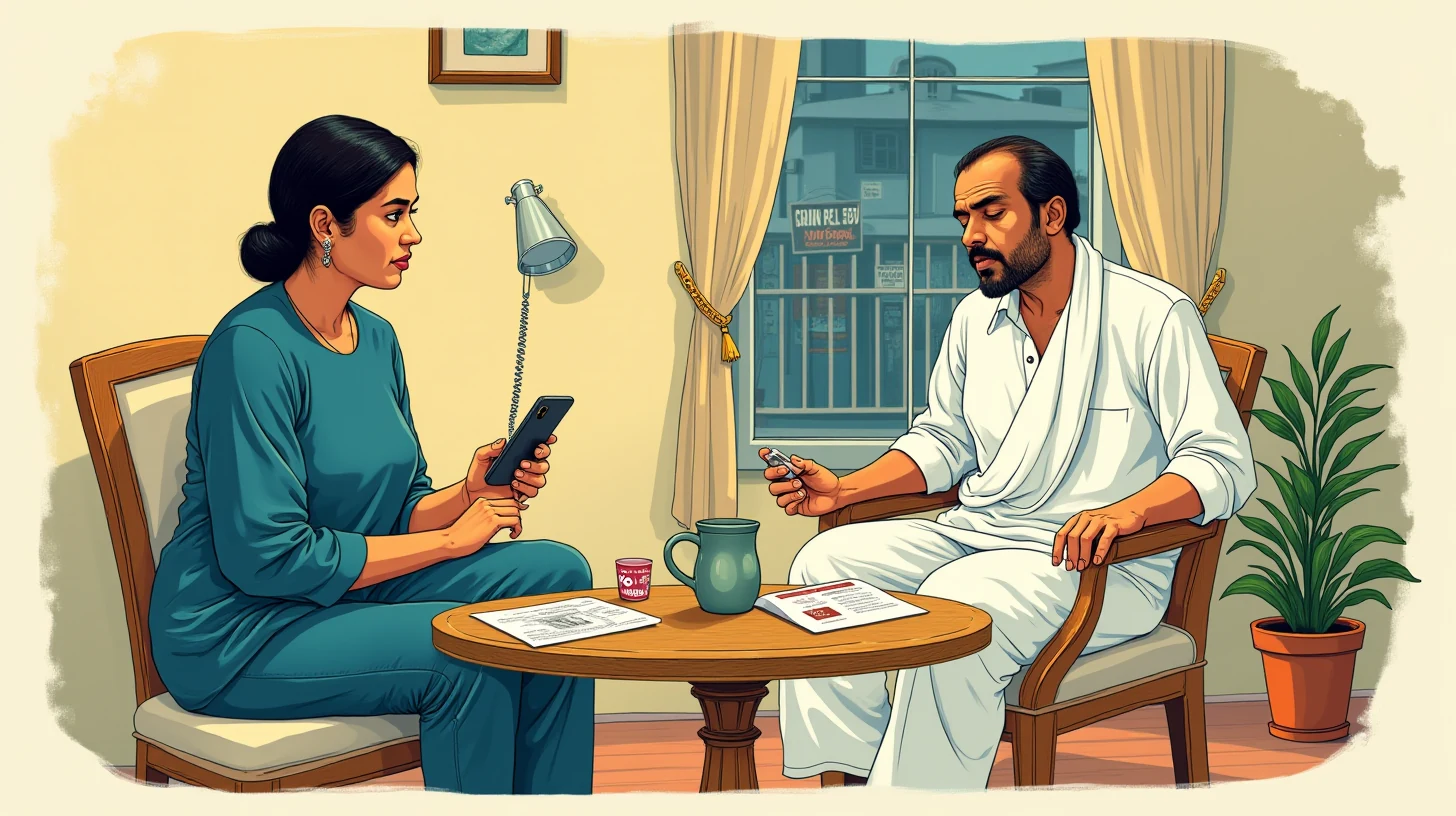
Her father is Ramachandran Venkataraman. He is sixty-eight years old. He is a retired junior engineer from the Tamil Nadu Highways Department, which means he has a small pension — ₹16,000 a month from the state government, deposited on the 7th of every month into his Canara Bank account on Luz Church Road. He has been diabetic since 2007, hypertensive since 2010, and was diagnosed with stage 4 chronic kidney disease in November 2023. He began hemodialysis in January 2024. He currently goes for dialysis three times a week — Monday, Wednesday, Friday — at a private nephrological centre in Alwarpet, where each session costs ₹2,200 and where the monthly bill, including the EPO injections for anaemia management and the vascular access maintenance, runs to somewhere between ₹28,000 and ₹35,000 depending on complications.
Ramachandran Venkataraman's pension is ₹16,000 a month. His dialysis bill is ₹28,000 to ₹35,000 a month. Lata's salary, after her own rent share and transport, contributes about ₹22,000 to the household. Karthik's ₹12,000 covers the rest. The arithmetic works out, barely, with nothing left for contingencies. This is the financial baseline of the story.
The second layer is the insurance question, which is the thing that kept Lata awake at 1 AM on a Tuesday in March 2024, reading a printout of the PMJAY beneficiary list and not finding her father's name.
- 🩺
November 2023 — Stage 4 CKD diagnosis
Ramachandran's nephrology workup at the Alwarpet centre. Hemodialysis begins January 2024. ₹28,000 to ₹35,000 a month on a ₹16,000-a-month pension.
- 🛑
March 2024 — the 1 AM PMJAY printout
Lata reads the beneficiary list at 1 AM on a Tuesday. Her father's name is not there. The CMCHIS helpline (14555) tells her his ₹1.92 lakh pension is above the income ceiling.
- 🔍
April — the agent reads four documents
Colleague Deepa shares a link. The agent reads the dialysis bill, the TNGHS card, the pension certificate, the PMJAY printout — in Tamil. Surfaces the 2022 TNGHS dialysis circular.
- ₹
May–June — TNKRF subsidy + TNGHS first claim
Fifty-percent dialysis subsidy applies the following month. TNGHS first claim — six retrospective months — reimburses ₹68,000 to Canara Bank, Luz Church Road.
🗓️ The insurance tangle
There are, in Tamil Nadu, at least three overlapping government health insurance schemes that Ramachandran Venkataraman might plausibly be eligible for, and none of them, taken individually, is obviously sufficient for chronic dialysis.
The first is Ayushman Bharat PM-JAY — the central government's health insurance scheme that provides up to ₹5 lakh per family per year for hospitalisation at empanelled hospitals, including dialysis. PM-JAY covers families that appear in the SECC 2011 database (the Socio-Economic Caste Census) or the state-level equivalent. Tamil Nadu, uniquely among large Indian states, chose to merge PM-JAY with its own scheme — the Chief Minister's Comprehensive Health Insurance Scheme, known as CMCHIS or colloquially as Amma Insurance, after the late J. Jayalalithaa under whose tenure it was substantially expanded. The merged scheme in Tamil Nadu is called the Tamil Nadu Chief Minister's Comprehensive Health Insurance Scheme (TNPMSSY / CMCHIS), and it covers families with an annual income below ₹72,000, providing up to ₹5 lakh per year in hospitalisation cover.
Ramachandran's pension is ₹16,000 a month, which annualises to ₹1.92 lakh — above the ₹72,000 threshold. This means he is, on a strict reading, ineligible for the standard CMCHIS cover. This is the first fact that is true and that nobody told Lata directly; she found it by accident when she called the scheme's helpline (14555) and spoke to a tired call centre person who said, in Tamil, "Avar income limit madhiyila varavillai ma" — your father doesn't fall within the income limit, ma. She asked what to do. The call centre person said she should consult the district office. She did not have time to consult the district office. She had a shipping deadline.
The second scheme is the Tamil Nadu Kidney Research Foundation (TNKRF) subsidy — a state government initiative under the Tamil Nadu Health Systems Project that provides dialysis at subsidised rates or free-of-cost to kidney patients below a certain income threshold, through a network of designated dialysis centres. The Alwarpet centre where her father goes is, it turns out, partially empanelled under this scheme — which Lata did not know, because the scheme is not prominently advertised and the centre's billing desk had not mentioned it, because the billing desk's job is to generate bills, not to navigate state health programme eligibility.
The third is the EPFO/state pensioner health benefit question. Tamil Nadu state government pensioners have access to the Tamil Nadu Government Employees Health Scheme (TNGHS), which covers them and their dependants for a range of hospitalisation costs. Ramachandran had, in fact, enrolled in TNGHS at retirement, but had never used it for anything beyond a routine checkup and had, in the chaos of the CKD diagnosis and the dialysis commencement, entirely forgotten it existed. He had never claimed anything under it. The TNGHS card was in the second drawer of his desk, under a stack of old Highways Department identity cards.
These are three separate schemes, administered by three separate agencies, with three separate enrolment processes, three separate claim submission pathways, and three separate customer care contacts. None of them refers to the other on its website. None of them is prominently explained in Tamil. None of the three pieces of paper her father owned — the pension certificate, the TNGHS card, the Aadhaar — had the kind of summary document that would let a thirty-four-year-old assistant merchandiser, working a forty-five-hour week and making dinner every night and accompanying her father to dialysis on Monday mornings, understand in twenty minutes what she was and wasn't entitled to claim.
"இது நான் தனியா புரிஞ்சுக்கணுமா?"— Am I supposed to understand this alone? Lata asked herself, at 1 AM on a Tuesday in March, the PMJAY printout in her hand.
⚠️ The dialysis centre billing
The Alwarpet centre's billing procedure added its own layer. Each dialysis session generated a receipt. The receipt listed the session charge, the EPO injection charge, the dialysis membrane charge, and a "sundry charges" line item that varied between ₹200 and ₹900 depending on something that was never explained on the bill. The monthly aggregate bill came on the last day of the month, but the individual session receipts were issued after each session on a printed slip, and the two did not always reconcile exactly, which Lata had noticed in February — a ₹1,400 discrepancy between the sum of the session slips and the monthly aggregate — but had not had the energy to pursue because it was not a large amount and she was tired.
The EPO injection brand had changed in March, and with it the cost, and nobody had told her. She had noticed on the March bill that the injection line item was ₹340 higher per session than in February, which across twelve sessions in the month added ₹4,080 to the bill, and when she asked the billing desk they said the previous brand had become unavailable and the alternative was slightly more expensive. This is true. It is also information she should have been given before the bill arrived, not after.
She was, by March, managing three simultaneous problems: understanding what insurance she was entitled to claim, reconciling the dialysis bills, and figuring out whether the TNKRF subsidy applied to her father's centre. She was doing this while meeting a shipping deadline. She is not a person who complains easily. She mentioned the insurance confusion to her colleague Deepa one afternoon in the lunch break, more as a comment than a complaint, and Deepa — whose mother-in-law had gone through a similar process two years earlier — said she had read about an AI that spoke Tamil and could read PDFs. She sent Lata the link.
"Oru try pannunga," she said — give it a try.
🌗 What the agent read
Lata tried it that evening. She photographed the March dialysis bill, the TNGHS card, her father's pension certificate, and the PMJAY beneficiary query result she had printed out. She asked the agent, in Tamil: "Appa-kku enna insurance kidaikkum? Antha TNKRF subsidy pethri ethaavadu theriyumaa?" — What insurance can my father get? Do you know anything about the TNKRF subsidy?
The agent read all four documents. It replied in Tamil, in clear sentences:
"Lata-ma, meendu paadipom. Ungal appa-vin pension aaandu ₹1.92 lakh — ithu CMCHIS standard limit-ai vida adhigam. Aana oru vali irukkiraathu: TNGHS card ungal kitte irukkiraathu. Ithu Tamil Nadu government pensioners-ukku, dependants-um serntha, hospitalisation cover tharum. Dialysis ithu 'hospitalisation procedure' keezhilae varugiraathu endra TNGHS circular 2022-il irukkirathu — aana itharkku claim claim-pannidaamal thadai irukkiraathu: ungal appa ithu varaikkum oru claim submit seyyal illai. Claim path'ku TN Directorate of Medical Education (DME) portal-ai use pannanum.
Rendam vishayam: ungal appa-in centre TNKRF empanelled list-il irukkiraathu. Naan list-ai paarthen — Alwarpet-il rendu centres irukkiraathu, onru ungal appa pohum peyar-odaathu poal therugiratha. Confirm pannanum endraal centre billing desk-il TNKRF enroll number kettaal porum.
Moonraam vishayam: March bill — sundry charges line ₹640 irukkirathu. Ithu etharkkaana charge enru bill-il solla villai. Oru letter ezhudhungal billing manager-kku ithil clarity ketkalam."
(Lata-ma, let us go through it step by step. Your father's pension is ₹1.92 lakh per year — this is above the CMCHIS standard limit. But there is one path: you have a TNGHS card with you. This gives hospitalisation cover for Tamil Nadu government pensioners including dependants. Dialysis falls under 'hospitalisation procedure' as per a TNGHS circular from 2022 — but there is one obstacle to claiming it: your father has not submitted a single claim so far. To follow the claim path you need to use the TN Directorate of Medical Education portal.
Second point: your father's centre appears in the TNKRF empanelled list. I checked the list — there are two centres in Alwarpet, one matches the name of the centre your father goes to. To confirm, just ask the billing desk for the TNKRF enrolment number.
Third point: the March bill — the sundry charges line is ₹640. There is no explanation for this charge on the bill. You could write a short letter to the billing manager asking for clarity on it.)
Lata read it three times. She then sat with it for a while, which is what you do when you have been drowning in a problem for four months and someone hands you a map.
What she did next
She did three things over the next two weeks, in order.
She went to the dialysis centre billing desk and asked for the TNKRF enrolment number. The billing executive — a young woman named Kavitha who was, by Lata's description, efficient and not unkind — confirmed that the centre was empanelled under TNKRF and that Ramachandran's income bracket qualified him for a fifty-percent subsidy on session charges. Kavitha said, with a slight undertone of the resignation of someone who has said this before, that most patients' families didn't know to ask. She filled in the TNKRF enrolment form on the spot, which took eight minutes. The subsidy applied from the following month.
She also asked about the sundry charges. Kavitha explained that the ₹640 was for the dialysis concentrate solution, which was sometimes included in the session rate and sometimes billed separately depending on which batch of consumables the centre was running. She said she would ensure it was itemised properly going forward. The ₹1,400 February discrepancy was, it turned out, also a concentrate-billing inconsistency, and Kavitha raised a credit note without requiring Lata to argue.
The TNGHS claim process took longer — two weeks, one morning off work, and two visits to the DME portal with the agent's help navigating the claim submission form, which is in English and which has a sequence of fields that require specific document references. The agent walked her through each field in Tamil, matching the field name to the exact line on her father's pension certificate and the TNGHS card. The first claim covered six months of retrospective dialysis sessions — ₹1.44 lakh in hospitalisation costs, of which TNGHS reimbursed ₹68,000 after the scheme's internal deductibles. This is not the full amount. It is not the full solution. But ₹68,000 is ₹68,000, and it arrived in the Canara Bank account on a Wednesday morning, and Ramachandran called Lata at work to tell her and she stepped out of the office to take the call and stood in the stairwell for a moment longer than necessary.
She wrote to Karthik that evening. She did not explain all the insurance mechanics. She said: "Appa's treatment is sorted out a bit better now. We found some coverage we didn't know about." He sent back a thumbs-up emoji and then, after a minute, a voice note that was thirty seconds long and was mostly him not saying anything and then saying he was glad.
The thing nobody mentions
There is a thing about being the caregiving child that does not appear in any government scheme documentation. It is the way that the administrative load of caregiving — the insurance portals, the billing reconciliations, the scheme eligibility searches, the appointment scheduling — accumulates in parallel with the actual care: the Monday morning trips to Alwarpet, the dinner made before you leave, the phone calls from the dialysis centre nurse when your father's blood pressure drops mid-session, the quarter-hour conversation with your father after he gets home when he is tired and cold and needs someone to sit with him while he warms up.
The administrative load and the actual care compete for the same finite hours. Every hour spent on the PMJAY portal is an hour not spent sitting with your father while he warms up. Every evening spent reconciling the dialysis bill is an evening you are at the desk instead of at the dining table. The schemes exist not to eliminate care but to make it financially possible to continue. When the schemes are difficult to navigate, when the insurance tangle requires four months of 1 AM sessions with a printout, the cost is not just financial. It is the attention that should have been elsewhere.
An agent that speaks Tamil, that reads the TNGHS circular from 2022 and the TNKRF empanelled list and the March dialysis bill, that tells you in plain language what you are entitled to and which number to call and what to say — this does not provide care. It does not go to Alwarpet on Monday mornings. What it does is take the administrative layer off the top so that the hours that were going into the insurance tangle can go back to the other thing. The actual thing. Sitting with your father while he warms up.
Lata said, when I asked what had changed: "Ippothaan concentrate panra neram kidaikkuthu" — now I actually have time to focus. That is, all considered, what we hoped the product would do.
What it does
- 🔍Reads the TNGHS card, the pension certificate, the dialysis bill, and the 2022 TNGHS dialysis circular — in Tamil.
- 🗂️Surfaces the TNKRF empanelled-centre list and identifies the Alwarpet centre under it.
- 📋Walks her through the TN DME claim form, field by field, matching pension-certificate references to the form fields.
What it does not do
- 🔒Does not enter the DME portal credentials or her Aadhaar OTP — Lata logs in, the agent reads alongside.
- 💳Does not pay the dialysis bill or claim the refund — Lata signs the cheques, Lata writes the letter to the billing manager.
- ✅Does not decide whether to pursue the PMJAY parallel claim or settle for TNKRF + TNGHS — that judgement stays with Lata and her brother.
🧭 Why we built it
There are, across India, roughly seven lakh patients on regular dialysis. The majority of them are in cities. The majority of their caregivers are family members — daughters, sons, spouses, daughters-in-law — who are navigating the same overlap of schemes that Lata was navigating, in states with their own insurance architectures, with their own empanelled hospital lists, with their own claim portals that are primarily in English and that require specific document references that are not obviously derivable from the documents the caregiver already has.
The schemes are real. The TNGHS is real. The TNKRF subsidy is real. CMCHIS is real. They are not perfectly funded and they do not cover everything, but they are there, and they were built, with public money, precisely for families like Ramachandran's. The gap between the scheme existing and the family accessing it is, in most cases, a navigation gap — a question of who knows to ask for the TNKRF enrolment number, who knows to cite the 2022 TNGHS circular, who knows that the DME portal is where the claim form lives.
A small, quiet, Tamil-speaking AI that reads the pension certificate and the TNGHS card and the dialysis bill and surfaces the path through that navigation gap — this is not impressive technology. It is the equivalent of having a cousin who works in healthcare administration and has an hour on a Tuesday evening. For the thirty-four-year-old assistant merchandiser with a shipping deadline, that cousin is usually unavailable.
🌱 What we hope happens
Hours come back. Not the financial cushion alone — that comes back too, in TNGHS reimbursements and TNKRF subsidy slabs — but the hours. The Monday morning sitting with her father after dialysis while he warms up. The ten minutes at her own kitchen table that are not at the desk under the PMJAY printout. The sleep that returns, somewhere in the second week of June. We do not solve the dialysis. We are not the nephrologist. We are a quiet reader who can find the 2022 TNGHS circular, in Tamil, so the daughter can be back at the dining table when her father needs her there.
If you are caring for a parent with a chronic illness anywhere in Tamil Nadu — or anywhere in India — and you would like to understand what insurance and subsidy schemes your family is entitled to, the product is free at gabforge.in. We have Tamil, Telugu, Kannada, Malayalam, Hindi, Marathi, Bengali, Gujarati, Punjabi, Odia, and Assamese, and the agent knows the regional scheme databases, the empanelled hospital lists, and the claim portal navigation for each state. We will not advertise to you during a hospital billing query. We will not sell your father's health data. We will read the TNGHS card with you, in Tamil, and tell you which counter to go to.