
The Daman daughter and the cross-UT succession after her father's death
Priya's father died on a Tuesday morning in February, in his sleep, in the Daman bungalow where he had lived for forty-three years. He was seventy-one, a retired government clerk, and the death was sudden—an arrhythmia, the doctor said, his heart simply stopping.
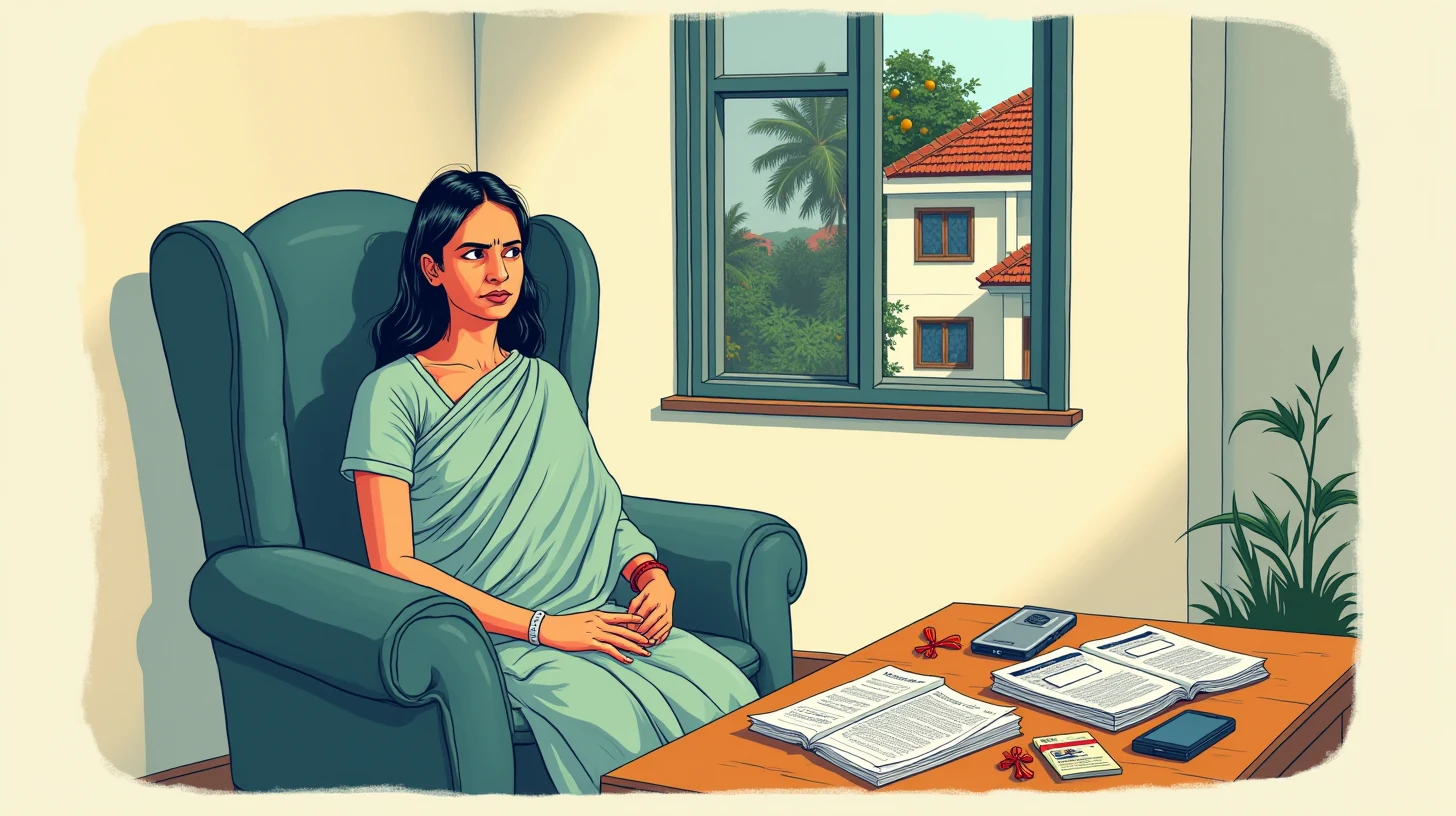
Priya, thirty-eight, had been living in Daman with him and her mother since her husband's transfer to the port authority. When the cremation ended and the relatives left, she was alone with her mother and the weight of administration that comes after death.
Her father's will was clear: the Daman bungalow to her mother, the ancestral plot in Silvassa—a piece of land in the neighboring Dadra and Nagar Haveli region that had belonged to his family for generations—to Priya and her two brothers equally. But the will existed on paper. The government required something different: mutations, succession certificates, proof of legal inheritance.
On February 18th, seven days after the cremation, Priya walked into the Daman Tahsildar Office.
🗓️ The UT merger that unified nothing
Dadra and Nagar Haveli and Daman & Diu were merged into a single union territory in January 2020. The union government published press releases about unified administration. They talked about streamlined land records. A single revenue department, theoretically. A single land registry, in theory.
Her father's property straddled both jurisdictions. The Daman bungalow was in Daman municipality. The ancestral land plot—two acres of low-yield agricultural land, worth perhaps ₹18 lakh at current market rates—sat in Silvassa, forty kilometers away, in what was technically the Dadra and Nagar Haveli section of the UT.
On paper, after the 2020 merger, they should have been under the same revenue regime. Same state, same rules, same office architecture. In practice, the Daman tahsildar's office and the Silvassa tahsildar's office still maintained separate ledgers. They still required separate applications. They still processed succession certificates using different forms. The merger had been administrative, not operational.
Priya learned this by asking. The clerk at the Daman office, a woman named Sheela with reading glasses on a chain around her neck, told her with casual certainty: "You will need two legal heir certificates. One for Daman property. One for Silvassa property. The Silvassa office keeps their own records."
"But it is the same union territory now," Priya said.
"Yes, same union territory," Sheela agreed, as if this explained nothing. "But different tahsildars. Different old records. They have not yet merged the databases."
⚠️ The bank that wanted both
Three weeks after the cremation, Priya's mother received a call from the State Bank of India. Her father's fixed deposit account, opened in 1998, held ₹8.5 lakh. It was frozen pending proof of legal succession.
The bank manager explained: succession certificates were required from all jurisdictions where the deceased held property. The Daman certificate alone was not enough. The Silvassa property required its own certificate. Only with both documents could the bank release the deposit to her mother.
This was when Priya understood: she would navigate not one succession, but two parallel ones.
"The bank," the manager said, "needs to see that succession has been established in all jurisdictions where your father held assets."
Priya sat at her kitchen table with her mother and her notebook and began to write down the steps. Two tahsildar offices. Two separate applications. Two different forms. Two different processing times. And at the end of both, maybe, the fixed deposit would be released.
She called her brothers in Bangalore and Delhi. She explained the situation. They said to proceed without them—the property in Silvassa was in Priya's name on the deed anyway, as her father had named her as the primary claimant for the ancestral land. (In his family, daughters were increasingly being named as property holders, though the preference for sons was still cultural default.) The succession certificate would be in her name, and her brothers would sign the deed transfer when that time came. For now, Priya would carry the succession alone.
- ⚖️
February 11 — Death and cremation
Her father dies on February 11. After three days of rituals, Priya begins the succession process.
- 📋
February 18 — Daman Tahsildar, first visit
Priya learns she needs two legal heir certificates. She files for the Daman bungalow certificate first.
- 📨
February 23 — Bank freeze notice
SBI Daman calls about the ₹8.5 lakh fixed deposit. They will not release funds until both succession certificates arrive.
- 🗂️
March 5 — Silvassa tahsildar application
Priya travels to Silvassa to file the second succession application for the ancestral land. She discovers the database is still separate.
🌗 The agent and the two-tahsildar pathway
Priya had heard about the agent from her cousin's wife in Belgaum—a tool you could type questions into, and it would find government information that was scattered across websites or buried in old PDFs. She was skeptical at first. Government work, in her experience, required walking into offices in person, standing in queues, learning the unwritten rules from other people waiting in the same queue.
But on the evening of February 23rd, after the bank manager's call, she opened a browser and typed carefully: "legal heir certificate daman silvassa succession two properties different tahsildar."
The agent responded within a minute. It provided the exact form numbers for both the Daman and Silvassa succession certificates. It listed the documents Priya would need: the death certificate, her father's will, the ration card, the bank passbook, proof of residence. It gave her the office address for the Silvassa tahsildar—an address that was not easy to find, because the Silvassa office's website was outdated and did not list the street name.
But more importantly, the agent structured the two processes in parallel. It told her: "The bank requires succession certificates from both offices. You do not need to wait for one before filing for the other. You can file both applications immediately. The Daman office will likely process in 3-4 weeks. The Silvassa office may take 4-6 weeks, due to lower office volume. File both. When the first one is ready, the bank can request it. When the second arrives, file the mutation order for the Silvassa property."
What it does
- 🔍Identifies which tahsildar office has jurisdiction over each property, based on location.
- 🗂️Locates the correct forms and documents required by each office, including out-of-date website information.
- ⏰Provides typical processing timelines from government sources, so you know when to follow up.
- 📞Surfaces the phone numbers and office hours for both tahsildar offices.
What it does not do
- 🔒Never submits applications on your behalf; you must visit the office and file the forms in person.
- 💳Never generates documents or certificates—only the tahsildar can issue these.
- ✅Never decides which property goes to which heir; only the will and succession law determine this.
Priya printed out the information the agent provided. She marked the form numbers in yellow. She created a folder on her desktop labeled "Succession — Dad." She began to organize.
On February 25th, she visited the Daman Tahsildar Office in person with her mother. She brought the death certificate (issued by the civil hospital), the will (notarized), her father's Aadhaar card, the ration card, the bank passbook, and the property documents for the Daman bungalow. She filled out Form A-1, the legal heir certificate form, in her own hand, because the clerk told her that typed forms were often rejected for signature-verification reasons.
The clerk reviewed everything. He stamped the form and gave her a receipt. Processing time: 3-4 weeks.
On March 1st, Priya took an autorickshaw to Silvassa. The town was quieter than Daman, with narrower streets and older colonial-era buildings. The Silvassa Tahsildar Office was in a small compound near the main bazaar. She found the same form, but with a different header—this one said "Dadra and Nagar Haveli Revenue Department" instead of "Daman & Diu Revenue Department." The clerk in Silvassa asked for additional documents: a revenue survey report showing her father's name and the ancestral plot boundaries, and a copy of the land tax receipt from the previous year.
"We keep our own record of ancestral properties," the Silvassa clerk explained. "We need to verify the land is still in his name in our ledger."
The verification took another week. Priya had to visit the revenue surveyor's office, provide a small fee (₹280), and request a certified copy of the 2024-25 land tax receipt. Only then could she complete the Silvassa form and file it.
By March 8th, both applications were in the system.
"આપના પરિવારમાં જો મિલકત બે જુદા જુદા તહસીલ કચેરીમાં છે, તો તમે બંને યોજના માટે એક જ વખતે અરજી કરી શકો છો. રાહ જોવા ની જરૂર નથી એક ના બીજો."
(If your family owns property in two different tahsildar offices, you can file applications for both at the same time. You do not need to wait for one before filing the other.)
🧭 Why the merger did not merge
The 2020 union territory merger promised unified land records and streamlined succession. But the Daman and Silvassa revenue offices remained operationally siloed. The databases were not merged. The forms were not fully standardized. A person with property in both jurisdictions—like Priya's father—had to navigate as if the merger had never happened.
The bank's demand for two certificates was not redundancy. It was the bank protecting itself against a fragmented system. Without both certificates, there would be a legal question: did the Silvassa property belong to her father's estate or not? The bank would not release the deposit until both jurisdictions confirmed their portion of the succession.
"આપના પપાએ આ બે જગ્યા પર મિલકત રાખી હતી, પણ સરકાર અલગ અલગ માને છે."— My father owned property in both places, but the government treats them separately.
By late March, the Daman certificate arrived. Priya collected it and immediately sent a scanned copy to the SBI branch manager. The Silvassa certificate followed on April 2nd. Within five days of submitting both to the bank, the ₹8.5 lakh fixed deposit was released to her mother's account.
The mutation process for the Daman bungalow—transferring the property title from her father's name to her mother's—took another two weeks. By late April, the Daman property was formally in her mother's name. The Silvassa land remained in limbo, pending the formal mutation application that Priya would file in June, once her brothers could travel for the signing ceremony.
🌱 The quiet inheritance
In the months after her father's death, Priya learned things she had not known she would need. She learned why banks freeze accounts after death, and why they stay frozen until succession certificates arrive from every jurisdiction where the deceased held property. She learned that administrative mergers are not the same as operational ones.
But she also learned something quieter: her father had given her a gift that many caregivers do not receive. His will was clear. He had planned. He had written it down. Because of that clarity, Priya's succession was straightforward—two properties, one will, two offices, but no ambiguity about who inherited what.
Many families in Daman do not have that clarity. A parent dies without a will, and the children fight. A will is lost. Or property has been in the family so long that no one can find the original deed. Priya's father, a retired government clerk, had left everything documented and ready.
She sits in the Daman bungalow now—her mother's property, her childhood home—and feels a kind of gratitude separate from grief. He left them the document. The system made them walk through two offices, wait through two timelines. But the document gave them a clear endpoint, a home waiting on the other side.