
The Itanagar son and the tribal pension that went silent
Temjen Wangsu is thirty-nine years old. He works as the administrator of a secondary school in Itanagar, the capital of Arunachal Pradesh — a town of roughly one hundred and twenty thousand people spread across a steep valley in the northeastern foothills, where afternoon rains come in at four o'clock and the power supply is, in his experienced opinion, a courtesy rather than a guarantee. He lives with his wife, a nurse at the District Hospital, and their two children in a rented house in Naharlagun, twenty minutes from Itanagar proper, in the direction of the Kameng River. His father, Yangda Wangsu, is sixty-eight years old and lives in the old family house in Banderdewa, forty kilometres north of Itanagar, in the region where the Papum Pare district becomes more forest than town. He is a retired schoolteacher, Nyishi ethnicity, and has lived in that house alone, by choice, for the fifteen years since Temjen's mother passed.
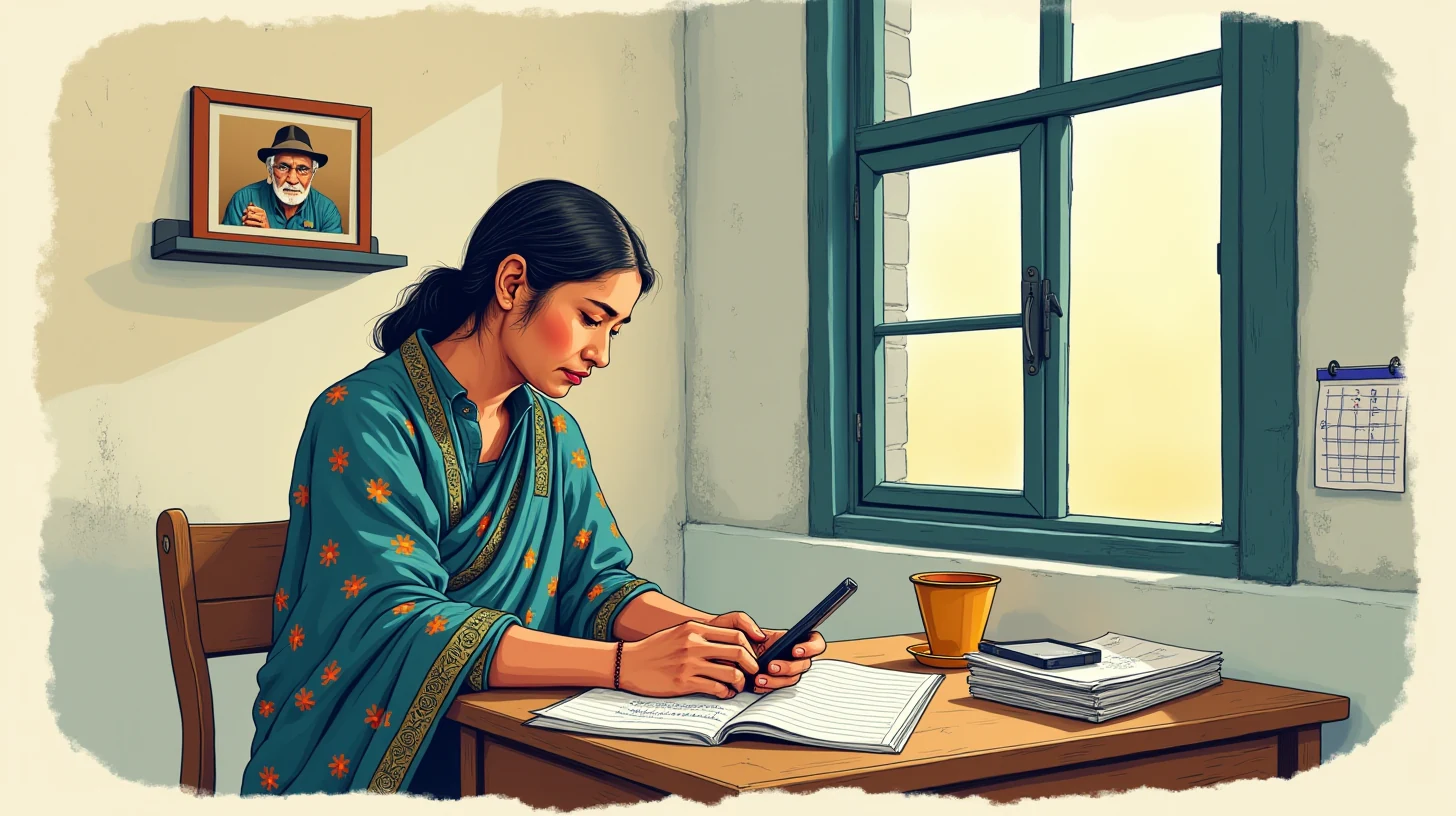
Yangda Wangsu had been receiving a monthly pension of ₹1,000 from the Arunachal Pradesh Department of Social Justice as an ST (Scheduled Tribe) old-age pension, deposited directly into a State Bank of India account at the local branch in Banderdewa. The pension had been regular. It arrived on the first of each month, without fail, for eight years. In April of this year, it stopped.
The SMS came first: a government notification asking Yangda to visit the designated Aadhaar seeding centre in Itanagar — a distance of forty-two kilometres from Banderdewa — to complete his biometric validation for the Jeevan Pramaan proof-of-life certificate. The notification, which arrived as a series of three SMS messages in a mix of English and Hindi, said the visit was "mandatory" and that failure to complete it within thirty days would result in "pension suspension under GoI NREGA guidelines" — a regulation Temjen later determined had nothing to do with old-age pensions, and which suggested the SMS templates were copied from unrelated schemes.
Yangda did not visit the seeding centre. He showed the SMS to Temjen on a Saturday when Temjen came home for the weekend. Temjen read it and did not understand it. He called the DC office in Itanagar. The DC office said they could not discuss pension matters and that he should call the Social Justice Department helpline. He called the helpline. The line was engaged for thirty minutes, and then went to an IVR system that offered options in Hindi and English but not in Nyishi or Assamese. He waited and was eventually transferred to a human being who confirmed that Yangda's pension had been suspended on the sixteenth of April because his biometric could not be verified in the system, and that a formal notice would be posted within seven working days.
The notice arrived a week later, in Hindi, addressed to Yangda by his Aadhaar number, not his name. It said that the pension had been suspended due to "biometric discrepancy" and that it would remain suspended until (a) he completed his biometric registration at the seeding centre, and (b) the District Commissioner confirmed that his original Scheduled Tribe status certificate was still valid. The address for the seeding centre was a government building with no street number, and the office hours listed were "9 AM to 1 PM, except Thursdays."
Yangda's monthly pension was ₹1,000. He had no other income. He owned the house in Banderdewa but had no land. Temjen's school salary was ₹28,000 a month. His wife earned ₹24,000 at the hospital. Their rent, for a three-room house, was ₹8,000. Yangda's ₹1,000 went to his mobile bill, his groceries, and the boy from the village who came twice a week to help him with the heavier work around the house.
This is a story about what Yangda did for the seven weeks that his pension did not arrive, what Temjen's wife Neha kept asking, and what changed when Temjen's sister-in-law — a woman named Aditya who works in the Itanagar Municipal Corporation and who speaks Nyishi, Hindi, English, and Assamese with equal ease — suggested that he try the agent on his father's phone.
🗓️ The quarterly seeding ritual and the certificate that never expired
The Jeevan Pramaan system — the "Life Proof" certificate — is a mechanism designed by the Ministry of Pension and Pensioners' Welfare to reduce pension fraud. Once a pensioner turns sixty, and begins receiving benefits, the government requires a proof-of-life verification either annually or once every two years, depending on the scheme. For state-level old-age pensions managed by individual state departments, the requirement is typically annual. The verification is performed through an Aadhaar biometric scan at designated seeding centres. The pensioner shows up, places their fingerprint or iris on a scanner, the scan is matched against the Aadhaar database in New Delhi, and if it matches, a digital proof-of-life certificate is generated and the pension continues.
For Yangda, this process had been routine. There is an Aadhaar seeding centre in the Itanagar government hospital complex, and it operates, in theory, five days a week. Yangda had completed his seeding visit without difficulty in April of the previous year, in June the year before that, and in March two years before that. The visits took about forty minutes total: a bus from Banderdewa to Itanagar, the visit itself (fifteen minutes), and the bus back. He had walked into the centre, placed his fingerprint, walked out, and heard nothing further. The pension had continued. There was no feedback. There was no explicit confirmation. The system presumed, if nothing went wrong, that the verification had succeeded.
In April of this year, something went wrong. The fingerprint scan failed. The biometric on file did not match Yangda's current fingerprint. The operator at the seeding centre attempted the scan twice, with both index fingers, and both times the system flagged the mismatch. The operator — a contract employee, not a government official, paid by the Ministry of Digital Services to staff these centres — told Yangda that there was "an issue with the database," that he should try again next week, and that in the meantime everything should be fine.
Everything was not fine. The seeding centre's system flagged the failed biometric as a "mismatch event" and uploaded it to the central Jeevan Pramaan database. The database, reading the mismatch event, automatically sent a suspension notice to Yangda's pension account manager at the Social Justice Department. The pension was suspended. The notice was generated. The SMS was sent. The pension was not paid on the first of May.
Yangda called the seeding centre. He was told that he should wait for the notice and follow its instructions. Yangda waited. The notice arrived. It was in Hindi. Yangda reads Nyishi and English, and he can read Hindi slowly, but he was looking for the word "pension" and found instead the phrases "biometric authentication failure," "compliance review," and "Scheduled Tribe status verification." He did not understand the notice. He called Temjen.
Temjen, reading the notice, understood the literal words but not the bureaucratic logic. If the biometric had failed, why did the notice say anything about tribal-status verification? If Yangda's tribal status had been questioned, why had the pension been paid regularly for eight years? The notice listed two actions: "complete Aadhaar seeding at the designated centre" and "submit updated Scheduled Tribe status certificate to the District Commissioner." The seeding centre was in Itanagar. The District Commissioner's office was also in Itanagar. The distance from Banderdewa to Itanagar, one way, was forty-two kilometres and required either a bus journey through town or a private vehicle. Yangda had neither regular access to a bus that suited his schedule nor a vehicle of his own.
⚠️ The Aadhaar update camp that came once a quarter and the deadline that was always next
The Arunachal Pradesh government, having decentralized some of the Aadhaar seeding operations, scheduled quarterly update camps in smaller towns and villages. These camps came to Banderdewa once every three months, according to the official schedule — set for the second Wednesday of June, September, December, and March. Yangda could walk to the Banderdewa camp. It would take him thirty minutes.
But Yangda's fingerprint mismatch had happened in April, after the March camp had passed and before the June camp was scheduled. The notice said the suspension would remain in place until the seeding was completed. It did not say that using the quarterly camp was an acceptable alternative to going to the Itanagar centre. It said "complete Aadhaar seeding at the designated centre." The designated centre, according to the Social Justice Department's website and the notice itself, was in Itanagar.
Temjen called the Social Justice Department helpline again. He reached a different person this time. This person said that yes, the Banderdewa camp would count as a seeding update, but only if it was completed before the thirty-day grace period ended. Today was the twelfth of April. The grace period ended on the fourteenth of May. The Banderdewa camp was scheduled for the tenth of June.
Temjen did the mathematics. The grace period would expire before the camp arrived.
He asked whether the grace period could be extended. The person on the phone — his name was Keshav, and he spoke Hindi — said that extensions had to be applied for at the District Commissioner's office, and that the application would require documented proof of hardship. Temjen asked what "hardship" meant. Keshav said it could mean mobility issues, medical conditions, or caregiver responsibilities. Temjen said his father had no documented medical issues; he was simply elderly and lived in a village and did not have easy access to Itanagar. Keshav said that that was not necessarily hardship, but that if his father had a written statement from a doctor or the village head, he could try. He also said, in the tone of a person who had said this many times, that the policy existed to prevent fraud, and that it was the government's job to prevent fraud, and that if preventing fraud was inconvenient, that was the price of integrity.
Temjen did not go to the doctor. Banderdewa did not have a sub-centre with a doctor; the nearest one was in Itanagar. Going to Itanagar meant the same thing his father had to do: forty-two kilometres away, half the day.
He decided to wait for the Banderdewa camp. It was two months away. Surely something could be arranged. Yangda would manage without the ₹1,000 for two months. It would be tight, but Temjen would help.
The camp arrived on the tenth of June, one day before the sixty-day deadline. Yangda walked to Banderdewa. The camp was a small folding table in the primary school, staffed by a young woman from the Itanagar office on a temporary posting. The woman scanned Yangda's fingerprint. It matched. A success. The woman said the update would be processed in the Itanagar system within three business days, and the pension would resume.
It did not resume. Temjen waited. He called the helpline on the fourth day. The woman who answered said that the camp submission had been received, but the process was now delayed because of a secondary flag: the Scheduled Tribe status certificate had been flagged as "requiring re-verification" during the compliance review that had been triggered by the biometric mismatch. She said Yangda would need to go to the District Commissioner's office with the original Scheduled Tribe certificate to have it verified.
🌗 The sister-in-law and the phone that began to read the letters
Aditya Tamang, Temjen's sister-in-law, came to visit on a Saturday in the second week of June. Temjen told her the story. Aditya listened, and when Temjen finished, she said: "Temjen, mero agent phones ma padhirako chha ni. Father-la ne install gara?" (Temjen, my agent reads stuff on my phone. Have you installed it for Father?)
Aditya works in the Itanagar Municipal Corporation. She processes building permits and land-use changes. She had started using a Hindi-Nyishi agent for reading the municipal documentation that comes through — circulars from the state government, court orders, and occasionally notices in a mix of languages. She had found that reading an SMS or a letter in Hindi, and then having it explained in Nyishi by the agent's voice, was faster than calling someone or waiting for Temjen to be available.
She offered to install it on Yangda's phone. Yangda had a phone — a Micromax Android device, five years old, cracked screen, that he used for occasional calls and video chats with Temjen's children. He did not have data, but Aditya said the agent could be set to cache conversations offline.
The following Saturday, Temjen and Aditya went to Banderdewa together. Aditya set up the agent on Yangda's phone. She showed him, in Nyishi, how to take a photograph of the notice and let the agent read it. She showed him how to ask for the phone number of the District Commissioner's office. She showed him how to ask the agent to explain, in simple Nyishi, what needed to happen next.
Yangda was skeptical. He had seen many things promised to elderly people that did not work. But he tried it. He held up the Social Justice Department notice — the one in Hindi that had been sitting on his table for five weeks. He opened the agent. He tapped the camera button. The agent read the notice and replied, in Nyishi, in a woman's voice that he described later as "like my granddaughter, but patient":
"Father, this notice is saying two things. First, your fingerprint was not matching in the system, but we just fixed that at the camp. Second, the office is wanting to see your Scheduled Tribe certificate to make sure it is still real. You need to take that certificate and go to the DC office in Itanagar and show it to them. They will check it and write a letter saying it is still good. Then the pension will come again."
Yangda had the Scheduled Tribe certificate. It was in a small wooden box in the corner of the room, along with other government papers — his retirement certificate from the education department, his marriage certificate (Nyishi, translated to English), and his wife's death certificate from 2011. The certificate said, in English, that Yangda Wangsu, born 1958, is a member of the Nyishi Tribe and is entitled to benefit from the Scheduled Tribe status in the State of Arunachal Pradesh. It was issued by the District Commissioner in 2005, twenty-one years ago. It was still in his name. It looked, to Temjen's eye, exactly as it had looked when his father had shown it to him for the first time.
The agent, reading a photograph of the certificate and the notice together, said: "This certificate is very old. Offices sometimes want them checked again. It is not saying your certificate is wrong. It is just saying to check. Take the certificate and the notice both to the DC office. Take Temjen with you. Take the original certificate, not a copy."
Yangda had, until that moment, been preparing to send the certificate by post, or by asking someone to carry it. The agent had said, specifically, to go himself. It was a small thing, but it changed his mind. He called Temjen on Sunday evening. He said, in Nyishi: "We should go on Tuesday. I will be ready."
🧭 Why the system breaks differently for rural elders and why we built it
There are, in Arunachal Pradesh, approximately forty-seven thousand pensioners receiving state old-age pensions at any given time. Of these, roughly seventy percent — thirty-three thousand — are Scheduled Tribe pensioners, eligible under the enhanced ST old-age pension scheme that provides a slightly higher pension than the general old-age scheme (₹1,000 versus ₹850 per month, in most cases). The vast majority of these pensioners live in villages or small towns. The vast majority do not speak English. Many do not speak Hindi fluently. Most do not have regular access to the capital.
The Jeevan Pramaan proof-of-life system was designed to prevent fraud — pensioners claiming benefits for deceased relatives, or applying for multiple pensions using false identities. It is a reasonable goal. The implementation, however, assumes that a pensioner can easily reach a seeding centre, can understand a notice in Hindi or English, and can navigate a compliance escalation without assistance. For Yangda, every one of these assumptions was false.
The biometric mismatch itself — a common occurrence among elderly pensioners with worn fingerprints, or those who have worked with their hands for a lifetime, or those in agricultural communities where hand injuries are routine — should have been treated as a recoverable error. The system should have sent a notice in Nyishi (or Assamese, or Arunachal's other languages), explained the issue simply, offered the quarterly camps as an alternative, and sent a reminder SMS when the camp was coming. Instead, it generated a three-step cascade — biometric failure to pension suspension to tribal-status re-verification — each step triggered by a rule written for a different population in a different context, each step explained in a language the recipient did not speak.
We built an agent that lives on the Android phone that Yangda already had. It reads the notices when they arrive. It explains them in Nyishi. It answers the questions he would ask a younger relative if that relative lived next door. It does not decide anything. Yangda still owns the certificate, Yangda still went to the DC office, Yangda is still the person engaging with the system. What it does is translate the system's language into his.
- ⚠️
April 12 — Biometric mismatch at seeding centre
Yangda's fingerprint does not match the Aadhaar database. The centre operator says to try again next week. Nothing seems wrong.
- 📨
April 16 — Pension suspended automatically
The mismatch event triggers an automatic suspension notice to the Social Justice Department. The pension is deactivated. No SMS arrives for four days.
- 🛑
April 20 — Notice arrives in Hindi
The formal notice arrives, mentioning both biometric failure and Scheduled Tribe status re-verification. Temjen does not understand the connection. The notice lists no deadline but implies urgency.
- ⏰
April 21-May 14 — Thirty-day grace period expires
Temjen discovers the grace period ends on May 14. The next quarterly seeding camp is June 10. The gap is too large. He cannot extend the deadline without proof of hardship.
- 📱
June 10 — Banderdewa camp biometric succeeds
Yangda's fingerprint matches at the camp. The submission is sent to Itanagar. Temjen waits for the pension to resume.
- ₹
June 15 — Secondary flag: tribal-status re-verification required
The helpline reveals a second requirement: the District Commissioner must verify the original Scheduled Tribe certificate. Yangda has it but must go to Itanagar.
What the notice said (in Hindi)
UnclearBiometric discrepancy flagged. Scheduled Tribe status verification required. Re-registration at designated seeding centre mandatory. Compliance review pending. No clear explanation of the connection between the two issues, no timeline that made sense to a reader who had just visited a seeding camp.
What the agent explained (in Nyishi)
ClearYour fingerprint did not match at the centre. The camp will fix that. But the office also wants to see your tribal certificate to make sure it is still real. Both things need to be done.
What Yangda needed to do
ActionableGo to the DC office with the original certificate and the notice. Show them the certificate. Get a letter confirming it is still valid. That is all.
"Mera pension ke baad se, main har mahine sochta tha — kya is baar aaega, ya nahi aayega? Ab agent mujhe batata hai, sab theek hai. Main samajh sakta hoon."— Every month after the pension stopped, I would wonder — will it come this time, or not? Now the agent tells me what happened, and I can understand.
Temjen and Yangda went to the District Commissioner's office on Tuesday morning. They took a shared cab from Banderdewa, which cost ₹180 per person. The office was on a steep hill in Itanagar, accessible by a long concrete staircase that left Yangda slightly breathless. Inside, they found a clerk named Sunita who processed Scheduled Tribe certificate verifications. Sunita looked at the certificate, looked at Yangda, checked a register, and said that the certificate was valid and had never been questioned. She asked why it was being re-verified. Temjen showed her the notice. She read it and said, in a tone of mildness that might have concealed irritation, that the notice was the result of an automatic process that the Jeevan Pramaan system had triggered, and that the system was sometimes overly cautious.
She wrote a letter, on DC's office letterhead, saying that Yangda Wangsu's Scheduled Tribe status certificate, issued in 2005, remained valid and was not in question. She stamped it. She handed it to Yangda. She said it should be sent to the Social Justice Department within the week.
Temjen sent it by registered post the same day. It arrived on Friday. On Monday, the first of July, Yangda's pension arrived. It was ₹1,000, the same as before. The next pension came on the first of August, and the first of September. Yangda told Temjen that he was never going to need to go to the DC office again because he was going to die before his certificate needed re-verifying.
But what actually changed was smaller. Yangda stopped putting the notices in a drawer. The notices still arrive — SMS messages from the government, occasionally a physical letter. Yangda still does not understand Hindi. But now, when a notice arrives, he photographs it, the agent reads it in Nyishi, and he knows whether it is urgent or routine, whether it needs something from him or is merely informational. The agent has not removed the notices. It has removed the silence that sits between receiving a government letter and understanding what it says.
🌱 The quiet close
There are, across India, hundreds of thousands of rural pensioners for whom a government notice in English or Hindi is, functionally, an unopened letter. They live in towns and villages. They are sixty years old and older. They have never had reason to learn the language of administration. The notices arrive anyway, in a language they do not speak, asking for things they do not understand. Some of them have children in cities. Some of them do not. Some of them arrange for help. Some of them do not. Some of the pensions get suspended, and some stay active by accident or luck. The system does not mean to punish them. It is simply indifferent to whether they understand.
Yangda is not — and would not claim to be — a particularly vulnerable person. He has a pension. He has a son. He has a house. He has enough. What he did not have was a bridge between the world of government notices and the world of his own language. The agent is a small thing. It reads letters. It explains them. That is all.
But for a man who lived for seven weeks in the uncertainty of whether his income would return, in the small shame of not understanding the letters addressed to him, in the knowledge that he was burdening his son and his son's wife with the weight of translation, the smallness of it is the whole point. Not a solution. An answer. Not a restructuring of government. A moment where a notice, when it arrives, is no longer a mystery.
The pension is still ₹1,000. The government still asks for biometric proofs. The quarterly camps still come once every three months. Yangda still has to understand the system. He just does not have to understand it alone.