
The Kavaratti daughter and the mainland-referral form her father's prostate biopsy needed
Amara had lived in Kavaratti for thirty-one years, since her marriage to a fisherman's son. She kept a small medical clinic from her home—not as a doctor, but as a nurse trained in basic screening and wound care—and tended to her aging father, Krishnan, who had moved to the island after his wife died. On the morning of February 14, 2026, the results from Indira Gandhi Hospital arrived on a slip of paper. His PSA—prostate-specific antigen—had jumped to 18. Normal is under 4. The doctor had marked it in red pen and written a two-word recommendation: "Biopsy needed."
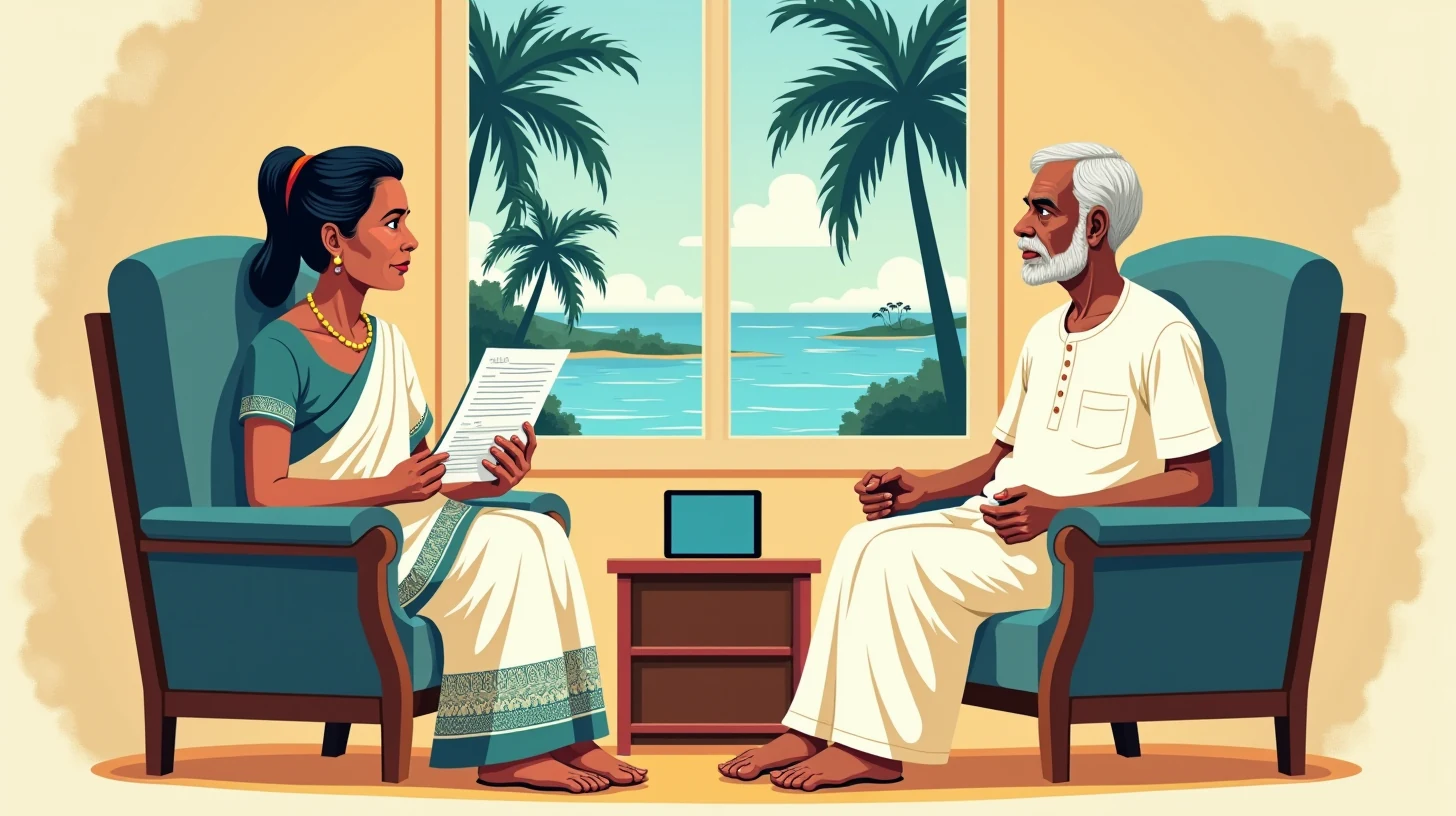
The island hospital could do blood draws, basic imaging, minor surgery. A prostate biopsy—tissue sampling under ultrasound guidance—required a urologist and pathology lab that Lakshadweep didn't have. Every complicated case went to the mainland. Kochi, three hundred and seventy kilometres away, was the nearest centre with the equipment. Amara had known this intellectually; now it was her father's body at stake.
What she didn't know was that the referral form wasn't a single sheet. It was a chain. The island's Medical and Health Services Department had to issue a formal recommendation to the Lakshadweep Administration. The Administration had to approve transport—either a plane ticket on the government's emergency-evacuation charter or a subsidised sea passage. Then came the "patient cannot self-arrange" affidavit, a legal document swearing that her father had no means to pay privately. None of these forms had names attached. No one had told her where to find them or whom to ask first.
🗓️ The island referral ritual
Lakshadweep had one operational island hospital—Indira Gandhi in Kavaratti—and three smaller primary health centres on the outlying atolls. For serious illness, the Department of Health Services had developed a standard sequence over decades. A patient needed a letter from the island doctor confirming the diagnosis and stating why mainland care was essential. Then came the administration hurdle: proving that the person couldn't afford private treatment elsewhere, and securing transport approval because flying or ferrying someone off the island was an expense the government had to justify.
Amara had walked to Indira Gandhi Hospital on the third morning after the PSA result, a concrete building near the lagoon with a government placard above the entrance. The urologist—one of two on the island, both visiting weekly—had confirmed that a biopsy couldn't be done there. "You'll need to go to Kochi," he said. "The referral department handles the paperwork." He handed her a carbon-copy form, already half-filled.
The referral department occupied a single room with two desks. The woman behind the left desk looked up and said, "This goes to Health Services first. You'll need to ask the director." The director's office was at the other end of the hospital. There, a clerk told her, "The form needs the medical superintendent's stamp, and then it goes to the Lakshadweep Administration in the capital office. That's in Kavaratti town. You can't submit it yourself—it has to go through official channels." Official channels, Amara learned, meant a delivery process that could take two weeks if the courier was busy, or never at all if the form landed on the wrong desk.
This was the ritual. No single point of contact. No phone number to call and ask, "Is my form in the queue?" The process had been designed for the rare case, in the 1990s, when perhaps three families per month needed mainland care. Now, with increasing chronic disease and a population scattered across twelve inhabited atolls, the system had become a bottleneck held together by the memory of individual staff members.
⚠️ The window closing
February turned to March. Amara checked with the hospital every three days. "Still processing," they said. No biopsy appointment could be booked in Kochi without a letter from Lakshadweep Administration confirming both the medical need and the transport approval. Her father's PSA was still 18. At his age—eighty-three—a high PSA left untreated could mean cancer spreading silently for weeks while paperwork circulated.
Amara began a parallel hunt. She called the Lakshadweep Health Services office using the number listed on their website portal at lakshadweep.gov.in/health-services/. The phone rang six times and went to a message. She sent an email to [email protected], the department email. Four days passed. No reply. She went back to the hospital, this time asking for the medical superintendent directly. He was kind but overworked. "The referral system," he told her, "is not my office. Once the form leaves here, it's in the administration's hands. I can only stamp my part."
The deadline in her mind was loosening. If Krishnan's biopsy wasn't done by mid-April, she'd have to repeat the PSA blood test to confirm the reading was stable. If it had risen further, they'd be starting over. She began staying awake at night, imagining scenarios where the tissue was already malignant and every day of delay was a day it spread.
Her sister, who worked in an NGO in Kochi, called and asked if she wanted to just take him privately—pay the ₹45,000 biopsy cost out of pocket and skip the government process. But Amara's father was a pensioner. The Indira Gandhi Hospital staff had hinted that they had Ayushman Bharat PM-JAY coverage—a government scheme covering up to ₹5 lakh in tertiary care per year. If she went private, he'd lose that protection. "Use the scheme," the nurse had said quietly. "It's why you're paying taxes." The catch was that the scheme only paid for care at empaneled hospitals listed with Ayushman Bharat, and Kochi hospital didn't show as empaneled until the referral letter arrived and the hospital registered him.
By late March, nothing had moved. The form, as far as Amara could tell, was somewhere between the hospital and the Lakshadweep Administration capital office. The medical superintendent had stopped picking up the phone—not out of rudeness, but because he was seeing patients. The referral department had told her, "We did our part. You need to follow up with the administration."
- ⚖️
Day 1–3: Hospital urologist diagnosis
PSA result confirmed; referral form initiated at Indira Gandhi Hospital. Urologist confirms biopsy cannot be done on island.
- 📋
Day 4–7: Hospital referral department
Form prepared; patient directed to obtain medical superintendent's stamp and submit to Health Services office. No timeline given.
- 🗂️
Day 8–14: Lakshadweep Health Services approval
Form submitted to director; medical-board recommendation drafted; submitted to Lakshadweep Administration. No tracking.
- ✈️
Day 15–28: Transport approval (admin capital)
Administration approves plane or sea passage. Affidavit ('patient cannot self-arrange') witnessed and stamped. Approval sent back to Health Services.
- 📨
Day 29–35: Referral letter issued
Health Services issues formal referral letter to mainland hospital and patient. Mainland hospital confirms receipt and books appointment.
- 🛑
Day 36+: Biopsy appointment
Patient travels; undergoes procedure; reports back. Total elapsed time: 35–45 days minimum.
🌗 The moment the tablet made a difference
On April 2, Amara sat at her kitchen table with her phone and a tablet belonging to her nephew, who'd left it with her. She'd downloaded the agent app weeks earlier, unsure of how to use it. She'd typed a few questions about PSA levels and prostate health, but never about bureaucracy. Now, frustrated and running out of time, she opened a new chat.
She typed: "My father's referral form is somewhere in the Lakshadweep government system. We've been waiting six weeks. No one can tell me where it is or when it will be approved. The hospital referral department says it's with the administration. The administration doesn't answer phones. How do I find out what's holding it up?"
The agent responded by asking a series of clarifying questions. Where exactly had she last confirmed the form was? Did she have a reference number? Had she tried the public service portal through which mainland referrals were formally tracked? This last question—about a portal—made Amara realise she'd been asking at the hospital for a process that might have existed online. The agent walked her through navigating the Lakshadweep Health Services portal at lakshadweep.gov.in/health-services/ and looking for a "Referral Status" tracking tool.
The portal had one. It required her to enter the patient's Aadhaar number and the date the referral was filed. Within seconds, a status appeared: "Pending medical-board recommendation signature." It had been stuck there for twelve days. The responsible officer was listed as Dr. S. Priya, Deputy Director, Health Services.
"Call her directly," the agent suggested, providing the main office number from the portal. "Have your father's Aadhaar and referral date ready. You're not asking for a favour; you're asking for status on a process that's already in motion."
Amara called the next morning. Dr. Priya's assistant answered, sounding harried. Amara gave the Aadhaar number and referral date. The assistant said, "Let me check." Thirty seconds later: "Oh, this one. Yes, it's waiting for the medical superintendent's counter-signature on the recommendation letter. The hospital didn't send it back to us after they stamped it." It had been sitting at Indira Gandhi Hospital the whole time—no one had told the administration or the patient.
Amara walked back to the hospital. The medical superintendent, when cornered in his office, looked embarrassed. The stamped recommendation had been filed in a paper tray marked "To send to admin." Someone had forgotten to actually send it. He called the referral department on the spot and watched them place it in the hands of a staff member who was driving to the capital office that afternoon. "It will be there tomorrow," the superintendent promised.
She typed back to the agent: "Found it. It was at the hospital all along. They're sending it today."
"നിങ്ങൾ കണ്ടെത്തിയത് വാസ്തവം. എന്നാൽ നിങ്ങളുടെ പിതാവിന്റെ നാമം, അവരുടെ സമൃദ്ധിയുടെ കുറിപ്പ്, ഇവയെല്ലാം സരകാരി വെബ്സൈറ്റിൽ പരിരക്ഷിതമാണ്. ഇപ്പോൾ നിങ്ങൾ വിവരാവകാശത്തിന് പ്രയോജനപ്പെടുത്തിക്കോളുക."
(Your father's name, the status, the notes—they're all protected by law on the government site. You now have the right to request updates directly, and each office must respond within fifteen days.)
"ആറ് ആഴ്ച ഞാൻ കാത്തിരുന്നു — ഫോം ആശുപത്രിയിൽ തന്നെ ഉണ്ടായിരുന്നു."— Six weeks I waited, and the form had never left the hospital.
🧭 Why the gap exists, and why it swallows families
The mainland-referral system in Lakshadweep was designed with good intent. Free or subsidised transport for those who couldn't afford private care. Medical boards to ensure the referral was medically necessary and not a convenience. The Ayushman Bharat PM-JAY scheme covering the tertiary-care cost—up to ₹5 lakh per family per year—made serious illness theoretically affordable.
But the system had three invisible fractures.
First, the referral paperwork flowed through a chain of seven offices, each with a singular job and no view of the pipeline. The hospital couldn't see what the Health Services office was doing. Health Services couldn't see whether the Administration's transport section had approved the passage. No one had a dashboard showing where any form was at any moment. If a form got stuck—filed in the wrong tray, waiting for a signature, or sitting on someone's desk while they were on medical leave—there was no alarm. No one checked. The patient and family just waited, without knowing if they should wait one more day or escalate.
Second, no family was told upfront that the process took 35 to 45 days. Amara had expected a week, maybe two. When it stretched into six, she didn't know if she was unlucky or if this was normal. That uncertainty paralysed her. She had almost given up and paid privately, which would have cost her father his Ayushman coverage and left the family exposed to future medical catastrophe.
Third, the assumption in the system was that the patient or family member could navigate multiple government offices, knew which forms to ask for, understood the Lakshadweep Health Services portal, and felt empowered to call officials directly by name. Amara had access to a phone, a tablet, and higher education. Many families in Lakshadweep—farmers, fishermen, labourers—didn't. They showed up at the hospital, were handed a form, and had no idea what happened next.
The agent hadn't solved the system. It hadn't created a new office or added staff to the referral department. What it had done was make the invisible visible. It showed Amara that the portal existed. It gave her a name and a phone number. It told her that asking for status was not rude or presumptuous—it was her right. It removed the shame of not knowing and the paralysis of assuming no one would help.
What it does
- 🔍Identifies the right portal, website, and office name for your specific process.
- 🗂️Walks you through how to read a status page, find a reference number, interpret government jargon.
- 📞Suggests which phone numbers to call, what information to have ready, how to ask clearly.
What it does not do
- 🔒Never enters your passwords or accesses your accounts on government portals.
- ✅Never submits a form or sends an email on your behalf without showing you first.
- 🏥Never tells the hospital or administration to approve your referral; you remain the advocate.
🌱 The quiet clarity
Two weeks later, Amara's father underwent his prostate biopsy at Lakshadweep Referral Unit in Kochi. The results came back: benign hyperplasia, not cancer. He would manage it with medication and regular monitoring, back home on Kavaratti. The government transport subsidy had paid for the sea passage. The Ayushman scheme had covered the biopsy cost entirely. Neither would have reached him if the referral form had stayed buried in the hospital's filing tray.
Amara still thinks about the weeks of waiting. The nights she'd lain awake certain something was broken, when really it was just invisible. She'd since gone back to the Lakshadweep Health Services portal and bookmarked it. She'd written down Dr. Priya's extension. She'd learned that the system had logic, even when no one had bothered to explain it to her. Not logic that served people well, but logic nonetheless.
When Krishnan asked her why she'd suddenly known where to look and whom to call, she told him the truth: "I asked the tablet. And it knew that somewhere in the government, there was a list of where things go."