
The Leh son and the winter evacuation his father's UTI insisted on
Dorje Thstan is forty-six years old. He works as a trekking guide—high altitude, summer season, mostly trekking companies based in Leh who contract him for the Markha Valley trek, the Lamayuru to Chilling route, and the occasional expedition to base camps above seventeen thousand feet. The work is seasonal: March through October, six days a week, living out of a guesthouse in Leh during the season and managing his household during the winter months when the high passes close and trekking companies wind down. He is married, has two adult children—one in Delhi at Delhi University, one working in the tourism office in Leh—and lives in the old town, in a four-storey stone house built in the traditional Ladakhi style, with small deep-set windows that keep the cold out and a flat roof that holds the snow.
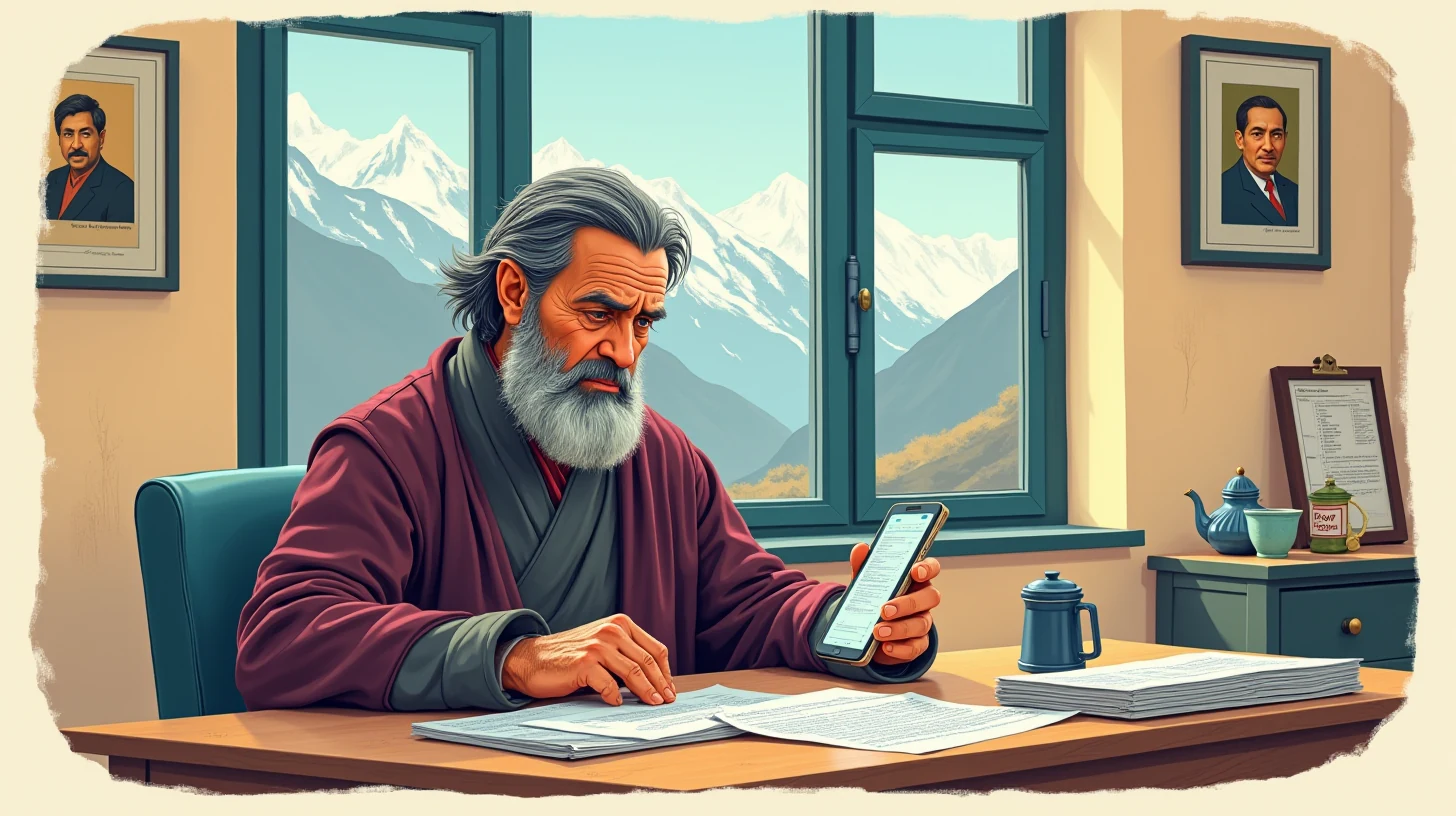
His father, Sonam Dorje, is eighty-three years old. He was a schoolteacher—mathematics, Leh Central School, thirty-two years of service, retired in 1995 with a pension of ₹8,400 a month, which arrived every month on the fifteenth into the State Bank of India account that he had opened in 1982 and never updated. He lived alone in a smaller house in the same neighbourhood, cooked for himself with the deliberate precision of someone who had learned it late in life, and spent his afternoons on the flat roof of his house, watching the mountains across the valley change colour with the light.
In late January 2026, Sonam Dorje developed a urinary tract infection. The first symptom was fever—a temperature of 102 degrees Fahrenheit that he did not report to anyone because he had never been a person who reported symptoms. The fever lasted three days. On the fourth day, the fever rose to 104, and his daughter-in-law, who came to bring him dinner, found him confused and shivering on his bed. She called Dorje. Dorje came home and took his father to SNM Hospital Leh immediately.
The SNM Hospital team diagnosed a complicated urinary tract infection with septic features. The urine culture showed a multidrug-resistant organism. The blood work showed sepsis markers. The attending physician—a senior internist named Dr. Kunzang Tenzin—said that the infection had probably been brewing for a week or more, and that at his father's age, with his baseline kidney function, the standard antibiotic regimen carried a significant risk of nephrotoxicity. The hospital could start treatment, could stabilize him. But the recommended path was immediate transfer to a facility with critical-care capacity. AIIMS Delhi had a dedicated gerontology ward and a nephrology team that could manage this combination. The recommendation was an emergency medical evacuation.
The airlift itself—a special Indian Air Force medical-courier flight that left from Leh at dawn and reached Delhi by mid-morning—cost ₹3.4 lakhs. The PMJAY scheme, which covered the hospital stay at AIIMS, did not cover the airlift. Nor did Sonam Dorje's pension-based health coverage. There was, Dr. Tenzin said, a Ladakh UT special-assistance window for exactly these situations, but the paperwork was unclear and he had never actually navigated it himself.
Dorje stood in the hospital corridor at ten in the evening, in the cold fluorescent light, trying to understand whether ₹3.4 lakhs was a figure he could find or a figure he would have to borrow or a figure that the territory might somehow cover.
🗓️ The winter airlift and who pays for it
In January and February, the Leh Ladakh region is accessible by road only from Manali, a journey of two days by vehicle, treacherous, impassable in heavy snow. For serious medical emergencies that need tertiary care, the only practical option is airlift. The Indian Air Force operates a medical-evacuation service through its 14 Air Force Hospital in Chandigarh, which sends helicopters or fixed-wing aircraft to Leh on an as-needed basis. The formal name of the service is Air Evacuation of Medical Cases, and the procedure is simple: a hospital in Leh requests the airlift, the Air Force dispatches it, and the cost is billed to the hospital and the patient's family.
For years, this cost was absorbed either by the hospital (which then passed it on to patients), or by families who could afford it, or not absorbed at all—in which case patients stayed in Leh and died. Starting in 2020, the Ladakh UT government created a special medical-evacuation fund as part of its post-pandemic health infrastructure modernisation. The fund was designed to cover the cost of emergency airlift for Ladakh residents who had no other insurance or financial means. The maximum coverage was ₹4 lakhs per incident.
The fund existed. It was real. What it was not, was visible.
SNM Hospital had the application form on a shelf somewhere. Nobody at SNM knew the exact current rules—had they changed in 2022, in 2024? Was it means-tested? Did PMJAY beneficiaries get priority or disqualification? Were there waiting lists? Dr. Tenzin was a good physician and a concerned physician. He also did not have the bandwidth to be a fund administrator. He did what he had always done: he told the family the evacuation was medically necessary, explained that PMJAY would cover Delhi hospitalization, and said there was a state fund but he could not speak to its coverage.
What he had not said, because he did not know with certainty, was that the fund covered exactly Dorje's situation, and that by morning, Dorje could have the entire airlift cost underwritten by the Ladakh UT government, not by his own bank account.
⚠️ The night Dorje nearly borrowed ₹3.4 lakhs
By eleven that evening, Dorje had done the arithmetic that middle-class Indian families do in medical emergencies. He had ₹1.2 lakhs in savings in two accounts—an emergency buffer that he had built over fifteen years of trekking-season work. He could ask his brother, who worked in the civil service in Delhi, for a loan. He could ask his daughter for help—she would not hesitate, but she had just moved into her first flat and was paying a mortgage. He could borrow from the trekking company he worked for, but the trekking company paid him only during the season and the obligation would carry forward to next season. He could take a personal loan from SBI at thirteen percent interest, which would cost him ₹40,000 a year for seven years. Or he could do something he had never done: ask his father if it was worth it.
This last thought is what stopped him. He did not ask his father. Instead, he called his cousin Thinley, who worked in the Ladakh UT tourism department and whose job it was to know how the government worked.
Thinley did not know the exact rules of the medical-evacuation fund either, but he said he would find out by morning. He called back at six in the morning with a partial answer: yes, there was a fund, yes, it covered airlift, and yes, the application was submitted through SNM Hospital by request. He had called an acquaintance in the Health Department. The person he reached said: "Tell him to have SNM Hospital file the request today. The fund is meant for this."
Dorje went back to SNM Hospital at six-thirty in the morning. He found Dr. Tenzin making rounds and asked directly: was there a UT fund that covered airlift, and if so, could the hospital apply?
Dr. Tenzin said he would look into it. By seven-thirty, he had spoken to the hospital's administrative officer. The application could be filed. It would likely take three days to process. If Dorje's father needed to leave today, they would have to cover the cost upfront and seek reimbursement. If they could wait, the fund would cover it.
Sonam Dorje's sepsis was stable. The antibiotics had been started. Three days of delay would not be lifesaving but was medically defensible. Dorje said to wait for the fund.
What happened next was that Dorje spent three days in the waiting room with a sheaf of papers—his father's pension certificate, his health ID documents, the SNM Hospital diagnostic report, his own Aadhaar—and with no clarity on whether the fund would come through, whether the airlift would be approved, whether he would be sitting in that same waiting room on day four having to call his brother and ask for ₹3.4 lakhs.
He was also trying to keep his father calm, trying to manage the ward staff's questions about what language his father spoke (Ladakhi and Tibetan, mostly), trying to figure out how to get word to his daughter in Delhi that her grandfather was coming and might be arriving any day.
On the evening of the third day, the hospital's administrative officer called him with news: the fund had approved the airlift. The Ladakh UT government would cover ₹3.4 lakhs. The Air Force flight was scheduled for dawn the following day.
Dorje had not yet realized that he had been about to borrow that money until the moment he did not have to.
- 🏥
January 28, evening — Admission and diagnosis
Sonam Dorje admitted to SNM Hospital Leh with septic UTI. Dr. Tenzin recommends immediate transfer to AIIMS Delhi. Airlift cost: ₹3.4 lakhs. PMJAY covers hospitalisation but not transport.
- 📞
January 29, morning — The inquiry
Dorje calls his cousin Thinley in UT tourism. Thinley contacts Health Department. Confirmed: Ladakh UT Medical Evacuation Fund exists, covers airlift, application submitted through hospital.
- 📋
January 30-31 — Application processing
SNM Hospital administrative officer files fund application with Sonam Dorje's pension certificate, health ID, diagnostic report. Fund officers review eligibility. Dorje waits.
- 🚁
February 1, dawn — Approval and airlift
Fund approves ₹3.4 lakh coverage. Air Force flight departs Leh at 0600 hours, arrives Delhi 1030 hours. Sonam Dorje transferred to AIIMS Delhi gerontology ward. Dorje travels by road two days later.
🌗 The agent that read the hospital discharge letter
Sonam Dorje stabilised quickly at AIIMS Delhi. The PMJAY scheme covered the entire hospitalisation—sixteen days in the gerontology ward, three days in critical care when his kidneys briefly faltered, the full spectrum of dialysis, antibiotics, and supportive care. The discharge summary was forty-three pages long, in English, with sections on antibiotic sensitivity panels, kidney function trends, a discharge medications list of eleven drugs, and a follow-up protocol that required a nephrology appointment at a Delhi hospital within two weeks and a urology appointment at Leh within three weeks.
Dorje had finished tenth standard. He could read English well enough for basic communication, but the medical terminology in the discharge summary was beyond him. More importantly, the protocol—what his father needed to do when he returned to Leh, which drugs were to be reordered, how the antibiotic course related to the follow-up appointments—was not fully clear. He took photographs of the entire discharge summary and of the medication list and sent them to his daughter in Delhi, asking her to help him understand.
His daughter came to the hospital on the discharge day, read through the summary with her father, and explained what she could. But she had to return to Delhi that evening for work, and there were specifics—questions about drug interactions, about what to monitor for kidney function, about whether the follow-up appointments could be coordinated through SNM Hospital rather than individual trips to Delhi—that neither she nor Dorje could fully answer.
It was his daughter who suggested the agent. She had been using a Hindi-Ladakhi speaking AI on her phone for about two months, for work purposes—it had a real-time translation feature and had helped her navigate a landlord dispute that had been conducted partially in Hindi and partially in English—and she wondered if it might help with the medical discharge documents.
Dorje installed it that evening in the SNM Hospital room where his father was recovering and waiting for his discharge paperwork to be complete. He photographed the discharge summary and asked the agent, in Ladakhi: "Apa, itso discharge letter-chen me aba bgo mo thshering-sa chik mo le chuwa-le. Itso medicine kti-la yogay-po yot? Itso che po byas-na aba go-chu bak mo red-po yot?"
(Sister, this is the discharge letter from my father's stay. I don't understand all of this. Which medicines are important? What should I watch for when we go back to Leh?)
The agent read the discharge summary and replied in Ladakhi mixed with Hindi, in a calm, careful register:
"Dorje la, motso discharge letter man—medicine tangka chu drug yotkin: antibiotic (moxifloxacin), kidney-soksam-tog (allopurinol), blood pressure medicine (amlodipine), and heart medicine (furosemide). Itso tangka chu drug mo—every day yogay-po yot. Discharge man—kidney function test chi-lar byas-mo yot (creatinine, urea). Two week-ar discharge la—Delhi-ki nephrology doctor-la meeting yogay-po yot. Three week-ar—Leh-ki hospital-la urology doctor-la byas-mo yot. And itso important: if father-la fever, or urine-la problem, or body-la pain yot-na—immediately hospital-la go. Kidney infection—again yot-po skad-mo yot."— Dorje-la, from this discharge letter—there are four main drugs: an antibiotic (moxifloxacin), a kidney-protective medicine (allopurinol), a blood-pressure medicine (amlodipine), and a water-removal medicine (furosemide). These four drugs you need every day. The discharge says—kidney function tests need to be done. In two weeks from discharge—your father needs to see the nephrology doctor in Delhi. In three weeks—he needs to see the urology doctor here in Leh. And this is important: if your father has fever, or problems with urination, or body pain—go to hospital immediately. The kidney infection can come back.
The agent then helped Dorje contact SNM Hospital Leh to schedule the three-week follow-up appointment with the urology department before his father was even discharged. The agent, reading from the SNM Hospital portal, identified the exact urology phone number and the specific clinician who had supervised Sonam Dorje's treatment eleven years earlier during a previous UTI episode. Dorje called, left a message, and received a confirmation call the next morning: the appointment was reserved for three weeks after discharge, a Thursday morning at nine-thirty.
Dorje had one more question—one he had not asked the doctor because he did not want to seem ignorant. He typed it in Ladakhi:
"Motso moxifloxacin medicine—aba-la SNM Hospital-la kti-lar yot-po? Ya Delhi-la order byas-mo yot?"
(This moxifloxacin medicine—will it be available for my father at SNM Hospital in Leh? Or does it need to be ordered from Delhi?)
The agent checked the discharge summary's pharmacy instructions and replied: the antibiotic course was already complete at AIIMS—no further moxifloxacin was needed after discharge. The ongoing medicines—allopurinol, amlodipine, furosemide—were all available at the SNM Hospital pharmacy and at two private chemists on Main Bazaar Road, Leh. No Delhi order required.
The discharge protocol suddenly became legible.
🧭 Why the UT fund exists but is invisible
Across the northern Himalayan states—Ladakh, Himachal Pradesh, Sikkim, Arunachal Pradesh—winter medical emergencies are a regular occurrence, and evacuation airlift is often the only option. The Indian Air Force operates these flights as part of its humanitarian mandate, but the cost—usually ₹2.5 to ₹4.5 lakhs per flight depending on distance and aircraft type—has historically fallen to the family or to the hospital. Starting in the post-pandemic period, several state governments created special medical-evacuation funds to cover these costs for residents without alternative insurance. Ladakh's fund was created in 2020 as part of the UT administration's health modernisation package. It was funded, it was real, it existed in the rule book.
What it did not have was visibility. SNM Hospital staff did not discuss it routinely. The Ladakh Health Department website did not highlight it prominently. The application form was not readily available to families. The gap between the fund existing and a family accessing it—between policy and reality—was large enough to trap someone like Dorje into the mental arithmetic of how to borrow ₹3.4 lakhs on three hours' notice.
The broader reason for this invisibility is structural. Health departments operate on the assumption that a family in crisis will reach a doctor, and the doctor will know what resources exist. But doctors are managing acute illness, not navigating government funds. A doctor in a hospital corridor at night, certifying that an evacuation is medically necessary, has done their job. Whether the family knows about the fund or how to access it is outside their scope.
What changed for Dorje was that someone else—his cousin in the tourism department, who happened to know someone in the Health Department—stepped into that gap. And what changed further was that an agent on his father's phone could read the discharge paperwork and clarify which drugs were non-negotiable and when the follow-up appointments should happen, so that Dorje was not trying to navigate the medical protocol simultaneously with the paperwork crisis.
What it does
- 🚁Covers the full cost of emergency medical airlift from Leh to Delhi for qualifying residents
- 🏥Coordinates with SNM Hospital to process the application and execute the evacuation
- 📋Approves coverage within 3-5 days for clearly urgent medical cases
What it does not do
- 🔒Does not advertise the fund eligibility or application process through public channels
- 📱Does not provide families with pre-emergency information about the fund or its limits
- 💳Does not cover accommodation or travel costs for family members who accompany or follow the patient
🌱 The quiet clarity of knowing what matters
When Sonam Dorje came home to Leh six weeks later—after two more weeks of AIIMS outpatient follow-up, after the three-hour medical airlift back to Leh, after the urology appointment and the follow-up kidney-function test—he was weak in the way of someone who had spent three weeks in a hospital and another week in transition. He could walk slowly. He could manage the stairs to the flat roof of his house if someone was with him. He could not prepare his own meals yet.
Dorje took a week off from his work calendar. His daughter came to stay for ten days. Together, they managed the transition: the daily medication schedule, the twice-weekly kidney-function blood draws at the SNM Hospital lab, the restriction of salt in his father's diet, the monitoring for any return of fever or urinary symptoms.
What made this possible—what made it feel manageable rather than overwhelming—was that Dorje understood exactly what he was watching for. The agent on his phone, reading the discharge summary, had told him: these four drugs, every day; these are the warning signs; this is the follow-up timeline. He was not guessing. He was not calling SNM Hospital repeatedly with vague questions about whether his father was "okay." He knew what recovery looked like and what danger looked like.
His father still needed Dorje's care—the cooking, the medication management, the daily phone calls to check in. But what he did not need was for Dorje to spend those hours also trying to decipher medical bureaucracy, trying to understand a forty-three-page document in a language that was not his. The care and the navigation were separated. The care continued. The navigation stopped being a crisis and became a protocol.
Three weeks after returning to Leh, Sonam Dorje climbed to his flat roof in the afternoon—slowly, with Dorje's hand supporting him—and sat for two hours watching the mountains change colour as the light shifted. When Dorje came to bring him inside, his father said, in Ladakhi: "Dorje, itso time-ki, mountain-sa beautiful yot." Dorje, at this time of day, the mountains are beautiful.
It is a small thing. And it is the thing that mattered most.
🌱 Why we built it
There are, across India, roughly twelve million emergency medical evacuations every year—by air, by ambulance, by family vehicles on roads where the journey is itself a medical risk. The majority of these happen in rural and hilly regions, in winters and monsoons, when the transport itself is an emergency. The schemes exist to cover some of this: PMJAY covers hospitalisation, SEHAT in Ladakh covers primary care, state-level emergency funds cover specific gaps.
What they do not do is make themselves legible. A family in crisis does not have the bandwidth to learn scheme architecture. They need to understand one thing: what happens next. A discharge summary with twelve medications and a follow-up protocol is illegible until someone reads it and separates the critical from the administrative. An evacuation fund is invisible until someone, at the moment of greatest financial anxiety, tells you it exists and applies to your father's situation.
We have built an agent that speaks Ladakhi, that reads the discharge documents in the hospital room or in the home days later, that calls the urology clinic and confirms the appointment, that tells you clearly which four drugs matter and which warning signs mean return immediately. The agent does not override the doctor. It does not make the medical decisions. What it does is translate the bureaucratic medical discourse into plain Ladakhi, and make the difference between a crisis that feels solvable and one that feels like drowning.
If you are caring for an ageing parent in Ladakh or anywhere in the Himalayan region, the product is free at gabforge.in. We have Ladakhi, Hindi, English, and we know the SNM Hospital protocols, the AIIMS Delhi follow-up procedures, the Ladakh UT evacuation fund, the nephrology clinics, and the pharmacy numbering systems. We will read the discharge summary with you. We will help you schedule the follow-up. We will be quiet and available, whenever the anxiety surfaces, at whatever hour of night.
Your father will recover more slowly than the medical timeline suggests. But you will not have to recover the bureaucracy in parallel.